Last updated 2026-07-24
TL;DR
Before and after defensible space work usually means clearing dead vegetation, spacing plants, and removing debris within 100 feet of a home (5 feet for Zone 0). CAL FIRE data shows this can mean the difference between a home surviving an ember storm and burning. Most homeowners spend $1,000 to $6,000 and 1-3 weekends on the basics, more if trees need removal.[1]
What does defensible space actually look like before and after?
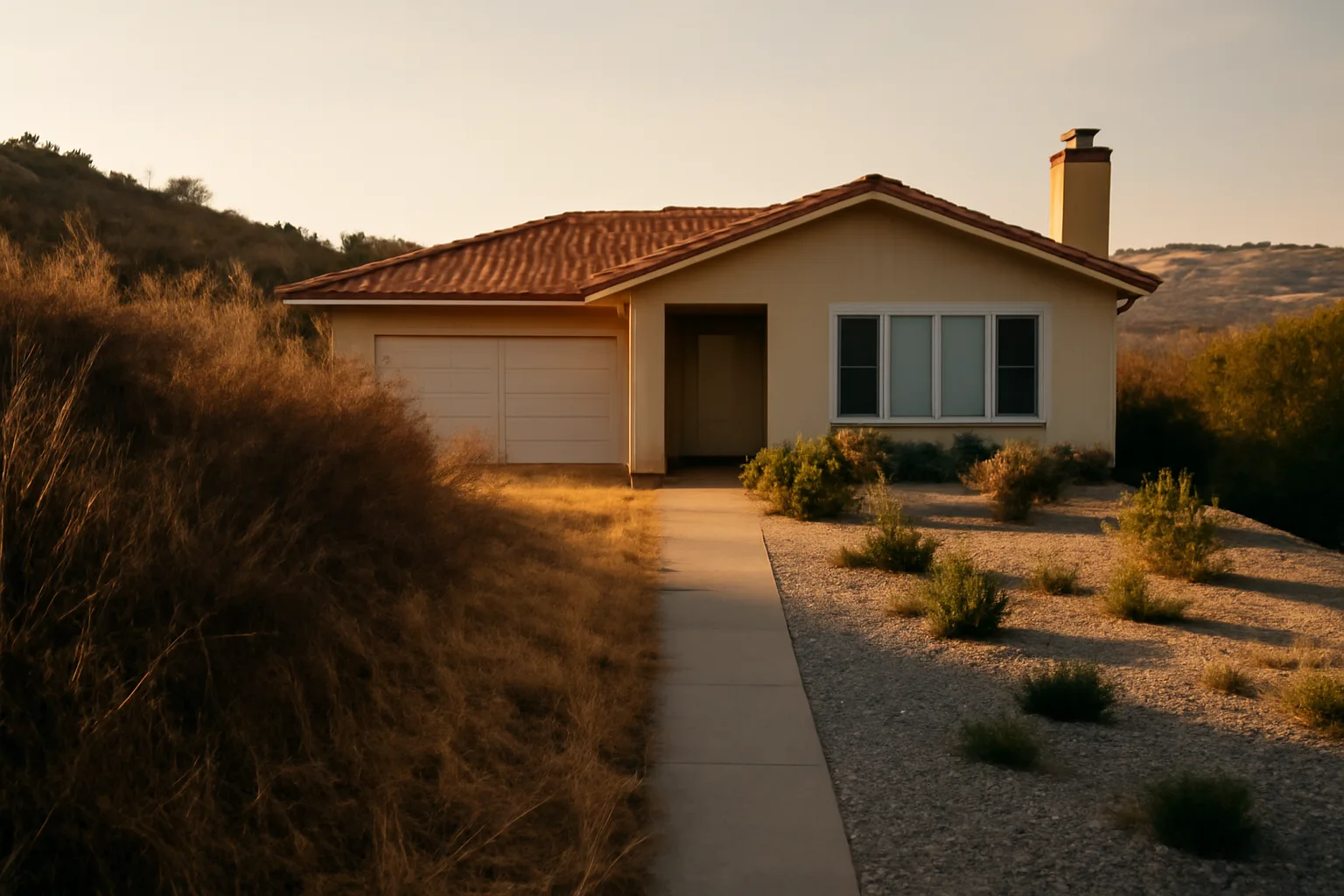
Before photos usually show the same thing: dead pine needles piled against the siding, a woodpile stacked next to the back door, shrubs touching the eaves, and grass that hasn't been cut since spring. After photos show bare mineral soil or gravel in the first 5 feet, spaced-out plants with gaps between crowns, trimmed tree limbs at least 6 feet off the ground, and a roof and gutters clear of needles and leaves. The difference isn't cosmetic. CAL FIRE's own guidance is blunt about why this matters: "Defensible space is the buffer you create between a building on your property and the grass, trees, shrubs, or any wildland area that surround it. This space is needed to slow or stop the spread of wildfire." [1] That buffer doesn't need to be a moonscape. It needs to break up continuous fuel so embers and flame don't have an unbroken path to your walls. Most "before" properties in wildfire zones fail for the same handful of reasons: overgrown grass within 30 feet, shrubs planted right against the foundation, tree branches overhanging the roof, and stored firewood or propane tanks too close to the structure. The "after" versions aren't landscaped magazine covers. They're just spaced out, cleaned up, and boring in the best way. For a full zone-by-zone breakdown, see fire safe landscaping California next to house.
What is Zone 0, and why is it the biggest before/after change?
Zone 0 is the 5 feet immediately surrounding a structure, and it's the newest and strictest part of California's defensible space rules. Before Zone 0 rules, that 5-foot ring often looked like any other yard: bark mulch, foundation shrubs, maybe a small tree. After Zone 0 compliance, it's supposed to be "ember-resistant," meaning noncombustible material like gravel, pavers, or bare soil, with no combustible mulch, no stored items, and nothing touching the walls. CAL FIRE describes Zone 0 as the area "from 0 to 5 feet from the structure" where the goal is to "remove all combustible materials." This zone exists because ember cast, not direct flame contact, destroys most homes in wildfires. Embers can travel over a mile ahead of a fire front, land in mulch or dry leaves against your wall, and ignite the house from the outside in. The catch: Zone 0 regulations were mandated under California Assembly Bill 3074 (2020), but the actual enforceable regulations from the Board of Forestry and Fire Protection have taken years to finalize. Homeowners keep asking when the California defensible space law goes into effect, and the honest answer as of this writing is: the statewide Zone 0 regulation has not been fully implemented; CAL FIRE and the Board of Forestry have been working through the rulemaking process, with proposed effective dates pushed back multiple times. Check your local fire district or CAL FIRE unit page for the current status where you live, because some jurisdictions are already requiring Zone 0-equivalent clearance through local ordinance even though the statewide rule isn't final.
When does the California defensible space law go into effect?
This is one of the most searched questions right now, and it deserves a straight answer: it depends on which rule you mean. California's basic 100-foot defensible space requirement (Public Resources Code 4291) has been in effect for years and applies to most homes in State Responsibility Areas and some Local Responsibility Areas with very high fire severity zones. That part isn't new. What's still moving is Zone 0. AB 3074 directed the Board of Forestry and Fire Protection to develop ember-resistant zone regulations for the 0-5 foot area, but as of the most recent public updates, the formal regulatory language and effective date have continued to slip. CAL FIRE's Zone 0 program page is the best source to check for the current status, since it gets updated as rulemaking progresses. If you got a non-renewal or inspection letter referencing Zone 0, ask your local fire district directly whether they're already enforcing it locally, because some counties and fire-safe councils have adopted stricter local standards ahead of the state timeline. Guided fill-in: check your local fire district's defensible space page for [your county/fire district name] to confirm current Zone 0 enforcement status, since rules and inspection dates vary by jurisdiction.
What fire-safe home rules take effect in 2026?
Several California building and vegetation rules have proposed 2026 timelines, but the specifics keep shifting as the Board of Forestry finalizes language. Rather than guess at a date that might change again, here's what to actually do: check the CAL FIRE Zone 0 regulations page and your state fire marshal's office directly before assuming a rule is or isn't in effect. What is stable is the underlying direction: California, Oregon, and Colorado have all moved toward stricter home-hardening standards (ember-resistant vents, Class A roofing, noncombustible siding in high-risk zones) layered on top of vegetation clearance rules. Oregon's statewide wildfire risk map and defensible space code work through the Oregon Department of Forestry, and Colorado's rules are largely set at the county level rather than statewide, so "2026 rules" mean something different depending on which state you're in. Guided fill-in: confirm current adoption status for [your state]'s 2026 wildfire building code update through your state fire marshal's office, since some provisions apply only to new construction or remodels over a certain size.
Why won't people follow the defensible space law in California?
It's a fair question, and the honest answer is usually money, time, and confusion, not defiance. A 2020 study on wildfire mitigation behavior found that cost and uncertainty about what actually counts as compliant are two of the biggest barriers to homeowners completing defensible space work, even when they know the risk. Some real reasons compliance lags: tree removal can cost $500 to $3,000 per tree depending on size and access, homeowners on fixed incomes can't absorb that in one season, and older homeowners physically can't do the labor themselves. Renters and absentee landlords are another gap; a tenant can't legally clear a landlord's trees, and landlords in fire-prone areas aren't always local enough to notice the problem. There's also a perception issue. Many homeowners genuinely believe their property is already defensible because it "looks fine," not realizing that a woodpile against the garage or an overgrown juniper hedge under a window is exactly the kind of fuel that catches embers. Inspection letters can feel arbitrary if the homeowner has never seen a fire behave up close. Enforcement is also inconsistent; CAL FIRE and local fire departments do defensible space inspections, but staffing limits mean not every property gets checked every year, so some homeowners simply haven't been told yet. None of this is a legal defense if you get cited or denied insurance over it. If you're behind on the work, the fastest path is triage: do Zone 0 first, then the 5-30 foot zone, then worry about the outer 30-100 feet.
How to prevent wildfires around your own property
You can't stop a wildfire from starting somewhere else, but you can control whether your property becomes fuel that spreads it or a break that stops it. Ready.gov's wildfire preparedness guidance centers on three actions: reduce fuel near the home, harden the structure itself, and keep an evacuation plan current. Practical priorities, in order of impact per dollar spent: clear the 5 feet against your walls first (cheapest, highest impact), remove dead vegetation and low tree limbs in the 5-30 foot zone, keep gutters and roof valleys clear of needles year-round, and store firewood at least 30 feet from any structure. Mowing dry grass to under 4 inches before fire season is one of the cheapest and most overlooked steps; CAL FIRE lists this explicitly in its defensible space checklist. [1] One stat worth remembering: most home ignitions during wildfires come from ember contact with small combustibles near the structure, not from direct flame contact with a wall of fire. That's why Zone 0 work (the 5 feet right at your house) tends to matter more per dollar than clearing the far edges of a large lot.
How to prepare for a wildfire (a realistic checklist)
Preparing for a wildfire has two tracks: property prep, which takes weeks, and personal/evacuation prep, which you can do in a weekend. Ready.gov recommends building a go-bag, knowing at least two evacuation routes, and signing up for local emergency alerts before fire season starts. Personal preparation checklist: a go-bag with medications, copies of ID and insurance documents, a battery radio, and a change of clothes for each household member; a documented home inventory with photos and receipts (do this before any inspection or claim, not after); a family communication plan since cell networks can jam during mass evacuations; and a list of two or three exit routes in case your primary road is blocked by fire crews or fallen power lines. Property preparation checklist: complete Zone 0 and Zone 1 clearance, install ember-resistant vent screens (1/8 inch mesh, metal), clear roof and gutters, move propane tanks and firewood 30+ feet from structures, and photograph the finished defensible space work for your records. Insurers increasingly want to see this documentation, more than hear that you did the work. For step-by-step guidance on documenting a home before a fire threat, see defensible.
How to prevent forest fires and how to avoid forest fires
Forest fire prevention at the individual level mostly comes down to ignition source control, since roughly 85 to 90% of wildfires in the U.S. are human-caused according to the National Park Service and USDA Forest Service data on wildfire causes. That means campfires, debris burning, equipment sparks, and discarded cigarettes account for the large majority of ignitions, not lightning. Simple habits that prevent forest fires: never leave a campfire unattended, drown and stir campfire ashes until cold to the touch (more than wet), avoid mowing dry grass midday when temperatures peak, check local burn ban status before any outdoor burning, and keep vehicles off dry grass since a hot catalytic converter can ignite it. Smokey Bear's long-running "Only you can prevent wildfires" campaign exists because individual behavior really is the biggest lever here; see only you can prevent wildfires for more on the history and current guidance behind that message. If you live near wildland, the same defensible space work that protects your house from an approaching fire also reduces the odds your property becomes the ignition point for a fire that spreads to neighbors.
How to prepare for forest fires if you live near wildland
Preparing for a forest fire near your property is really defensible space work plus a communication plan, since forest fires and wildland-urban interface fires behave the same way once they reach a structure. The core numbers to know: CAL FIRE recommends 100 feet of defensible space where terrain and lot size allow it, broken into Zone 0 (0-5 ft), Zone 1 (5-30 ft), and Zone 2 (30-100 ft). [1] If your lot is smaller than 100 feet to your property line, do what you can and coordinate with neighbors, since defensible space works best as a shared buffer, not an isolated island. A perfectly cleared lot next to an overgrown, unmanaged neighboring parcel still has real risk from ember cast and radiant heat crossing the property line. One practical step many homeowners skip: know your fire district's inspection schedule and ask for a copy of any past inspection notes on your property. This becomes documentation later, especially if you're contesting a non-renewal decision or applying for a fire-safe discount where available.
Is Santa Barbara safe from fire?
No place in California's chaparral and coastal foothill zones is "safe" from fire in an absolute sense, and Santa Barbara County has direct experience proving that. The Thomas Fire (2017) burned into Santa Barbara County and was followed by the Montecito debris flow that killed 23 people in January 2018, a disaster driven partly by the burned, denuded hillsides above town. [2] The Jesusita Fire (2009) and the Tea Fire (2008) both burned into the Santa Barbara foothills as well. What that history means practically: Santa Barbara's wildland-urban interface, especially the foothill neighborhoods along the base of the Santa Ynez Mountains, sits in a very high fire severity zone under CAL FIRE's mapping. [3] Homeowners there are subject to the same 100-foot defensible space law as anyone else in a State Responsibility Area or mapped high-severity zone in a Local Responsibility Area. If you're in Santa Barbara, Montecito, Goleta foothills, or similar terrain, the honest read is: your risk is real and mapped, insurance non-renewals in that corridor have been common in recent years, and defensible space plus home hardening is the most concrete thing you control. Check your specific parcel against CAL FIRE's Fire Hazard Severity Zone viewer rather than relying on general reputation about the area.
How can we prevent forest fires as a community, more than individually?
Individual defensible space work matters, but fire doesn't respect property lines, so community-level prevention has a real multiplier effect. Firewise USA, a National Fire Protection Association program, organizes neighborhoods to do coordinated fuel reduction, shared chipper days, and joint evacuation planning, and NFPA reports thousands of recognized Firewise sites across the U.S. Community actions that move the needle: joint neighborhood chipping days (cheaper per household than solo tree service calls), shared agreements on maintaining roadside vegetation for evacuation routes, coordinated defensible space audits so no single unmanaged lot undermines everyone else's work, and pooled funding or grants for high-cost items like fuel breaks on shared open space. Some Fire Safe Councils in California also connect homeowners to cost-share programs for vegetation removal. If your HOA or neighborhood association hasn't looked into Firewise USA designation, it's worth the paperwork. Insurers in some markets have started asking about community-level mitigation status, more than individual property compliance, when evaluating renewal risk in a given zip code.
What should your defensible space documentation include for insurers?
Insurers reviewing a wildfire policy renewal generally want to see dated, specific evidence, more than a claim that you "did the work." A strong documentation packet includes: before and after photos with visible dates, a written list of what was cleared and when (tree removal, brush clearing, gutter cleaning), any local fire department inspection report or certificate, receipts for contractor work, and a simple property diagram marking Zone 0, 1, and 2 boundaries. This is where a lot of homeowners get stuck: they did real work but have no organized way to present it when a non-renewal letter arrives. A basic version costs nothing but an afternoon with a camera and a folder. If you'd rather have a structured template built for this exact situation, DefensibleHome's $99 one-time Wildfire Insurance Survival Kit walks through exactly what to photograph, what to log, and how to organize it into something an underwriter can actually review quickly. It's a documentation tool, not a guarantee: we don't contact your insurer on your behalf, file claims, or promise reinstatement. You prepare and send your own file. Start at /survival-kit-builder. Whatever method you use, redo the photos every season. Vegetation grows back, needles reaccumulate on roofs, and a photo from two years ago won't help you if the underwriter wants current proof.
What happens if a fire actually reaches a defensible-space property?
The honest answer is: defensible space improves survival odds, it doesn't guarantee anything. Research from the Insurance Institute for Business & Home Safety and CAL FIRE's own post-fire assessments consistently find that homes with cleared zones, ember-resistant vents, and Class A roofing survive at meaningfully higher rates in the same fire event than unmitigated neighbors, but "higher rate" isn't "certain." Wind-driven ember storms can overwhelm even well-prepared properties, and a defensible space property next to an unmanaged one still absorbs radiant heat and ember load from that neighbor. This is why the CAL FIRE messaging pairs defensible space with structure hardening (vents, roofing, siding) rather than treating vegetation clearance alone as sufficient. [1] If your home has survived a nearby fire event, or a neighbor's has burned while yours didn't, that's exactly the kind of before/after evidence worth documenting for future insurance conversations, more than as a personal record. See house fire and fire at a house for what post-fire documentation and claims context typically look like.
Frequently asked questions
When does the California defensible space law go into effect?
The base 100-foot defensible space law (PRC 4291) has been in effect for years. The newer Zone 0 (0-5 foot ember-resistant zone) rule under AB 3074 is still going through Board of Forestry rulemaking, with the effective date pushed back multiple times. Check CAL FIRE's Zone 0 page and your local fire district for current status.[2][3]
Why won't people follow the defensible space law in California?
Mostly cost, physical ability, and confusion about what counts as compliant, not defiance. Tree removal alone can run $500 to $3,000 per tree, and studies on mitigation behavior show cost and unclear requirements are top barriers.[6] Renters and absentee landlords add another compliance gap since tenants can't legally alter a landlord's trees.
What is Zone 0 and why does it matter most?
Zone 0 is the 5 feet immediately around a structure, and CAL FIRE calls for it to be ember-resistant: gravel, pavers, or bare soil, no mulch, no stored combustibles touching the walls.[2] It matters most because embers, not direct flame, ignite most homes in wildfires, and Zone 0 is where embers land closest to the wall.
How much does defensible space work typically cost?
Basic vegetation clearing and debris removal for a typical lot runs roughly $1,000 to $6,000 depending on lot size, slope, and how much has been neglected. Tree removal adds $500 to $3,000 per tree. Costs vary widely by region and contractor availability; get local quotes rather than relying on national averages.
How do I prevent wildfires from starting on my own property?
Keep dry grass mowed under 4 inches, never leave a fire or grill unattended, store firewood 30+ feet from structures, avoid mowing dry vegetation midday, and keep vehicles off dry grass since hot exhaust systems can ignite it. Human activity causes 85-90% of U.S. wildfires, so behavior control matters as much as landscaping.[8]
How to prepare for a wildfire if I get a non-renewal letter?
First complete or document your existing Zone 0-2 defensible space work with dated photos. Then build a go-bag, confirm two evacuation routes, and organize insurance documents. If reapplying for coverage, present organized before/after documentation rather than verbal assurance that work was done.
What fire-safe home rules take effect in 2026?
Several proposed California and state-level building and vegetation standards have targeted 2026 timelines, but exact provisions keep shifting during rulemaking. Confirm current status directly through CAL FIRE's Zone 0 regulations page and your state fire marshal's office rather than relying on a fixed date, since it has moved before.[2][5]
Is Santa Barbara safe from fire?
No, not in an absolute sense. Santa Barbara County has burned repeatedly (Tea Fire 2008, Jesusita Fire 2009, Thomas Fire 2017, followed by the deadly 2018 Montecito debris flow). Foothill neighborhoods sit in mapped very high fire severity zones, so residents there are subject to standard defensible space requirements.[9][10]
How can we prevent forest fires at a neighborhood level?
Join or start a Firewise USA program through the National Fire Protection Association, organize shared chipper days, coordinate defensible space audits so one unmanaged lot doesn't undermine everyone's work, and maintain shared evacuation route vegetation. NFPA recognizes thousands of Firewise sites nationally.[11]
What's the difference between Zone 1 and Zone 2 defensible space?
Zone 1 covers roughly 5 to 30 feet from the structure and requires removing dead vegetation, spacing shrubs, and limbing trees up 6 feet. Zone 2 covers 30 to 100 feet and allows more natural vegetation but still requires reduced fuel density and mowed grass under 4 inches.[1]
Do renters have any defensible space responsibility?
Generally no. Defensible space compliance falls on the property owner, not the tenant, since tenants usually can't legally remove trees or make structural changes. Renters should document the property's condition and notify the landlord in writing if vegetation clearly violates local fire codes.
Does defensible space guarantee my house won't burn?
No. It significantly improves survival odds, especially combined with ember-resistant vents and Class A roofing, but wind-driven ember storms can still damage prepared homes, particularly next to unmanaged neighboring lots. CAL FIRE frames defensible space as risk reduction, not a guarantee.[1]
What documentation should I keep for insurance purposes?
Dated before/after photos of each defensible space zone, contractor receipts, any fire department inspection reports, and a simple diagram marking Zone 0 through 2 boundaries. Redo photos each season since regrowth and debris accumulation make older photos less useful to underwriters.
Sources
- CAL FIRE, Defensible Space: Definition of defensible space, 100-foot zone structure, mowing dry grass under 4 inches
- CAL FIRE, Fire Hazard Severity Zone Viewer: Mapped very high fire severity zones including Santa Barbara County foothill areas
- NFPA, Firewise USA Program: Firewise USA neighborhood recognition program and community wildfire mitigation coordination
- CAL FIRE: Zone 0 is the ember-resistant zone within five feet of a structure and represents the newest, most significant change to defensible space requirements.
- Ready for Wildfire (CAL FIRE): CAL FIRE's Ready for Wildfire program provides guidance on creating and maintaining defensible space around homes in three zones.
- Ready for Wildfire (CAL FIRE): Homeowners are advised to create a wildfire action plan as part of preparing for a wildfire, including evacuation routes and emergency supplies.
- California Department of Insurance: The California Department of Insurance's Safer from Wildfires framework ties insurance discounts to documented defensible space and home hardening measures.
- National Fire Protection Association: NFPA outlines home hardening and preparation steps homeowners can take to reduce wildfire risk before a fire occurs.
- Santa Barbara County: Santa Barbara County has developed a Community Wildfire Protection Plan addressing local wildfire risk and community-level prevention efforts.