Last updated 2026-07-25
TL;DR
Most wildfire-prone states require 100 feet of defensible space around a home, split into zones: 0-5 feet (ember-resistant), 5-30 feet (lean and clean), and 30-100 feet (reduced fuel). California law (PRC 4291) sets the 100-foot standard; some counties and insurers ask for more depending on slope and vegetation.
how much defensible space do you actually need around your house
The short answer is 100 feet, measured out from your house in every direction, if you're in California or most other high wildfire-risk states. That 100 feet isn't one uniform strip of dirt. It's broken into zones, and each zone has different rules for what can and can't grow there. California's Public Resources Code section 4291 is the anchor law here. It requires "defensible space of 100 feet from each side and from the front and rear of the structure" on land that's covered with flammable vegetation, for anyone in a State Responsibility Area or a Very High Fire Hazard Severity Zone in a Local Responsibility Area [1]. Colorado, Oregon, and Arizona don't have one single statewide statute that mirrors this exactly, but their state forestry and fire agencies recommend the same 100-foot, zone-based approach, largely because it's based on the same fire behavior research. Here's the part people miss: 100 feet is a ceiling, not always a floor. If your lot is smaller than that, you clear to your property line and coordinate with neighbors. If you're on a steep slope, CAL FIRE's own guidance says you may need to extend beyond 100 feet because fire moves faster uphill. Slope, wind exposure, and the fuel type on neighboring land all push that number around. Nobody has a perfect formula that covers every parcel, but the zone system gives you a working structure to plan from.
what are the defensible space zones and what goes in each one
| Zone 0 | 0-5 ft | Ember resistance | Noncombustible surfaces, no mulch or stored fuel | |
|---|---|---|---|---|
| Zone 1 | 5-30 ft | Lean, clean, green | Dead vegetation removed, 10-ft canopy spacing | |
| Zone 2 | 30-100 ft | Fuel reduction | Thinned brush, grass under 4 inches, no fuel ladders | For plant selection and layout inside these zones, see our guide on fire safe landscaping in California next to a house. |
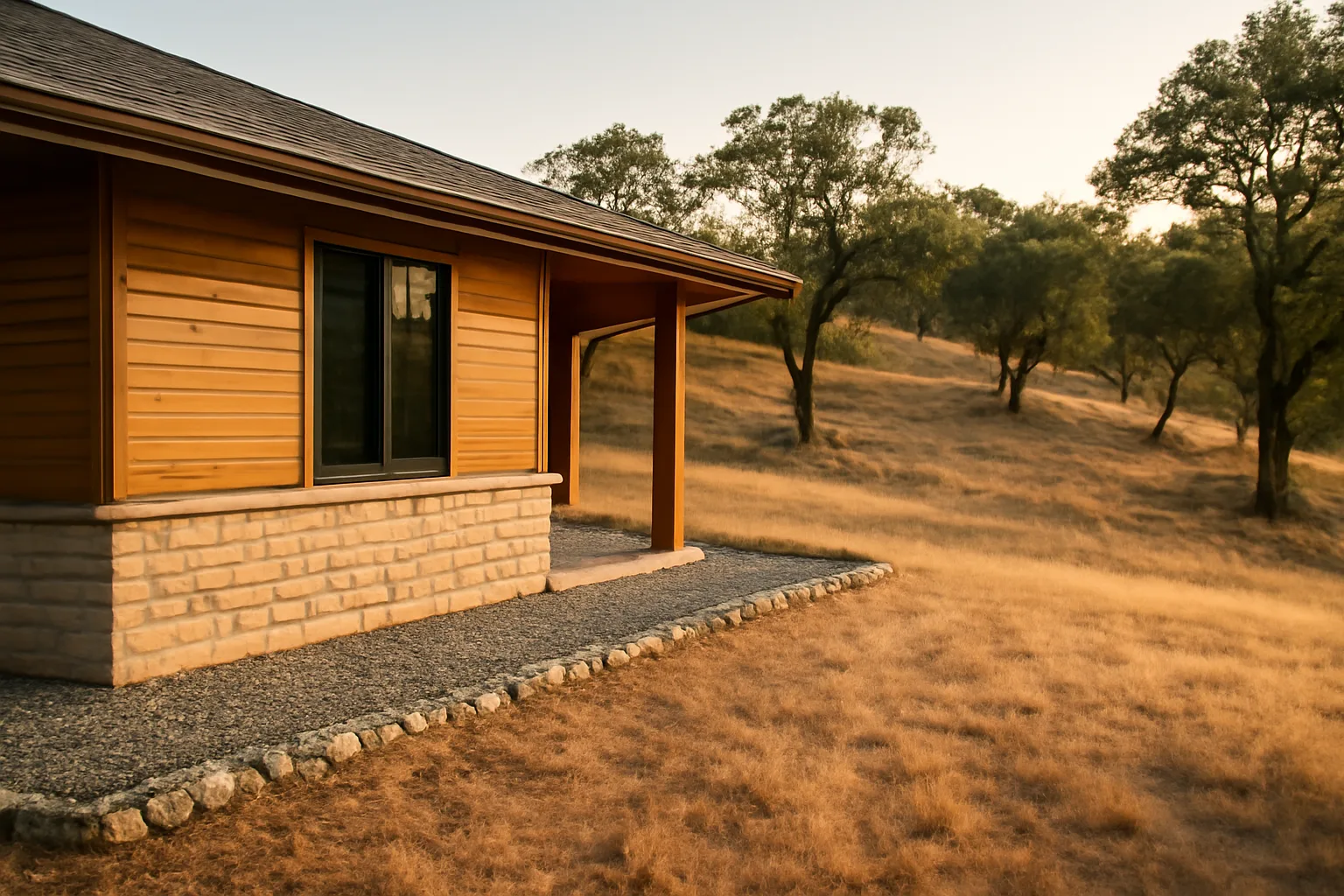
CAL FIRE splits the 100 feet into three zones, and each one has a distinct job. Zone 0 is new as of recent rulemaking, Zone 1 is the classic 'lean, clean, and green' ring, and Zone 2 is about fuel reduction, not a bare-dirt look. Zone 0 (0-5 feet from structures): This is the ember-resistant zone. CAL FIRE's guidance calls for no combustible mulch, no stored firewood, no flammable plants, and non-combustible ground cover like gravel or pavers immediately against the house. This zone exists because most homes in wildfires ignite from wind-blown embers landing on or near the structure, not from a wall of flame arriving. Zone 1 (5-30 feet): Remove dead plants, dead branches, dry leaves and needles. Space trees so canopies are at least 10 feet apart. Keep grass mowed to under 4 inches. No flammable vegetation directly under windows or next to fences that touch the house. Zone 2 (30-100 feet): Thin trees and brush so fire can't easily jump from plant to plant. Remove fallen leaves, needles, and small branches. Cut annual grass down to 4 inches or less. This zone is about breaking fuel continuity, not stripping the land bare. |Zone|Distance from structure|Main goal|Key requirement|
when does the california defensible space law go into effect
PRC 4291's 100-foot requirement has been law since 2005, so it's not new. What is new, and what's causing confusion, is the Zone 0 ember-resistant zone rule. The California Board of Forestry and Fire Protection has been working through formal rulemaking for the Zone 0 regulation (the 0-5 foot ember-resistant zone) under SB 63 (2021) and related legislation. As of the most recent board updates, the regulation had not yet been finalized and adopted into the California Code of Regulations; CAL FIRE's public messaging has referenced a 2023 target that slipped, with the Board of Forestry continuing rulemaking work into 2024 and beyond. If you're checking whether Zone 0 is enforceable in your area right now, the honest answer is: check your local fire district's current adoption status, because state rulemaking and local enforcement dates don't always match, and this has moved slower than originally announced. The base 100-foot, three-zone defensible space requirement, by contrast, is fully in effect now and has been enforced through local vegetation inspections for years. Don't wait on Zone 0's final rule text to start Zone 1 and Zone 2 work. Those are enforceable today.
what fire safe home rules take effect in 2026
There isn't one single nationwide 'fire safe homes' law with a 2026 effective date, and claims to that effect are usually oversimplified or refer to a specific state's building code cycle. What's actually happening: California's Building Standards Commission updates the California Building Code and Wildland-Urban Interface (WUI) building standards on a triennial cycle, and the next full code cycle after 2022 lands around 2025-2026 for local adoption [2]. Separately, the Zone 0 ember-resistant zone regulation discussed above has been targeted for various effective dates by CAL FIRE and the Board of Forestry, and some public communications have referenced 2026 timelines for full enforcement in Very High Fire Hazard Severity Zones. Because this rule has shifted before, treat any specific year you read, including this one, as provisional until you confirm it directly with the California Board of Forestry and Fire Protection or your local building department. What you can act on now, regardless of exact effective dates: harden your roof, vents, and the first 5 feet around your foundation. Insurers and inspectors are already scoring homes on these features ahead of any regulatory deadline. For a broader look at how a single ignition event unfolds and what stops it, read house fire and fire at a house.
why won't people follow the defensible space law in california
Cost, confusion, and enforcement gaps are the three real reasons, and none of them are irrational on their own even though the combined effect is a lot of noncompliant properties. Cost is the biggest one. Clearing 100 feet of established brush, especially on a lot that hasn't been touched in years, can run into thousands of dollars in labor and hauling fees, and that's before you address structural hardening like vents or roofing. For lower-income and elderly homeowners on fixed incomes, that bill competes directly with mortgage, property tax, and now often a rising or non-renewed insurance premium. Confusion is real too. Zone boundaries, what counts as 'flammable vegetation,' and how local fire districts interpret PRC 4291 all vary. A homeowner who clears Zone 1 perfectly might still fail inspection because a neighbor's untended lot backs up against their Zone 2. Enforcement is inconsistent. CAL FIRE and local fire agencies conduct defensible space inspections, but staffing limits mean not every parcel gets checked every year, and penalties for noncompliance (typically citations, and in repeat cases the county can do the work and bill the owner under PRC 4291) aren't always pursued to their full extent [1]. That inconsistency lets some property owners defer the work indefinitely, until an inspection letter or an insurance non-renewal forces the issue.
how to prevent wildfires and how can we prevent forest fires
At the individual level, wildfire prevention comes down to three things: don't start them, don't let them spread from your property, and reduce fuel continuity across the landscape. Roughly 85 percent of wildfires in the U.S. are caused by human activity, according to the National Park Service's tracking of wildfire causes, including unattended campfires, debris burning, equipment use, and discarded cigarettes. At home: never leave a campfire unattended, follow local burn permit rules for debris burning, keep vehicles and equipment (chainsaws, mowers, grinders) off dry grass since a hot exhaust or a metal spark can ignite it, and maintain your defensible space zones so any ignition near your property doesn't reach your structure. At the community and forest level, prevention means fuel management: prescribed burns, mechanical thinning, and fuel breaks conducted by state and federal forestry agencies. Individual homeowners can support this indirectly by participating in Firewise USA community programs (run through the National Fire Protection Association) and by clearing their own parcels so a community-wide fuel break actually connects. How to prevent forest fires and how to avoid forest fires are really the same question from two angles: prevention is what you do proactively (fuel management, permits, equipment care), avoidance is what you do reactively (situational awareness of red flag warnings, avoiding high-risk activities during extreme fire weather). Check your state's current fire weather and red flag warning status before any outdoor burning or equipment work, since this is often the single largest controllable risk factor day to day.
how to prepare for a wildfire and how to prepare for forest fires
Preparation splits into three timeframes: what you do this season, what you do this week when a warning is issued, and what you do in the final hours before evacuation. Ready.gov's wildfire preparedness guidance is the standard federal reference and recommends assembling an emergency kit, creating a family communication plan, and knowing your evacuation zone and routes well before fire season starts [3]. This season: finish your defensible space zones, harden vents and roof edges, clear gutters of debris, and store any propane tanks or firewood outside Zone 1. Photograph your home's exterior, roof, and defensible space from multiple angles, dated, in case you need documentation later for an inspection or insurance conversation. This week (when a warning covers your area): move flammable patio furniture and doormats inside, close all windows and vents you can, park vehicles facing out in the driveway, and pack go-bags with medications, documents, and chargers. Final hours: turn on exterior lights so your house is visible in smoke, leave gates unlocked for firefighter access, and leave early rather than waiting for a mandatory order if conditions look bad. Ready.gov specifically recommends leaving 'as soon as an evacuation is recommended' rather than waiting for a mandatory order [3], because roads clog and visibility drops fast once a fire is actively moving. How to prepare for forest fires as a rural or forest-adjacent homeowner adds a few things: know your nearest water source and whether your property has usable access for fire apparatus (width, turnaround space, address visibility), and check whether your county requires an address sign visible from the road.
is santa barbara safe from fire
No coastal or foothill community in California is 'safe' from wildfire risk in an absolute sense, and Santa Barbara County has a documented history that argues against complacency. The 2017 Thomas Fire burned over 281,000 acres across Ventura and Santa Barbara counties and was, at the time, the largest wildfire in modern California history, later surpassed by other fires [4]. The subsequent debris flow in Montecito in January 2018 killed 23 people, a reminder that wildfire risk compounds into post-fire hazards like flooding and mudslides on burned slopes . CAL FIRE's Fire Hazard Severity Zone maps classify large portions of the hills above Santa Barabara and Montecito as Very High Fire Hazard Severity Zones, which triggers the full 100-foot defensible space requirement and, often, WUI building code standards for new construction . If your property sits within or near one of these zones, you can check your specific parcel's designation on CAL FIRE's FHSZ viewer rather than relying on general reputation about the area. The honest framing for any specific city or neighborhood, Santa Barbara included, is to check the current CAL FIRE hazard zone map for your exact parcel, since risk varies block to block based on slope, vegetation, and prevailing wind corridors, not by city name alone.
how do i know if my property meets the 100-foot standard
Walk your property line by line with a tape measure or a laser rangefinder, starting at each exterior wall, and check each zone against its specific rules rather than eyeballing the whole 100 feet at once. Most defensible space failures happen in one zone, not across the whole distance. Start at Zone 0. Stand at your foundation and look for anything combustible within 5 feet: mulch, stored firewood, wood fencing attached directly to the house, dry plants under windows. This is the zone CAL FIRE and most local fire districts are checking hardest right now, since it's the zone most directly tied to ember ignition of the structure itself. Move to Zone 1 (5-30 feet). Check canopy spacing between trees and shrubs, mow height, and whether dead material has accumulated. Check that no single plant or branch creates a continuous path ('ladder fuel') from ground grass up into a tree canopy. Check Zone 2 (30-100 feet) for general thinning and fallen debris, understanding that this zone allows more natural vegetation than Zone 1, just not dense, continuous fuel. Local fire districts vary in how strictly they enforce each zone and what specific plant species or mulch types they flag, so [check with your local fire district's current defensible space checklist] for the exact standard that applies to your address. Many counties publish a downloadable inspection checklist that mirrors what an actual inspector will use.
what happens if you don't have enough defensible space
Three things can happen, roughly in order of how often they occur: a citation and correction notice from your local fire agency, the county doing the clearing itself and billing you under PRC 4291, or an insurance non-renewal. In practice, insurance is usually what motivates action faster than the legal penalty does. Under PRC 4291, if a property owner fails to comply with a written notice to clear defensible space, the local agency (or CAL FIRE in State Responsibility Areas) may do the work and bill the owner for the cost, with that cost becoming a lien on the property if unpaid [1]. This is a real enforcement mechanism, though as noted above, it isn't applied uniformly everywhere. Insurance carriers, particularly since the wave of non-renewals across California, Colorado, Oregon, and Arizona following major wildfire years, increasingly send their own inspectors or use aerial and satellite imagery to check defensible space compliance independent of the fire agency's inspection cycle. A non-renewal letter citing 'brush clearance' or 'vegetation management' concerns is now common, and it often references the same 100-foot, zone-based standard even though the insurer's own checklist may be stricter in specific spots (mulch type, tree species, roof material) than the state minimum. If you've received a non-renewal or inspection letter citing defensible space, documenting your current compliance with dated photos and measurements, per zone, is the first concrete step, regardless of whether you plan to appeal, switch carriers, or apply for California's FAIR Plan.
where to go for exact requirements and next steps
Your local fire district sets the specific enforcement details, so start there before assuming the statewide minimum is exactly what applies to your address. [Check with your local fire district for exact defensible space requirements, inspection scheduling, and any local ordinances stricter than the state 100-foot standard.] For plant choices and layout inside your zones, see fire safe landscaping in California next to a house. If you're in Washington state and looking at contractor options for clearing, see wildfire defensible space clearing contracts through Washington State DNR. For a broader definition of what 'defensible space' legally means and how it's measured, see defensible. And if you want the origin and context behind the phrase most people remember from Smokey Bear campaigns, only you can prevent wildfires covers that history. If you're documenting your property for an insurer or preparing an appeal packet after a non-renewal letter, a structured, dated photo and measurement record per zone is the single most useful thing you can hand over. We built a $99 one-time Wildfire Insurance Survival Kit for exactly this: a guided way to document your defensible space zones, roof and vent condition, and property access, all organized the way an inspector or underwriter actually reads it. You still send it yourself; we don't file claims, contact your carrier on your behalf, or promise reinstatement, but a clear, dated record is what makes your case worth reading. Start at /survival-kit-builder if you want that structure done for you instead of from scratch.
Frequently asked questions
When does the California defensible space law go into effect?
The core 100-foot, three-zone defensible space requirement under PRC 4291 has been law since 2005 and is enforced now. The newer Zone 0 ember-resistant zone rule (0-5 feet from structures) has been in rulemaking through the Board of Forestry and Fire Protection and hasn't been finalized with a locked statewide date; check current status with your county before assuming it's fully in force.
How much defensible space does California actually require?
100 feet from each side of the structure, or to the property line if the lot is smaller, split into three zones: Zone 0 (0-5 ft, ember resistant), Zone 1 (5-30 ft, lean and clean), Zone 2 (30-100 ft, reduced fuel). Steep slopes may require clearing beyond 100 feet under CAL FIRE guidance.
Why won't people follow the defensible space law in California?
Mainly cost, confusion over zone rules, and inconsistent enforcement. Clearing established brush across 100 feet can cost thousands of dollars, zone boundaries and species restrictions vary by local fire district, and not every parcel gets inspected every year, so some owners defer the work until a citation or insurance letter forces the issue.
How do I prevent wildfires around my own home?
Maintain your defensible space zones, never leave campfires or debris burns unattended, keep equipment and vehicles off dry grass, and follow local burn permit rules. About 85% of U.S. wildfires are human-caused according to National Park Service data, so equipment care and fire discipline matter as much as landscaping.
How do I prepare for a wildfire if I get an evacuation warning?
Ready.gov recommends leaving as soon as an evacuation is recommended, not waiting for a mandatory order. Pack a go-bag with medications and documents, move flammable items away from the house, close windows and vents, park vehicles facing out, and leave exterior lights on for visibility in smoke.
What's the difference between preventing wildfires and preventing forest fires?
They're the same underlying goal described from different angles: fire prevention focuses on stopping ignitions (campfire safety, equipment care, burn permits), while forest fire prevention often refers to landscape-scale fuel management like prescribed burns and mechanical thinning done by state and federal forestry agencies.
What fire safe home rules take effect in 2026?
There's no single confirmed nationwide 2026 rule. California's WUI building code updates on a roughly triennial cycle and the Zone 0 ember-resistant zone regulation has had various proposed effective dates from the Board of Forestry, some referencing 2026, but neither is locked as of this writing. Confirm directly with your local building department.
Is Santa Barbara safe from wildfire?
No area with Very High Fire Hazard Severity Zone designation is fully safe, and Santa Barbara County has significant history here, including the 2017 Thomas Fire (over 281,000 acres) and the 2018 Montecito debris flow that killed 23 people. Check CAL FIRE's hazard zone map for your specific parcel rather than relying on the city's general reputation.
How can we prevent forest fires as a community, more than individually?
Community-level prevention relies on connected fuel breaks, prescribed burns run by state and federal agencies, and coordinated defensible space across adjoining properties, since one uncleared lot can undercut a neighborhood's work. Programs like Firewise USA, run through the National Fire Protection Association, help coordinate this at the neighborhood level.
Do I need more than 100 feet of defensible space on a slope?
Possibly. CAL FIRE guidance notes that fire moves faster uphill, and steep slopes can require extending defensible space beyond the standard 100 feet. There's no single universal formula; your local fire district can tell you if slope-based extensions apply to your specific parcel.
What happens if I don't meet defensible space requirements?
Local fire agencies can issue a citation and correction notice; under PRC 4291, if you don't comply, the agency can do the clearing itself and bill you, with unpaid costs becoming a property lien. Increasingly, insurers also send non-renewal letters citing vegetation management, independent of fire agency enforcement.
Does defensible space guarantee my house won't burn?
No. Defensible space reduces the chance of ignition and gives firefighters a safer space to defend your home, but it doesn't guarantee anything, especially against long-range ember showers or extreme fire behavior. Structural hardening (roof, vents, siding) works together with defensible space, not as a substitute for it.
Sources
- California Public Resources Code Section 4291: 100-foot defensible space requirement and county lien authority for noncompliance
- California Building Standards Commission, Building Code adoption cycle: Triennial update cycle for California Building Code including WUI standards
- CAL FIRE, Thomas Fire incident information: 2017 Thomas Fire burned over 281,000 acres in Ventura and Santa Barbara counties
- CAL FIRE, Fire Hazard Severity Zone Viewer: Very High Fire Hazard Severity Zone designation for hillside areas including near Santa Barbara
- California Office of the State Fire Marshal: Ready, Set, Go! guidance helps residents prepare their property and family for wildfire evacuation.
- CAL FIRE: Defensible space zone requirements specify different vegetation clearance standards for Zone 0, Zone 1, and Zone 2.
- California Legislative Information: Assembly Bill 3074 established the ember-resistant Zone 0 requirement within five feet of structures.
- County of Santa Barbara: Santa Barbara County provides wildfire preparedness resources and defensible space inspection information for residents.
- CAL FIRE Ready for Wildfire: Homeowners can find detailed guidance on how to create and maintain defensible space around their property.
- California Office of the State Fire Marshal: Fire Hazard Severity Zone maps determine which properties are subject to defensible space law requirements.