Last updated 2026-07-25
TL;DR
You can't stop wildfires entirely, but you can cut ignition risk hard by clearing defensible space, hardening your home's weak points (vents, roof, eaves), and following your state fire marshal's rules. California's defensible space law (PRC 4291) already applies; new Zone 0 ember-resistant rules take effect no earlier than 2026 in high-risk areas.
can we actually stop wildfires from happening?
No. Wildfire is a natural process in most Western ecosystems, and roughly 85% of wildfires in the U.S. are human-caused according to the National Park Service, which means the honest goal isn't "stopping" fire but cutting ignition sources and limiting how a fire spreads once it starts. Lightning, downed power lines, and dry vegetation will keep producing fires no matter what any homeowner does. What you can control is ignition risk on your own property and in your community. CAL FIRE's entire defensible space program is built around this distinction: you're not preventing wildfire as a phenomenon, you're reducing the odds that a wildfire becomes a home-ignition event. That's a narrower, more useful question, and it's the one this article actually answers. If you got a non-renewal letter or an inspection notice, this is the framing insurers and fire marshals use too. They're not asking "did you stop the fire." They're asking "did you reduce the chance embers and flame contact turn into a structure fire."
how to prevent wildfires: what actually works at the human-cause level
Since most wildfires start from human activity, prevention starts with cutting off ignition sources, more than landscaping. The Insurance Institute for Business & Home Safety and CAL FIRE both point to the same top causes: unattended campfires, dragging trailer chains, mowing dry grass mid-day, sparks from equipment, and downed power lines [1]. A few concrete habits matter more than people think. Don't mow or use string trimmers on dry grass during red flag warning days; a single rock strike on a mower blade can ignite grass in seconds. Check trailer chains aren't dragging on pavement. Fully extinguish campfires (drown, stir, drown again) rather than just adding dirt, which insulates embers rather than killing them. Report sagging or arcing power lines to your utility immediately. At the community level, prescribed burns and fuel breaks reduce the dead vegetation that lets small fires become megafires. CAL FIRE's Vegetation Treatment Program and similar state efforts fund this work, but it moves slowly and covers a small fraction of at-risk acreage each year. Individual homeowners can't control that timeline. What you can control is your own parcel, and that's where defensible space law comes in.
when does the california defensible space law go into effect?
California's core defensible space law, Public Resources Code 4291, is already in effect and has been since 2005 when the state expanded the requirement from 30 feet to 100 feet of clearance around structures in State Responsibility Areas and designated wildland-urban interface zones [2]. This isn't a future rule. If you own a home in a SRA or a Very High Fire Hazard Severity Zone, you're required to maintain defensible space right now. The law breaks clearance into zones. Zone 1 extends 30 feet from structures and requires removal of dead vegetation and significant spacing between plants. Zone 2 extends from 30 to 100 feet (or to the property line) and requires reduced fuel loads, though not bare ground. What's new, and genuinely upcoming, is Zone 0, the ember-resistant zone within 5 feet of structures. CAL FIRE's statutory authority for Zone 0 comes from Assembly Bill 3074 (2020), but the actual enforceable regulation has been delayed multiple times. As of CAL FIRE's public guidance, Zone 0 regulations are not expected to take effect before 2026, and the agency has said implementation will likely be phased with different timelines for existing versus new construction. If you're in a high-risk zone, don't wait for the regulation to become mandatory. Insurers and inspectors are already scoring homes on ember-resistant clearance within 5 feet, regulation or not.
why won't people follow the defensible space law in california
Compliance with PRC 4291 is inconsistent, and the reasons are pretty practical rather than people just ignoring the risk. Cost is the biggest one: clearing 100 feet of established landscaping, removing mature trees, and maintaining that clearance annually can run into the thousands of dollars, and CAL FIRE inspections don't come with a subsidy attached. A lot of homeowners also don't know the rule applies to them. Defensible space requirements are tied to State Responsibility Area maps and Fire Hazard Severity Zone maps that get updated periodically, and plenty of people bought homes years before their parcel got reclassified into a higher-risk zone. Some genuinely don't get a notice until an inspector shows up or an insurer flags it. There's also a real tension between defensible space rules and other values: shade for energy efficiency, privacy screening from neighbors, erosion control on slopes, and plain aesthetic preference for green, layered landscaping. Removing a mature oak 40 feet from the house because it's in Zone 2 is a hard sell to someone who planted it themselves. Enforcement is uneven too. Local fire districts inspect on different schedules, and rural parcels get far less inspection attention than dense WUI subdivisions. CAL FIRE has stated defensible space inspections found roughly 80% initial compliance rates in some program years, meaning a real chunk of inspected properties fail on first check. None of this means the law doesn't matter. It means the gap between "required" and "done" is wide, and insurers know it.
how to prepare for a wildfire: the pre-season checklist
Preparing for wildfire season means having your evacuation plan, home hardening, and documentation done before a fire is anywhere near you, not during a red flag warning. Ready.gov breaks this into three buckets: create a plan, gather supplies, and prepare your home [3]. For your plan: know two evacuation routes out of your neighborhood, pick an out-of-area contact everyone in your family will check in with, and sign up for local emergency alerts (most counties run reverse-911 or Wireless Emergency Alert systems). For supplies: Ready.gov recommends a go-bag with at least 3 days of food and water per person, medications, copies of insurance and ID documents, a battery radio, and N95 masks for smoke [3]. Keep it in your car during fire season, not in a closet. For your home: this is where defensible space and hardening overlap. Clear gutters of leaves and needles, move firewood stacks at least 30 feet from structures, close eave vents with ember-resistant mesh, and know where your gas shutoff is. If you want a structured way to walk through hardening priorities by zone, defensible space work is the practical starting point, and fire safe landscaping choices near the house covers the plant side specifically. Document your home now, not after. Insurers increasingly want dated photos of your roof, vents, siding, and defensible space clearance as proof of mitigation, and that documentation is far more useful if you took it in June than if you're trying to reconstruct it after a claim in October.
how to prevent forest fires and how to avoid forest fires
These two questions get asked separately online but they're really the same question: reduce the ignition sources and reduce the fuel that lets a small fire spread. On the ignition side, the U.S. Forest Service and National Park Service both point to the same top causes of forest fires: unattended or abandoned campfires, arson, discarded cigarettes, and equipment sparks. Practical steps that actually reduce forest fire starts: build campfires only in established fire rings, never leave one burning unattended even for a few minutes, check local fire restrictions before any outdoor burning (many national forests post seasonal burn bans), and avoid parking hot vehicles on dry grass since catalytic converters can reach 1,000+ degrees Fahrenheit. On the fuel side, this is where prescribed burning and mechanical thinning come in. The Forest Service's own research indicates forests with recent prescribed fire treatment burn less severely when a wildfire does hit them, because there's simply less dead fuel to carry flame into the canopy. This is federal and state land management policy, not something an individual homeowner executes, but it's worth knowing because it's the actual answer to "how do we reduce forest fire severity at scale," separate from home-level prevention.
how to prepare for forest fires if you live near wildland
If your property backs up to national forest, state forest, or open wildland, preparation means treating the wildland edge as your first line of defense, not an afterthought. Start with a fuel break: a strip of reduced vegetation along your property line facing the wildland, ideally coordinated with neighbors so it's continuous rather than patchy. Check whether your state runs a cost-share or volunteer clearing program. Washington's Department of Natural Resources, for example, runs defensible space clearing contract programs that help landowners fund fuel reduction work near wildland boundaries, and similar cost-share programs exist in Oregon and Colorado through state forestry agencies. If you're in the Pacific Northwest, defensible space clearing contracts through Washington DNR is worth reading before you hire a contractor on your own. Beyond vegetation, know your terrain. Fire moves faster uphill and with wind, so a home on a ridge or at the top of a canyon faces materially higher exposure than one in a flat clearing, even with identical landscaping. This is why fire hazard severity maps weight slope and aspect, more than vegetation type.
what fire safe rules for homes take effect in 2026?
The most significant 2026-adjacent rule is California's Zone 0 ember-resistant zone regulation, which CAL FIRE has indicated will not take effect before 2026 and may phase in with separate timelines for new construction versus existing homes. Zone 0 covers the 5 feet immediately surrounding a structure and is expected to require noncombustible surfacing, no combustible mulch, and strict limits on vegetation and stored items directly against the home. Beyond California, other states are moving on their own timelines. Colorado's Division of Fire Prevention and Control has been expanding wildfire-adjacent building code recommendations for WUI areas, and Oregon's Department of Forestry has its own defensible space code tied to the state's wildfire hazard map system, both of which get periodic updates rather than one fixed effective date . Because these rules genuinely vary by county and fire district, check your specific fire district's current requirement before assuming a statewide date applies to your parcel: (fill in your local fire district's defensible space or WUI code page here). If you're waiting on Zone 0 to become mandatory before you act, you're behind where insurers already are. Several major carriers and California's FAIR Plan have started asking about ember-resistant clearance within 5 feet as part of underwriting and renewal decisions well ahead of the regulation's effective date.
is santa barbara safe from fire?
No part of Santa Barbara County is fully safe from fire, and large sections of it sit in state-designated Very High Fire Hazard Severity Zones, particularly the foothill communities along the Santa Ynez range like Montecito, Mission Canyon, and the Riviera area . CAL FIRE's Fire Hazard Severity Zone maps for Santa Barbara County show extensive VHFHSZ coverage in the WUI areas above the 101 corridor. The Thomas Fire (2017) and the subsequent Montecito debris flow are the clearest evidence of the compounded risk here: it's more than flame, it's the post-fire landslide and mudflow risk on burned, denuded slopes during the next heavy rain. That's a Santa Barbara-specific hazard layer that flatter, drier fire zones don't have to the same degree. If you own property in the Santa Barbara foothills, your defensible space and hardening priorities should assume WUI-level risk regardless of how close you feel to downtown or the coast. Check your parcel's specific FHSZ designation on CAL FIRE's map viewer rather than going by neighborhood reputation.
how can we prevent forest fires at the community and policy level?
Community-level forest fire prevention runs through three channels: fuel management on public land, building codes in the WUI, and coordinated evacuation infrastructure. None of these are things one homeowner controls alone, but understanding them explains why your neighborhood's risk score might differ from your own home's hardening score. Fuel management includes prescribed burning, mechanical thinning, and grazing programs on state and federal land adjacent to communities. Funding for this is chronically behind the acreage that actually needs treatment; the Forest Service has publicly acknowledged the treatment backlog spans tens of millions of acres nationally. Building codes matter more than people expect. California's Chapter 7A building code requirements (ignition-resistant construction for new builds in WUI zones) have measurably reduced structure loss rates in fires that hit post-2008 construction compared to older homes, according to CAL FIRE's post-fire damage assessments. If your community is mostly older housing stock, that's a real structural disadvantage no amount of individual landscaping fully offsets. Evacuation infrastructure, meaning road capacity, warning systems, and staging areas, is a policy problem, not a homeowner problem, but it's worth attending your county fire safe council meetings if you have one. That's where these decisions actually get made.
what should a homeowner actually do first, in priority order
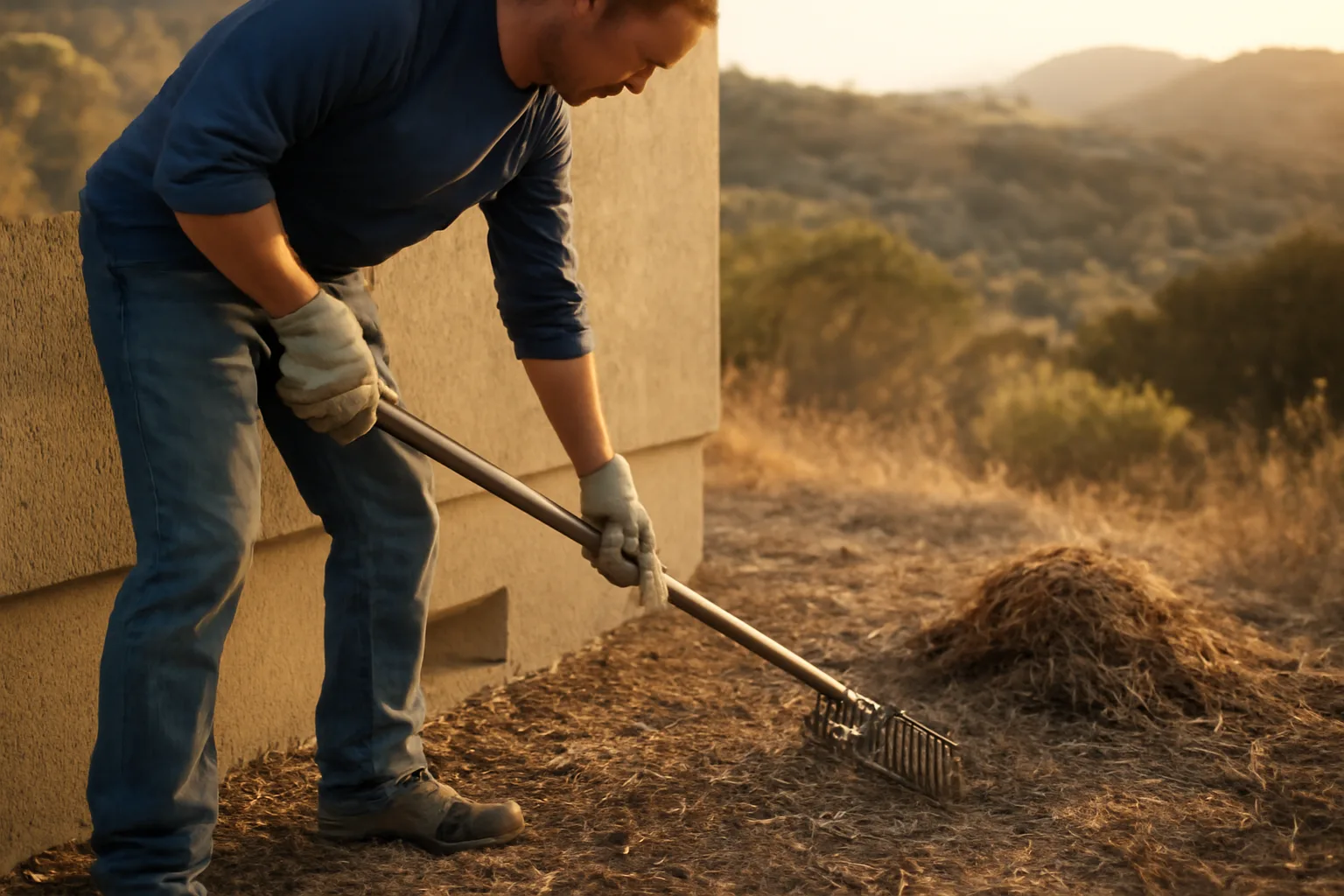
If you're facing a non-renewal letter or inspection notice, work in this order because it matches how insurers and CAL FIRE actually score risk. First, clear Zone 0 (the 5 feet closest to your home): remove mulch, debris, and combustible plants right against the foundation, even though the formal regulation isn't final yet. Second, harden the ember-entry points: vents, eaves, and any gaps under decks or in roof valleys. Embers, not direct flame contact, cause the majority of home ignitions in wildfires according to IBHS research on the 2007-2018 California wildfire seasons [1]. A $30 ember-resistant vent screen matters more than an expensive landscaping overhaul. Third, work outward through Zone 1 (5-30 feet) and Zone 2 (30-100 feet), thinning and spacing vegetation per CAL FIRE's defensible space guidance [2]. Fourth, document everything with dated photos, because that's what you'll actually need if your insurer requests proof of mitigation or if you're appealing a non-renewal. This is the exact gap the $99 Wildfire Insurance Survival Kit is built for: a structured way to photograph and organize your defensible space, vents, roof, and clearance work into the format insurers actually ask for, without paying a public adjuster or claims consultant to do it. It doesn't file anything or contact your insurer on your behalf. You do the documentation, you send it. Start at /survival-kit-builder.
Frequently asked questions
When does the California defensible space law go into effect?
California's core defensible space law (PRC 4291) has been in effect since 2005 and applies now to homes in State Responsibility Areas and Very High Fire Hazard Severity Zones. The newer Zone 0 ember-resistant clearance rule is separate and, per CAL FIRE, is not expected to take effect before 2026, with possible phased timelines for new versus existing homes.
Why won't people follow the defensible space law in California?
Cost, lack of awareness that a parcel is even in a regulated zone, competing priorities like shade and privacy landscaping, and uneven local enforcement all contribute. CAL FIRE inspection data has shown initial compliance rates around 80% in some program years, meaning a meaningful share of inspected properties fail their first check.
How do I prevent wildfires from starting on my own property?
Avoid mowing dry grass in the heat of the day, fully extinguish campfires and cigarettes, keep trailer chains from dragging on pavement, and report sagging or arcing power lines immediately. Roughly 85% of U.S. wildfires are human-caused according to the National Park Service, so ignition prevention matters as much as landscaping.
How do I prepare for a wildfire if I live in a fire-prone area?
Build a household plan with two evacuation routes and an out-of-area contact, keep a go-bag with at least 3 days of supplies per Ready.gov guidance, and finish home hardening (vents, roof, gutters, defensible space) before fire season starts, not during a red flag warning.
How can we prevent forest fires at a larger scale?
Prescribed burning and mechanical thinning on public land reduce the dead fuel that lets small fires become severe ones. This is federal and state land management work, not something individual homeowners execute, but it directly affects how bad a fire gets once it starts near your community.
How do I avoid forest fires when camping or recreating?
Use only established fire rings, never leave a fire unattended, drown and stir campfires until cold before leaving, check for active fire restrictions or burn bans before any outdoor burning, and avoid parking hot vehicles on dry grass or brush.
What fire-safe home rules take effect in 2026?
California's Zone 0 ember-resistant zone rule, covering the 5 feet around a structure, is the main one, though CAL FIRE has delayed its effective date multiple times and it's not guaranteed to be finalized by 2026. Other states like Colorado and Oregon update their own WUI codes on separate, non-fixed timelines, so check your local fire district directly.
Is Santa Barbara safe from wildfire?
No. Large parts of Santa Barbara County, especially foothill communities like Montecito and Mission Canyon, sit in CAL FIRE-designated Very High Fire Hazard Severity Zones. The area also faces post-fire debris flow risk, as shown after the 2017 Thomas Fire, which adds a hazard layer beyond the flame risk itself.
Can defensible space actually stop a wildfire from reaching my house?
Defensible space doesn't stop a wildfire, but it reduces the odds that flame contact or embers ignite your home, and it gives firefighters a safer space to defend the structure. CAL FIRE frames it as reducing home-ignition risk, not fire prevention in the broader sense.
What's the difference between Zone 0, Zone 1, and Zone 2 in California defensible space rules?
Zone 0 is the 5 feet immediately around the structure and requires ember-resistant, noncombustible conditions. Zone 1 runs 5 to 30 feet and requires vegetation removal and spacing. Zone 2 runs 30 to 100 feet and requires reduced fuel loads, not bare ground, per CAL FIRE's PRC 4291 guidance.
Do prescribed burns actually reduce wildfire severity?
Yes. U.S. Forest Service research has found forest areas with recent prescribed fire treatment tend to burn less severely when a wildfire later moves through them, because there's less accumulated dead fuel to carry fire into the tree canopy.
What's the single most cost-effective wildfire prevention step for a homeowner?
Sealing ember entry points, vents, eaves, and gaps under decks, is generally the best return per dollar. IBHS research shows embers cause the majority of home ignitions in wildfires, and ember-resistant vent screens cost far less than large-scale landscaping overhauls.
Sources
- California Public Resources Code Section 4291: 100-foot defensible space clearance requirement and zone structure
- CAL FIRE, Zone 0 Ember-Resistant Zone information: Zone 0 regulation status and expected effective timeline
- USDA Forest Service, Prescribed Fire: Prescribed fire treatment reduces subsequent wildfire severity
- CAL FIRE: State fire prevention and wildfire mitigation program funding and community-level prevention efforts.
- California Legislature: AB 38 requirements for home hardening disclosures and wildfire risk mitigation in high-fire-severity zones.
- National Fire Protection Association (NFPA): Firewise USA program as a community-level model for reducing wildfire risk through resident participation.
- CAL FIRE / Ready for Wildfire: Defensible space zone guidelines (Zone 0, Zone 1, Zone 2) for home wildfire preparedness.
- County of Santa Barbara: Local wildfire risk information and preparedness resources specific to Santa Barbara County.
- CAL FIRE: New home hardening standards under Zone 0 taking effect and their requirements for structures near wildland.