Last updated 2026-07-25
TL;DR
Mitigating wildfire risk means clearing defensible space in zones around your home, hardening vents and roofs against embers, and documenting it all before insurers ask. California's zone 0 ember-resistant rule (5 feet from the structure) is expected to take effect in 2026 once the State Fire Marshal finalizes regulations under SB 63 and prior AB 3074 authority, but many local fire districts already enforce equivalent standards now.
What does it actually mean to mitigate wildfire risk at home?
Mitigating wildfire risk means reducing the odds that embers, radiant heat, or direct flame contact ignite your house or the vegetation next to it. It is not one action. It is a stack of smaller ones: clearing brush, upgrading vents, moving mulch away from the foundation, cleaning gutters, and documenting all of it. CAL FIRE breaks the property into zones. Zone 0, the "ember-resistant zone," covers the 0 to 5 feet immediately around the structure. Zone 1 runs 5 to 30 feet, and Zone 2 runs 30 to 100 feet (or to the property line) [1]. Most home ignitions in wildfires come from embers landing on or near the structure, not a wall of flame arriving, which is why Zone 0 gets the most regulatory attention right now. Think of it less as landscaping and more as risk engineering. A house with a Class A fire-rated roof, ember-resistant vents, and a clean 5-foot perimeter survives a very different fire than the same house with a cedar shake roof and a woodpile against the siding. Insurers increasingly ask for proof of exactly this stack, which is why documentation matters as much as the physical work.
When does the California defensible space law go into effect?
California has had a defensible space law on the books since 1965, requiring 100 feet of defensible space around structures in State Responsibility Areas (Public Resources Code 4291) [2]. What's changing is the Zone 0 ember-resistant zone requirement, a newer layer targeting the 5 feet closest to the home. AB 3074, passed in 2020, directed the Board of Forestry and Fire Protection to develop Zone 0 regulations [3]. Those regulations went through years of delay. In 2025, Governor Newsom signed SB 63, which set a target of January 1, 2026 for the Office of the State Fire Marshal to adopt final Zone 0 regulations, with local jurisdictions given time afterward to align enforcement [4]. As of this writing, the regulations are in the rulemaking process, and homeowners should check the Board of Forestry and Fire Protection's website for the finalized text and effective date, since rulemaking timelines slip. Here's the honest uncertainty: state law sets a floor, but a lot of the real enforcement happens at the fire district or county level, and those timelines vary. [Guided fill-in: check your local fire district's defensible space page] for the exact date your jurisdiction begins citing homeowners for Zone 0 violations, because some Fire Safe Councils and county fire departments have already adopted equivalent rules ahead of the state deadline.
What Zone 0 changes take effect for homes in 2026?
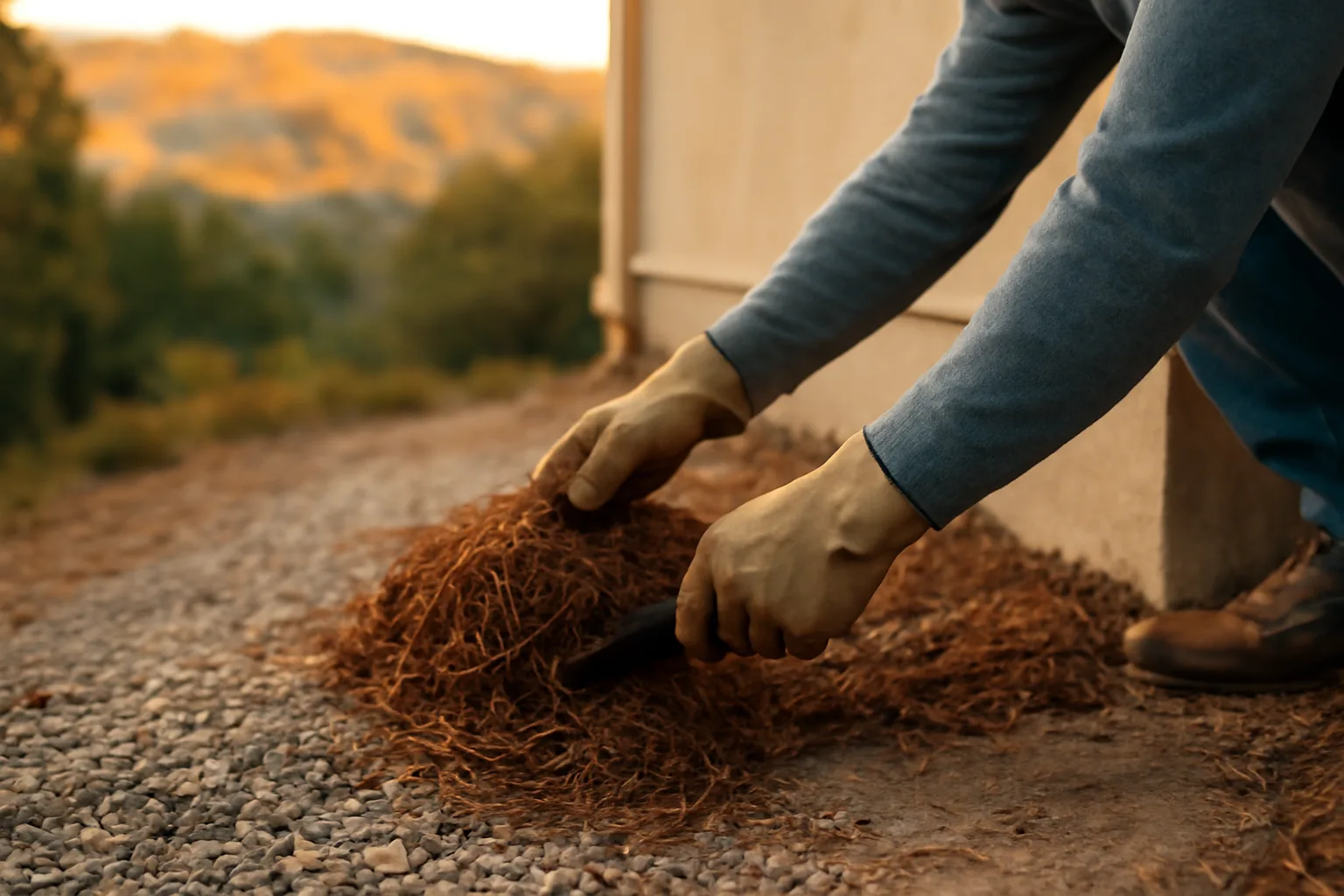
The core Zone 0 concept: no combustible materials within 5 feet of your house, attached deck, or fence line that touches the structure. That means no bark mulch, no dry leaves, no stored firewood, no wood fencing that connects directly to the house, and no combustible furniture cushions left out during fire season, under the framework the Board of Forestry has been developing [3]. Specific proposed elements include: - Non-combustible or ember-resistant ground cover (gravel, pavers, bare soil) within 5 feet
- Removal of vegetation touching or overhanging the structure
- No combustible mulch or bark within the zone
- Attached wood fencing replaced with non-combustible material for at least the first 5 feet from the house This is the piece homeowners find hardest, because it touches the parts of a yard people actually use: the patio, the deck, the spot where the propane grill sits. Retrofitting Zone 0 on an older home can run anywhere from a few hundred dollars (removing mulch, relocating woodpiles) to several thousand (replacing an attached wood fence or re-doing hardscape). There's no single national cost study on Zone 0 retrofits specifically; treat any number you see as a rough range, not a quote, until a licensed contractor walks your property. For landscaping choices that meet the concept without turning your yard into gravel, see fire safe landscaping in California next to the house.
Why won't people follow the defensible space law in California?
This is a fair question, and it's not really about ignorance. Surveys and after-action reports from California wildfires point to a mix of cost, labor, aesthetics, and distrust in enforcement. A few real drivers, based on CAL FIRE inspection data and post-fire assessments: 1. Cost and labor. Clearing 100 feet of defensible space on a sloped, brush-heavy lot can require professional crews, chainsaws, chippers, and disposal fees. For elderly or physically limited homeowners, this is a real barrier, not laziness. 2. Aesthetic attachment. People move to wildfire-prone areas partly for the tree cover and privacy. Being told to remove mature trees near the house feels like losing the reason they bought the property. 3. Enforcement inconsistency. CAL FIRE conducts defensible space inspections in State Responsibility Areas, but capacity is limited, and compliance rates in past inspection cycles have hovered well under 100 percent in some counties, according to CAL FIRE's own inspection program reporting [5]. When people see neighbors skip it without consequence, motivation drops. 4. Confusion about what's actually required. The zones, distances, and exceptions (slope adjustments, HOA rules, tree canopy spacing) are genuinely confusing without a walkthrough. Many homeowners simply don't know the specifics of PRC 4291's 100-foot requirement, let alone the newer Zone 0 rules. None of this means the law doesn't matter. It means enforcement and cost assistance programs (some counties offer chipper day programs and cost-share grants) need to close the gap, and homeowners waiting for a citation before acting are gambling with worse odds than they think.
How to prevent wildfires from starting near your property
Preventing wildfire ignition and preventing wildfire damage to your home are two different problems, and it's worth separating them. Ignition prevention is about not being the spark. Home hardening is about surviving a fire that starts somewhere else. On ignition prevention, the numbers are stark: CAL FIRE and the National Interagency Fire Center attribute the large majority of wildfires in the U.S. to human causes, including unattended campfires, downed power lines, equipment sparks, and debris burning, rather than lightning [6]. Ready.gov's wildfire preparedness guidance emphasizes checking local burn restrictions, never leaving a fire unattended, and keeping equipment (mowers, chainsaws, ATVs) away from dry grass, since a hot muffler or spark can ignite dry vegetation in seconds. Practical steps that actually move the needle: - Never burn debris on red flag warning days; check your county fire department's burn permit status before any outdoor burning
- Keep chainsaws, mowers, and grinders off dry grass, and carry a shovel and water when using them
- Maintain vehicle spark arrestors if you drive off-road in wildland areas
- Report downed power lines immediately rather than assuming someone else will
- Store gasoline and other flammables away from ignition sources and direct sun None of this is exotic. It's mostly discipline during fire season, and it's the cheapest mitigation available because it costs nothing but attention.
How to prepare for a wildfire before one starts
Preparing for a wildfire means having your evacuation plan, your "go kit," and your home hardening done before a Red Flag Warning, not during one. Ready.gov recommends assembling an emergency supply kit, planning two evacuation routes, and signing up for local emergency alerts well ahead of fire season. A reasonable preparation checklist: 1. Build a go-bag with medications, copies of ID and insurance documents, phone chargers, and a few days of clothing 2. Photograph and inventory your home's interior and exterior (this becomes your insurance documentation baseline) 3. Identify two evacuation routes from your neighborhood in case one is blocked 4. Sign up for county-level emergency alerts (most California counties run these through their Office of Emergency Services) 5. Complete Zone 0 and defensible space work before fire season starts, not during a warning 6. Keep a hose long enough to reach all sides of the house, and know where your shutoff valves are The insurance side is where a lot of homeowners get caught flat-footed. If your policy gets non-renewed or your insurer schedules an inspection, having dated photos of your completed defensible space work, receipts for hardening upgrades, and a clear record of vent and roof materials is the difference between a fast reinstatement conversation and a drawn-out dispute. This is exactly the gap the $99 Wildfire Insurance Survival Kit is built to close: a structured way to document your mitigation work so you have it ready before an adjuster or underwriter asks, not after. You still file the claim or send the documentation yourself; nobody on our team negotiates with your insurer or promises a coverage outcome. Check the survival kit builder if you want a starting template rather than building one from scratch.
How to prevent forest fires and avoid forest fires on public and private land
Forest fire prevention is mostly the same discipline as backyard fire prevention, scaled up. The U.S. Forest Service's Smokey Bear program, which has run public wildfire prevention messaging since 1944, centers on a short list of behaviors: fully extinguish campfires (drown, stir, feel for heat), never leave a fire unattended, follow local burn bans, and check that your vehicle or equipment isn't dragging sparks onto dry grass [7]. Specific to forested and wildland areas: - Only build campfires in designated fire rings where allowed, and check current restrictions with the local ranger district before you go
- Drown campfires completely; a fire that looks out is often still smoldering underneath
- Avoid parking on dry grass, since catalytic converters can reach temperatures well above the ignition point of dry vegetation
- Pack out cigarette butts rather than discarding them
- Follow fireworks bans in wildland-urban interface areas; illegal fireworks are a documented cause of several major California wildfires On the "how can we prevent forest fires" question at a broader level: state and federal agencies also do this through fuel reduction (prescribed burns, mechanical thinning) on public land, which is a policy and budget issue more than an individual one. Homeowners bordering public wildland can still help by maintaining their own defensible space so a fire that reaches their property line doesn't have easy fuel to jump into the neighborhood.
How to prepare for forest fires if you live near wildland
If your property borders forested or wildland areas, the preparation list above still applies, with extra weight on defensible space and evacuation timing. Homes in the wildland-urban interface (WUI) face faster-moving fire fronts and shorter warning windows than homes in denser suburban areas. CAL FIRE's Ready for Wildfire program recommends homeowners complete defensible space work annually, before the start of fire season, since brush and grass that were compliant last year may have regrown [1]. In WUI zones specifically: - Keep Zone 1 (5-30 feet) and Zone 2 (30-100 feet) clearance current every spring
- Remove ladder fuels (shrubs and low branches that let ground fire climb into tree canopy)
- Space tree canopies so they don't touch or overlap near the structure
- Keep evacuation routes clear of overhanging brush
- Know your local fire district's specific rules, since WUI counties often layer additional requirements onto the state baseline. [Guided fill-in: confirm your county's WUI defensible space ordinance and inspection schedule with your local fire department] For a broader look at how these clearance zones work together, see defensible space zones as a starting reference, and the general home-hardening priorities that pair with clearance work.
Is Santa Barbara safe from fire?
No area in California's wildland-urban interface is fully "safe" from fire, and Santa Barbara County has a long documented history of major wildfires, including the 1990 Painted Cave Fire and the 2017 Thomas Fire, which at the time was the largest wildfire in modern California history by acreage before being surpassed by later fires [8]. The Thomas Fire also triggered the Montecito debris flow in January 2018, a reminder that fire risk and post-fire flood/mudslide risk are linked in steep coastal terrain. Santa Barbara's risk comes from a specific combination: steep canyon terrain that channels wind, dense chaparral fuel, a long dry season, and periodic Sundowner winds that can push fire downslope toward the coast at high speed. CAL FIRE's Fire Hazard Severity Zone maps classify large portions of the Santa Barbara foothills and adjacent unincorporated areas as Very High severity zones [9]. That doesn't mean Santa Barbara is uniquely doomed. It means homeowners there, like homeowners in Boulder County, Colorado, Ashland, Oregon, or Prescott, Arizona, need to treat defensible space and home hardening as ongoing maintenance, not a one-time project. If you're deciding where to buy or how much to invest in mitigation, check your specific parcel's Fire Hazard Severity Zone designation on CAL FIRE's map rather than relying on the city's general reputation, since risk varies block by block in hillside terrain.
What home hardening upgrades matter most before 2026?
| Ember-resistant vent screens (1/8 inch metal mesh) | $150-$600 for a typical home | Vents are a top ember entry point | |
|---|---|---|---|
| Class A fire-rated roof covering | $8,000-$25,000+ (full replacement) | Roof is the largest ember-catching surface | |
| Zone 0 clearance (5 ft ember-resistant zone) | $300-$3,000+ depending on existing landscaping | Removes ignition fuel at the foundation | |
| Gutter guards / gutter cleaning | $100-$800 | Dry leaves in gutters ignite easily from embers | |
| Dual-pane tempered glass windows | $400-$1,000+ per window | Radiant heat can shatter single-pane glass, letting embers inside | |
| Enclosing eaves | $500-$2,000 per section | Open eaves let embers into the attic | Cost ranges above are general contractor estimates commonly cited in home-hardening guidance and vary heavily by region, home size, and existing materials; get a local quote rather than treating these as fixed prices. If your roof is already Class A and your vents are already screened, your dollars are probably better spent on Zone 0 landscaping and gutter maintenance than on redundant upgrades. For a broader walkthrough of what a full hardening project looks like room by room and system by system, see home hardening priorities and how fire at a house actually starts and spreads once embers get inside. |
If you can only do a few things before next fire season, prioritize the ones that address ember intrusion, since embers (not direct flame contact) cause most home ignitions during wildfires, according to research summarized by the Insurance Institute for Business & Home Safety. Ranked by typical impact and reasonable cost: | Upgrade | Approx. cost range | Why it matters |
How do fire districts differ on what's actually required?
This is the part that trips people up: state law sets the floor, but your actual obligations depend on your specific fire district, county, or city ordinance, and those can be stricter than the state minimum. [Guided fill-in: insert your fire district's name] requires defensible space inspections on a [guided fill-in: annual / biennial] basis, with violations subject to [guided fill-in: fine amount] and a compliance deadline of [guided fill-in: number of days]. Some districts, particularly in high-severity zones, have adopted local Zone 0 ordinances ahead of the state's 2026 target, so check before assuming you have until the state deadline. A few things to actually check with your local fire department or Fire Safe Council: - Whether your parcel is in a State Responsibility Area (CAL FIRE jurisdiction) or Local Responsibility Area (city/county jurisdiction), since inspection authority differs
- Whether your county offers a chipper day or cost-share grant for defensible space work
- Whether your HOA has separate landscaping rules that could conflict with defensible space requirements (this happens more often than you'd expect, and some California HOA restrictions on fire-resistant landscaping have been preempted by state law)
- Your specific inspection cycle and any grace period after a violation notice Don't assume; a five-minute call to your local fire marshal's office clears up more confusion than an hour of forum reading.
How do I document mitigation work for my insurer?
Insurers and FAIR Plan underwriters increasingly want proof, more than a claim that you "did the work." Photographs with visible dates, contractor invoices, and a written summary of what was done and when carry real weight in a non-renewal appeal or reinstatement request. A basic documentation packet should include: 1. Dated before-and-after photos of each defensible space zone 2. Contractor invoices or receipts for vent replacement, roof work, or fence replacement 3. A simple written log: date, work performed, who performed it 4. Any inspection certificates from your local fire department, if your district issues them 5. Photos of specific hardening features (mesh vent screens, Class A roof labels if visible, enclosed eaves) This is the exact gap a lot of homeowners hit after a non-renewal letter: they did real mitigation work but have no organized way to prove it. That's the specific problem the $99 one-time Wildfire Insurance Survival Kit is built around: a structured template for organizing your defensible space and hardening documentation into something you can hand to an underwriter or attach to your own appeal letter. To be clear about scope: this is a documentation tool, not a claims service. Nobody on our end negotiates with your insurer, files anything on your behalf, or promises a discount or reinstatement; you send your own documentation. If you want a structured starting point, the survival kit builder walks through the categories underwriters actually ask about.
Frequently asked questions
When does the California defensible space law go into effect?
California's core 100-foot defensible space requirement (Public Resources Code 4291) has been law since 1965. The newer Zone 0 ember-resistant zone rule, targeting the 5 feet around structures, is expected to be finalized by the Office of the State Fire Marshal with a 2026 target date under SB 63, though rulemaking timelines can shift. Check your county fire department for local effective dates.
Why won't people follow the defensible space law in California?
Cost, labor, aesthetic attachment to trees and shrubs, and inconsistent enforcement are the main reasons, based on CAL FIRE inspection reporting. Clearing 100 feet on a sloped, brush-heavy lot can require paid crews and disposal fees, and many homeowners don't fully understand the zone-by-zone requirements without a professional walkthrough.
How do I prevent wildfires from starting on my property?
Never leave outdoor fires unattended, avoid burning debris on Red Flag Warning days, keep mowers and chainsaws off dry grass, maintain vehicle spark arrestors, and report downed power lines immediately. Most wildfires in the U.S. are human-caused, according to CAL FIRE and National Interagency Fire Center data, not lightning.
How do I prepare for a wildfire?
Build a go-bag, photograph your home for insurance documentation, plan two evacuation routes, sign up for county emergency alerts, and complete defensible space and home hardening work before fire season, not during a warning. Ready.gov's wildfire guidance covers the full preparedness checklist.
How can we prevent forest fires?
Individually: fully extinguish campfires, follow local burn bans, avoid parking on dry grass, and pack out cigarettes. At a policy level, agencies reduce forest fire risk through prescribed burns and mechanical fuel thinning on public land, which is a budget and land-management issue separate from individual behavior.
How do I avoid forest fires when camping or working in wildland areas?
Check current fire restrictions with the local ranger district before building any fire, use only designated fire rings, drown campfires completely and feel for heat before leaving, and keep vehicles off dry grass since hot exhaust components can ignite vegetation.
What fire-safe home rules take effect in 2026?
California's Zone 0 ember-resistant zone rule, requiring non-combustible materials within 5 feet of structures, is expected to be finalized with a 2026 target under SB 63 and the earlier AB 3074 mandate. Some local fire districts already enforce equivalent standards ahead of the state deadline.
Is Santa Barbara safe from fire?
No part of Santa Barbara's wildland-urban interface is fully safe from fire. The county has experienced major fires including the 1990 Painted Cave Fire and the 2017 Thomas Fire, and CAL FIRE maps large sections of the foothills as Very High Fire Hazard Severity Zones. Risk varies significantly by specific parcel and terrain.
What is Zone 0 and how is it different from the 100-foot defensible space rule?
Zone 0 is the 0-5 foot ember-resistant zone immediately around a structure, requiring non-combustible ground cover and no attached combustible materials. The 100-foot rule (Public Resources Code 4291) covers the broader property, split into Zone 1 (5-30 feet) and Zone 2 (30-100 feet), with different vegetation spacing requirements.
What upgrades reduce ember intrusion into a home?
Ember-resistant vent screens (1/8 inch metal mesh), enclosed eaves, dual-pane tempered windows, and a Class A fire-rated roof address the main ember entry points, since embers cause most home ignitions during wildfires according to Insurance Institute for Business & Home Safety research.
Does my HOA's landscaping rule override defensible space law?
Generally no. California law has moved to prevent HOAs from blocking fire-resistant landscaping choices that meet defensible space requirements, though specific conflicts should be raised with your local fire marshal's office, since enforcement details vary by jurisdiction and HOA governing documents differ.
Will completing defensible space work get my insurance policy reinstated?
Completing the work and documenting it thoroughly improves your case, but no contractor, product, or documentation kit can promise reinstatement or a discount; that decision belongs entirely to your insurer or the state FAIR Plan. Send your own documentation directly, and treat any promise of guaranteed reinstatement as a red flag.
How often do I need to redo defensible space clearance?
CAL FIRE's Ready for Wildfire program recommends redoing defensible space clearance annually, before fire season starts, since brush, grass, and leaf litter regrow every year. Zone 0 non-combustible ground cover needs less frequent redo but should be checked for accumulated debris each spring.
Sources
- CAL FIRE, Defensible Space (Zones): Zone definitions: Zone 0 (0-5 ft), Zone 1 (5-30 ft), Zone 2 (30-100 ft)
- California Public Resources Code Section 4291: 100-foot defensible space requirement in State Responsibility Areas
- California Assembly Bill 3074 (2020): Directed the Board of Forestry and Fire Protection to develop Zone 0 ember-resistant zone regulations
- California Senate Bill 63 (2025): Set a target for the Office of the State Fire Marshal to finalize Zone 0 regulations around 2026
- CAL FIRE, Defensible Space Inspections Program: CAL FIRE conducts defensible space compliance inspections in State Responsibility Areas
- National Interagency Fire Center, Statistics: The large majority of U.S. wildfires are human-caused rather than started by lightning
- USDA Forest Service, Smokey Bear campfire safety: Campfire safety guidance: drown, stir, feel for heat before leaving a fire
- CAL FIRE, Thomas Fire Incident Archive: The 2017 Thomas Fire was, at the time, the largest wildfire in modern California history by acreage
- CAL FIRE, Fire Hazard Severity Zone Maps: CAL FIRE classifies portions of Santa Barbara County foothills as Very High Fire Hazard Severity Zones