Last updated 2026-07-24
TL;DR
Most forest fires start from human causes, not lightning. Preventing them means clearing dead vegetation, keeping equipment and vehicles maintained, following local burn bans, hardening your home's first five feet, and pushing your fire district to enforce defensible space rules already on the books. No single action does it; the fixes stack.
How do most forest fires actually start?
About 85 to 90 percent of wildland fires in the United States are caused by people, not nature, according to the National Park Service and USDA Forest Service, which track ignition sources across federal and state lands [1]. That means the biggest lever for prevention isn't rain or luck. It's human behavior. Common causes include unattended campfires, debris burning that gets away from someone, dragging trailer chains that throw sparks, mowing dry grass with metal blades, malfunctioning equipment, and arson. CAL FIRE's own incident data repeatedly points to equipment use, vehicles, and escaped debris burns as top causes in California specifically. Lightning still starts fires, especially in the Mountain West and parts of California's higher elevations, but it's the minority cause nationally. So when people ask how to prevent forest fires, the honest answer starts with: control what humans do near dry vegetation, more than what nature does. This matters because it changes where you put your effort. You can't stop lightning. You can absolutely stop a mower blade from throwing sparks onto cured grass in August, or make sure nobody tows a chain-dragging trailer down a dirt road at 2pm on a Red Flag day.
How to prevent wildfires: the practical checklist
Preventing wildfires is really two different jobs: stopping ignition, and stopping spread once something does ignite. Both matter, and most homeowners only think about the second one. To reduce ignition risk:
- Never burn debris on windy or Red Flag Warning days. Check your local fire weather forecast before any outdoor burning, and follow your county's burn permit rules.
- Keep vehicles and equipment off dry grass. A hot exhaust pipe or catalytic converter parked over cured grass is a known ignition source; CAL FIRE and multiple state agencies specifically warn against parking on dry vegetation.
- Maintain chainsaws, mowers, and ATVs. Spark arrestors matter. A missing or broken one on small engine equipment is a preventable cause.
- Extinguish cigarettes completely, in metal containers, never tossed from vehicles.
- Follow local fireworks bans. Many wildfire-prone counties ban all fireworks, including "safe and sane" ones, during dry season. To reduce spread once a fire starts nearby:
- Maintain defensible space around structures (more on the specific zones below).
- Remove flammable debris from roofs and gutters.
- Keep a fuel break between wildland vegetation and any structure.
- Report unattended fires and suspicious smoke immediately; early suppression is disproportionately effective compared to fighting an established fire. None of this is exotic. It's maintenance, discipline around timing, and reporting. The frustrating truth is that prevention is mostly boring, repeated tasks, not a single dramatic fix.
How to prepare for a wildfire before it happens
Preparing for a wildfire means having your evacuation plan, your home hardening, and your documentation done before smoke is visible, not during. Ready.gov recommends every household build a wildfire action plan that covers evacuation routes, a communication plan, and a go-bag, well ahead of fire season. Start with these steps months, not days, ahead: 1. Sign up for local emergency alerts (reverse-911 systems, county alert apps). Don't rely on hearing sirens. 2. Identify two evacuation routes out of your neighborhood, since one may be blocked by fire or traffic. 3. Prepare a go-bag with medications, copies of ID and insurance documents, chargers, and a change of clothes. 4. Photograph and inventory your home's exterior, roof, and defensible space zones. This documentation matters enormously if you ever face an insurance dispute or need to prove compliance with mitigation work. (A structured version of this is what the Wildfire Insurance Survival Kit is built around: a $99 one-time packet homeowners use to organize their own defensible-space photos, receipts, and dates into something an inspector or insurer can actually use. You still send it yourself; we don't file claims or negotiate coverage for you.) 5. Trim, clear, and maintain your defensible space zones annually, not once. FEMA and Ready.gov both stress that "preparing now" for wildfire, rather than during an active warning, is what actually saves time and reduces panic decisions during evacuation. If you've watched a neighbor lose coverage or get a non-renewal letter, this same documentation habit is exactly what insurers and inspectors want to see.
How to prepare for forest fires if you live near wildland
If your property backs up to national forest, BLM land, or open wildland, your prep list is longer than a typical suburban homeowner's, because your risk exposure and legal defensible-space requirements are usually stricter. Check with your local fire district for the exact zone requirements in your area, since defensible space rules genuinely vary by jurisdiction. In California, state law (Public Resources Code 4291) sets statewide minimums, but many local fire districts add stricter requirements on top. [Guided fill-in: enter your fire district name/website here to confirm your specific zone distances and any additional local ordinances.] General wildland-adjacent priorities:
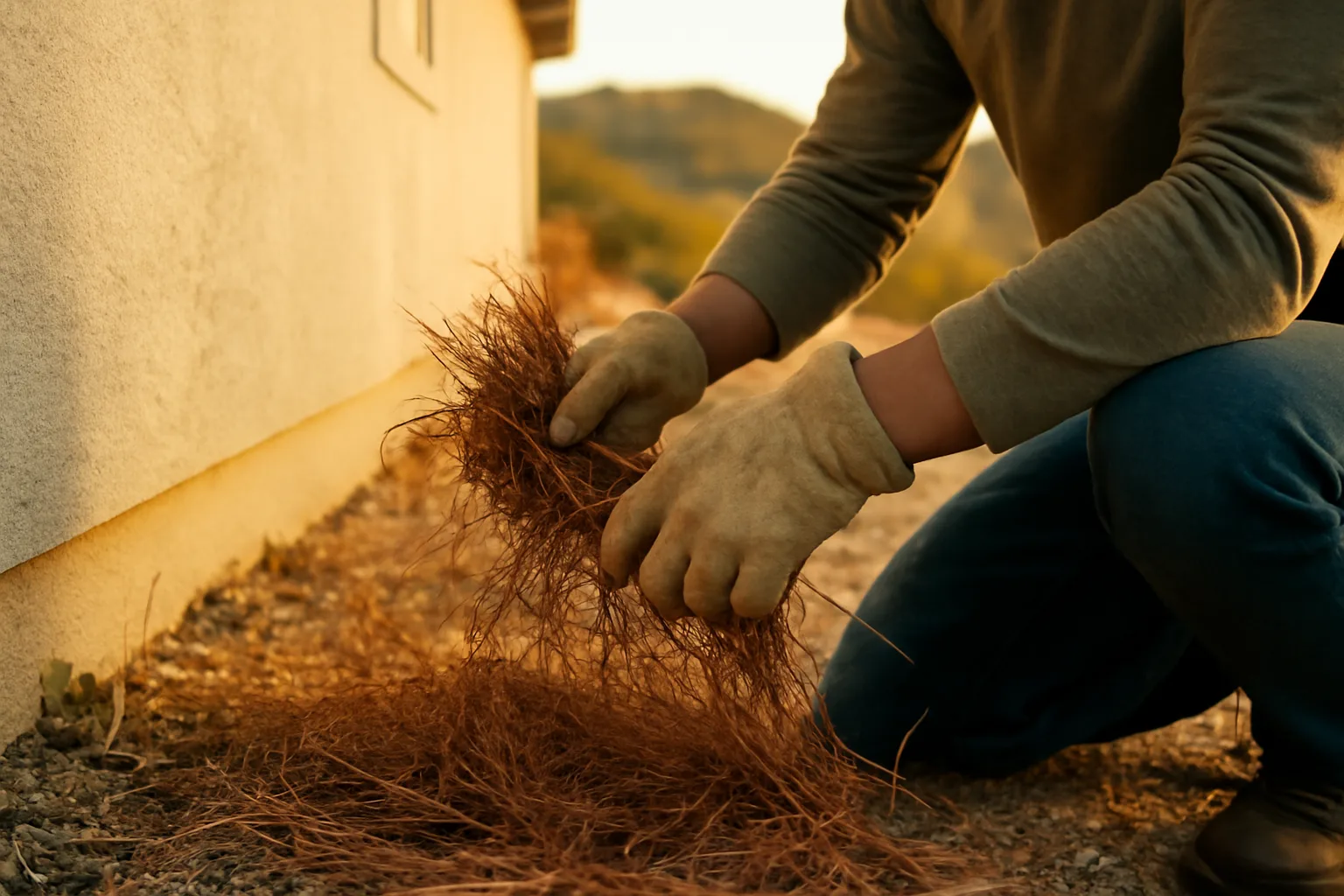
- Zone 0 (0-5 feet from structures): noncombustible materials only, no mulch, no stored wood.
- Zone 1 (5-30 feet): widely spaced, low, irrigated plants; no ladder fuels connecting ground vegetation to tree canopy.
- Zone 2 (30-100 feet): reduced fuel loads, thinned trees, mowed dry grass. CAL FIRE's defensible space guidance describes these zones in detail and is the primary technical reference most local ordinances build from [2]. If you want the deeper landscaping specifics, we cover plant selection and layout in fire safe landscaping California next to house. Beyond vegetation, wildland-adjacent homes should also confirm driveway width for fire apparatus access, address visibility from the road, and a backup water source if you're on a well. These aren't glamorous items, but they're the difference between a fire engine being able to defend your home and driving past it.
When does the California defensible space law go into effect?
California's core defensible space law, Public Resources Code Section 4291, has been in effect for decades and currently requires 100 feet of defensible space clearance around structures in State Responsibility Areas and certain local responsibility areas, a distance expanded from 30 feet by legislation signed in 2004. This isn't a new law; it's an existing one that many homeowners simply haven't complied with. What is new is the additional "Zone 0" ember-resistant zone rule. California's SB 63 (2024) and related regulatory action direct the Board of Forestry and Fire Protection to adopt a defensible space regulation requiring an ember-resistant zone within 5 feet of structures in the highest-risk areas [3]. As of this writing, the Board of Forestry has been working through the formal rulemaking process, and homeowners should check CAL FIRE's defensible space page directly for the current adoption and enforcement timeline, since rulemaking dates shift [2]. [Guided fill-in: confirm current Zone 0 adoption/enforcement status and applicable start date for your specific county via your local CAL FIRE unit or fire marshal's office, as this is actively moving through rulemaking.] The practical takeaway: the 100-foot defensible space requirement is already law and already enforceable. The Zone 0 five-foot ember-resistant rule is the newer layer being phased in, and its exact statewide effective date depends on the finalized regulation, so don't assume it's either fully in effect or years away without checking your local CAL FIRE unit.
What fire-safe home rules take effect in 2026?
Several states are tightening wildfire building and defensible-space codes with effective dates landing in 2025 and 2026, but the specifics vary enough by state and county that you need to verify locally rather than assume a single national rule. California's Zone 0 ember-resistant zone regulation, discussed above, is the most-watched 2025-2026 change, and CAL FIRE's Board of Forestry page is the authoritative place to check current status [2] [3]. Separately, many California insurers are now participating in the state's Safer from Wildfires initiative, which ties potential insurance discounts to documented mitigation actions like Zone 0 compliance, ember-resistant vents, and Class A roofing, under regulations from the California Department of Insurance [4]. We don't handle insurance negotiations or claims here (see the note below), but it's worth knowing this framework exists because it's shaping what "fire-safe home" means on paper in 2026. Oregon, Colorado, and Arizona each have their own defensible space and wildfire-urban-interface code frameworks moving through their legislatures and state forestry agencies on separate timelines. [Guided fill-in: insert your state fire marshal's current wildfire building code page and effective date here, since Oregon's SB 762 wildfire risk map and defensible space rules, Colorado's wildfire mitigation statutes, and Arizona's state forestry rules are each on their own schedule.] Rather than trust a single blog's date claim for "2026 rules," treat this as a standing homework item: check your state fire marshal's site and your county's building department every fire season, because these rules are actively being revised state by state.
Why won't people follow the defensible space law in California?
Compliance with California's defensible space law is inconsistent, and the reasons are more practical than ideological. Cost is the biggest one: clearing 100 feet of vegetation on a sloped, wooded lot can run into the thousands of dollars, especially if it requires professional tree removal or chipping equipment. Enforcement is also uneven. CAL FIRE and local fire districts conduct defensible space inspections, but staffing is limited relative to the number of parcels in State Responsibility Areas, and enforcement often relies on complaint-driven inspections or periodic sweeps rather than universal annual checks. Some homeowners simply never get inspected and assume, incorrectly, that means they're compliant. Other common reasons cited by fire agencies and researchers:
- Confusion about exact zone boundaries and what's allowed to stay (a mature oak near the house, for example, has different rules than brush).
- Aesthetic resistance; some homeowners don't want to remove trees or landscaping they value.
- Physical inability, especially for elderly or disabled homeowners on large or steep lots, to do the clearing themselves.
- Renters and absentee owners who aren't present to manage the property.
- A belief that "it won't happen to me," despite living in a mapped high-risk zone. The honest fix isn't just more citations. Several California counties and nonprofits run chipper day programs and cost-share assistance specifically because affordability, not defiance, is the real barrier for a lot of households. If cost is your blocker, check with your county fire department or resource conservation district before assuming you're stuck; many offer free or subsidized vegetation removal days.
How can we prevent forest fires at the community level?
Individual defensible space matters, but forest fires spread across property lines, so community-level action multiplies the effect of any one household's work. A single hardened home surrounded by unmanaged fuel is still at serious risk; a neighborhood that coordinates fuel breaks is measurably safer. Effective community strategies include:
- Firewise USA sites, a National Fire Protection Association program where neighborhoods organize collective defensible space work and get formal recognition (and sometimes insurance consideration) for doing so [5].
- Community chipper days and green waste programs that remove the cost barrier for individual households.
- Coordinated fuel breaks along shared boundaries, roads, and open space, rather than each property clearing independently and leaving gaps.
- Local ordinance enforcement paired with education, since fire districts that pair inspections with actual assistance programs tend to see higher compliance than pure-citation enforcement models.
- Prescribed burns and mechanical thinning on adjacent public lands, coordinated with USDA Forest Service and state forestry agencies, to reduce the fuel load that reaches private property lines in the first place. CAL FIRE and the U.S. Forest Service both point to landscape-scale fuel treatment, more than individual defensible space, as necessary because wildfires don't respect parcel boundaries [1]. If you're organizing your street or HOA, start by contacting your local fire district about Firewise USA enrollment; it's free to join and gives you a structured framework instead of reinventing one.
How to avoid forest fires when you're outdoors
Recreational and outdoor-work ignitions are a huge share of preventable fires, and the rules are straightforward even if compliance often isn't. Before any outdoor fire activity, check current restrictions: many wildfire-prone counties impose seasonal burn bans, and violating them isn't just risky, it's often a cited legal offense. Campfire safety basics that actually prevent fires:
- Use only established fire rings where legal, never build one on dry grass or duff.
- Keep a shovel and water within reach the entire time the fire burns.
- Drown, stir, and feel the ashes cold before leaving, every single time. "If it's too hot to touch, it's too hot to leave" is the standard Forest Service guidance shorthand.
- Never leave a campfire unattended, even for a few minutes. For vehicles and equipment outdoors:
- Don't drive or park on dry grass; catalytic converters can exceed 1,000°F.
- Carry a fire extinguisher and shovel in remote areas, which several states legally require during fire season for certain activities like chainsaw use on public land.
- Check spark arrestor requirements for OHVs, chainsaws, and generators used in wildland areas; these are often legally mandated, not optional. Fireworks deserve a specific mention because they cause a disproportionate number of wildfires relative to how often people use them, especially around July 4th in dry grass season. If you're unsure whether fireworks are legal where you're staying, assume they're banned and check your county's specific ordinance before assuming "safe and sane" fireworks are allowed.
Is Santa Barbara safe from fire?
No coastal California community, including Santa Barbara, is "safe" from wildfire in an absolute sense; the county has a documented history of major, damaging fires, and CAL FIRE and Santa Barbara County both maintain active high fire hazard severity zone maps covering large sections of the foothills and wildland-urban interface. Santa Barbara County has experienced several significant fires in recent decades, including the Thomas Fire (2017), which at the time was one of the largest fires in modern California history and was followed by deadly debris flows in Montecito. The Jesusita Fire (2009) and Tea Fire (2008) also burned into residential areas of the city itself. This history is part of why the county maintains detailed Fire Hazard Severity Zone maps through CAL FIRE, covering the foothill and interface neighborhoods most exposed to wildland fuel. If you live in or near Santa Barbara, the right question isn't "is it safe" but "what's my specific parcel's hazard zone rating, and what does that require of me." Check your address against the CAL FIRE Fire Hazard Severity Zone viewer, confirm with your local fire district what defensible space distance applies to your parcel, and treat any "moderate" or "high" zone designation as a real, actionable requirement rather than a background label. [Guided fill-in: insert your specific Santa Barbara zone designation and local fire district contact once confirmed via the CAL FIRE viewer.]
What documentation should you keep to prove you've done the work?
Whether you're responding to an insurance non-renewal, a county inspection notice, or just want proof for your own records, documentation is what turns "I did the work" into something an inspector or adjuster can verify. This is true whether or not you ever have a claim. At minimum, keep:
- Dated photos of all defensible space zones (0-5, 5-30, 30-100 feet), taken from multiple angles, ideally every spring before fire season and again after any major clearing work.
- Receipts or invoices for vegetation removal, tree trimming, gutter cleaning, and any vent or roof upgrades.
- A copy of any local defensible space inspection report or compliance certificate.
- Contractor licensing info if you hired out the work.
- A simple written log: date, what was done, who did it. Insurers increasingly ask for exactly this kind of evidence when reviewing a policy for renewal, and having it organized before you're asked saves real time during a stressful process. To be clear: neither this article nor any product referenced here files claims, negotiates with insurers, or promises reinstatement or discounts. You prepare the documentation; you send it yourself, to your inspector or insurer, in whatever format they require. If you want a structured starting point rather than building a folder from scratch, the Wildfire Insurance Survival Kit is a $99 one-time tool built specifically to organize this kind of defensible-space and hardening documentation into something submission-ready. It's optional. A spreadsheet and a labeled photo folder does the same basic job if you'd rather build it yourself.
What's the difference between preventing ignition and preventing home loss?
These get conflated constantly, and the distinction matters for where you spend money and time. Preventing ignition stops a fire from starting in the first place: no unattended campfires, no sparking equipment on dry grass, no illegal burning. Preventing home loss is about surviving a fire that's already burning nearby, which is a structural and landscaping problem, not a behavior problem. Home hardening, the structural side, focuses on ember resistance: Class A roofing, ember-resistant vents, enclosed eaves, tempered dual-pane windows, and noncombustible siding in the first 5 feet. CAL FIRE research and post-fire damage assessments consistently find that embers, not direct flame contact, cause the majority of home ignitions during wildfires, because embers can travel over a mile ahead of the fire front [2]. That's why Zone 0 (the 0-5 foot ember-resistant zone discussed earlier) gets so much regulatory attention right now. It's not about stopping a wall of flame; it's about denying embers a foothold. We go deeper on the structural side in defensible and cover the broader home-hardening priority list separately. If you're triaging a limited budget, the research consistently points toward doing the 5-foot ember zone and vent/roof upgrades before landscaping further out, since that's where the ignition risk concentrates for an already-built home.
Where can you learn what's required in your specific area?
Because defensible space and fire-safe building rules vary by state, county, and even individual fire district, no article, including this one, can give you a single universal number that applies everywhere. Use these primary sources directly: - CAL FIRE's defensible space page for California zone requirements, Fire Hazard Severity Zone maps, and current Board of Forestry rulemaking status [2].
- Ready.gov's wildfire preparedness section for evacuation planning and household emergency kits, applicable regardless of state.
- Your state fire marshal's office for state-level building codes and wildfire mitigation statutes. [Guided fill-in: insert your state fire marshal's.gov URL here.]
- Your local fire district or fire protection district for the specific clearance distances, inspection schedule, and permit rules that apply to your exact parcel, since these frequently exceed state minimums.
- Your county assessor or planning department for your parcel's specific Fire Hazard Severity Zone or Wildland-Urban Interface designation. If you've received a non-renewal or inspection letter, the letter itself usually names the specific standard you're being measured against; treat that as your starting checklist rather than a generic one. For more on what an actual fire event and its aftermath look like structurally, see house fire and fire at a house. For the well-known federal wildfire prevention messaging most Americans grew up with, see only you can prevent wildfires. If you're in Washington State specifically, wildfire defensible space clearing contracts washington state dnr covers contractor and DNR program specifics.
Frequently asked questions
How to prevent forest fires in general terms?
Since most wildfires are human-caused, prevention means controlling ignition sources (unattended campfires, sparking equipment, illegal burning on dry or windy days) and maintaining defensible space so any fire that does start can't easily spread to structures. CAL FIRE and the National Park Service both cite roughly 85-90% of wildfires as human-caused [1][2].
How to prevent wildfires from spreading once they start?
Maintain defensible space zones (0-5, 5-30, 30-100 feet from structures), remove roof and gutter debris, keep fuel breaks between wildland vegetation and buildings, and report any unattended fire or suspicious smoke immediately. Early suppression is far more effective than fighting an established fire, which is why fast reporting matters as much as clearing brush.
When does the California defensible space law go into effect?
California's core 100-foot defensible space law (Public Resources Code 4291) has been in effect since it was expanded from 30 feet in 2004; it's already enforceable now. The newer Zone 0 ember-resistant zone rule from SB 63 is still moving through Board of Forestry rulemaking, so check CAL FIRE's site for the current adoption status in your county [4][5][6].
Why won't people follow the defensible space law in California?
Cost is the biggest reason, since clearing 100 feet on a sloped or wooded lot can run into thousands of dollars. Uneven enforcement, confusion about exact zone boundaries, physical inability on large properties, and absentee ownership also contribute. Chipper day programs and cost-share assistance exist in many counties specifically to address the affordability barrier.
How to prepare for a wildfire if you get a non-renewal letter?
Read exactly what standard the letter cites, then document your defensible space with dated photos and receipts before you respond. Build a go-bag and evacuation plan per Ready.gov guidance, and confirm your specific fire district's clearance requirements. This article doesn't file claims or negotiate coverage; you prepare and send your own documentation.
How to prepare for forest fires if you live in a wildland-urban interface area?
Confirm your exact zone requirements with your local fire district since rules often exceed state minimums, maintain all three defensible space zones (0-5, 5-30, 30-100 feet), ensure driveway width allows fire apparatus access, and have a backup water source if you're on a well. Wildland-adjacent homes carry higher baseline risk than interior suburban lots.
What fire-safe home rules take effect in 2026?
California's Zone 0 ember-resistant zone regulation is the most significant pending 2025-2026 change, still moving through Board of Forestry rulemaking as of this writing. Other states (Oregon, Colorado, Arizona) have separate wildfire building code timelines. Check your state fire marshal's site directly rather than trusting a single fixed date, since rulemaking schedules shift.
Is Santa Barbara safe from fire?
No; Santa Barbara County has a documented history of major fires (Tea Fire 2008, Jesusita Fire 2009, Thomas Fire 2017) and maintains active CAL FIRE Fire Hazard Severity Zone maps covering large foothill and wildland-urban interface areas. Check your specific parcel's zone rating rather than assuming coastal proximity means lower risk.
How can we prevent forest fires at the neighborhood or community level?
Join or start a Firewise USA site through the National Fire Protection Association, organize community chipper days to remove cost barriers, coordinate fuel breaks across property lines rather than clearing in isolation, and support landscape-scale fuel treatment on adjacent public lands through your local fire district and USDA Forest Service contacts [8].
How to avoid forest fires while camping or doing outdoor work?
Check current burn restrictions before any fire activity, use only established fire rings, keep water and a shovel within reach, and fully drown and stir ashes until cold before leaving. Never park or drive on dry grass since catalytic converters can exceed 1,000°F, and confirm spark arrestor requirements for chainsaws, OHVs, and generators.
What's the single most effective thing a homeowner can do to prevent fire damage?
Harden the first 5 feet around your structure (Zone 0): noncombustible surfacing, no mulch or stored wood, ember-resistant vents. CAL FIRE data shows embers, which can travel over a mile ahead of a fire front, cause most home ignitions, not direct flame contact, so this zone offers the highest return per dollar spent [4].
Do I need a permit to burn debris where I live?
In most wildfire-prone counties, yes, and permits are often suspended entirely during fire season regardless of whether you already have one. Check your county fire department or CAL FIRE unit directly before burning; requirements and seasonal bans vary by jurisdiction and can change with short notice based on current fire weather conditions.
Sources
- CAL FIRE, Wildfire Prevention: Common wildfire causes in California including equipment use, vehicles, and debris burning
- California Public Resources Code Section 4291: 100-foot defensible space clearance requirement around structures in State Responsibility Areas
- California Department of Insurance, Safer from Wildfires: Insurance regulation tying mitigation actions like Zone 0 compliance to potential insurer consideration
- National Fire Protection Association, Firewise USA: Community-level wildfire mitigation recognition program for neighborhoods
- CAL FIRE, Fire Hazard Severity Zone Maps: Santa Barbara County foothill and wildland-urban interface areas mapped as high fire hazard severity zones