Last updated 2026-07-25
TL;DR
Effective wildfire mitigation combines a 5-foot noncombustible zone around the house, ember-resistant vents, metal roofing/gutters, and lean landscaping out to 100 feet. California's expanded defensible space law (the ember-resistant Zone 0 rule under SB 63/AB 3074) is still pending final regulations as of 2025, with enforcement expected to phase in after CAL FIRE and the Board of Forestry adopt standards, likely no earlier than 2026.
What does good wildfire mitigation actually look like on a real property?
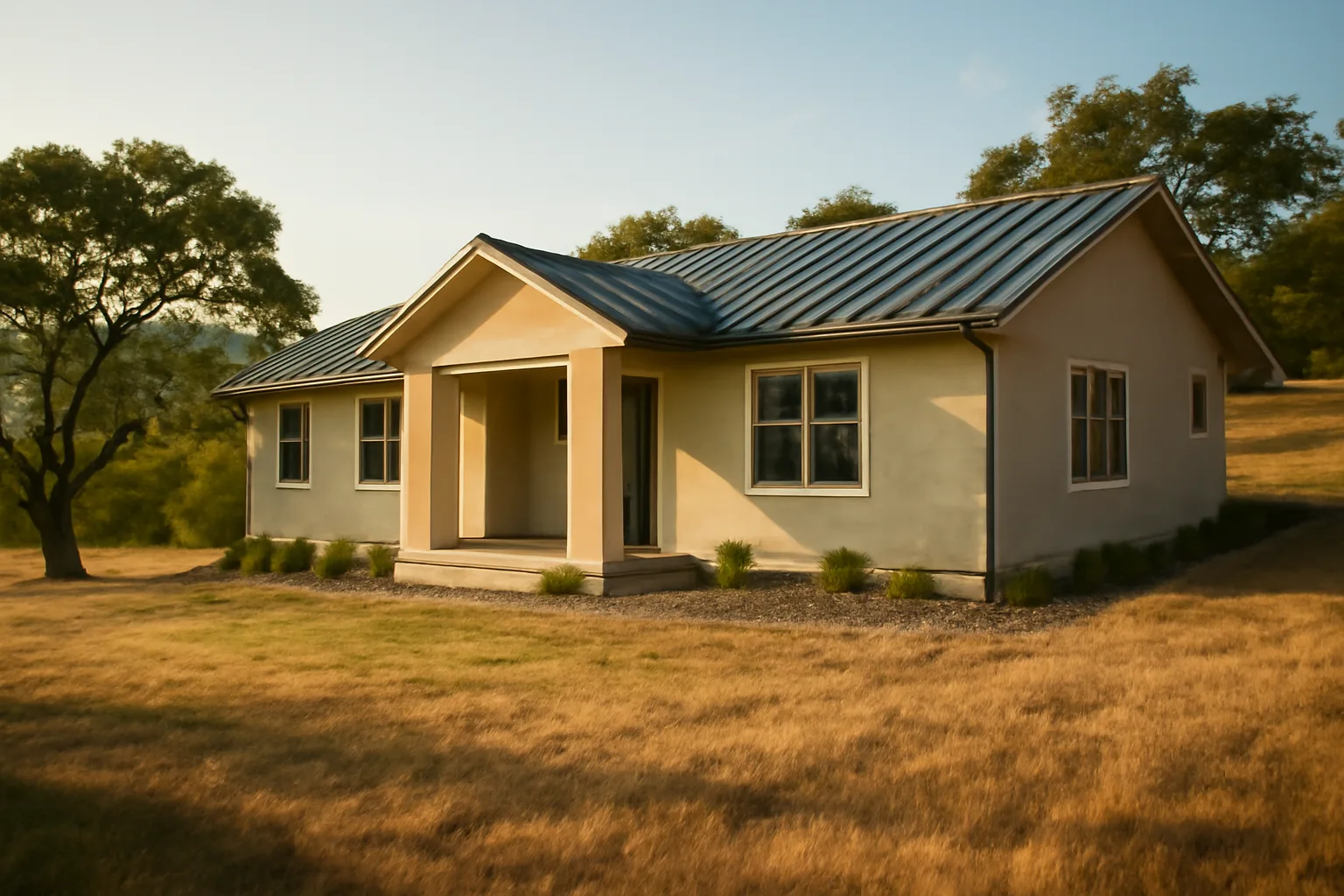
Good wildfire mitigation is boring to look at. It is gravel instead of bark mulch against the foundation, a metal roof with the gutters cleaned out, and a yard where the nearest bush is farther from the wall than you'd expect. It's not a single product. It's a set of small, unglamorous changes stacked around the house in rings. CAL FIRE frames this as "defensible space," a term with a specific legal meaning in California: the buffer you create by removing or reducing flammable vegetation around a structure. The agency's guidance is direct about the goal: "Defensible space is the buffer you create between a building on your property and the grass, trees, shrubs, or any wildland area that surround it". That buffer does two things. It slows the fire down before it reaches your walls, and it gives firefighters a safer place to work if they show up. A real example: a ranch-style home in Sonoma County with a 5-foot band of decomposed granite around the foundation instead of the bark mulch that used to sit there, corrugated metal flashing sealing the gap under the eaves, and a lawn kept mowed to under 4 inches out to 30 feet. None of that is expensive by itself. Together it changes how that house behaves when embers land on it, which is how most homes actually catch fire in a wildfire, not from a wall of flame marching up to the door. For a broader walkthrough of what inspectors look for room by room and zone by zone, see defensible space clearing.
What's the difference between Zone 0, Zone 1, and Zone 2, with examples for each?
| Zone 0 | 0-5 ft from structure | Gravel or pavers instead of mulch, no wood fencing attached to the house, nothing stored under decks, potted plants removed from against the wall | |
|---|---|---|---|
| Zone 1 | 5-30 ft | Shrubs spaced so canopies don't touch, tree limbs pruned 6+ ft off the ground, dead branches and pine needles removed from the roof and gutters | |
| Zone 2 | 30-100 ft | Grass mowed to under 4 inches, brush thinned, wood piles moved out of this zone or covered, "fuel breaks" cut between tree clusters | CAL FIRE's official zone guidance describes Zone 1 as extending "30 feet from the home" and instructs removing "dead plants, grass and weeds" and keeping tree branches trimmed "at least 10 feet from other trees". Zone 2 guidance calls for cutting annual grass down to 4 inches and creating horizontal and vertical spacing between shrubs and trees so fire can't ladder up into the canopy. A homeowner in the Sierra foothills, for instance, might thin a stand of manzanita in Zone 2 down to clumps 10 feet apart, remove the lower limbs on nearby oaks, and haul away a brush pile that had been sitting 40 feet from the garage for three years. That's a full afternoon with a chainsaw and a truck, not a contractor job, and it's the kind of change an inspector actually credits. For plant-by-plant guidance on what to keep and what to pull near the house, see fire-safe landscaping close to the house. |
California's defensible space rule breaks the property into zones measured from the structure, and each zone has a different job. Zone 0 (0 to 5 feet) is about denying embers a place to land and smolder. Zone 1 (5 to 30 feet) is about breaking up continuous fuel so fire can't run at the house. Zone 2 (30 to 100 feet) is about slowing a fire down before it ever reaches Zone 1. Here's what compliant work looks like in practice, by zone. | Zone | Distance | Example mitigation |
When does the California defensible space law go into effect?
The current, general defensible space requirement (100 feet of clearance under Public Resources Code 4291) has been in effect for years and is already enforced by CAL FIRE and local fire agencies. What's new, and not yet fully in effect, is the ember-resistant Zone 0 standard. Assembly Bill 3074 (2020) directed the Board of Forestry and Fire Protection to develop regulations for a "zone 0" ember-resistant area within 5 feet of structures in the State Responsibility Area and other high-hazard zones [1]. As of 2025, those Zone 0 regulations have been drafted and gone through public comment, but they are not finalized as enforceable law yet. Senate Bill 63 (2024) extended the mandate and pushed timelines, and reporting from CAL FIRE and legislative staff has repeatedly noted the regulation package is not expected to be adopted and enforceable before 2026 at the earliest, with a compliance grace period likely to follow adoption. So if you're asking "what fire-safe rules for homes take effect in 2026," the honest answer is: probably the Zone 0 ember-resistant zone rules, but treat that date as a target, not a guarantee. Regulatory adoption dates for California fire code changes have slipped before. Check the Board of Forestry and Fire Protection's rulemaking page directly before you budget around a specific deadline [2], and check with [[YOUR FIRE DISTRICT / COUNTY FIRE MARSHAL]] for any local ordinance that may move faster than the state timeline. Until Zone 0 rules are locked in, the safest move is to build to the stricter draft standard now, since retrofitting gravel and noncombustible siding later costs more than doing it once.
Why won't people follow the defensible space law in California?
Nobody has a clean survey answer to this, but CAL FIRE's own compliance data and inspection reporting point to a few repeat reasons, and cost is the biggest one. Removing mature trees, replacing wood fencing, and regrading a slope for a fuel break can run into the thousands of dollars, and many of the properties most exposed to wildfire are also lower-income, rural, or owned by people on fixed incomes. A second reason is simple disagreement about risk. Some homeowners genuinely don't believe their property will burn, especially if it hasn't in living memory, and defensible space work (cutting down a shade tree, tearing out a hedge someone planted decades ago) feels like a loss for a hypothetical benefit. A third reason is confusion about what's actually required. Defensible space rules are enforced locally, and specifics (inspection cadence, exact clearance distances, whether an ordinance is stricter than the state minimum) vary by fire district. A homeowner who gets a vague inspection notice with no clear checklist is more likely to do nothing than to guess wrong. And a fourth, less discussed reason: enforcement has historically been inconsistent. CAL FIRE inspects properties in State Responsibility Areas, but many communities are in Local Responsibility Areas where enforcement capacity, staffing, and follow-through vary a lot by city and county budget. When the penalty for noncompliance feels unlikely to actually land, some people deprioritize the work, especially with everything else competing for a homeowner's weekend. None of that changes the physics. Homes with defensible space and hardened construction survive wildfires at meaningfully higher rates than homes without it, which is the entire reason the law exists.
How do you prevent wildfires from starting in the first place?
Most wildfires are not started by lightning. Roughly 85 to 90 percent of wildland fires in the United States are caused by people, according to the National Park Service and Forest Service data on ignition sources. That means prevention starts with everyday behavior, more than landscaping. The practical list: don't park or idle a hot vehicle over dry grass (catalytic converters routinely start roadside fires), fully drown and stir campfires until they're cold to the touch, don't tow trailer chains that can spark on pavement, avoid using power tools like chainsaws and mowers on dry vegetation during red flag warnings, and check local burn permit rules before doing any debris burning. Utility-caused fires are another major category, especially in California, where downed power lines and vegetation contact with electrical equipment have caused some of the state's most destructive fires. Homeowners can help by keeping trees trimmed away from power lines on their property and reporting sagging lines or exposed equipment to the utility. At the home level, prevention overlaps heavily with mitigation: an ember-resistant Zone 0, a clean roof and gutters, and no woodpiles against the house reduce the odds that a nearby ignition (a neighbor's fire, a passing ember from miles away) turns into a structure fire at your address. For the mechanics of how a structure fire actually starts and spreads once ignited, house fire basics covers the fire triangle in plain terms.
How do you prepare for a wildfire before it happens?
Preparation splits into three buckets: the house, the yard, and the family plan. Skipping any one of them leaves a gap. For the house: harden the vents (mesh screens rated 1/8 inch or smaller keep embers out), replace wood shake roofing if you still have it, box in open eaves, and make sure gutters have covers or get cleaned before fire season. Ready.gov's wildfire preparedness guidance specifically recommends homeowners "clean debris from rain gutters" and "cover exterior vents with metal wire mesh" as ember-entry prevention [3]. For the yard: work the zones described above, keep a hose long enough to reach every side of the house, and store propane tanks and firewood well clear of structures. For the family: build (or buy) a go-bag with copies of insurance documents, medications, chargers, and a change of clothes per person, agree on two exit routes out of the neighborhood in case one is blocked, and designate an out-of-area contact everyone can check in with if local phone networks are jammed. Ready.gov recommends practicing your evacuation route rather than assuming you'll remember it under stress [3]. This is also the point where documentation matters, and it's worth doing before you need it, not after. A dated photo record of your defensible space work, your roof material, and your home's condition is the kind of thing an insurer or adjuster will ask for after a claim, and it's much easier to produce if you built the file in advance. That's the entire premise behind our $99 Wildfire Insurance Survival Kit, a one-time toolkit for organizing that documentation yourself. We don't negotiate with insurers, file claims, or promise coverage or reinstatement; you prepare and send your own records.
How do you prevent and avoid forest fires when you're out on the land, more than at home?
Forest fire prevention away from the house comes down to fire behavior around ignition sources you control directly. The U.S. Forest Service's Smokey Bear program has run the same core message for decades because the causes haven't changed: campfires, debris burning, equipment sparks, and discarded smoking materials [4]. Practical rules that hold up in real conditions: build campfires only in established, cleared fire rings, keep them small, and never leave one unattended, even for a few minutes. Drown it, stir the ashes, drown it again, and check for heat with the back of your hand before you leave. Don't drive or park over dry grass. Check the local fire danger rating (often posted at trailheads and ranger stations) before doing anything with an open flame or spark-producing tool, and respect burn bans when they're posted; they exist because conditions have crossed a threshold, not as a formality. If you're a landowner managing acreage rather than a quarter-acre lot, prescribed fire and mechanical thinning contracts are the bigger lever, not household habits. States like Washington run structured programs connecting landowners with contractors for exactly this kind of large-scale fuel reduction work; see defensible space clearing contracts through Washington State DNR for how that process works if you're managing forested acreage rather than a suburban lot.
How do you prepare for forest fires if you live near wildland, not in a city?
Preparing for forest fire exposure on rural or forested property adds a layer beyond suburban defensible space work: access and water. Make sure your driveway and access road are wide enough and clear enough for a fire engine to actually reach your house; CAL FIRE's Fire Prevention guidelines call for the removal of vegetation encroaching on access roads and clearly visible address numbers so responders can find the property fast. If you have a well or pond, know how to get water out of it manually if the power's out. If you're on propane, know where the shutoff is and make sure the tank has clearance around it per your zone requirements. Also build a fuel break plan specific to your terrain. Fire moves faster uphill and with wind, so a property on a south-facing slope in a canyon needs a wider, more aggressive Zone 2 treatment than a flat lot in a subdivision. This is exactly the kind of variation that makes "just follow the 100-foot rule" insufficient on its own; slope, prevailing wind, and fuel type all change what "enough" defensible space actually means on your specific parcel. Check with [[YOUR LOCAL FIRE DISTRICT]] for terrain-adjusted requirements, since many jurisdictions ask for wider clearance on steep slopes.
What fire-safe rules for homes take effect in 2026?
The rule most likely to actually take effect around 2026 is California's ember-resistant Zone 0 standard for the 5-foot zone immediately around structures, developed under the mandate in AB 3074 and extended by SB 63 [1]. The draft standard would require noncombustible surfaces (gravel, pavers, concrete) instead of bark mulch or dense plantings in that zone, removal of anything flammable stored against the house, and restrictions on attached wood fencing. But "takes effect in 2026" is doing a lot of work in that sentence, and homeowners should read it carefully. As of this writing, the Board of Forestry and Fire Protection has not finalized and adopted the Zone 0 regulation text, and CAL FIRE's public messaging has consistently described the rule as under development rather than locked to a specific enforcement date [2]. Legislative delays, additional comment periods, or phased compliance timelines by property type (single-family homes vs. multi-family, SRA vs. LRA) could all push real enforcement later than 2026. Outside California, other wildfire-prone states are moving on separate tracks. Oregon's wildfire risk map and defensible space code updates under Senate Bill 762 (2021) have gone through their own multi-year rollout, with mapping revisions after public pushback [5]. Colorado and Arizona largely handle defensible space through local and county wildland-urban interface codes rather than one statewide mandate, so "what takes effect in 2026" is a very different answer depending on which state and even which county you're in. Check [[YOUR STATE FIRE MARSHAL]] and [[YOUR COUNTY OR FIRE DISTRICT]] directly rather than relying on a single national headline.
Is Santa Barbara safe from fire, and how do you check risk for a specific neighborhood?
No California coastal or foothill community, Santa Barbara included, can be called "safe" from wildfire in any absolute sense, and the area's own fire history makes that clear. Santa Barbara County has burned repeatedly in major fires, including the 1990 Painted Cave Fire and the 2017 Thomas Fire, which at the time was the largest wildfire in modern California history by acreage and directly preceded the deadly Montecito debris flow in January 2018 . That said, "safe" isn't really the right frame. Risk varies block by block based on proximity to wildland, slope, vegetation type, and how well individual homes are hardened, more than by city name. CAL FIRE maintains Fire Hazard Severity Zone maps that let you check the specific designation (moderate, high, or very high) for any parcel in California, including neighborhoods within Santa Barbara and the surrounding foothill communities like Montecito and Mission Canyon . Some flat, urbanized parts of Santa Barbara sit in moderate zones; homes tucked against the foothills or in canyon-adjacent neighborhoods often sit in high or very high zones on the same map. The practical move for anyone asking this question about their own address, in Santa Barbara or anywhere else: pull up the CAL FIRE Fire Hazard Severity Zone Viewer, enter the address, and read the zone designation directly rather than relying on a city's general reputation . Then match your defensible space and hardening work to that specific zone's requirements, since insurers increasingly underwrite based on parcel-level risk data, more than city or ZIP code.
What role does insurance non-renewal play in all of this, and what should homeowners document?
Insurance non-renewal notices in wildfire-prone states have surged as carriers reassess risk using increasingly granular wildfire modeling, and California's FAIR Plan (the state's insurer of last resort) has grown accordingly, though exact enrollment figures shift year to year and are best checked directly on the FAIR Plan's own reporting. What matters practically for a homeowner who just got a non-renewal or inspection letter: the mitigation work described in this article (Zone 0 through Zone 2, roof and vent hardening) is exactly what insurers and their inspectors are checking for, and documenting it well is the difference between a paper trail that supports your case and a pile of receipts nobody can make sense of later. Document dates, before-and-after photos, contractor invoices where applicable, and the specific materials used (roof class rating, vent mesh size, gravel depth in Zone 0). Keep copies somewhere other than just the house itself, since a fire that destroys your home destroys paper records stored inside it too. We built the $99 one-time Wildfire Insurance Survival Kit around exactly this gap: a structured way to organize your own defensible space and hardening documentation so you have something coherent to hand an inspector or attach to your own records. We don't negotiate with insurers, file claims on your behalf, or promise reinstatement or discounts; you prepare and send your own documentation, and the decision sits with your insurer.
Frequently asked questions
When does the California defensible space law go into effect?
The general 100-foot defensible space requirement under Public Resources Code 4291 is already in effect and enforced. The newer ember-resistant Zone 0 standard, mandated by AB 3074 and extended by SB 63, is still in the regulatory adoption process as of 2025, with enforcement realistically expected no earlier than 2026. Check the Board of Forestry and Fire Protection's rulemaking page for the current status before assuming a firm date.
Why won't some people follow the defensible space law in California?
Cost is the biggest factor; clearing mature trees and replacing fencing can run into the thousands. Others underestimate their risk, especially if their property hasn't burned before. Confusion about local requirements (which vary by fire district) and inconsistent enforcement, especially outside CAL FIRE's direct jurisdiction in Local Responsibility Areas, also contribute to low compliance.
How can homeowners prevent wildfires from starting?
About 85 to 90 percent of U.S. wildfires are human-caused, per National Park Service data. Prevention means drowning campfires completely, not parking over dry grass, avoiding power tools on red flag days, checking local burn permits, and reporting downed power lines. At the home level, ember-resistant zones and clean gutters reduce the odds a nearby ignition becomes a structure fire.
How do you prepare for a wildfire as a homeowner?
Harden the house (metal roof, ember-resistant vents, boxed eaves), clear defensible space in the three zones out to 100 feet, and build a family plan with a go-bag, two evacuation routes, and an out-of-area contact. Ready.gov specifically recommends practicing your evacuation route in advance rather than relying on memory under stress.
How do you prevent forest fires when camping or working outdoors?
Build fires only in established rings, keep them small, and drown and stir ashes until cold before leaving, even briefly. Avoid parking over dry grass, respect posted burn bans, and check local fire danger ratings before using chainsaws, welders, or other spark-producing tools during dry, windy conditions.
How do you avoid forest fires spreading onto your property?
Maintain the layered defensible space zones: noncombustible material in the first 5 feet, spaced-out shrubs and pruned trees from 5 to 30 feet, and thinned brush with mowed grass from 30 to 100 feet. Fuel breaks and wider clearance are needed on slopes, since fire moves faster uphill.
How do you prepare for forest fires if you live in a rural or wildland-adjacent area?
Beyond standard defensible space, make sure access roads are wide and clear enough for fire engines, address numbers are visible, and you know how to manually access well or pond water if the power goes out. Wider fuel breaks are typically needed on steep or south-facing slopes.
What fire-safe rules for homes take effect in 2026?
California's ember-resistant Zone 0 standard for the 5-foot zone around structures is the rule most likely to take effect around 2026, though the Board of Forestry and Fire Protection has not finalized the regulation text as of this writing. Other states like Oregon are on separate timelines under their own legislation (SB 762).
Is Santa Barbara safe from fire?
No community in California's wildland-urban interface, including Santa Barbara, is fully safe from wildfire; the area has burned repeatedly, including the 1990 Painted Cave Fire and the 2017 Thomas Fire. Risk varies by specific parcel based on CAL FIRE's Fire Hazard Severity Zone maps, so check your exact address rather than the city's general reputation.
How can we prevent forest fires as a community, more than individually?
Community-level prevention includes coordinated fuel breaks between properties, shared debris burning schedules that respect local bans, utility vegetation management around power lines, and pooled defensible space work in neighborhoods where wildland fuels cross property lines. States like Washington run contractor programs through their DNR to support this kind of coordinated clearing.
What's the single most effective wildfire mitigation example for a typical home?
Ember-resistant Zone 0 (the first 5 feet around the structure) is generally considered the highest-leverage single change, since most home ignitions during wildfires come from windblown embers landing on or near the house, not from direct flame contact. Gravel or pavers instead of mulch, and no combustible items against the wall, address that directly.
Do defensible space rules apply the same way in every fire district?
No. Base state law sets minimums, but enforcement, inspection frequency, and sometimes stricter local distances vary by county and fire district. Always confirm current requirements with your specific fire district or county fire marshal rather than assuming a statewide rule covers every local detail.
Sources
- California Legislative Information, AB-3074 Fire prevention: wildfire risk: Mandate for Board of Forestry to develop ember-resistant Zone 0 regulations
- California Board of Forestry and Fire Protection, Rulemaking: Current status of Zone 0 regulation adoption process
- U.S. Forest Service, Smokey Bear Wildfire Prevention: Long-running federal wildfire prevention messaging around human-caused ignition sources
- InciWeb / National Interagency Fire Center, Thomas Fire incident history: Thomas Fire (2017) was the largest wildfire in modern California history at the time, preceding the Montecito debris flow
- CAL FIRE, Fire Hazard Severity Zones Viewer: Parcel-level fire hazard severity zone designations (moderate, high, very high) for addresses statewide