Last updated 2026-07-25
TL;DR
Wildfire mitigation services are contractors or programs that create defensible space, harden your home, and produce the documentation insurers and fire districts want. Costs typically run $1,500 to $8,000+ for a quarter-acre lot depending on vegetation density. California's defensible space law (PRC 4291) is already in effect; new Zone 0 ember-resistance rules are still being finalized for a 2026 target date.
What are wildfire mitigation services, exactly?
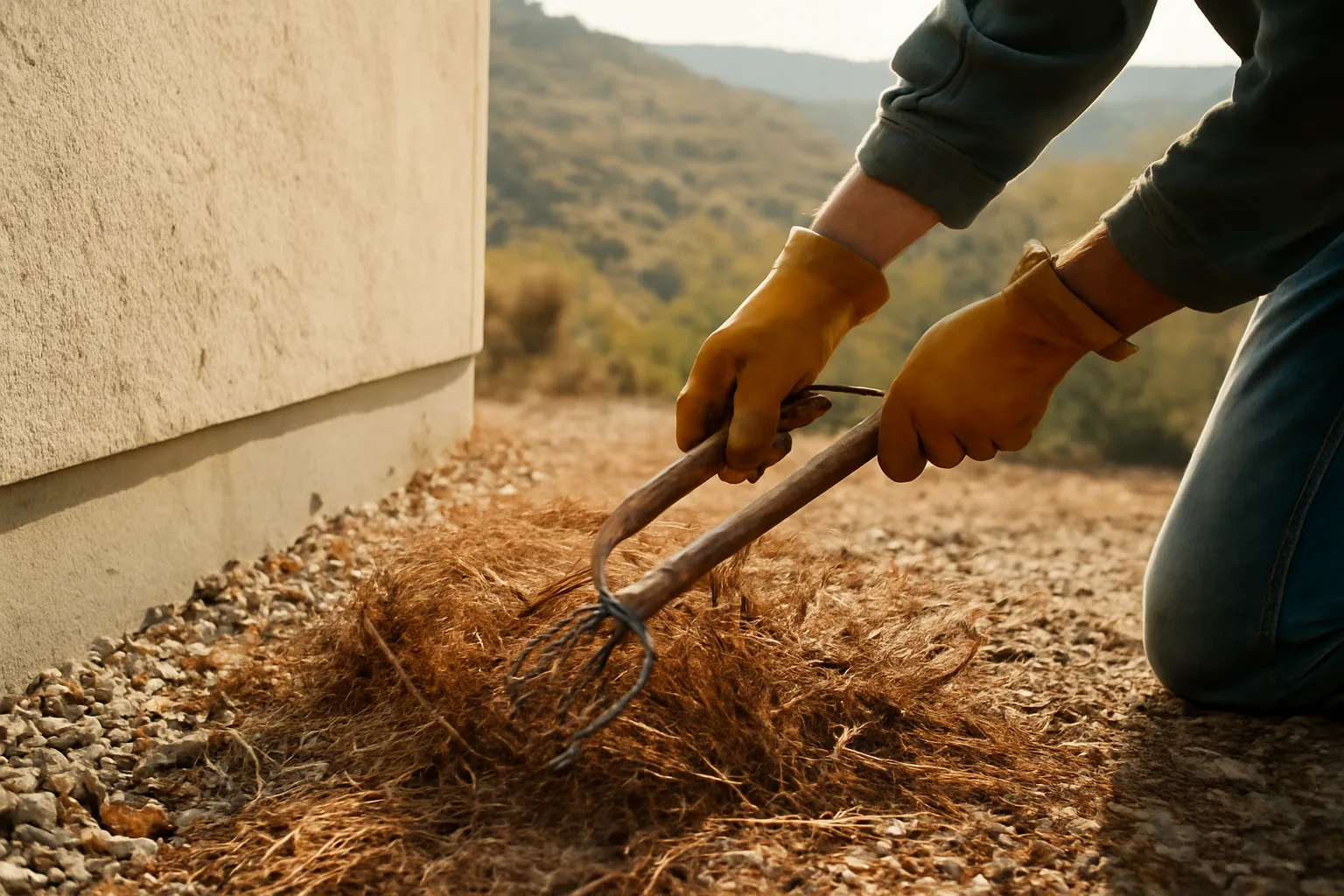
Wildfire mitigation services cover three overlapping jobs: clearing vegetation to create defensible space, hardening the structure itself (vents, roofing, siding, gutters), and documenting the work so you have proof for an insurer, a fire district inspector, or your own records. Some companies do all three. Many only do vegetation clearing, which is the cheapest and most common entry point. CAL FIRE describes defensible space as "the buffer you create by removing dead plants, grass and weeds... and other flammable vegetation" around a structure. That buffer is organized into zones: an ember-resistant zone right against the house (often called Zone 0), a lean-and-clean zone out to roughly 30 feet, and a reduced-fuel zone out to 100 feet or the property line, whichever comes first. A legitimate mitigation contractor will walk your property, measure distances from combustible structures, note species and spacing of vegetation, and hand you a written scope of work. If a company shows up, quotes a flat number without walking the lot, and won't give you anything in writing, that's a company to skip. You want photos, measurements, and a dated report, more than a mowed yard. For a full breakdown of zone-by-zone requirements, see defensible space clearing rules by zone.
When does the California defensible space law go into effect?
California's core defensible space law, Public Resources Code 4291, has been in effect for decades and currently requires 100 feet of defensible space (or to the property line) around structures in State Responsibility Areas and some Local Responsibility Areas designated as very high fire hazard severity zones [1]. This isn't a future rule. If you own a home in one of these zones, it applies to you now, every year, not as a one-time project. What's newer, and still being finalized, is the "Zone 0" ember-resistant zone within 5 feet of structures. The California Board of Forestry and Fire Protection has been working through the rulemaking process for Zone 0 regulations under SB 63 (2023) and earlier authorizing legislation (AB 3074, 2020) [2]. As of this writing, the regulation has not been formally adopted into the Building Standards Code; CAL FIRE's own materials describe Zone 0 concepts as guidance homeowners can adopt voluntarily ahead of the formal rule [2]. So when people ask what fire-safe home rules "take effect in 2026," the honest answer is: the state has been targeting a 2026 effective date for enforceable Zone 0 standards, but rulemaking timelines slip, and enforcement mechanisms (who inspects, who penalizes, in which jurisdictions) are still being worked out at the Board of Forestry level. Check the Board of Forestry's current rulemaking status page before assuming a hard deadline [2]. Don't wait for the ink to dry, though. Insurers are already asking about ember-resistant zones in underwriting questionnaires well ahead of any state mandate.
Why won't people follow the defensible space law in California?
Compliance rates are genuinely mixed, and there isn't one single national dataset that tracks it cleanly, so take any specific percentage with caution. The reasons people skip it are pretty consistent though, and they're not usually about ignorance. Cost is the biggest one. Removing mature trees, regrading slopes, or replacing wood fencing near a house can run into the thousands, and low and moderate income homeowners, especially retirees on fixed incomes, often can't absorb that in one season. Enforcement is the second issue. Many Local Responsibility Areas rely on self-certification or infrequent inspections, so there's no immediate consequence for skipping it, until a fire happens or an insurer sends a non-renewal letter. There's also a genuine information gap. Homeowners often don't know their parcel is in a State Responsibility Area or a Very High Fire Hazard Severity Zone until they get a letter. And some people love their landscaping and don't want to cut mature trees or remove the ivy they planted twenty years ago. That's an emotional cost, more than a financial one, and mitigation companies that ignore it lose customers. Finally, some homeowners just don't believe it will happen to them. That's the hardest one to fix with a pamphlet. It usually takes a neighbor's loss, or a fire district letter of their own, to move people from "I'll get to it" to "I'm calling a contractor this week."
How to prevent wildfires (what actually reduces ignition risk)
Wildfire prevention splits into two categories: preventing ignitions in the first place, and keeping an ignition from becoming a structure loss. Most homeowner-facing advice, including this article, focuses on the second, but ignition prevention matters too, especially since a huge share of wildfires are human-caused. On ignition prevention: don't tow with dragging chains, don't mow dry grass midday, don't park hot vehicles on dry grass, and follow local burn permit rules exactly. Ready.gov notes that most wildfires are started by people, through unattended campfires, debris burning, and equipment use. Simple behavior changes cut ignition risk more than any product you can buy. On keeping your home from becoming a casualty: this is where defensible space and home hardening do the real work. Embers, not flame fronts, cause most home losses in wildfires. That means vent screens (1/8 inch metal mesh, no larger), Class A fire-rated roofing, enclosed eaves, and dual-pane tempered windows matter more than most people expect. CAL FIRE's Ready for Wildfire program lists ember intrusion as a leading cause of home ignition, which is why Zone 0 focuses so heavily on the 5-foot zone rather than deep vegetation clearing alone. For a step-by-step on hardening priorities by budget, see defensible space clearing rules by zone and fire safe landscaping next to the house.
How to prepare for a wildfire (a real checklist, not a vibe)
Preparing for a wildfire means doing the physical mitigation work before fire season, and having a go-plan ready in case you need to evacuate with little notice. Ready.gov's wildfire preparedness guidance centers on three things: defensible space, an emergency supply kit, and a family communication plan. Here's a realistic prep sequence, roughly in order of urgency: 1. Clear the 5-foot zone around your house of anything combustible: mulch, dry leaves, stored firewood, patio cushions. 2. Clean gutters and roof valleys of pine needles and leaf litter; this is a top ignition point for embers. 3. Trim tree limbs so nothing overhangs the roof, and keep canopy spacing per CAL FIRE zone guidance. 4. Build or update a go-bag: medications, copies of insurance documents, chargers, a change of clothes, pet supplies. 5. Photograph your home's exterior, interior, and major belongings, dated, for insurance documentation before anything happens. 6. Sign up for your county's emergency alert system (most CA, CO, OR, and AZ counties have one; check your county sheriff or emergency management site). 7. Know two evacuation routes out of your neighborhood, more than one. That fifth step, documentation, is where a lot of homeowners get caught flat. If you're already dealing with a non-renewal letter or trying to get ahead of one, having dated photos and a written scope of completed mitigation work is the single most useful thing you can hand an insurer or agent. This is the exact gap the $99 Wildfire Insurance Survival Kit is built to close: a structured way to document defensible space work, home hardening features, and pre-loss inventory in one file, not a claims service and not a guarantee of coverage.
How to prevent forest fires (and how that differs from home protection)
Preventing forest fires broadly is a land-management and behavior issue: prescribed burns, fuel breaks, careful debris burning, and responsible recreation. Protecting your specific home from a forest fire that's already burning is a different, narrower problem, and it's the one homeowners actually control. The U.S. Forest Service and CAL FIRE both use prescribed fire and mechanical fuel reduction on public land to reduce the intensity of future wildfires, but that's not something an individual homeowner does. What you can control is reducing continuous fuel ("ladder fuels": grass to shrub to tree canopy) on your own parcel, so a fire moving through the area has less to burn once it reaches your property line. If you're on the wildland-urban interface, coordinate with neighbors. A single well-hardened house surrounded by unmanaged lots is still at serious risk from radiant heat and embers drifting from nearby vegetation. CAL FIRE's defensible space guidance explicitly recommends looking beyond your own fence line at neighboring fuel loads when you're in a WUI zone.
How to avoid forest fires as a homeowner in the WUI
Avoiding forest fire damage to your specific property comes down to fuel management, ignition-resistant construction, and staying informed on local fire weather. There's no way to make a WUI home fireproof, but you can shift the odds significantly with a handful of proven changes. The biggest bang for the buck, according to CAL FIRE's zone framework, is the first 5 feet around the structure. Gravel or hardscape instead of mulch, no combustible fencing attached directly to the house, and clearing anything stored against exterior walls. After that, roof and vent hardening matters more than tree removal for most homes, because embers land on and enter through roofs and vents far more often than flame fronts reach the structure directly. Stay on top of local fire weather watches (Red Flag Warnings from the National Weather Service) and know your county's evacuation zone number. Arizona, Colorado, and Oregon all have state-level wildfire risk mapping tools comparable to CAL FIRE's, worth checking even if you're outside California. [fill-in: check your local fire district's current Red Flag Warning criteria and evacuation zone map, since thresholds vary by county]
How to prepare for forest fires living near wildland
Preparation for a forest fire near your home layers two things: reducing the fuel and ignition risk on your property, and having your evacuation and documentation systems ready before smoke is visible from your porch. Do both. Neither one alone is enough. On the property side, walk your lot every spring and note where dead vegetation has accumulated over winter. Grass and brush that were manageable last October may be a fire hazard by June. Local weed abatement ordinances often require annual clearing by a set date (commonly May or June in California counties), and missing that date can mean a fine on top of the fire risk. On the household side, keep your go-bag current, not stale. Check expiration dates on medications, update the family contact list, and re-photograph your home each spring since renovations and new landscaping change what you'd need to document for an insurance claim later. [fill-in: confirm your fire district's specific weed abatement deadline and any local burn ban dates].
Is Santa Barbara safe from fire?
No area in the Santa Barbara region is fully safe from wildfire; large parts of Santa Barbara County are mapped by CAL FIRE as Very High Fire Hazard Severity Zones, particularly in the foothill and wildland-urban interface communities like Montecito, Mission Canyon, and the hillside neighborhoods above the city [3]. The 2017 Thomas Fire, which at the time was the largest wildfire in modern California history, burned into Santa Barbara County and was followed by the deadly Montecito debris flow in January 2018 [4]. That doesn't mean every parcel in Santa Barbara carries equal risk. Coastal, flatter areas away from chaparral-covered slopes carry meaningfully lower wildfire exposure than hillside lots backing onto open wildland. If you're evaluating a specific address, CAL FIRE's Fire Hazard Severity Zone viewer lets you check zone designation by parcel, and it's worth doing before you buy or before you assume your current policy risk hasn't changed [3]. Insurers have been non-renewing policies across these hillside zones at a noticeably higher rate than flatter coastal areas, which is part of why California created the FAIR Plan as an insurer of last resort. That's a separate topic worth its own read if you've already received a non-renewal notice.
How can we prevent forest fires? (community-level answers)
At a community level, forest fire prevention means coordinated fuel breaks, shared defensible space standards across a neighborhood, enforced weed abatement, and public education on ignition sources like debris burning and equipment sparks. Individual homeowner action matters, but wildfires don't respect property lines, so neighborhood-wide participation changes outcomes more than any single house. Firewise USA, a National Fire Protection Association program, organizes neighborhoods to do joint defensible space work and share the cost of chipper days and vegetation removal. Communities with active Firewise programs often see better coordination on fuel reduction than scattered individual efforts, though NFPA doesn't publish a single national statistic guaranteeing reduced loss rates, so treat that as a reasonable inference rather than a proven number. At the policy level, states have pushed prescribed burning and mechanical thinning on public land, and some counties have adopted mandatory defensible space inspection programs rather than relying on self-certification. If your HOA or neighborhood association doesn't have a coordinated mitigation effort yet, that's often the highest-leverage thing a motivated homeowner can start, more impactful than doing extra work on your own single lot.
How much do wildfire mitigation services cost?
| Basic Zone 0 cleanup (5 ft) | $300 - $1,200 | Removing mulch, combustible debris, storage items | |
|---|---|---|---|
| Full defensible space clearing (0-30 ft) | $1,500 - $4,000 | Brush removal, tree limbing, spacing | |
| Extended zone (30-100 ft) on wooded lot | $3,000 - $10,000+ | Depends heavily on tree density, slope, access | |
| Vent and gutter hardening | $500 - $3,000 | Ember-resistant vents, gutter guards | |
| Roof replacement to Class A rating | $8,000 - $25,000+ | Only if current roof isn't already rated | |
| Documentation/inventory service | $99 - $500 | Photo and report packages for insurer records | Get at least two written quotes, and ask each contractor to reference the specific zone distances (0-5 ft, 5-30 ft, 30-100 ft) they're pricing against, more than a flat "defensible space package." Contractors who can't tell you which zone they're clearing probably haven't read the current CAL FIRE guidance. If you're in Washington State, note that DNR runs a different program structure for defensible space contracts; see wildfire defensible space clearing contracts in Washington State for how that differs from California's model. |
Costs vary enormously by lot size, vegetation density, slope, and region, and no single number applies everywhere. Here's a rough range based on typical scopes of work for a residential parcel: | Service | Typical cost range | Notes |
What should a wildfire mitigation report include for insurers?
A useful mitigation report for insurance purposes includes dated, geotagged photos of all three defensible space zones, a written list of completed work with dates, and documentation of any hardening features (roof class, vent type, window glazing). Insurers and agents respond far better to a structured file than to a verbal description of "we cleared the yard." At minimum, include: the date work was completed, before-and-after photos of each zone, the contractor's name and license number if a contractor was used, and any receipts. If your fire district or county performed an inspection, include a copy of that report too, since some insurers weight third-party inspection reports more heavily than self-documentation. To be clear: none of this is a guarantee of reinstatement, a lower premium, or a successful claim outcome. A homeowner (or a documentation service, like the Wildfire Insurance Survival Kit, which is a one-time $99 tool for organizing this exact packet) prepares and sends their own file. Nobody negotiates with the insurer on your behalf, files claims for you, or promises coverage will be restored. That's public adjuster and licensed agent territory, and it's regulated separately in every state. What a good documentation packet does is give you a strong, organized starting point for that conversation, whether it's with your current carrier, a new one, or your state's FAIR Plan. If you've already had a fire event and are documenting damage rather than mitigation, that's a different process; see house fire documentation basics and documenting a fire at a house for insurance.
Frequently asked questions
When does the California defensible space law go into effect?
California's core defensible space law (PRC 4291) is already in effect and has been for years; it requires up to 100 feet of clearance around structures in high fire hazard zones. Newer Zone 0 ember-resistant zone rules are still in the rulemaking process at the Board of Forestry, with a 2026 target date that hasn't been finalized as of this writing.
Why won't people follow the defensible space law in California?
Cost is the biggest barrier, since clearing mature vegetation or upgrading a roof can run thousands of dollars. Weak enforcement in many Local Responsibility Areas, low awareness of zone designation, attachment to existing landscaping, and simple normalcy bias ('it won't happen to me') round out the main reasons compliance lags in practice.
How do I prevent wildfires from starting near my property?
Avoid dragging tow chains on dry roads, don't mow dry grass in the heat of the day, follow local burn permit rules exactly, and keep equipment like chainsaws and mowers away from dry vegetation. Ready.gov notes most wildfires are human-caused, so behavior changes reduce ignition risk more than any product purchase.
How do I prepare for a wildfire if I live in a high-risk zone?
Clear the 5-foot zone around your house, clean gutters of debris, build a go-bag with medications and documents, photograph your home for insurance records, and sign up for your county's emergency alert system. Ready.gov frames these as the core steps: defensible space, a supply kit, and a communication plan.
What fire-safe home rules take effect in 2026?
California has targeted 2026 for enforceable Zone 0 ember-resistant zone standards (the 5-foot area around structures), but the regulation is still moving through the Board of Forestry's rulemaking process and hasn't been formally adopted into the Building Standards Code as of this writing. Check the Board's rulemaking status page for the current timeline.
Is Santa Barbara safe from fire?
No, not fully. Large parts of Santa Barbara County, especially hillside and wildland-urban interface communities like Montecito, are mapped as Very High Fire Hazard Severity Zones by CAL FIRE. The 2017 Thomas Fire burned into the county and was followed by the deadly 2018 Montecito debris flow, showing the ongoing risk in foothill areas.
How much does defensible space clearing cost?
Basic 5-foot zone cleanup runs roughly $300 to $1,200. Full defensible space clearing from 0 to 30 feet typically costs $1,500 to $4,000. Extended clearing out to 100 feet on a heavily wooded lot can run $3,000 to $10,000 or more, depending on tree density and slope access.
Do I need a licensed contractor for defensible space work, or can I DIY it?
Most basic clearing (removing dead leaves, dry grass, stored debris) is fine to DIY. Tree removal, slope work, and anything involving power equipment on steep terrain is safer and often required to go through a licensed contractor, especially if the work needs to satisfy an insurer's or fire district's documentation request.
What's the difference between Zone 0, Zone 1, and Zone 2?
Zone 0 is the ember-resistant zone within 5 feet of a structure; Zone 1 (or the 'lean, clean, and green' zone) extends to roughly 30 feet; Zone 2 (reduced fuel zone) extends to 100 feet or the property line, whichever is closer. CAL FIRE's defensible space guidance defines all three.
Will clearing defensible space guarantee my insurance gets reinstated?
No. Completing defensible space and hardening work improves your risk profile and gives you documentation to show an insurer, but it doesn't guarantee reinstatement, a lower premium, or approval. Underwriting decisions are made by the carrier or the state FAIR Plan, not by contractors or documentation services.
How often do I need to redo defensible space clearing?
Annually, at minimum, and more often in fast-growing vegetation zones. Grass and brush that were compliant last fall can regrow to non-compliant levels by the following summer. Many counties set a specific weed abatement deadline (often May or June); check your local fire district for the exact date.
Can prescribed burns and forest management actually prevent wildfires?
Prescribed burns and mechanical thinning reduce fuel loads and can lower the intensity and spread rate of future wildfires on public land, which is why the U.S. Forest Service and CAL FIRE both use them. They reduce risk rather than eliminate it, and they don't replace individual home hardening and defensible space work.
Sources
- California Public Resources Code Section 4291: 100-foot defensible space requirement around structures in SRA and designated LRA zones
- California Board of Forestry and Fire Protection, Zone 0 Rulemaking: Status of Zone 0 ember-resistant zone regulation development under SB 63 and AB 3074
- CAL FIRE, Fire Hazard Severity Zone Viewer: Mapping of Very High Fire Hazard Severity Zones including Santa Barbara County hillside areas
- National Fire Protection Association, Firewise USA: Firewise USA program structure for community-level defensible space coordination
- California State Board of Forestry and Fire Protection, SB 63 (2023): Legislative authorization for Zone 0 ember-resistant zone regulation