Last updated 2026-07-25
TL;DR
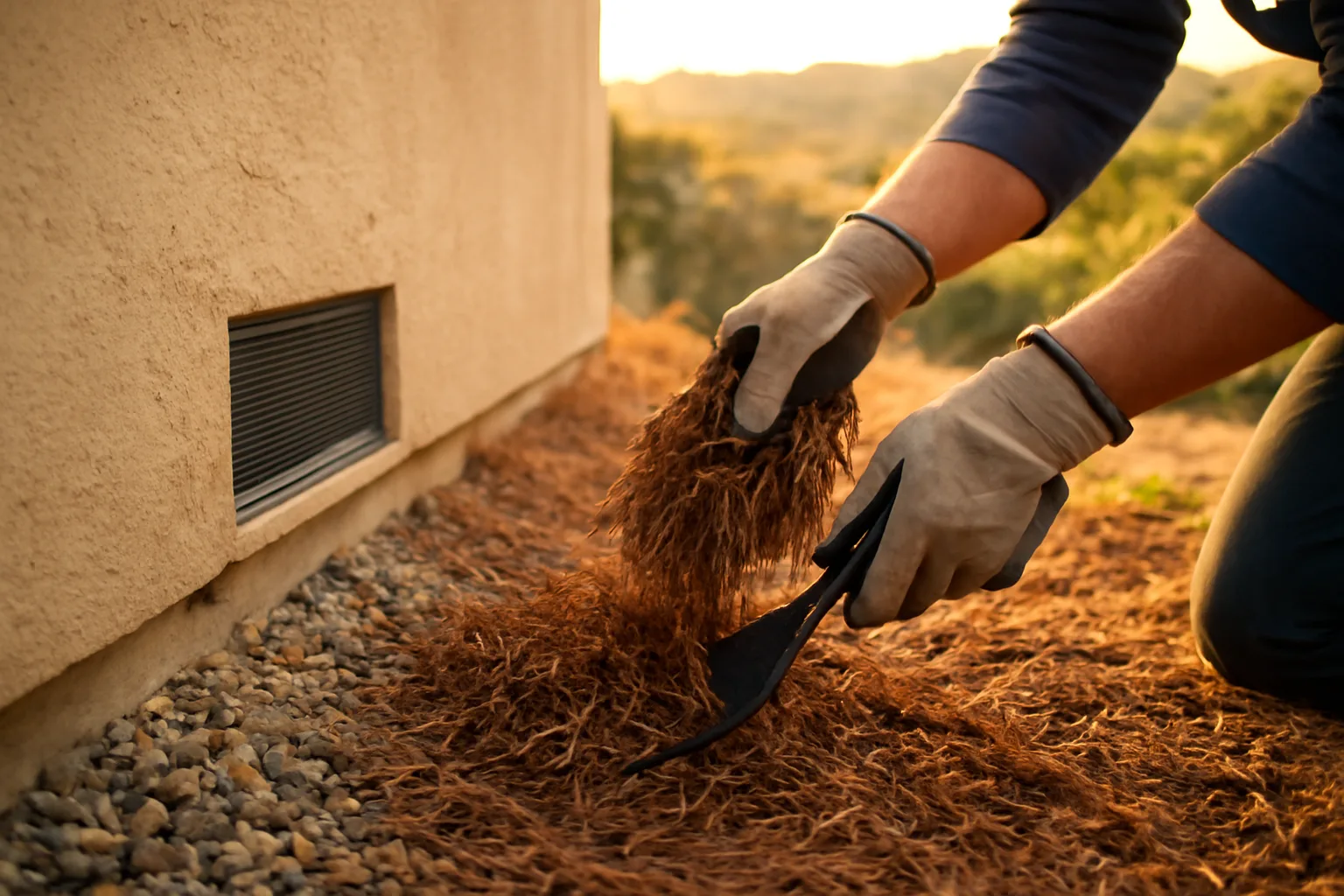
Preventing a house fire in wildfire country means clearing the 5 feet closest to your walls (Zone 0), hardening vents and roofs against embers, keeping gutters and roofs clear, and building an evacuation plan before smoke shows up. California's Zone 0 ember-resistant zone rule (SB 63/AB 3074) still has no enforced start date after years of delay; CAL FIRE and the Board of Forestry are targeting proposed regulations for 2026, with local adoption to follow.
How do you actually prevent a house fire in a wildfire zone?
Most homes that burn in wildfires don't go up because a wall of flame rolled through. They catch from embers, tiny burning bits of bark and debris that can travel over a mile ahead of a fire front and land in gutters, vents, and mulch beds right against the house. CAL FIRE's research arm has said for years that ember exposure, not direct flame contact, is the primary reason homes ignite during wildfires. So prevention isn't one thing. It's a stack of small, boring fixes: clean gutters, metal mesh over vents, gravel instead of bark mulch next to the foundation, a roof rated for fire, and space between your house and anything that burns. Insurers and fire departments increasingly grade homes on exactly this stack, because it's what predicts survival. The fastest way to think about it: work outward from your walls in rings. CAL FIRE's defensible space framework breaks your property into Zone 0 (0-5 feet from structures), Zone 1 (5-30 feet), and Zone 2 (30-100 feet). Each ring has a different job. Zone 0 stops embers from finding fuel right at your siding. Zone 1 breaks up continuous fuel so a ground fire can't ladder into your eaves. Zone 2 slows the fire down before it gets that far. If you want a structured way to document all of this for an insurer or adjuster later, that's a separate project from the physical work, but it matters just as much. More on that below.
When does the California defensible space law (Zone 0) go into effect?
Short answer: it hasn't taken effect yet, and that's a sore point for a lot of homeowners who did the work early expecting a deadline that kept moving. California passed AB 3074 in 2020, which created a new "ember-resistant zone" (informally Zone 0) for the 0-5 foot area around structures in State Responsibility Areas and certain Wildland-Urban Interface areas, and required the Board of Forestry and Fire Protection to adopt implementing regulations [1]. The law itself didn't set a fixed statewide compliance date; it directed the Board to write the actual rules, and that process has taken years longer than expected. SB 63, signed in 2025, pushed the timeline further and expanded which areas the rule covers, extending Zone 0 requirements to more Wildland-Urban Interface zones beyond State Responsibility Areas [2]. As of this writing, CAL FIRE and the Board of Forestry are still working through the regulatory process, with proposed regulations expected to move in 2026 and local enforcement following after that, likely with a phase-in period once rules are final [1] [2]. If someone tells you Zone 0 is already mandatory and enforced statewide, that's not accurate yet. Check your specific county or fire district, because some local jurisdictions have adopted their own Zone 0 style ordinances ahead of the state rule. Our guided fill-in for your own address: [enter your county/fire district here] currently requires: [confirm with local fire marshal or building department]. Because this varies block to block in the WUI, don't rely on a generic answer, call your local fire safe council or building department directly. For background on how defensible space zoning works in general, see defensible.
What fire-safe home rules take effect in 2026?
2026 is shaping up to be the year several California wildfire-hardening rules move from "proposed" to "real," though exact effective dates depend on when the Board of Forestry finalizes text. The Zone 0 ember-resistant zone regulation under AB 3074 and SB 63 is the big one. CAL FIRE's public materials describe the intent as requiring homeowners in covered areas to remove combustible mulch, dead vegetation, stored fuel, and other ignitable material within 5 feet of structures, and to consider hardscape (gravel, pavers, concrete) in that zone instead [1]. The Board's rulemaking timeline has targeted formal proposed regulations in 2026, but as of publication no statewide enforcement date has been locked in, so don't assume a specific month yet, verify with CAL FIRE's Zone 0 rulemaking page before you rely on it [1]. Separately, some counties and cities have been adopting their own vent-screening, roofing, and defensible space ordinances ahead of the state timeline, often tied to Chapter 7A of the California Building Code for new construction and remodels in high fire severity zones [3]. If you're in one of those jurisdictions, your 2026 deadline might already be local law rather than pending state law. Local fire-safe rule fill-in: [your city/county] requires defensible space inspection by [date], vent mesh spec of [size], and roofing class of [rating]. Confirm with your local fire marshal's office, because these numbers differ by district and this article can't guess yours.
Why won't people follow the defensible space law in California?
Compliance rates on defensible space inspections have historically been mixed, and it's not because homeowners don't care about their houses burning down. The reasons are more practical than that. Cost is a real barrier. Clearing brush, removing trees, and hardening a home can run from a few hundred dollars in DIY labor to tens of thousands for tree removal, roofing, and vent retrofits on an older house. For a retired homeowner on a fixed income, a $15,000 recommendation from an inspector isn't a to-do item, it's a wall. Confusion is another factor. Zone boundaries, what counts as "defensible," and which rules apply (state PRC 4291 defensible space requirements versus local ordinances versus insurer-specific standards) genuinely differ by jurisdiction, and homeowners get conflicting information from different sources [4]. California's Public Resources Code Section 4291 has required 100 feet of defensible space clearance around structures in State Responsibility Areas since it was amended in 2005, but enforcement has historically been inconsistent, handled mostly through local CAL FIRE unit inspections with warnings before citations [4]. There's also a trust problem. Some homeowners have done the clearing, hardened vents, replaced roofing, and still gotten a non-renewal notice anyway, because insurers use their own risk models that don't always map cleanly to the state's compliance categories. When the rules don't obviously protect your coverage, motivation to spend money on them drops. That disconnect is a big part of why the FAIR Plan and insurer non-renewals have become such a flashpoint alongside the defensible space rules themselves. And some of it is plain inertia: a property changed hands, a previous owner never cleared it, and the new owner didn't know there was a legal minimum at all until an inspection letter showed up.
How to prevent house fires: the room-by-room and property checklist
| 1 | Screen all vents with 1/8-inch corrosion-resistant metal mesh | $50-$300 DIY | Embers enter attics and crawlspaces through unscreened vents | |
|---|---|---|---|---|
| 2 | Clear Zone 0 (0-5 ft): no mulch, no stored wood, no dry plants against walls | $0-$500 | Embers need fuel right at the wall to ignite siding | |
| 3 | Clean gutters and roof of leaves/needles before fire season | $0-$200 | Dry debris in gutters is a common first ignition point | |
| 4 | Class A fire-rated roofing (if replacing) | $8,000-$25,000+ | Roofs are a major ember-catch surface on older homes [3] | |
| 5 | Enclose eaves, box in open rafter tails | $500-$3,000 | Open eaves let embers into the attic directly | |
| 6 | Zone 1 (5-30 ft): space out shrubs, remove ladder fuels under trees | $0-$2,000 | Stops ground fire from climbing into tree canopy and eaves | |
| 7 | Ember-resistant dual-pane or tempered windows | $2,000-$8,000/window | Radiant heat can shatter single-pane glass, letting embers in | Inside the house, basic fire prevention still applies regardless of wildfire risk: test smoke alarms monthly, replace batteries twice a year, keep a fire extinguisher rated for kitchen fires within reach, and never leave cooking unattended. The National Fire Protection Association and Ready.gov both note that having working smoke alarms roughly halves your risk of dying in a home fire compared to homes with no alarms or non-functioning ones [5]. For landscaping specifics, including which plants to avoid near the foundation, see fire safe landscaping california next to house. |
Here's the practical stack, roughly in order of ember-stopping value per dollar. | Priority | Action | Rough cost | Why it matters |
How to prepare for a wildfire before it happens
Preparation splits into three buckets: the house, the documents, and the people. For the house, do the defensible space and hardening work above well before fire season, not when a red flag warning is already up. Ready.gov recommends creating and maintaining defensible space, using fire-resistant building materials, and keeping the immediate area around the home clear of flammable vegetation as core wildfire preparedness steps. For documents, this is the part people skip until it's too late. Photograph and video every room, every closet, the garage, and the exterior, with close-ups of higher-value items and serial numbers where visible. Store this off-site or in cloud storage, because a phone that burns with the house doesn't help you file a claim. Keep copies of your insurance policy declarations page, an inventory of major systems (roof age, HVAC, water heater), and any defensible space or inspection records you have. This is exactly the gap our $99 one-time Wildfire Insurance Survival Kit is built to close: a structured way to document your home's condition and mitigation work before a non-renewal letter or a fire forces the issue, so you have your own organized record to send to your insurer or adjuster. We don't negotiate with insurers, file claims, or promise coverage or reinstatement. You prepare the documentation; you send it. For people, build a go-bag with medications, copies of ID, chargers, and a change of clothes, and agree on two exit routes and a meeting point with your household in case cell service is down. Ready.gov's wildfire preparedness guidance recommends practicing your evacuation plan at least twice a year. If you've watched a neighbor lose coverage or get a non-renewal letter yourself, read house fire and fire at a house for what typically happens next and how documentation timing affects your options.
How to prevent wildfires from starting in the first place
Most wildfires aren't sparked by lightning, they're started by people, and that's actually good news because it means a lot of them are preventable with basic caution. Roughly 85 percent of wildfires in the U.S. are human-caused, according to the National Interagency Fire Center, from causes like unattended campfires, downed power lines, equipment sparks, and debris burning [6]. Simple habits cut this risk a lot: fully drown and stir campfires until they're cold to the touch (more than doused once), never park a hot vehicle on dry grass since catalytic converters can ignite it, avoid mowing or using power equipment during red flag warnings, and check local burn permit rules before any debris burning. CAL FIRE's "Fire Prevention" guidance specifically flags equipment use, debris burning, and vehicle fires as leading preventable ignition sources in California [7]. Defer any outdoor grinding, welding, or chainsaw work to early morning when humidity is higher and wind is lower, and keep a shovel and water source nearby whenever you're doing anything that throws sparks. Smokey Bear's long-running message still holds: only you can prevent wildfires for the human-caused share of ignitions, even though nothing can fully prevent fires sparked by lightning or downed lines in dry, windy conditions.
How do you avoid or prevent forest fires as an individual?
If you camp, hike, or live near forested land, the individual actions that matter most are: build fires only in established rings or pits, keep them small, never leave them unattended even for a few minutes, and carry enough water to fully extinguish a fire (CAL FIRE recommends drowning, stirring, and feeling for heat before leaving any campfire) [7]. Don't discharge firearms or set off fireworks in dry vegetation; both are common ignition sources in wildland areas and are restricted or banned outright in many national forests during fire season. Check current fire restrictions for the specific forest or BLM land you're visiting, since these change week to week based on conditions. At home, if you live adjacent to forest or wildland, chain saws, mowers, and off-road vehicles can all throw sparks onto dry grass; avoid using them during the hottest, driest, windiest part of the day. Report any smoke or fire sighting immediately rather than assuming someone else already called it in; early detection is one of the few variables that reliably shrinks final fire size.
How do you prepare for forest fires if you live near wildland?
Preparing for a forest fire near your property overlaps heavily with wildfire prep generally, but proximity to unmanaged forest adds a few specifics. First, know your fuel load beyond your own property line. Talk to your local fire district or a registered professional forester about whether nearby forest land has had recent fuel reduction work, prescribed burns, or thinning; unmanaged, overstocked forest right behind a property is a materially higher risk than land that's been actively managed. Second, widen your defensible space thinking past the standard 100 feet if terrain slopes upward toward your home, since fire moves faster uphill and radiant heat exposure increases on slopes. CAL FIRE's defensible space guidance notes that steep slopes can require expanded clearance beyond the standard zones for that reason. Third, get on your county's emergency alert system (many California counties use systems like Genasys or Everbridge under different local names) and know your evacuation zone number before fire season starts, not while you're watching smoke from your porch.
Is Santa Barbara safe from fire?
No coastal California city is "safe" from wildfire risk, and Santa Barbara County has a well-documented history that argues against complacency. The Thomas Fire in December 2017 burned over 281,000 acres across Ventura and Santa Barbara counties and was, at the time, the largest wildfire in modern California history, followed weeks later by the Montecito debris flow that killed 23 people when rain hit the burn scar [8]. Santa Barbara's foothill and Montecito-adjacent neighborhoods sit directly against chaparral-covered hills with a documented history of fast-moving, wind-driven fires (the Jesusita Fire in 2009, the Tea Fire in 2008, the Painted Cave Fire in 1990). CAL FIRE's Fire Hazard Severity Zone maps classify large portions of the Santa Barbara foothills as "Very High" hazard severity zone, the state's top risk category [9]. So the honest answer is: parts of Santa Barbara city proper and the flatter areas near the coast carry lower wildfire risk than the hillside and Montecito-adjacent zones, but no address in that county should assume it's exempt. If you own property there, check your specific parcel against CAL FIRE's Fire Hazard Severity Zone viewer rather than relying on the city's general reputation.
How can we prevent forest fires as a community, more than individually?
Individual caution matters, but the biggest reductions in forest fire risk at scale come from coordinated fuel management: prescribed burns, mechanical thinning, and fuel breaks done by agencies and, increasingly, by neighborhood-level fire safe councils. California's Vegetation Treatment Program, run through CAL FIRE, funds and permits landscape-scale fuel reduction projects including prescribed fire and mechanical thinning on both public and private land [10]. If your community sits in a high hazard zone, ask your local fire safe council whether a fuel break or shaded fuel break project exists near your neighborhood, and whether HOA or community-level defensible space compliance is being tracked collectively, since one non-compliant lot can undermine an entire block's clearance work. Reporting downed power lines immediately, supporting utility undergrounding or vegetation management programs in your area, and showing up to local fire safe council meetings sounds unglamorous, but these are the mechanisms that actually move community-wide risk instead of just your own parcel's risk.
What does insurer-ready documentation look like once you've done the prevention work?
Doing the physical mitigation work is half the job; documenting it in a way an insurer or adjuster can actually use is the other half, and it's the part most homeowners improvise badly under stress. At minimum, keep dated photos of your cleared Zone 0, your vent screening, your roof condition, and any professional invoices for tree removal, brush clearance, or roofing work. If a local fire department or CAL FIRE unit did a defensible space inspection, keep the inspection report or compliance letter, since some insurers now ask for it directly when underwriting or renewing wildfire-zone policies. We built the $99 one-time Wildfire Insurance Survival Kit specifically for this gap: a structured template to organize your property photos, mitigation invoices, and inspection records into one document set before you need it, whether that's for a renewal application, a non-renewal appeal, or a claim after a loss. To be clear about scope: this is a documentation tool, not a legal or insurance service. We do not negotiate with insurers, file claims on your behalf, or promise any specific coverage, discount, or reinstatement outcome. You prepare the file; you decide what to send and to whom. If you're already past a non-renewal letter, house fire and fire at a house cover what typically happens procedurally after that point.
Frequently asked questions
When does the California defensible space law (Zone 0) actually go into effect?
There's no locked statewide enforcement date yet. AB 3074 (2020) created the Zone 0 ember-resistant zone concept and SB 63 (2025) expanded its scope, but the Board of Forestry and Fire Protection is still finalizing implementing regulations, with proposed rules targeted for 2026. Check CAL FIRE's Zone 0 rulemaking page and your local fire district before assuming a specific deadline applies to you.
Why won't people follow the defensible space law in California?
Cost, confusion, and trust. Clearing brush and hardening a home can cost thousands of dollars, the rules differ by jurisdiction and overlap with local ordinances and insurer standards, and some homeowners who did comply still got non-renewed anyway, which undercuts the incentive to spend more money on compliance.
How do you prevent wildfires from starting?
About 85% of U.S. wildfires are human-caused, per the National Interagency Fire Center. Fully drown and stir campfires, avoid parking on dry grass, skip yard equipment use during red flag warnings, follow local burn permit rules, and report downed power lines immediately. These habits address the majority of preventable ignition sources.
How do I prepare for a wildfire if I live in a fire-prone area?
Build and maintain defensible space around your home, use fire-resistant materials where you can afford to, photograph and cloud-store an inventory of your home's contents and condition, pack a go-bag with medications and documents, and agree on two evacuation routes with your household, per Ready.gov's wildfire guidance.
How do you prevent forest fires while camping or hiking?
Use established fire rings only, keep fires small, never leave them unattended, and drown, stir, and feel for heat before leaving. Follow current fire restrictions for the specific forest, avoid fireworks or shooting in dry vegetation, and report any unattended smoke or fire immediately rather than assuming it's been reported.
How do you avoid forest fires near your property?
Reduce fuel load beyond your own fence line by talking to your local fire district about nearby forest management, widen defensible space if your property sits on an upward slope, and enroll in your county's emergency alert system before fire season so you know your evacuation zone in advance.
What fire-safe home rules take effect in 2026 in California?
The Zone 0 ember-resistant zone regulation (5 feet around structures) under AB 3074/SB 63 is targeting proposed regulations in 2026, though no statewide enforcement date is locked in yet. Some counties already enforce local vent-screening, roofing, and defensible space ordinances tied to Building Code Chapter 7A independent of the state timeline.
Is Santa Barbara safe from wildfire?
No, especially the foothill and Montecito-adjacent neighborhoods, which CAL FIRE maps as Very High Fire Hazard Severity Zone. The 2017 Thomas Fire burned over 281,000 acres in the area, followed by a deadly debris flow. Flatter, coastal parts of the city carry lower relative risk, but check your specific parcel's hazard zone rather than assuming safety.
What is the single most effective thing I can do to prevent my house from catching fire?
Clear combustible material from the 5 feet closest to your walls (Zone 0) and screen all attic and foundation vents with 1/8-inch metal mesh. Embers, not direct flame, ignite most homes in wildfires, and these two fixes address the most common ember entry and ignition points for a few hundred dollars.
How much does defensible space and home hardening typically cost?
It ranges widely: basic vent screening and Zone 0 clearing can run $100-$800 in DIY labor and materials, while a Class A roof replacement can run $8,000-$25,000 or more. Tree removal and major brush clearance on larger lots often costs several thousand dollars depending on lot size and terrain.
Does California require 100 feet of defensible space?
Yes, Public Resources Code Section 4291 has required 100 feet of defensible space clearance around structures in State Responsibility Areas since a 2005 amendment, with two distinct zones (0-30 ft and 30-100 ft) that have different clearance standards. Enforcement is handled through local CAL FIRE unit inspections.
What percentage of wildfires are caused by humans versus lightning?
Roughly 85% of wildfires in the United States are human-caused, according to the National Interagency Fire Center, from sources like unattended campfires, equipment sparks, debris burning, and downed power lines. The remainder are primarily lightning-caused, which tends to produce larger fires in remote terrain.
How do working smoke alarms affect house fire survival?
Homes with no smoke alarms or non-functioning ones have roughly double the death rate in reported home fires compared to homes with working alarms, according to national fire safety data referenced by the National Fire Protection Association. Test alarms monthly and replace batteries at least twice a year.
Sources
- California Legislative Information, AB 3074 (2020) chaptered text: AB 3074 created the ember-resistant zone (Zone 0) requirement and directed the Board of Forestry to adopt implementing regulations
- California Legislative Information, SB 63 (2025) chaptered text: SB 63 expanded Zone 0 requirements to additional Wildland-Urban Interface areas and adjusted the implementation timeline
- California Building Standards Commission, California Building Code Chapter 7A (Materials and Construction Methods for Exterior Wildfire Exposure): Local roofing, vent, and construction standards for high fire severity zones in new construction and remodels
- California Public Resources Code Section 4291: 100 feet of defensible space clearance has been required around structures in State Responsibility Areas since the 2005 amendment
- National Fire Protection Association, Smoke Alarms in U.S. Home Fires report: Homes without working smoke alarms have roughly double the death rate in home fires compared to homes with working alarms
- National Interagency Fire Center, statistics page: Roughly 85% of wildfires in the U.S. are human-caused
- CAL FIRE, Fire Prevention page: Equipment use, debris burning, and vehicle fires are leading preventable wildfire ignition sources; campfire drowning/stirring guidance
- CAL FIRE, Thomas Fire incident archive: The Thomas Fire burned over 281,000 acres across Ventura and Santa Barbara counties in December 2017
- CAL FIRE, Fire Hazard Severity Zone Viewer / maps: Portions of the Santa Barbara foothills are classified as Very High Fire Hazard Severity Zone
- CAL FIRE, Vegetation Treatment Program (VTP) page: CAL FIRE's Vegetation Treatment Program funds landscape-scale fuel reduction including prescribed burns and mechanical thinning