Last updated 2026-07-25
TL;DR
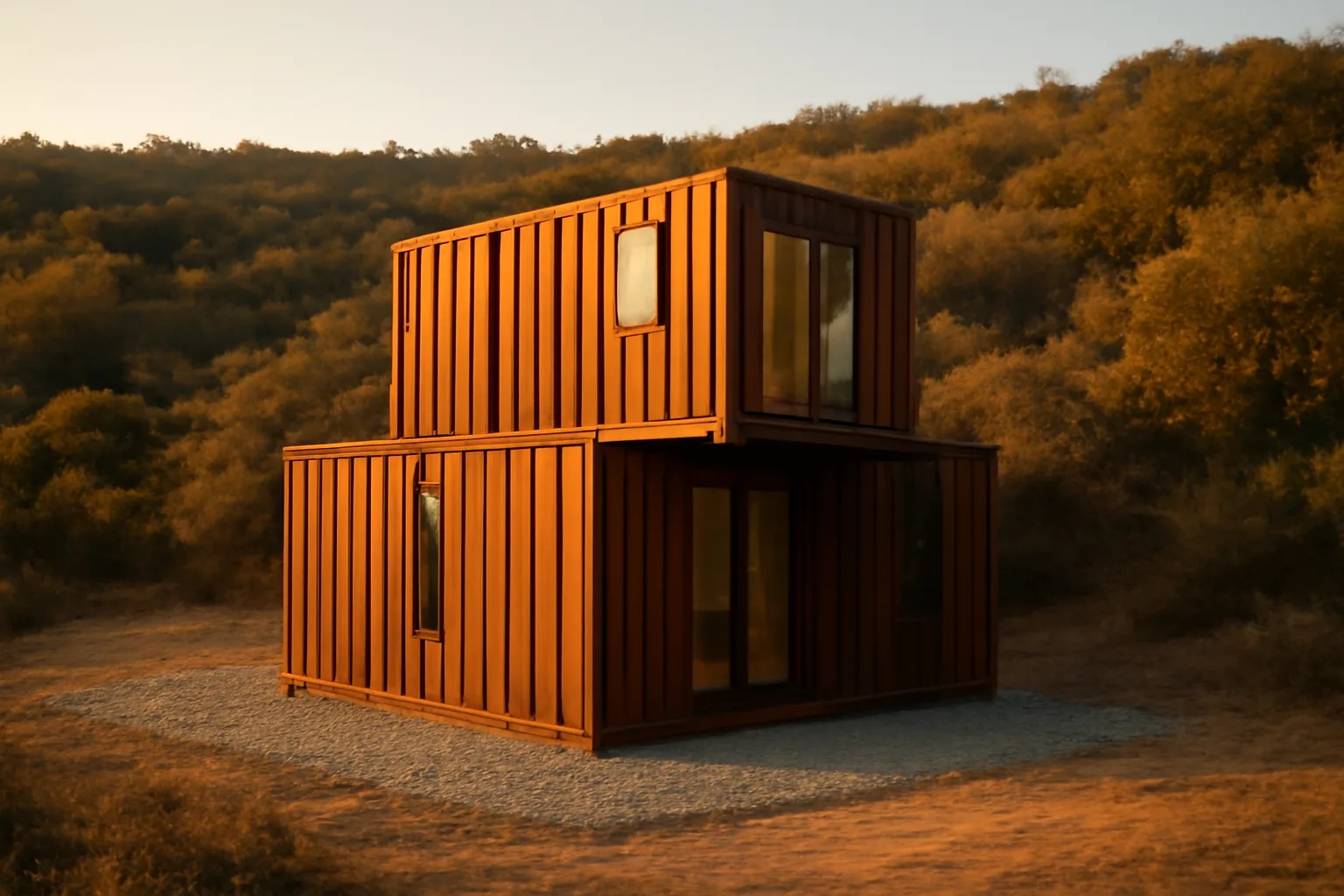
Steel container homes resist ignition from embers and direct flame contact better than wood-framed houses because steel doesn't combust. But steel conducts heat fast, warps above roughly 1,000-1,200°F, and the windows, doors, insulation, and roof are the same vulnerable materials as any other house. A container shell helps; it isn't a wildfire solution by itself.
Are container homes fire resistant, or just made of a material that doesn't burn?
Steel doesn't burn, and that's the whole reason container homes get a fire-resistant reputation. Corten steel, the weathering steel used in most shipping containers, has no combustible content to feed a flame. In a wildfire, that matters most during the ember stage, which is how most homes actually catch fire. Embers can travel over a mile ahead of a fire front and lodge in vents, gutters, and combustible siding, according to CAL FIRE's wildfire preparedness guidance. A steel wall gives embers nothing to ignite directly. But "doesn't burn" isn't the same as "fire resistant" in the way the term gets used for building materials and assemblies. Fire resistance in code language usually means a rated assembly, like a wall system tested to withstand fire exposure for a specific duration (one-hour, two-hour rated walls, for example). A bare container isn't a rated assembly. It's a steel box that happens to not combust, sitting next to windows, doors, roofing, and interior finishes that absolutely can. Steel also conducts heat extremely well, which is a problem people don't think about until it bites them. During sustained direct flame contact, like a house fire or a wildfire that reaches structure-to-structure ignition, steel walls heat up and transfer that heat to whatever's inside or attached. Structural steel starts losing significant strength around 1,000°F and can reach critical failure temperatures near 1,100-1,300°F depending on the alloy and load, per general fire engineering references on structural steel behavior. Corten container steel isn't immune to that physics. If you want the fuller picture on how ordinary house fire dynamics play out against different building materials, that's worth reading before you assume steel solves the problem.
What parts of a container home actually catch fire?
The weak points are almost always the same ones as any other house: windows, vents, doors, roof eaves, and anything wood or vinyl attached to the exterior. A steel shell doesn't protect you if the heat radiating off a wildfire front shatters a single-pane window and embers get inside. Most container home builds cut large window and door openings into the steel for light and access, which is necessary for a livable house but removes a meaningful chunk of the fire-resistant advantage. Dual-pane, tempered glass windows perform far better under radiant heat than standard single-pane glass, and that's true whether your walls are steel or wood. Roofs matter enormously too. Many container homes still use a conventional roof assembly (wood decking, underlayment, shingles or metal panels) sitting on top of the steel container frame. If that roof isn't Class A fire-rated, the container walls underneath are almost irrelevant, because the fire gets in from above. CAL FIRE's home hardening guidance specifically flags roofs, vents, and eaves as the top three ignition points in wildfire-urban interface fires. Insulation is another overlooked spot. Spray foam and rigid foam insulation, common choices for container retrofits because of the tight thermal envelope they create, are petroleum-based and combustible unless treated with fire retardants and covered by a fire-rated interior finish. A steel exterior with foam insulation directly behind it is not a fire-resistant wall assembly just because the outer layer is metal.
Do container homes meet wildfire building codes in California, Colorado, Oregon, or Arizona?
Container homes can meet wildfire-zone building codes, but only if the finished assembly, more than the container shell, is built and tested to the applicable standard. California's Chapter 7A building code (part of the California Building Code, Title 24) governs construction in Wildland-Urban Interface Fire Areas and requires specific ignition-resistant materials for exterior walls, roofs, vents, windows, decking, and eaves [1]. A container's steel skin can satisfy the exterior wall material requirement in some configurations, but the vents, windows, doors, and roof still need to independently meet Chapter 7A standards. This is guided by your local fire district's specific requirements, so check with your county building department or local fire marshal before assuming a container build is pre-approved. Requirements differ by jurisdiction: [insert local fire district contact and permit requirements here]. Oregon and Colorado have their own wildfire-hazard building overlays tied to state fire marshal rules and county wildfire risk maps, and Arizona counties with high wildfire risk (parts of Coconino, Yavapai, Gila) often defer to International Wildland-Urban Interface Code (IWUIC) provisions adopted locally. None of these codes certify "container home" as a category. They certify assemblies and components. That means the same container shell could pass in one county and fail in another depending on what windows, vents, and roof get attached to it, and depending on local amendments to the base code.
How do container homes compare to wood-framed and stucco homes in wildfire risk?
| Feature | Steel container home | Wood-framed (vinyl/wood siding) | Stucco/masonry | |
|---|---|---|---|---|
| Wall combustibility | Non-combustible steel skin | Combustible siding, ignites from embers | Non-combustible surface, but assembly can have combustible sheathing behind it | |
| Ember resistance (walls) | High | Low to moderate | High | |
| Heat conduction risk | High (steel transfers heat fast) | Low (wood chars, insulates itself somewhat) | Moderate | |
| Roof vulnerability | Same as any home; depends on roofing material | Same as any home | Same as any home | |
| Window/vent vulnerability | Same as any home | Same as any home | Same as any home | |
| Code compliance path | Must retrofit to meet Chapter 7A/IWUIC component rules | Established Chapter 7A compliant assemblies widely available | Established Chapter 7A compliant assemblies widely available | The honest takeaway: a container home's walls beat wood siding on ember resistance, but lose to nothing meaningfully on roof, vent, and window vulnerability, because those parts aren't inherently different just because the wall material changed. Stucco and masonry homes, built to Chapter 7A specs, arguably have a more mature and better-tested track record in real wildfire events than container conversions, which are still a newer building type with less fire-performance data specific to wildfire exposure. Nobody has published a rigorous wildfire-specific burn study comparing container home assemblies to conventional Chapter 7A assemblies. The closest available data is general structural steel fire behavior research and CAL FIRE's post-fire structure damage assessments, which track ignition point (ember, radiant heat, direct flame) but don't break results out by wall material category like "container vs. stick-built." If you're picking a home type for a high-risk zone, treat the steel-shell advantage as real but modest, not decisive. |
Will a container home survive a direct wildfire hit?
No home reliably survives sustained direct flame contact from a wildfire front, and that includes container homes. What determines survival is almost always defensible space and ember management, not wall material. CAL FIRE's defensible space standard requires 100 feet of vegetation management around structures in State Responsibility Areas, split into an ember-resistant zone (0-5 feet from the structure) and a lean, clean, and green zone extending out to 100 feet [2]. A container home sitting in unmanaged brush with a wood deck attached will burn just like any other poorly defended house, steel walls or not. The realistic best case for a container home in a wildfire is that the walls themselves don't ignite or fuel the fire, buying time and reducing total loss if the fire passes through relatively fast (which is common in wind-driven wildfire events, where the flame front moves through in minutes). The realistic worst case is a slow-moving fire or ember storm that finds every unprotected window, vent, and roof edge, heats the steel to structural failure temperatures, and destroys the home anyway, just without the walls contributing fuel to the fire. For the vegetation and clearance side of this, fire safe landscaping next to the house covers what actually needs to happen in that 0-5 foot zone, and it applies identically whether you live in a container home or a conventional one.
When does the California defensible space law go into effect?
California's defensible space requirement under Public Resources Code 4291 has been in effect for years and currently requires 100 feet of defensible space clearance around structures in State Responsibility Areas [2]. What's changing is the more detailed "ember-resistant zone" (Zone 0) regulation for the 0-5 foot area immediately around structures. SB 63, signed in 2025, extended the state's defensible space and home hardening requirements to a broader set of high fire-risk local jurisdictions beyond just State Responsibility Areas, and set a framework for Zone 0 ember-resistant zone regulations to be developed by the Board of Forestry and Fire Protection [3]. As of this writing, the Board has not finalized enforceable statewide Zone 0 regulations; check fire.ca.gov directly for the current adoption status and effective date, since this has been delayed multiple times and the timeline keeps shifting [4]. This is exactly the kind of rule that's guided by your local fire district's timeline as much as the state's, so confirm with your county fire authority: [insert local Zone 0 enforcement date and inspection schedule here].
What fire-safe home rules take effect in 2026?
Several California wildfire-related building and defensible space provisions are tied to 2025-2026 timelines, but specifics are still being finalized by CAL FIRE and the Board of Forestry and Fire Protection, so treat any single "2026 deadline" claim with caution unless it comes straight from fire.ca.gov. What's confirmed: SB 63 (2025) expanded which local governments must adopt defensible space ordinances consistent with state standards, phasing in over the years following signing [3]. The Zone 0 ember-resistant zone standard, which would require noncombustible materials (gravel, pavers, bare soil) within 5 feet of structures instead of bark mulch, wood fencing, or dense shrubs, has been in development since AB 3074 (2020) directed the Board of Forestry to create it, but as of 2025 it still hadn't been formally adopted as enforceable regulation statewide [4]. Insurance timelines matter here too. California's FAIR Plan and the state's evolving Safer from Wildfires regulation (adopted by the Department of Insurance) let insurers give discounts for wildfire mitigation actions like defensible space compliance and home hardening, and insurers are increasingly requiring documentation of both before renewal. If you got a non-renewal notice, the practical 2026 deadline that matters most to you personally is probably your own policy's mitigation deadline, not a statewide regulation date. Check your notice and your county fire district's current requirements directly.
Why won't people follow the defensible space law in California?
Cost, labor shortage, and enforcement gaps are the three real reasons, based on CAL FIRE inspection data and reporting on compliance rates. CAL FIRE's own inspections have historically found significant portions of properties in State Responsibility Areas out of full compliance with PRC 4291, though compliance rates vary widely by year and region and CAL FIRE doesn't publish a single consistent statewide percentage every year, so avoid citing a specific number without checking the current year's inspection report [2]. Clearing 100 feet of defensible space on a sloped, brush-covered lot isn't cheap. Vegetation removal, tree limbing, and debris hauling commonly runs from several hundred to several thousand dollars depending on lot size, vegetation density, and slope, and that's a real number that keeps a lot of homeowners from doing the full job, especially on larger rural parcels. Labor shortages for qualified defensible space contractors are also a documented problem in high-risk counties, particularly after major fire years when demand for vegetation clearing spikes region-wide. There's also a behavioral piece: people underestimate their own risk, especially if they haven't personally experienced a close call. CAL FIRE and Ready.gov both note that homeowner risk perception tends to lag actual regional fire risk, which is part of why defensible space compliance is often lower in areas that haven't burned recently, even when the fuel load and slope conditions are identical to areas that have. For a broader look at how state-level defensible space rules compare and where the gaps are, see defensible space clearing contracts in Washington state, which shows how another state handles the same enforcement problem differently.
How do you prevent wildfires and forest fires from starting in the first place?
Most wildfires are human-caused, not lightning-caused. CAL FIRE and the National Interagency Fire Center both report that roughly 85-90% of wildfires nationally are started by human activity: unattended campfires, equipment sparks, downed power lines, arson, and vehicle-related ignitions, depending on the year and region studied [5]. The practical prevention list, per Ready.gov and CAL FIRE, is short and unglamorous: fully extinguish campfires (drown, stir, drown again, and feel for heat before leaving), don't park or drive vehicles over dry grass (catalytic converters routinely start grass fires), maintain equipment with spark arrestors on chainsaws and off-road vehicles, avoid outdoor burning during red flag warnings, and keep vehicles and trailer chains from dragging on pavement. At the property level, prevention is really the same thing as home hardening: clearing the 0-5 foot zone of combustible mulch and vegetation, keeping gutters free of dry leaves and pine needles, screening attic and foundation vents with 1/8 inch metal mesh to block ember entry, and maintaining a fire-resistant roof. The only you can prevent wildfires messaging from Smokey Bear isn't just a slogan; the human-ignition statistic is the actual reason it's the campaign's core message.
How should you prepare for a wildfire if you get an evacuation warning?
Prepare before the warning comes, not after. Ready.gov's wildfire guidance recommends building a go-bag with medications, documents, a change of clothes, and water for each household member well before fire season starts, and knowing at least two evacuation routes out of your area in case one is blocked by fire or traffic. CAL FIRE's "Ready, Set, Go!" program breaks preparation into three stages: Ready means year-round defensible space maintenance and having your emergency kit and plan in place; Set means actively preparing to leave once a fire is reported nearby (loading the car, doing a final walk-through); Go means leaving immediately when told to, not waiting to see how bad it gets. Waiting past the Go stage is one of the most common and most dangerous mistakes CAL FIRE documents in post-fire reviews. Documentation matters here too, separate from evacuation logistics. Before fire season, photograph and video every room of your home, your roof, your defensible space clearing, and any mitigation work you've done, and store copies somewhere off-property (cloud storage, a relative's house, a safe deposit box). This isn't about the fire itself; it's about what happens afterward with your insurer if you need to document a loss or prove you'd completed mitigation work before a non-renewal notice arrived. A $99 one-time Wildfire Insurance Survival Kit is built around exactly this gap: pre-formatted checklists and documentation templates so you're not improvising a home inventory and mitigation record while also packing a go-bag. We don't file claims or represent you with your insurer; you send your own documentation, we just help you organize what to send.
Is Santa Barbara safe from fire?
No California coastal or foothill community, including Santa Barbara, is "safe" from wildfire risk in any absolute sense; Santa Barbara County has a documented history of major wildfires, including the 1990 Painted Cave Fire and the 2017 Thomas Fire, which at the time was the largest wildfire in modern California history by acreage, later surpassed by subsequent fires [6]. Santa Barbara's specific risk factors are well understood: steep chaparral-covered hillsides, Santa Ana/sundowner wind events that can drive fire rapidly downslope toward populated areas, and wildland-urban interface development where homes sit directly against undeveloped brush. CAL FIRE maintains Fire Hazard Severity Zone maps that classify specific parcels within Santa Barbara County as Moderate, High, or Very High risk, and homeowners can check their specific address against the current map through CAL FIRE's FHSZ viewer [7]. The honest answer for any specific property is: check your parcel's Fire Hazard Severity Zone designation directly, because "Santa Barbara" as a city name covers a huge range of actual risk depending on whether a given home sits in a dense urban grid or backs up against wildland.
How can homeowners actually reduce their wildfire risk today?
Start with the highest-leverage, lowest-cost items first: clear the 0-5 foot zone around your foundation of mulch, dead vegetation, and anything combustible, screen vents with 1/8 inch metal mesh, and clean gutters and roof valleys of dry debris. CAL FIRE's home hardening checklist ranks these among the highest-impact, lowest-cost mitigation steps available to homeowners. Next tier: replace single-pane windows with dual-pane tempered glass where budget allows, since radiant heat from a nearby fire can shatter single-pane glass well before flames arrive, and box in open eaves, which are a documented ember entry point. If you're evaluating a container home or any alternative construction type specifically for wildfire resistance, remember the walls are only one piece; budget for Chapter 7A-compliant windows, vents, and roofing regardless of what the shell is made of. Finally, document everything. Photograph your defensible space clearing, your vent screens, your roof material, and keep receipts for any hardening work. If you've received a non-renewal notice, this documentation is often exactly what an insurer wants to see to reconsider coverage or what a FAIR Plan application requires. For a full comparison of what different home hardening options actually cost and deliver, see defensible and fire at a house for real-world ignition case patterns worth understanding before you prioritize your own project list.
Frequently asked questions
Are shipping container homes fireproof?
No. Container homes are fire-resistant in the sense that steel doesn't combust, which helps against ember ignition on bare walls. But windows, vents, roofs, and interior insulation are the same materials used in any home and remain vulnerable. No home, container or otherwise, is truly fireproof against a direct, sustained wildfire hit.
Do container homes meet California's Chapter 7A wildfire building code?
They can, but only if the full assembly (windows, vents, roofing, eaves, decking) independently meets Chapter 7A standards, more than the steel shell. Check with your county building department, since Chapter 7A requirements apply in designated Wildland-Urban Interface Fire Areas and enforcement details vary by jurisdiction.
When does the California defensible space law go into effect?
The core 100-foot defensible space requirement under PRC 4291 has been law for years. SB 63 (2025) expanded which jurisdictions must enforce it, and a stricter Zone 0 ember-resistant zone rule for the 0-5 foot area is still being finalized by the Board of Forestry and Fire Protection; check fire.ca.gov for the current adoption status.
Why won't some homeowners follow California's defensible space law?
Mainly cost, contractor shortages, and underestimating personal risk. Clearing dense vegetation on sloped, brush-heavy lots can run into the thousands of dollars, qualified defensible space contractors are in short supply in high-risk counties, and homeowners in areas that haven't recently burned often assume the risk doesn't apply to them.
How do you prevent wildfires from starting?
Fully extinguish campfires, avoid parking on dry grass (hot exhaust and catalytic converters spark grass fires), use spark arrestors on outdoor equipment, and avoid outdoor burning during red flag warnings. Roughly 85-90% of wildfires are human-caused according to CAL FIRE and national fire data, so most prevention is behavioral, not structural.
How should I prepare for a wildfire evacuation?
Build a go-bag with medications, documents, and water before fire season starts, know at least two evacuation routes, and follow CAL FIRE's Ready, Set, Go framework: maintain defensible space year-round (Ready), actively prepare to leave when fire is reported nearby (Set), and evacuate immediately when told (Go), without waiting to assess the danger yourself.
What fire-safe home rules take effect in 2026?
No single confirmed 2026 statewide deadline exists yet for California's Zone 0 ember-resistant zone rule; it's still in development by the Board of Forestry and Fire Protection. SB 63 (2025) is expanding local defensible space ordinance requirements on a phased timeline. Check fire.ca.gov directly, since dates have shifted before.
Is Santa Barbara safe from wildfire?
No area in Santa Barbara County is fully safe; the region has a documented history of major fires including the 1990 Painted Cave Fire and the 2017 Thomas Fire. Risk varies enormously by parcel depending on proximity to chaparral hillsides and Fire Hazard Severity Zone designation, which homeowners can check through CAL FIRE's mapping tool.
How can we prevent forest fires as individuals?
Extinguish campfires completely, don't drive or park on dry vegetation, maintain spark arrestors on equipment, avoid outdoor burning during red flag warnings, and report unattended fires immediately. At the property level, clearing defensible space and screening vents reduces the odds that a nearby fire spreads to your structure and further into wildland.
Does a steel container home need defensible space clearing too?
Yes, exactly the same as any other home. Defensible space and ember-resistant zone requirements under California's PRC 4291 apply based on property location and State Responsibility Area status, not construction material. A steel shell doesn't exempt a container home from vegetation clearance requirements.
What's the biggest fire risk in a container home that people overlook?
The roof and window openings. Builders often cut large window and door openings into the steel and add a conventional wood-based roof assembly on top. If that roof isn't Class A fire-rated and the windows are single-pane, the non-combustible walls provide much less real-world protection than owners assume.
Can insulation in a container home catch fire even though the walls are steel?
Yes. Most container retrofits use spray foam or rigid foam insulation against the interior steel wall, and both are petroleum-based and combustible unless treated with fire retardant and covered by a fire-rated interior finish. The steel exterior does not make the insulation behind it fire resistant.
Sources
- California Building Standards Commission, California Building Code Chapter 7A: Chapter 7A requires ignition-resistant materials for exterior walls, roofs, vents, and windows in Wildland-Urban Interface Fire Areas
- California Public Resources Code Section 4291: 100 feet of defensible space clearance required around structures in State Responsibility Areas
- California Senate Bill 63 (2025): SB 63 expanded defensible space and home hardening ordinance requirements to additional high fire-risk local jurisdictions
- California Assembly Bill 3074 (2020): AB 3074 directed the Board of Forestry and Fire Protection to develop the Zone 0 ember-resistant zone standard
- National Interagency Fire Center, statistics: Roughly 85-90% of wildfires are human-caused
- CAL FIRE, Thomas Fire incident information: The 2017 Thomas Fire was the largest wildfire in modern California history by acreage at the time
- CAL FIRE, Fire Hazard Severity Zone Viewer: CAL FIRE maintains Fire Hazard Severity Zone maps classifying parcels as Moderate, High, or Very High risk