Last updated 2026-07-25
TL;DR
CAL FIRE requires 100 feet of defensible space around homes in State Responsibility Areas, split into Zone 0 (0-5 ft, ember-resistant), Zone 1 (5-30 ft), and Zone 2 (30-100 ft). A new Zone 0 ember-resistant regulation, required by Assembly Bill 3074, was expected to take effect in 2023 but as of mid-2025 the Board of Forestry had not yet finalized the rule; check your local fire district for current enforcement dates.
What are CAL FIRE's defensible space guidelines, exactly?
CAL FIRE's defensible space rule requires homeowners in State Responsibility Areas (SRA) and some Local Responsibility Area fire hazard severity zones to maintain 100 feet of cleared, managed space around structures, measured from the building outward. The requirement comes from California Public Resources Code Section 4291, which says a person who owns, leases, controls, operates, or maintains a building in an SRA "shall maintain defensible space of 100 feet from each side and from the front and rear of the structure." [1] The 100 feet is broken into zones, not a single uniform clearing. Zone 0 runs from the structure to 5 feet out. Zone 1 runs from 5 feet to 30 feet. Zone 2 runs from 30 feet to 100 feet, or to the property line, whichever comes first. Each zone has different rules for vegetation, spacing, and what's allowed to stay. This isn't a suggestion. CAL FIRE and local fire agencies can issue a notice of violation, and if the work isn't done, the county can perform the clearing itself and bill the property owner, per PRC 4291-4292. Insurance companies also increasingly ask for photo proof of compliance before renewing a policy, which is a separate headache from the legal requirement but often the one that gets people moving.
What is Zone 0 and what's different about it?
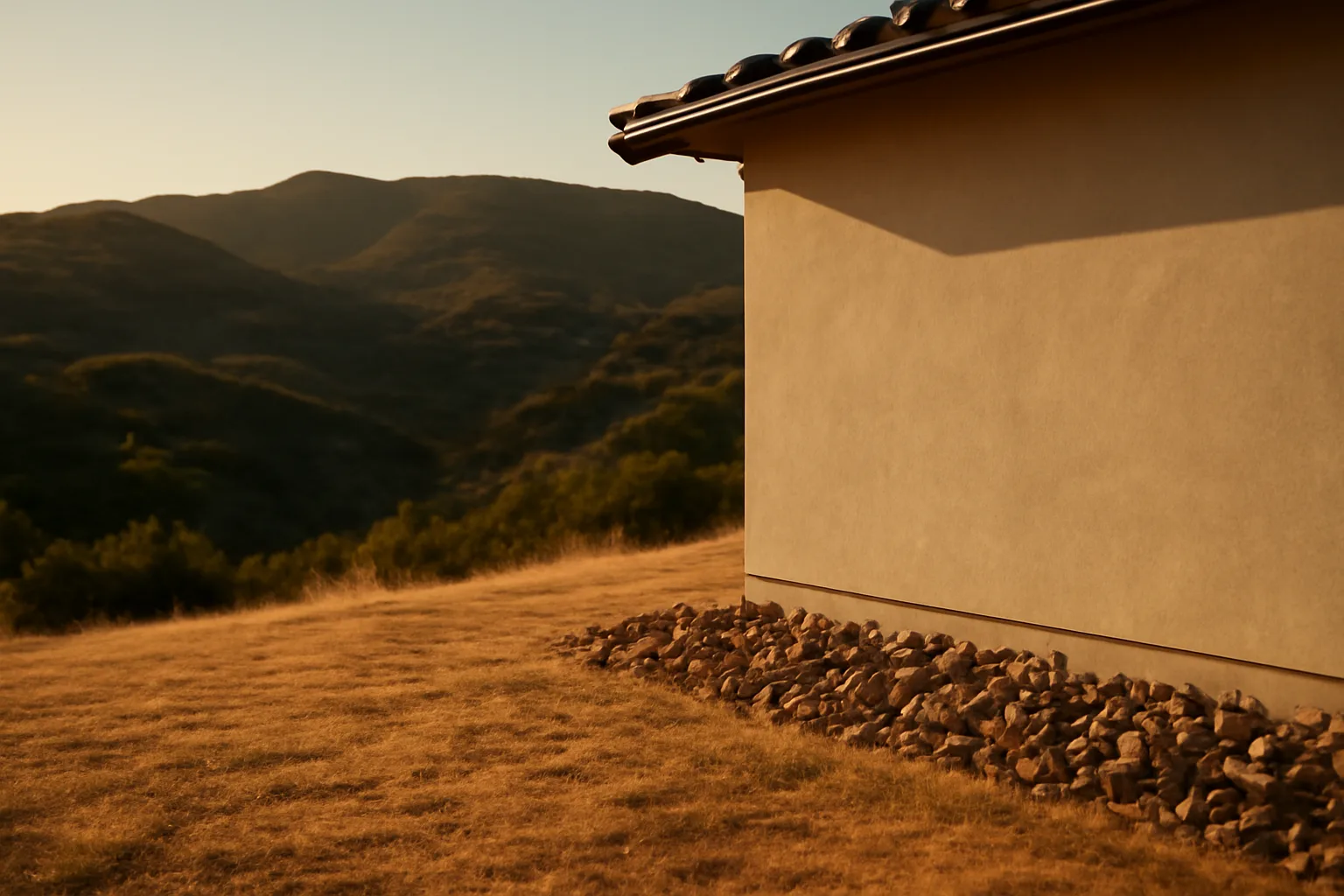
Zone 0 is the 5 feet immediately surrounding your home, deck, and attached structures, and CAL FIRE calls it the "ember-resistant zone" because embers, not flame fronts, ignite most homes in wildfires. CAL FIRE's own guidance states that "the most important zone to reduce wildfire risk to your home is the first five feet," since embers can travel a mile or more ahead of a fire and land directly against siding, under decks, or in gutters. Zone 0 guidance calls for removing all combustible mulch, dead vegetation, and stored items (firewood piles, propane tanks, wood furniture) from that 5-foot band. Landscaping in Zone 0 should be limited to non-combustible material like rock, pavers, or well-irrigated low groundcover, kept separated from anything that touches the house. Nothing woody should touch the siding. Assembly Bill 3074, signed in 2020, directed the Board of Forestry and Fire Protection to adopt regulations defining this ember-resistant zone in law. As of this writing, the Board has been working through the regulatory process for years without a final adopted rule; CAL FIRE's public materials describe Zone 0 as recommended best practice statewide even though the formal regulation isn't yet enforceable everywhere. That gap between guidance and binding law is a major source of homeowner confusion, which we untangle in the next section.
When does the California defensible space law go into effect?
The base 100-foot defensible space requirement under PRC 4291 has been in effect since it was expanded from 30 feet to 100 feet by legislation back in 2005, so that part of the law is not new and is already enforceable in SRA zones today. [1] What's still pending is the specific Zone 0 ember-resistant regulation mandated by AB 3074 (2020), which was supposed to be adopted and take effect for new construction and eventually existing homes. CAL FIRE's own webpages on Zone 0 note the ember-resistant zone requirement "will eventually be required by law" but stop short of giving a hard date, because the Board of Forestry's rulemaking process has been delayed multiple times. If you've seen headlines saying "defensible space rules take effect in 2026," that most likely refers to the anticipated (but not yet finalized, as of this writing) applicability date for Zone 0 regulations on existing homes in high and very high fire hazard severity zones, following an earlier phase covering new construction. Because the exact effective date keeps shifting, the honest answer is: check directly with your local CAL FIRE unit or fire district for the current status, since enforcement timing can vary by jurisdiction even before the statewide Zone 0 rule is finalized. Don't wait for a hard deadline to do the work; insurers are already asking for Zone 0-level compliance in underwriting today, deadline or not.
What does Zone 1 (5 to 30 feet) require?
Zone 1 covers 5 to 30 feet from your home and focuses on breaking up continuous fuel rather than eliminating all vegetation. CAL FIRE's defensible space guidance calls for removing dead plants, dead branches, and dry leaf litter, and creating horizontal and vertical spacing between shrubs, trees, and structures so fire can't easily climb from ground fuel into tree canopy. Practical Zone 1 targets: keep tree branches at least 10 feet from other trees' canopies, remove branches within 10 feet of chimneys and stovepipes, and keep grass mowed to a maximum height, commonly cited around 4 inches, though exact mowing height can vary by local ordinance. Trim tree limbs up from the ground (a common standard is 6 feet, but check your local fire district) to prevent "ladder fuels" that let a ground fire climb into the canopy. This zone is where most of the actual physical labor happens: removing dead shrubs, thinning overgrown landscaping, relocating woodpiles away from the 30-foot line, and cleaning up needle drop under trees. For landscaping choices that hold up in Zone 1 without turning your yard into gravel, see fire safe landscaping california next to house.
What does Zone 2 (30 to 100 feet) require?
Zone 2 extends from 30 feet to 100 feet from the structure (or to your property line) and asks for reduced fuel volume rather than a cleared zone. CAL FIRE's guidance calls this the "reduced fuel zone," where the goal is cutting annual grasses down to around 4 inches, removing dead vegetation, and spacing trees and shrubs so a fire can't carry continuously across the landscape. Spacing requirements in Zone 2 typically scale with slope, since fire moves faster uphill. On flat ground you might space shrub clusters a few times their height apart; on steep slopes, CAL FIRE recommends much greater spacing because fire behavior accelerates dramatically on grades above roughly 20 to 30 percent. If your property backs onto open wildland, this zone is worth walking with a local fire inspector or forester, because generic spacing charts don't always match local vegetation type (chaparral behaves very differently from oak woodland or timber). Zone 2 is also where a lot of the 100-foot requirement quietly fails, because it often extends onto a neighbor's land or into land you don't fully control. PRC 4291 requires you to maintain it "to the extent the [owner] has legal right and authority," which creates real friction between neighbors, discussed more below.
Why won't people follow the defensible space law in California?
Cost, confusion, and a sense that the risk won't hit them personally are the three biggest reasons compliance lags, and none of them are irrational, just risky. Clearing 100 feet of vegetation on a rural, sloped, oak-covered lot can run into the thousands of dollars, especially with tree removal, chipping, and disposal fees, and CAL FIRE inspections are not always followed by enforcement in every county due to limited staffing. Another real reason: people genuinely don't know the rule applies to them. Defensible space law in PRC 4291 applies specifically in State Responsibility Areas, and many homeowners in unincorporated areas don't know if they're in an SRA, a Local Responsibility Area, or a Federal Responsibility Area, each with different enforcement bodies. CAL FIRE maintains SRA maps by county, but the average homeowner has never looked one up. There's also a genuine tension around Zone 2 spanning property lines. If your neighbor won't clear their side, you can legally only do so much, and PRC 4291 explicitly limits your obligation to land you have "legal right and authority" over. This turns defensible space into a collective action problem in dense rural subdivisions, more than an individual chore. Finally, a lot of people treat it as a compliance checkbox instead of connecting it to what actually saved or lost homes in past fires. Research after the 2007 Angora Fire and other California wildfires found that structures with cleared defensible space and hardened features (dual-pane windows, enclosed eaves, non-combustible roofing) survived at meaningfully higher rates than those without, echoing findings the U.S. Forest Service and other researchers have documented across multiple wildfire events. [2] The rule isn't bureaucratic theater; it tracks with what actually determines whether a house is standing after the fire passes.
How do you prepare for a wildfire, beyond defensible space?
Defensible space reduces the odds your home ignites, but wildfire preparedness also means having an evacuation plan, a go-bag, and documentation ready before you're told to leave. Ready.gov's wildfire preparedness guidance recommends assembling an emergency supply kit, knowing at least two evacuation routes out of your neighborhood, and signing up for local emergency alerts before fire season starts, not during it. Practical prep beyond landscaping: harden the physical structure (ember-resistant vents, Class A fire-rated roofing, enclosed eaves), keep gutters clear of debris, store a garden hose long enough to reach all sides of the house, and know where your gas shutoff valve is. Photograph your home's exterior, interior, and major belongings now, while you have time, since post-fire insurance claims move faster with dated proof of what existed and what condition it was in. For documentation specifically built around insurance non-renewal situations, a $99 one-time Wildfire Insurance Survival Kit (see the survival kit builder) walks you through organizing photos, receipts, and defensible space records into a package insurers actually want to see. That's not a substitute for filing a claim or negotiating with your insurer (we don't do either, and you shouldn't expect anyone selling a document kit to), but having your own file ready before a denial or non-renewal letter arrives puts you in a stronger position than scrambling afterward.
How do you prevent wildfires from starting in the first place?
Most wildfires in the U.S. are human-caused, not lightning-caused, which means prevention is mostly about behavior around equipment, debris burning, and vehicles. The National Interagency Fire Center and multiple state agencies attribute the large majority of wildfire ignitions to human activity rather than natural causes, which is the origin of the long-running "only you can prevent wildfires" message from Smokey Bear and the U.S. Forest Service. Concrete prevention steps that actually move the needle: never leave a campfire unattended and drown it completely (stir the ashes, feel for heat) before leaving; avoid driving or parking on dry grass, since a hot catalytic converter can ignite vegetation in minutes; check local burn permit requirements before any debris or agricultural burning, since permit rules and burn bans vary by county and season; and maintain equipment like chainsaws, mowers, and trimmers so they don't throw sparks into dry grass during high fire-danger days. On your own property, defensible space work doubles as fire prevention, more than fire defense. A cleared, well-maintained yard is less likely to catch a stray ember from a neighbor's burn pile, a passing vehicle, or a downed power line. For a broader rundown of prevention habits tied to home ignition risk, see only you can prevent wildfires.
How do you prevent forest fires when you're not a homeowner?
If you're a camper, hiker, or renter rather than a property owner, forest fire prevention comes down to fire-use discipline in wildland areas rather than landscaping work. Follow posted fire restrictions exactly (many national forests ban campfires entirely during red flag conditions), use established fire rings only, and check current restriction levels before you go, since they change week to week during fire season. Smoking materials are a surprisingly common ignition source; never toss a cigarette from a vehicle window or drop one in dry grass or duff. If you're operating off-road vehicles, chainsaws, or generators in wildland areas, keep a shovel and fire extinguisher within reach, since sparks from metal-on-rock contact or hot exhaust systems have started real fires. Report smoke or fire immediately rather than assuming someone else already has; early detection is one of the few prevention levers an individual actually controls once a fire has started. This applies whether you own the land or not.
How do you avoid forest fires and prepare if one is already burning near you?
Avoiding forest fires as an individual mostly means avoiding ignition behaviors listed above, but "preparing for forest fires" that are already burning nearby is a different, more urgent task focused on evacuation readiness. Ready.gov recommends knowing your community's specific evacuation zones and routes in advance, since roads can fill quickly and some routes close as fire perimeters shift. If a fire is active in your region, even miles away, pack your go-bag, move vehicles to face outward for a quick exit, and keep your phone charged in case cell towers get congested. Follow official evacuation orders immediately rather than waiting for visual confirmation of flames; wildfire smoke and embers can outrun the visible fire line by a significant margin, and evacuation delays are one of the most common factors in fire fatalities according to post-incident reviews by state fire agencies. For homeowners specifically, this is also the moment your defensible space work matters most: firefighters make real-time, often split-second decisions about which structures are safe enough to defend, and CAL FIRE has stated publicly that homes with maintained defensible space are more likely to be defensible during active fire operations.
What fire-safe home rules take effect in 2026?
The most commonly referenced 2026-adjacent change is the Zone 0 ember-resistant zone regulation under AB 3074, though as of mid-2025 the Board of Forestry and Fire Protection had not published a final adopted rule with a confirmed statewide effective date. Various drafts and public comment periods have floated applicability windows for new construction first, then a later phase-in for existing homes in high and very high Fire Hazard Severity Zones. Separately, California's insurance market has been moving faster than the regulatory calendar. The California Department of Insurance's "Safer from Wildfires" regulation, effective under the state's Sustainable Insurance Strategy, requires insurers to give discounts or credits for wildfire mitigation actions, including defensible space and home hardening steps, when calculating premiums. [3] That regulation is already in force and is arguably more relevant to homeowners right now than the still-pending Zone 0 statute, because it directly affects premiums today rather than a future enforcement date. Because both the Zone 0 timeline and local fire district enforcement dates keep shifting, treat any specific "2026" date you read with caution and verify directly with your county fire authority or CAL FIRE unit before assuming a hard deadline applies to your property.
Is Santa Barbara safe from fire risk?
No coastal California community, including Santa Barbara, is exempt from wildfire risk, and Santa Barbara County has a documented history of major, destructive fires driven by Santa Ana-style wind events and steep chaparral terrain. The 2017 Thomas Fire burned into Santa Barbara County and, combined with the debris flow that followed in Montecito in January 2018, was linked to significant loss of life and property, according to CAL FIRE incident records. [4] Much of the hillside area around Santa Barbara and Montecito sits in a Very High Fire Hazard Severity Zone as mapped by CAL FIRE, meaning defensible space requirements under PRC 4291 apply directly to many properties there, more than in inland or mountain communities. [5] Coastal fog and marine influence lower fire risk somewhat compared to interior chaparral zones, but they don't eliminate it, especially during offshore wind events in fall and winter when humidity drops fast. If you own property in or near Santa Barbara's foothill communities (Montecito, Mission Canyon, the Riviera, San Roque foothills), check your specific parcel against CAL FIRE's Fire Hazard Severity Zone viewer rather than assuming coastal proximity provides protection. Homes closer to open wildland interface carry meaningfully higher risk regardless of general regional climate.
How can we prevent forest fires as a community, more than individually?
Community-level prevention works differently than individual defensible space work, because fire moves across property lines and a single unmaintained lot can undermine a whole block's compliance. Firewise USA, a program run by the National Fire Protection Association in partnership with the U.S. Forest Service and state forestry agencies, organizes neighborhoods to do coordinated fuel reduction, shared chipping days, and joint risk assessments rather than leaving it to individual households. [6] Local fire districts and county fire safe councils also run cost-share programs, chipping voucher programs, and grant-funded vegetation removal for lower-income or elderly homeowners who can't afford contractor rates. Check with your county fire safe council for current programs, since funding and availability change year to year and vary heavily by county. At a policy level, community prevention also means supporting (or at least not fighting) utility vegetation management around power lines, since utility equipment has caused some of the largest and most destructive California wildfires in the last decade, including fires attributed to Pacific Gas & Electric equipment in CAL FIRE and CPUC investigations. Individual defensible space work matters, but it works best layered on top of these community and utility-level prevention systems, not as a replacement for them.
Frequently asked questions
When does the California defensible space law go into effect?
The base 100-foot defensible space requirement under Public Resources Code 4291 is already in effect and has applied in State Responsibility Areas for years. The newer Zone 0 ember-resistant zone regulation, mandated by AB 3074 (2020), was still pending final adoption by the Board of Forestry and Fire Protection as of mid-2025, so its exact statewide effective date has not been locked in.
Why won't people follow the defensible space law in California?
Cost of clearing (often thousands of dollars on wooded or sloped lots), confusion about whether the SRA rule even applies to their property, and disputes with neighbors over shared Zone 2 areas are the top three reasons. Limited local enforcement staffing in some counties also means violations aren't always followed up on.
How do I prevent wildfires from starting near my home?
Keep debris burning within permit rules, never leave campfires unattended, avoid parking on dry grass, maintain equipment that could throw sparks, and clear Zone 0 (the 5 feet nearest your house) of anything combustible. Most wildfires are human-caused, so behavior around equipment and open flame matters as much as landscaping.
How do I prepare for a wildfire if I live in a fire-prone area?
Build defensible space per CAL FIRE's zone guidance, harden your home's vents and roofing, pack a go-bag, know two evacuation routes, and sign up for local emergency alerts before fire season. Ready.gov recommends doing this preparation well before a fire starts, not during an active evacuation order.
How can we prevent forest fires as a community?
Programs like Firewise USA, run through the National Fire Protection Association with state forestry agency partners, organize neighborhoods to do coordinated fuel reduction and shared risk assessments. County fire safe councils also often run chipping and cost-share programs for residents who can't afford contractor-led vegetation clearing alone.
How do I avoid forest fires while camping or hiking?
Follow posted fire restrictions exactly, use only established fire rings, fully drown and stir campfire ashes before leaving, never discard cigarettes in dry vegetation, and check current fire danger levels before you go since restrictions change weekly during peak season.
What fire-safe home rules take effect in 2026?
The most-discussed pending rule is California's Zone 0 ember-resistant zone regulation under AB 3074, though CAL FIRE and the Board of Forestry had not finalized a confirmed statewide effective date as of mid-2025. Separately, the state's Safer from Wildfires insurance discount regulation is already active and affects premiums now.
Is Santa Barbara safe from wildfire risk?
No. Much of the hillside area around Santa Barbara, including Montecito and surrounding foothill neighborhoods, sits in a CAL FIRE-mapped Very High Fire Hazard Severity Zone. The 2017 Thomas Fire and 2018 Montecito debris flow show the region carries real, documented wildfire and post-fire risk despite its coastal setting.
What is Zone 0 in CAL FIRE's defensible space rules?
Zone 0 is the 5 feet immediately around a home, deck, or attached structure. CAL FIRE calls it the ember-resistant zone because most home ignitions come from windblown embers landing against the structure, not from direct flame contact, so this zone should have no combustible mulch, plants touching siding, or stored fuel.
How far does defensible space have to extend from my house in California?
California Public Resources Code 4291 requires up to 100 feet of defensible space around structures in State Responsibility Areas, split into Zone 0 (0-5 ft), Zone 1 (5-30 ft), and Zone 2 (30-100 ft), or to the property line if that comes first.
Can CAL FIRE or my county fine me for not clearing defensible space?
Yes. Under PRC 4291-4292, local fire authorities can issue a notice of violation, and if the required clearing isn't done, the county can perform the work itself and bill the property owner for the cost, in addition to possible fines depending on local ordinance.
Does defensible space actually help my home survive a wildfire?
Research following major California wildfires, including the 2007 Angora Fire, found homes with cleared defensible space and hardened features like enclosed eaves and dual-pane windows survived at notably higher rates than homes without those measures, a pattern also documented broadly by U.S. Forest Service wildfire research.
Does my insurance company care about defensible space compliance?
Increasingly, yes. California's Safer from Wildfires regulation requires insurers to factor wildfire mitigation actions, including defensible space and home hardening, into premium discounts. Many insurers now request photo documentation of Zone 0 through Zone 2 compliance before renewing policies in high-risk areas.
Sources
- California Legislative Information, Public Resources Code Section 4291: 100-foot defensible space requirement in State Responsibility Areas and county authority to perform clearing and bill owners
- USDA Forest Service, wildfire home survival research: Homes with defensible space and hardening features survive wildfire at higher rates
- California Department of Insurance, Safer from Wildfires regulation: Insurers must provide premium discounts for wildfire mitigation actions including defensible space
- CAL FIRE, Thomas Fire incident information: 2017 Thomas Fire burned into Santa Barbara County and preceded the Montecito debris flow
- CAL FIRE, Fire Hazard Severity Zone maps: Santa Barbara foothill areas are mapped within Very High Fire Hazard Severity Zones
- National Fire Protection Association, Firewise USA program: Firewise USA organizes community-level fuel reduction and wildfire risk assessment programs