Last updated 2026-07-25
TL;DR
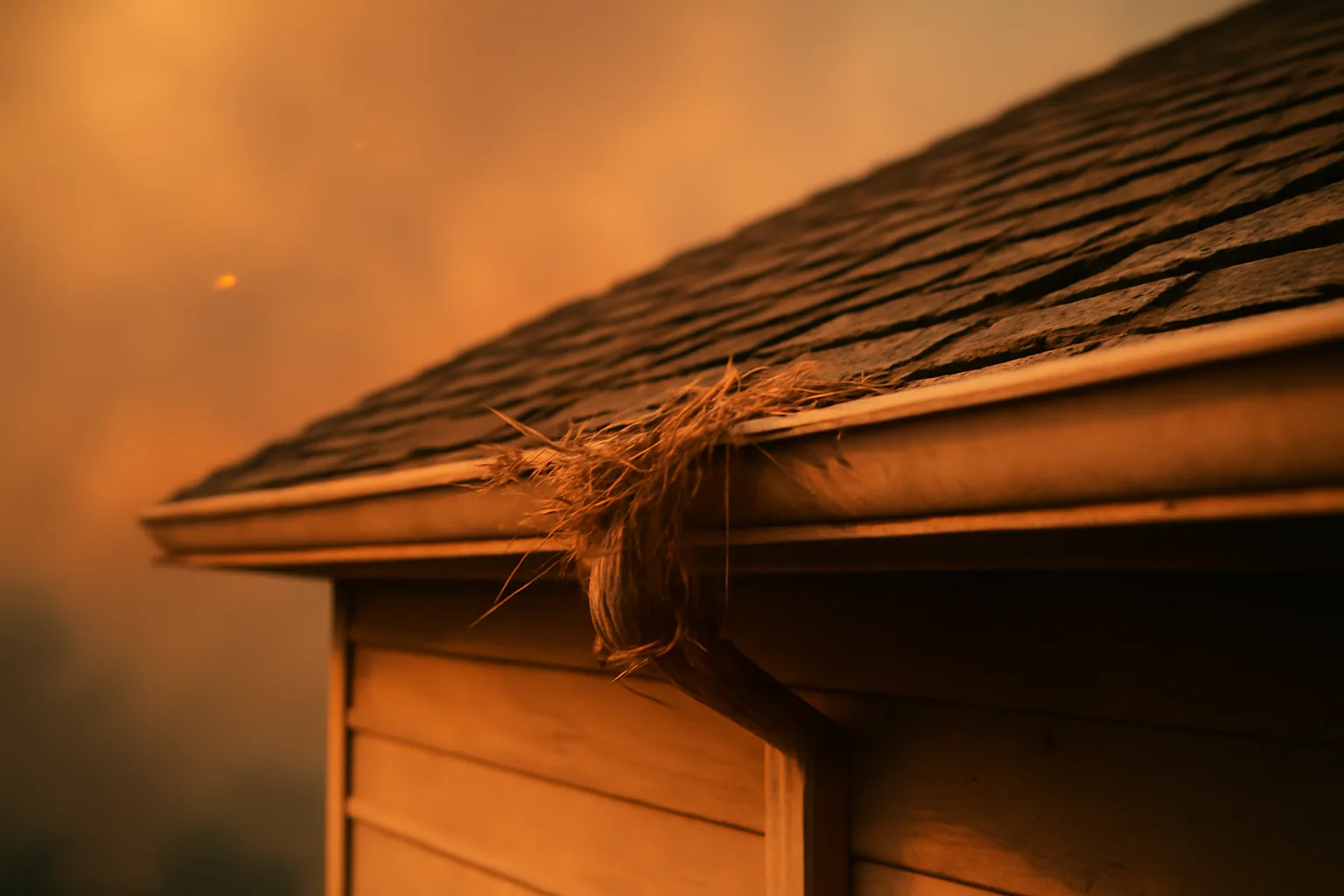
When people say "fire on the house," they usually mean embers or flames reaching the structure itself, which is how most homes actually burn in wildfires. CAL FIRE data shows embers cause the majority of home ignitions, often landing far ahead of the fire front. Zone 0 (0-5 feet) rules, expected in 2026, target exactly this problem.
what does "fire on the house" actually mean
When someone says there's "fire on the house," they're usually not describing a wall of flame rolling through the yard. Most of the time, it's embers. Small, glowing pieces of burning material that travel on wind, sometimes a mile or more ahead of the actual fire front, land on a roof, in a gutter full of dry leaves, or against a wood fence touching the siding [1]. That's the part people get wrong. They picture a wildfire like a tidal wave of fire hitting the house directly. In reality, CAL FIRE's own research says embers and small flames are the primary way homes ignite during wildfires, not direct flame contact from the main fire [1]. A house a quarter mile from the tree line can still burn to the ground because an ember landed in a pine-needle-clogged gutter three hours after the fire passed. This matters for what you actually do about it. If the threat were mainly big flames marching up to your wall, you'd focus all your effort on distance. Since it's embers, you have to think about small stuff too: mesh over vents, nothing combustible touching the house, a roof that isn't accumulating debris. We cover this in more detail in house fire and fire at a house, which look at ignition points room by room.
how to prevent wildfires from starting in the first place
Most wildfires are not started by lightning. Depending on the state and year, somewhere around 85-90% of wildfires in the U.S. are human-caused, according to figures cited by the U.S. Forest Service and repeated across state fire agency guidance [2]. That means the biggest lever most of us have isn't defensible space at all. It's not starting the fire. The common causes are boring and preventable: unattended campfires, dragging trailer chains that spark on pavement, mowing dry grass with metal blades in the afternoon heat, discarded cigarettes, and downed power lines. CAL FIRE's fire prevention guidance specifically calls out equipment use during red flag warning days (mowers, chainsaws, grinders) as a leading ignition source in high fire season [3]. A few concrete habits actually move the needle: mow before 10am when it's cooler and less windy, keep a shovel and water nearby when doing yard work with equipment, never park a hot vehicle on dry grass (catalytic converters run over 500°F and this alone causes real fires every year), and fully drown and stir campfire ash, don't just add water once. If you're near a chipper, generator, or welding project on a Red Flag day, that's the day to skip it, not push through.
how to prevent forest fires versus how to prevent your house from burning
These are two different problems and people conflate them constantly. Preventing forest fires is about ignition sources in wildland areas: campfire rules, target shooting restrictions in dry grass, equipment spark arrestors, and reporting smoke early. Preventing your house from burning during a wildfire that someone else started is a structural and landscaping problem, and it's the one you actually control. You can't stop a wildfire twelve miles away from starting. You can absolutely change whether your house survives it. That's the entire premise of defensible space and home hardening, and it's why insurers increasingly grade properties on it rather than on regional fire risk alone. The practical split: forest fire prevention is a "be careful with sparks" problem. House survival is a "remove fuel and block ember entry" problem. If you're reading this after a non-renewal letter, you care about the second one far more than the first.
how to prepare for a wildfire before you get a warning
| Now, no fire season pressure | Clear gutters, screen vents with 1/8" mesh, remove wood mulch touching foundation | |
|---|---|---|
| 1-2 months before fire season | Thin vegetation in Zone 1 (5-30 ft), trim tree limbs to 6-10 ft off ground | |
| Red Flag Warning declared | Move patio furniture/doormats inside, close windows, park car facing out | |
| Evacuation order | Leave immediately, don't wait for "one more thing" | A go-bag should have copies of insurance documents, medications, a phone charger, and photos of your property (interior and exterior) for claims purposes later. That last one is easy to forget and expensive to regret. |
Preparation has two tracks that need to happen months apart: the structure and landscaping work (weeks to do right), and the go-bag/evacuation planning (a weekend, honestly). Ready.gov's wildfire preparedness guidance recommends building an emergency supply kit, having a family communication plan, and knowing two ways out of your neighborhood before a fire ever starts. On the structure side, focus on the ember-vulnerable zones first: gutters, vents, the area within 5 feet of the foundation (more on that below), and anything wood touching the house. CAL FIRE's defensible space guidance breaks the yard into concentric zones going out to 100 feet, each with different clearance rules [1]. Here's a rough prep timeline that actually works for most homeowners, not a fantasy one: | Timeframe | What to do |
how to avoid forest fires when you're out recreating
Most avoidable ignitions happen because someone didn't think a small flame could become a big one fast. If you're camping, hiking, or working land in a wildfire-prone state, the rules are simple but people skip them constantly. Check local fire restrictions before you go. Many national forests and state lands post current fire danger levels and campfire restrictions, and these change week to week depending on drought conditions. Don't build a campfire in high wind. Keep a shovel and at least a gallon of water at any campfire site. Fully extinguish, meaning cold to the touch, more than no visible flame. If you're driving off-road vehicles or towing on dry grass, watch for sparks off metal-on-metal contact or dragging chains. Several documented wildfires in California and Colorado have been traced to vehicle-related sparks in dry roadside grass during summer months, which is part of why some states restrict off-highway vehicle use during peak fire danger.
how to prepare for forest fires as a homeowner near wildland
If your property backs up to wildland, national forest, or open grassland, your preparation checklist is longer than someone in a suburban tract. You need actual defensible space work, more than an evacuation kit. CAL FIRE's zone system is the standard most states reference in some form: Zone 0 (0-5 feet from structures, the ember-ignition zone), Zone 1 (5-30 feet, lean and green), and Zone 2 (30-100 feet, reduced fuel load) [1]. Each zone has different rules about what vegetation is allowed and how it needs to be spaced. For landscaping specifically that fits fire-prone code, our guide on fire safe landscaping in California next to the house walks through plant selection and spacing zone by zone. If your county or fire district has additional local rules (many do, layered on top of state minimums), check with your local fire marshal's office before doing major landscaping work, since requirements vary by fire district and some are stricter than the state baseline.
when does the california defensible space law go into effect
California's core defensible space statute, Public Resources Code 4291, has been in effect for years and currently requires 100 feet of defensible space clearance around structures in State Responsibility Areas and some Local Responsibility Areas classified as very high fire hazard severity zones [4]. That part isn't new and isn't changing in 2026. What is changing is Zone 0. California's SB 63 (2025) and the related regulatory process direct the Board of Forestry to adopt ember-resistant zone regulations for the 0-5 foot area immediately around structures, often called "Zone 0" [5]. The original statutory target for Zone 0 regulations was earlier, but CAL FIRE and the Board of Forestry pushed the effective date back multiple times as the rulemaking process worked through public comment periods and stakeholder pushback on cost and feasibility. As of the most recent guidance, the Board of Forestry and Fire Protection's regulatory timeline points to Zone 0 rules taking effect for existing homes in high-risk zones sometime in 2026, though exact dates have moved before and could move again before the rule is finalized [5]. If you want the current, exact effective date, check the Board of Forestry's rulemaking page directly, since this is exactly the kind of date that gets pushed and shouldn't be treated as locked in from a secondhand source.
what fire-safe rules for homes take effect in 2026
The headline 2026 change is Zone 0: no combustible mulch, no wood fencing directly attached to the house within 5 feet, no combustible furniture or storage against exterior walls, in the highest-risk fire zones [5]. This is the "ember zone" rule, built directly around the finding that embers, not flame fronts, ignite most homes [1]. Specific expected elements of Zone 0 rules include removing combustible mulch and vegetation within 5 feet of the structure, replacing wood fencing that attaches directly to the house with a noncombustible section at the connection point, and keeping stored items (firewood piles, propane tanks, wood furniture) away from the foundation [5]. The rule is expected to apply first to new construction and, on a phased timeline, to existing homes in Very High Fire Hazard Severity Zones. If you're in Colorado, Oregon, or Arizona, there's no direct equivalent yet at the state level as of this writing, though some local fire districts and insurers are already requiring similar clearances as a condition of coverage, independent of state law. Check your state fire marshal's office for what's actually enforced where you live, since this is genuinely a moving target across states.
why won't people follow the defensible space law in california
This is a fair question and the honest answer is a mix of cost, confusion, and inspection capacity, more than stubbornness. Clearing 100 feet of defensible space on a sloped, wooded lot can run into the thousands of dollars, and homeowners on fixed incomes or with large parcels often can't absorb that cost in one season. There's also real confusion about what's actually required. PRC 4291 sets a 100-foot state minimum, but many counties and fire districts layer additional requirements on top, and homeowners genuinely don't always know which rules apply to their specific parcel. Some believe (incorrectly) that if their home isn't in a mapped Very High Fire Hazard Severity Zone, none of this applies to them. Enforcement capacity is also thin. CAL FIRE and local fire departments are responsible for inspecting an enormous number of parcels, and in practice many properties go years without a compliance check unless a neighbor complains or an inspector happens to notice during another visit. That gap between "the law requires it" and "someone is checking" is a big part of why compliance lags, especially on absentee-owned or rural parcels. Finally, some homeowners genuinely disagree with the aesthetic or ecological tradeoffs, removing mature trees or native shrubs they value. That's a real tension, more than laziness, and it's worth taking seriously even if the fire risk math still favors clearing.
is santa barbara safe from fire
No California coastal or foothill community, including Santa Barbara, is "safe" from wildfire in any absolute sense, and the area's own history makes that clear. Santa Barbara County has been hit by several major wildfires in the last two decades, including the 2017 Thomas Fire, which at the time was the largest wildfire in modern California history by acreage, and the subsequent Montecito debris flow in January 2018 that killed 23 people, a disaster directly tied to the burned, denuded hillsides left by the fire [6]. The city and county sit against steep, chaparral-covered mountains with strong offshore Sundowner winds that can push fire downhill toward homes at high speed, a combination that fire scientists have specifically flagged as dangerous for the region. Parts of unincorporated Santa Barbara County are mapped by CAL FIRE as Very High Fire Hazard Severity Zones, meaning the 100-foot defensible space requirement under PRC 4291 applies directly to those parcels [4]. So the honest answer: Santa Barbara is not uniquely unsafe compared to other California wildland-urban interface communities, but it is absolutely not exempt from wildfire risk, and residents in the hillside and foothill neighborhoods should treat defensible space and home hardening as seriously as anyone in the Sierra foothills or Southern California chaparral belt.
how can we prevent forest fires at a community level
Individual behavior matters, but community-level prevention has a bigger multiplier. Coordinated defensible space across a neighborhood is far more effective than one compliant house surrounded by five overgrown lots, because embers and radiant heat don't respect property lines. Communities that organize Firewise USA groups (a National Fire Protection Association program) get access to structured planning support and, in some cases, grant funding for shared fuel reduction projects . Some California counties also run chipper day programs, where residents can drop cleared vegetation for free or reduced cost, removing the biggest excuse (cost of disposal) for not doing the clearing work. Reporting matters too. If you see unattended campfires, illegal fireworks, or downed power lines in dry vegetation, calling it in early is genuinely one of the highest-leverage things an individual can do, since most wildfires are caught in their first minutes or not at all. At the household level, this is also where documentation earns its keep. If your area is getting non-renewal letters, insurers increasingly want photographic proof of defensible space compliance, more than a self-certification. The Wildfire Insurance Survival Kit is built around exactly this: a one-time $99 tool to help you document your defensible space and hardening work in the format adjusters and insurers actually want to see. It doesn't file claims or deal with your insurer on your behalf (we're not a public adjuster and don't promise reinstatement or discounts); it just helps you build the paper trail yourself, which is the part homeowners consistently get wrong.
what to check before you assume you're compliant
A lot of homeowners assume they're fine because they mowed the lawn and trimmed one tree. That's not what CAL FIRE or your insurer means by defensible space. Before you tell anyone you're compliant, walk your property with this list: - Zone 0 (0-5 ft): no wood mulch, no combustible furniture, no firewood stacks against the house
- Zone 1 (5-30 ft): trees limbed up 6-10 feet, no "ladder fuels" connecting ground brush to tree canopy
- Zone 2 (30-100 ft): grass mowed to 4 inches or less, dead vegetation removed, spacing between shrub clusters
- Roof and gutters: clear of pine needles and leaf litter, no combustible debris
- Vents: covered with 1/8 inch metal mesh, not fiberglass or plastic screening
- Fencing: any wood fence section touching the house replaced or separated with noncombustible material Specific requirements vary by fire district and county, so treat this as a starting checklist, not a final answer. Confirm exact distances and rules with your local fire marshal or fire protection district before assuming you meet code. For a broader look at how these zones interact and where insurers focus their attention, see defensible, and for a plain look at prevention messaging and its actual limits, only you can prevent wildfires is worth a read too.
Frequently asked questions
When does the California defensible space law go into effect?
The core 100-foot defensible space requirement under PRC 4291 is already in effect and has been for years. The newer Zone 0 (0-5 feet) ember-resistant zone rules, directed by SB 63, are expected to take effect in 2026 for homes in high fire severity zones, though the Board of Forestry has pushed this date before, so confirm the current status directly with them.
Why won't people follow the defensible space law in California?
Mainly cost, confusion about which rules apply to their parcel, and thin enforcement capacity. Clearing 100 feet on a large or sloped lot can cost thousands, many homeowners don't know local rules layered on top of the state minimum, and fire departments can't inspect every parcel every year, so compliance often isn't checked until a complaint or wildfire event.
How do I prevent wildfires from starting near my property?
Avoid mowing dry grass with metal blades on hot, windy afternoons, never park a hot vehicle on dry grass, fully drown and stir campfire ash rather than just adding water once, and skip equipment work like grinding or welding on Red Flag Warning days. Roughly 85-90% of wildfires nationally are human-caused, so behavior change is a real lever.
How do I prepare for a wildfire if I live in a fire-prone area?
Build a go-bag with medications, insurance documents, and property photos, know two evacuation routes, and harden your home's ember-vulnerable zones (vents, gutters, the 0-5 foot zone around the foundation). Ready.gov recommends a family communication plan and an emergency kit built before fire season starts, not during a Red Flag Warning.
How can we prevent forest fires as individuals and communities?
Individually, follow campfire and equipment rules and report smoke or downed lines early. As a community, coordinate defensible space clearing across neighboring lots (embers don't respect property lines) and consider joining a Firewise USA group, which offers structured planning support and sometimes grant funding for shared fuel reduction work.
How do I avoid forest fires when camping or recreating outdoors?
Check current local fire restrictions before you go, never build a campfire in high wind, keep a shovel and water at the site, and fully extinguish fires until they're cold to the touch. Watch for sparks from dragging trailer chains or vehicle contact with dry grass, a documented cause of several wildfires.
What fire-safe rules for homes take effect in 2026?
California's expected Zone 0 rules target the 0-5 foot zone around structures: no combustible mulch, no wood fencing attached directly to the house within that zone, and no combustible storage against exterior walls. It's aimed at ember ignition specifically, since embers cause most home losses in wildfires, not direct flame contact.
Is Santa Barbara safe from fire?
No, not in any absolute sense. Santa Barbara County has experienced major wildfires including the 2017 Thomas Fire, and the subsequent 2018 Montecito debris flow killed 23 people. Parts of the county are mapped as Very High Fire Hazard Severity Zones, meaning state defensible space law applies directly to many hillside properties there.
What does 'fire on the house' actually mean during a wildfire?
It usually refers to embers or small flames reaching and igniting the structure itself, not a wall of fire hitting the wall directly. CAL FIRE's research identifies embers as the primary mechanism by which homes ignite during wildfires, often landing well ahead of the visible fire front.
What is Zone 0 and why does it matter?
Zone 0 is the 0-5 foot area immediately surrounding a structure. It's the highest-risk zone for ember ignition because embers landing in mulch, on furniture, or against wood fencing in that zone can ignite the house directly, even when the main fire is still far away.
Do the same defensible space rules apply in Colorado, Oregon, and Arizona?
Not identically. California has the most detailed statewide statute (PRC 4291) and the pending Zone 0 rule. Colorado, Oregon, and Arizona have their own state and local requirements that vary by fire district; some local jurisdictions mirror California's zone approach, but there's no single national standard, so check your state fire marshal's office directly.
What should I put in a wildfire go-bag?
Copies of insurance documents, medications, a phone charger, cash, and photos of your property's interior and exterior for later claims documentation. Ready.gov recommends packing this before fire season starts, along with a family communication plan, so you're not assembling it during an active evacuation order.
Sources
- CAL FIRE, Defensible Space (PRC 4291) guidance: Zone-based defensible space requirements and the role of embers in home ignition
- USDA Forest Service, wildfire cause statistics: Majority of U.S. wildfires are human-caused
- CAL FIRE, Fire Prevention information: Equipment use on high fire danger days as a common ignition source
- California Public Resources Code Section 4291: 100-foot defensible space clearance requirement in State Responsibility Areas
- California Board of Forestry and Fire Protection, Zone 0 rulemaking: Zone 0 (0-5 foot) ember-resistant zone regulations and 2026 phased effective timeline
- National Fire Protection Association, Firewise USA program: Community-level defensible space coordination program offering planning support