Last updated 2026-07-25
TL;DR
Fire-resistant siding means noncombustible or ignition-resistant materials like fiber cement, stucco, metal, or treated wood rated for wildfire exposure. Fiber cement runs $6-$13 per square foot installed; metal panel siding runs $8-$20. Vinyl siding melts around 165°F and is a documented weak point in ember and radiant-heat exposure, per CAL FIRE's home hardening guidance.
what actually counts as fire-resistant siding
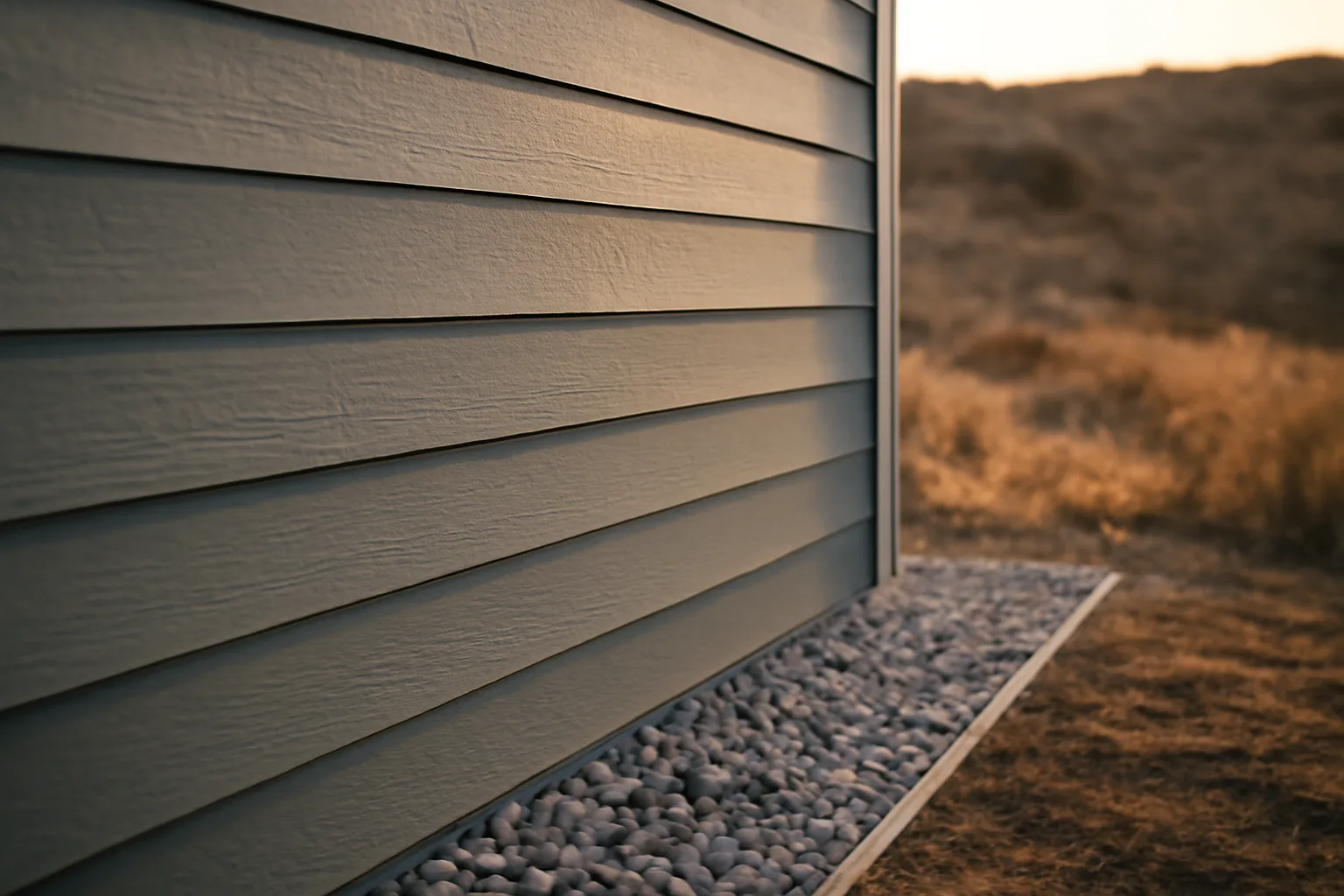
Fire-resistant siding is any exterior wall covering that resists ignition from embers, direct flame contact, and radiant heat long enough to keep a fire from getting into your wall cavity. CAL FIRE's Wildfire Prevention guidance for building materials names noncombustible materials, ignition-resistant materials, and treated wood as the three acceptable categories for siding in high fire hazard severity zones. Noncombustible means it won't burn, period. Stucco, fiber cement, brick, and most metal panel products fall here. Ignition-resistant is a step down: the material can char or degrade but resists sustained flame spread under standard test conditions. Some treated wood products and certain composite sidings fall into this middle category. What doesn't count, no matter what the marketing says: vinyl siding. Vinyl is a petroleum-based plastic that starts to soften around 165°F and can ignite or melt away entirely under radiant heat from a burning structure or vegetation 10-15 feet away, well before flame ever touches it. CAL FIRE's own "Building Materials" list for defensible space and hardening explicitly does not include vinyl among approved exterior wall coverings for high-risk zones. If your neighbor's house or your own shed catches, softened vinyl can drip and pool burning plastic against your wall base, which is worse than doing nothing. The practical takeaway: if you're re-siding a home in a mapped Fire Hazard Severity Zone, plan on fiber cement, stucco/cement plaster, brick veneer, or metal. Everything else is a gamble you're taking with your own house.
which siding materials actually resist fire, and how do they compare
| Fiber cement (e.g. HardiePlank-type) | $6-$13 | Noncombustible core, Class A rated assemblies available | Most common WUI retrofit choice | |
|---|---|---|---|---|
| Stucco / cement plaster | $7-$14 | Noncombustible | Needs proper substrate; cracks need repair to stay effective | |
| Metal panel (steel/aluminum) | $8-$20 | Noncombustible | Can transmit heat to substrate; check underlying sheathing | |
| Brick veneer | $10-$20 | Noncombustible | Heavy, needs structural support, high upfront cost | |
| Fire-retardant treated wood | $8-$16 | Ignition-resistant, not noncombustible | Treatment can degrade over time; check manufacturer warranty | |
| Vinyl | $3-$8 | Not fire-resistant | Softens ~165°F, not accepted in CAL FIRE material lists | |
| Untreated wood/cedar shake | $8-$15 | Not fire-resistant, banned in many WUI codes | Common in older CA/CO mountain homes, often flagged in inspections | The cost spread within any category depends heavily on your local labor market, home square footage, and whether you're tearing off existing siding or building new. A 2,000 sq ft home re-sided in fiber cement typically lands somewhere between $12,000 and $26,000 installed, before accounting for any rot or sheathing repair discovered once the old siding comes off, which happens more often than homeowners expect. |
Here's how the common options stack up on cost and fire performance. Prices are national installed-cost ranges and will run higher in California and Colorado markets with permit and contractor demand pressure. | Material | Installed cost per sq ft | Fire performance | Notes |
does fire-resistant siding actually stop a house from burning
Siding alone doesn't save a house. It's one layer in a system that includes roofing, vents, eaves, windows, and the 5-foot noncombustible zone around the foundation. Research from the Insurance Institute for Business & Home Safety (IBHS) and CAL FIRE both point to embers, not the flame front, as the primary way homes ignite in wildfires: embers can travel over a mile ahead of a fire and get into vents, gaps, and combustible material touching the wall base. That means fire-resistant siding does its real work at the joints and edges, more than the flat wall surface. A fiber cement wall with an open vent gap, unscreened eave, or wood fence butted directly against it can still let a house burn. CAL FIRE's zone 0 guidance (the 5 feet closest to the structure) calls for noncombustible material at ground level precisely because that's where ember-ignited mulch, debris, or dead vegetation meets your wall siding. So the honest answer: fire-resistant siding lowers your risk meaningfully, especially against radiant heat and direct ember accumulation on the wall surface, but it's not a standalone fix. If you're planning a hardening project, pair siding work with vent screening (1/8 inch mesh, ember-resistant vents), a noncombustible zone 0, and dual-pane tempered windows. For a fuller picture of what's involved in creating that noncombustible perimeter, see our guide on fire safe landscaping in California next to the house.
when does the california defensible space law go into effect
California's defensible space requirements under Public Resources Code 4291 are already in effect and have been since 2005 for the 100-foot clearance zone around structures in State Responsibility Areas and some Local Responsibility Areas [1]. What's newer and still rolling out is the Zone 0 (0-5 feet) ember-resistant zone requirement. AB 3074, passed in 2020, directed the California Board of Forestry and Fire Protection to develop regulations for a 0-5 foot ember-resistant zone around structures [2]. As of early 2025, the Board had not yet finalized and adopted the Zone 0 regulation; it remains in the rulemaking process, with CAL FIRE and the Board continuing to develop draft regulatory language. Homeowners should check the Board of Forestry's current rulemaking status directly, since proposed effective dates have shifted more than once. The practical guidance in the meantime: CAL FIRE recommends homeowners voluntarily start treating the 5 feet closest to their home as if the ember-resistant zone rule were already active, since it reflects the same ember-ignition science whether or not the regulation is finalized yet. That means no bark mulch, no wood fencing directly attached to the house, and no combustible items (patio furniture, firewood stacks) within that 5-foot ring.
what fire-safe rules for homes take effect in 2026
There isn't one single national "2026 rule." What's happening instead is a patchwork of state-level rulemaking, and homeowners in CA, CO, OR, and AZ each need to check their own state fire marshal's office for the current timeline, since dates have moved before. In California, the Zone 0 ember-resistant zone regulation under AB 3074 has been in an extended rulemaking process; check the Board of Forestry and Fire Protection's current regulatory status page for the latest adopted or proposed effective date, since it has been delayed from earlier projected timelines [2]. Colorado doesn't have a statewide defensible space mandate comparable to California's; wildfire mitigation requirements are largely set at the county and fire district level, so "2026 rules" in Colorado will vary block by block. Oregon's Senate Bill 762 (2021) created a statewide wildfire risk map and defensible space/home hardening framework tied to risk classifications, with codes rules phased in over several years and adjusted after public pushback over the risk map itself [3]. Arizona similarly leaves most wildfire mitigation requirements to county and municipal ordinance rather than a single statewide code. Guided fill-in: [check your local fire district's current defensible space and building material requirements, since specific clearance distances and siding rules vary by jurisdiction]. Don't assume a neighboring county's rule applies to you, and don't assume last year's requirement is still current; several states have adjusted timelines mid-process.
why won't people follow the defensible space law in california
Cost, confusion, and enforcement gaps are the three real reasons compliance lags, based on what fire agencies and researchers have documented. CAL FIRE inspections regularly find noncompliance even in mapped high-hazard zones, and it's rarely because homeowners don't care about fire. Cost is the biggest one. Re-siding a home, replacing a wood deck, or clearing mature landscaping that's decades old can run into the tens of thousands of dollars, and there's no statewide subsidy that covers most of it. Some homeowners simply can't afford full compliance in one pass, which is why phased projects (siding this year, vents next year) are common and reasonable. Confusion is the second driver. Requirements differ between State Responsibility Areas and Local Responsibility Areas, between counties, and even between adjoining fire districts. A homeowner who did the right thing under one interpretation of the rule can still fail an inspection under a neighboring district's stricter local ordinance. This is exactly why we tell readers to treat every rule in this article as a starting point, not a final answer, and to [confirm current requirements with their local fire district]. Enforcement is uneven too. PRC 4291 gives local fire officials authority to inspect and require corrections, but staffing for proactive inspection varies enormously by county, so some homeowners simply never get inspected and never prioritize the work until an insurer's own inspector shows up first. That's often the actual trigger for compliance: not the law itself, but a non-renewal letter.
how to prevent wildfires around your home
The measures with the best evidence behind them focus on the home itself, not the surrounding forest, since research consistently shows ember exposure and structure-to-structure fire spread cause most home losses in wildfire disasters, not direct contact with the main fire front. Start with the roof: Class A fire-rated roofing (asphalt shingle, metal, tile) is the single highest-leverage upgrade, since roofs and gutters are common ember-catch points. Next, screen every vent opening with 1/8 inch metal mesh; unscreened attic and foundation vents are one of the most common ignition paths CAL FIRE documents in post-fire damage assessments. Then work outward: maintain the 5-foot noncombustible zone at the foundation, keep gutters clear of dead leaves and pine needles, and remove anything flammable stored against exterior walls (firewood, propane tanks, wood fencing). For the broader defensible space zones beyond your walls, our guide on defensible space work covers the 30-foot and 100-foot zone requirements in more depth. Finally, don't skip your neighbors' risk. A wood fence connecting your yard to a neighbor's shed, or a shared wood pile at a property line, can carry fire onto your property even if your own home is fully hardened. Wildfire spread in dense WUI neighborhoods is often structure-to-structure, meaning only-you-can-prevent-wildfires applies just as much to what happens on your fence line as what happens in the forest.
how to prepare for a wildfire (evacuation and documentation, more than the house)
Preparing for a wildfire means having your evacuation plan, go-bag, and property documentation ready well before a red flag warning, not the night of. Ready.gov's wildfire preparedness guidance recommends creating a family communication plan, identifying two evacuation routes from your neighborhood, and signing up for local emergency alerts before fire season starts. Document your home's condition now, while nothing is on fire. Photograph and video every room, closet, and the exterior from all four sides, plus your defensible space work as it's completed. This isn't paperwork for its own sake: if you ever need to show an insurer what mitigation work you'd done, or file a claim after a loss, dated photos are the single most useful thing you can hand them. We built a $99 one-time Wildfire Insurance Survival Kit specifically to walk homeowners through that documentation process step by step, since most people don't know what to photograph or how to organize it until it's too late. To be clear: this is a self-documentation tool. We don't negotiate with insurers, file claims on your behalf, or promise any coverage outcome; you prepare the record and send it yourself. Ready.gov also recommends keeping a physical go-bag with medications, copies of insurance documents, and chargers, since cell networks and home wifi can go down during an active evacuation. Keep a paper copy of your insurance policy number and agent contact in that bag too; don't rely on a phone that might not charge.
how to prevent forest fires and avoid forest fires more broadly
Most forest fires in the US are human-caused, and the prevention steps are mostly about what you do outdoors, not what you build. According to the National Interagency Fire Center's long-running statistics, roughly 85-90% of wildland fires in the US are started by human activity (campfires, debris burning, equipment sparks, arson, downed power lines) rather than natural causes like lightning, though the exact yearly percentage shifts [4]. The basics that actually matter: fully extinguish campfires (drown, stir, drown again, feel for heat before leaving), never burn debris on windy or red-flag days, keep vehicles and equipment off dry grass (catalytic converters and dragging trailer chains cause real fires every year), and maintain chainsaws and mowers with spark arrestors in dry conditions. CAL FIRE's "One Less Spark" campaign specifically targets equipment-caused fires from mowing dry grass during peak summer hours. If you live near wildland, report unattended fires and smoke immediately rather than assuming someone else already called it in; delayed reporting is a documented factor in fires growing past initial-attack containment. Ready.gov's guidance frames this simply: prevention is mostly about controlling ignition sources during high-risk conditions, since fuel and weather are largely outside any individual's control.
is santa barbara safe from fire
No coastal California city is "safe" from wildfire risk in an absolute sense, and Santa Barbara County has a documented history of major destructive fires, including the 2017 Thomas Fire and the debris flow that followed in Montecito. Parts of Santa Barbara County, especially the foothill and wildland-urban interface communities like Montecito, Mission Canyon, and the Riviera, fall within CAL FIRE-mapped Very High Fire Hazard Severity Zones [5]. That said, risk varies enormously within the county. Downtown Santa Barbara near the ocean has different exposure than homes backed up against the foothills or in canyon communities with heavy chaparral fuel loads. If you're evaluating a specific property, CAL FIRE's Fire Hazard Severity Zone viewer lets you check the exact designation for an address, which is a better answer than any general statement about the whole county [5]. The honest framing: if you own or are buying a home in the Santa Barbara foothills or similar WUI zones anywhere in California, treat defensible space and home hardening as an ongoing responsibility, not a one-time checkbox. The Thomas Fire burned over 280,000 acres and destroyed over 1,000 structures across Ventura and Santa Barbara counties, which is a useful reminder that historical fire activity in the region is real, not hypothetical [6].
how much does replacing siding for wildfire resistance actually cost, and is it worth it
For a typical single-story 1,500-2,000 sq ft home, fiber cement re-siding runs roughly $9,000 to $22,000 installed, including tear-off of existing siding, according to the cost ranges above applied to standard exterior square footage (walls typically run 1.0-1.3x floor area once you account for height and gables). Stucco and metal panel projects land in similar or slightly higher ranges depending on substrate work needed. Whether it's worth it depends on three things: your current insurance situation, your material's actual condition, and your local fire risk designation. If you've already received a non-renewal notice or an inspection letter citing combustible siding, replacing it is often the single highest-impact item on the list, since it's frequently named specifically in FAIR Plan and admitted-carrier underwriting criteria for wildfire zones. If you haven't received a notice yet but live in a Very High Fire Hazard Severity Zone, prioritize based on what's cheapest to fix first: vent screening and clearing the 5-foot zone cost far less than full re-siding and address the same ember-ignition risk. Save the siding replacement for when you're already re-siding for another reason (weather damage, aesthetic remodel) or when an inspector has flagged it directly. For homeowners who've already been through an inspection or a fire event nearby, our guide on house fire documentation and recovery steps covers what to do with the paperwork side once damage has occurred.
Frequently asked questions
When does the California defensible space law go into effect?
The 100-foot defensible space clearance under Public Resources Code 4291 has been in effect since 2005. The newer Zone 0 (0-5 foot ember-resistant zone) regulation from AB 3074 (2020) is still in the Board of Forestry's rulemaking process as of early 2025; check the Board's current regulatory status page for the adopted effective date.
Why won't people follow the defensible space law in California?
Cost is the biggest barrier: re-siding, deck replacement, and mature landscape removal can cost tens of thousands of dollars with limited subsidy. Confusion between State and Local Responsibility Area rules and inconsistent local enforcement also contribute. Many homeowners only prioritize compliance after an insurer's inspection or non-renewal letter forces the issue.
How to prevent wildfires around a home?
Install Class A rated roofing, screen every vent opening with 1/8 inch metal mesh, keep gutters clear of debris, maintain a noncombustible 5-foot zone at the foundation, and remove flammable items (firewood, propane tanks) from touching exterior walls. Ember exposure, not direct flame contact, causes most home ignitions, per CAL FIRE and IBHS research.
How to prepare for a wildfire?
Create a family communication plan and identify two evacuation routes before fire season, per Ready.gov. Pack a go-bag with medications, chargers, and paper copies of insurance documents. Photograph and video your home's interior and exterior now, dated, so you have documentation ready if you ever need to file a claim.
How to prevent forest fires?
Roughly 85-90% of US wildland fires are human-caused, per National Interagency Fire Center data. Fully extinguish campfires (drown, stir, drown, feel for heat), avoid debris burning on windy days, keep vehicles off dry grass, and maintain equipment spark arrestors. Report unattended fires or smoke immediately rather than assuming someone else called it in.
How to avoid forest fires when recreating outdoors?
Check local fire restrictions before camping, use established fire rings only, never leave a campfire unattended, and carry water and a shovel to fully extinguish it. Avoid parking or driving on dry grass, since hot exhaust systems and catalytic converters start real fires every year, especially during red flag warning conditions.
How to prepare for forest fires as a nearby resident?
Sign up for local emergency alerts, know your evacuation zone and routes, and keep defensible space maintained year-round rather than just before fire season. Ready.gov recommends having a go-bag and family communication plan ready in advance, since evacuation orders during active forest fires often come with very short notice.
What fire-safe rules for homes take effect in 2026?
There's no single national 2026 rule. California's Zone 0 ember-resistant zone regulation remains in Board of Forestry rulemaking with a shifting timeline. Oregon phased in requirements under Senate Bill 762. Colorado and Arizona set most rules at the county or fire district level. Check your specific state fire marshal's office for current dates.
Is Santa Barbara safe from fire?
No California WUI community is fully safe from fire risk. Parts of Santa Barbara County, especially foothill communities like Montecito and Mission Canyon, sit in CAL FIRE-mapped Very High Fire Hazard Severity Zones. The 2017 Thomas Fire burned over 280,000 acres across Ventura and Santa Barbara counties. Check CAL FIRE's hazard zone viewer for a specific address.
How can we prevent forest fires as a community?
Community chipper days, coordinated fuel breaks, and shared defensible space enforcement help more than individual action alone, since fire spreads structure-to-structure in dense WUI neighborhoods. Report equipment use and unattended fires promptly, support local fire district education campaigns, and coordinate with neighbors on shared fence lines and fuel loads at property boundaries.
Is vinyl siding acceptable in California wildfire zones?
No. Vinyl siding is not included among CAL FIRE's recommended noncombustible or ignition-resistant materials for high fire hazard severity zones. Vinyl softens around 165°F and can ignite or melt under radiant heat well before flame contact, making it a documented weak point compared to fiber cement, stucco, brick, or metal siding.
What is the cheapest fire-resistant siding option?
Fiber cement is generally the cheapest true fire-resistant option, running roughly $6-$13 per square foot installed, compared to $10-$20 for brick veneer or $8-$20 for metal panel siding. Stucco falls in a similar range to fiber cement but depends heavily on substrate condition and local labor costs.
Does fire-resistant siding lower home insurance premiums?
It can support underwriting decisions but doesn't guarantee a premium reduction or reinstatement on its own; insurers weigh siding alongside roofing, vents, defensible space, and overall property risk. Document the material, installation date, and any manufacturer fire rating, and provide that documentation directly to your insurer or agent when requesting a review.
Sources
- California Public Resources Code Section 4291: 100-foot defensible space clearance requirement around structures in State Responsibility Areas, in effect since 2005
- California Assembly Bill 3074 (2020): Directs the Board of Forestry and Fire Protection to develop a 0-5 foot ember-resistant zone regulation
- Oregon Senate Bill 762 (2021): Statewide wildfire risk map and defensible space/building code framework phased in over several years
- National Interagency Fire Center, Statistics: Majority of US wildland fires are human-caused rather than started by lightning or other natural causes
- CAL FIRE, Fire Hazard Severity Zones Viewer: Fire Hazard Severity Zone mapping showing Very High designation for foothill communities in Santa Barbara County
- CAL FIRE, Thomas Fire Incident Archive: Thomas Fire burned over 280,000 acres and destroyed over 1,000 structures across Ventura and Santa Barbara counties