Last updated 2026-07-24
TL;DR
Fire safe landscaping in California means managing three zones out to 100 feet: Zone 0 (0-5 ft, ember-resistant, no combustibles), Zone 1 (5-30 ft, spaced fire-resistant plants), and Zone 2 (30-100 ft, reduced fuel volume). CAL FIRE's Zone 0 regulations were due by law but as of mid-2025 are still being finalized by the Board of Forestry, with statewide enforcement expected on a delayed timeline.
What does "fire safe landscaping" actually mean in California?
Fire safe landscaping is the practice of arranging and maintaining plants, mulch, and hardscape around a structure so that an approaching wildfire has less fuel to grab onto and fewer ember-catching surfaces near the walls. It is not the same as "no plants." CAL FIRE's own guidance is explicit that defensible space "is not a fuel break, and it is not the removal of all vegetation". The goal is spacing, plant selection, and maintenance, not a moonscape yard. California law (Public Resources Code 4291) requires most homeowners in State Responsibility Areas and many Local Responsibility Areas to maintain 100 feet of defensible space around structures, split into zones with different rules [1]. Zone 0 is the ember zone right against your house. Zone 1 runs from 5 to 30 feet. Zone 2 runs from 30 to 100 feet, or to your property line, whichever comes first. Most homes that burn in wildfires don't burn because a wall of flame rolled through. They ignite from embers landing in gutters, on wood mulch pressed against siding, or under a wood deck. Research from the Insurance Institute for Business & Home Safety and CAL FIRE's own wildfire investigations consistently point to embers and small flames as the dominant ignition path in the wildland-urban interface, which is exactly why Zone 0 gets so much regulatory attention right now. If you want the fuller zone-by-zone clearing plan, including what counts as "vertical spacing" between shrubs and tree canopies, see fire safe landscaping California next to house.
When does the California defensible space law go into effect?
The base 100-foot defensible space requirement under PRC 4291 has been in effect for years and applies now, not in some future year. What's newer, and still catching people off guard, is Zone 0. Assembly Bill 3074 (2020) directed the Board of Forestry and Fire Protection to write specific ember-resistant zone regulations for the 0-5 foot area around structures [2]. The law set an original target for the Board to adopt these regulations, but rulemaking has slipped past that date repeatedly. As of the most recent Board of Forestry updates, draft Zone 0 regulations have gone through public comment periods but had not been finalized into enforceable code for homeowners statewide. Here's the honest timeline problem: state agencies have discussed a effective date sometime in 2025 or 2026 once regulations clear the Office of Administrative Law, but the exact enforcement start date depends on final rulemaking, and it has moved before. If someone tells you Zone 0 is already legally mandatory everywhere in California, they're ahead of where the regulation actually sits. Check the Board of Forestry's Zone 0 page directly for the current status before you assume a deadline. What you should NOT do is wait for the final regulation. Insurers and CAL FIRE inspectors are already grading homes against draft Zone 0 standards (noncombustible surfaces, no bark mulch, no shrubs touching the house) because that's the direction the law is heading. Waiting for the ink to dry on the regulation while your insurer non-renews you this year is a bad bet.
What fire-safe home rules take effect in 2026?
Nobody should promise you a single hard 2026 date, because California's rulemaking calendar keeps shifting, but a few things are converging around that window. The Zone 0 ember-resistant zone rules under AB 3074 are the biggest pending item, and multiple Board of Forestry timelines have pointed toward 2025-2026 for statewide applicability once adopted [2]. Separately, California's Chapter 7A building code (the wildland-urban interface fire hardening standard for new construction and additions) already requires ember- and flame-resistant materials for vents, roofing, siding, and windows in designated Fire Hazard Severity Zones [3]. This isn't new for 2026, it's been phased in for new construction since the mid-2000s, but retrofit incentive programs tied to it keep getting updated, so check your local building department for what applies to remodels. The practical move: don't wait for a specific 2026 trigger date. Treat Zone 0 (noncombustible zone against the house) as if it's already required, because insurers are already using it as an underwriting signal, and CAL FIRE inspectors in many counties are already citing it in defensible space inspections ahead of formal statewide enforcement.
How do I build a fire-safe landscape zone by zone?
| Zone 0 | 0-5 ft | Noncombustible surfaces, no attached wood fencing [1] | |
|---|---|---|---|
| Zone 1 | 5-30 ft | 10 ft canopy spacing, remove ladder fuels [1] | |
| Zone 2 | 30-100 ft | Reduce fuel volume, mow to 4 in [1] | For plant lists by climate zone (coastal, foothill, high desert) and species-specific fire ratings, the deeper species guide lives at fire safe landscaping California next to house. Local requirements vary by fire district, so confirm exact distances and exceptions with your local fire authority [_______ guided fill-in: your county fire department or fire safe council_]. |
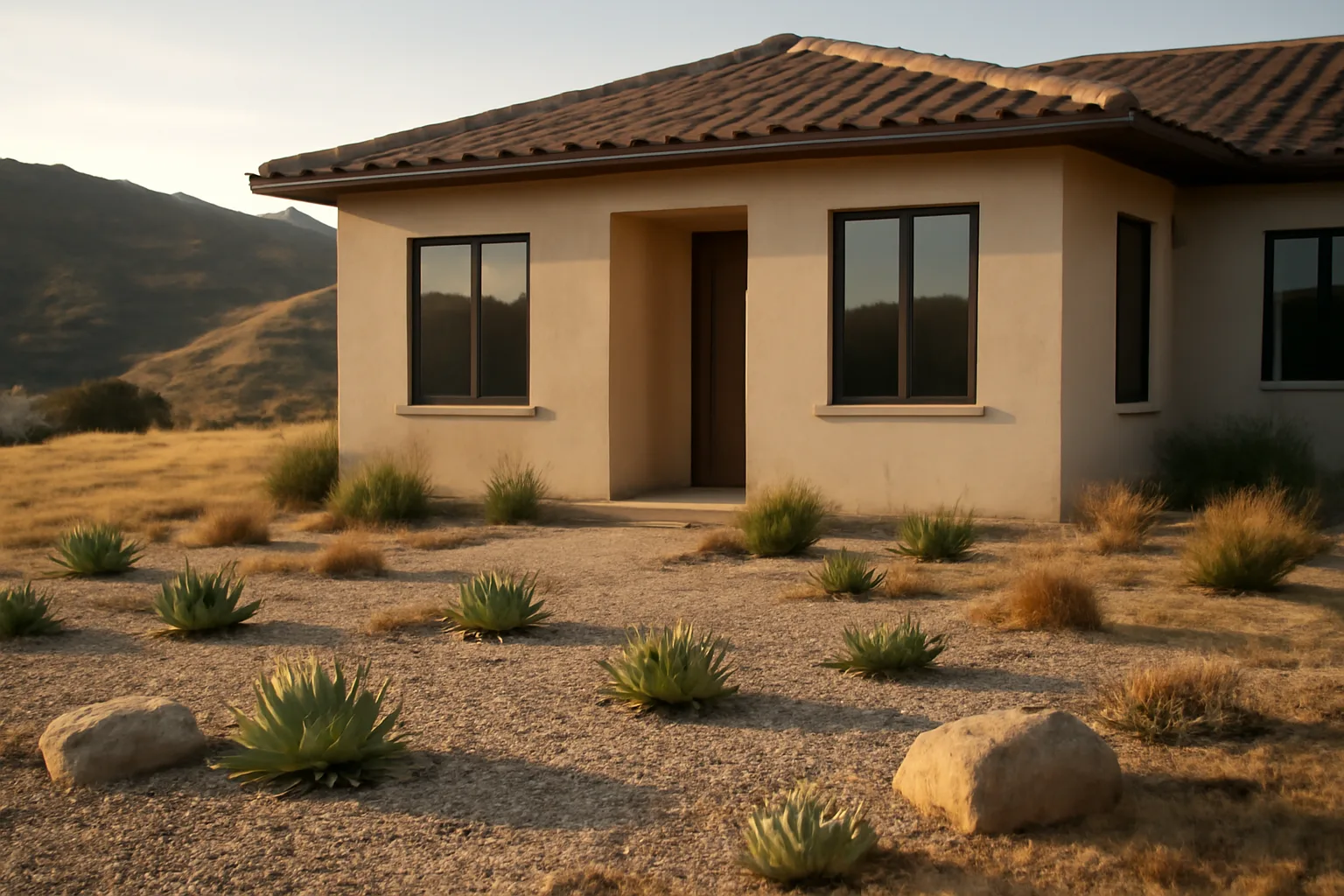
Zone 0 (0-5 feet from structure): This is the highest-priority zone and the one under active rulemaking. Remove bark and wood mulch, replace with gravel, pavers, or bare mineral soil. No shrubs or trees within 5 feet of the structure. No wood fencing attached to the house (attach a metal gate section as a break instead). Clear anything stored under decks or against walls. Zone 1 (5-30 feet): Space trees so canopies are at least 10 feet apart, more on slopes. Remove "ladder fuels," meaning shrubs growing under trees that let fire climb from ground to canopy. Keep grass mowed to 4 inches or less. Prune tree limbs up 6 feet from the ground. Zone 2 (30-100 feet): Reduce total fuel volume, thin dead brush, keep grass cut, space out clumps of vegetation. You don't need bare ground here, just broken continuity so fire can't run unimpeded to your house. | Zone | Distance | Key rule |
Why won't people follow the defensible space law in California?
This is a real and underdiscussed problem, and it's more than laziness. CAL FIRE's own defensible space inspection data shows compliance rates well below 100% in many high-risk counties, and fire agencies have cited cost, labor shortages, and confusion over rules as recurring barriers. Cost is the biggest one. Removing mature trees, regrading Zone 0 to gravel, and hiring a licensed clearing crew can run from a few hundred dollars for a small lot cleanup to $10,000 or more for a heavily wooded acre property, and there's no single statewide subsidy that covers most of that. Some counties and Fire Safe Councils offer cost-share chipper days or reimbursement grants, but availability is patchy and depends on your specific district's budget that year. Confusion is the second big one. Zone 0 rules are still in draft form in the exact sense described above, so homeowners genuinely don't know what the final standard will require, and nobody wants to spend money twice. Add in renters and absentee owners who don't live on the property full time, elderly homeowners who physically can't clear brush themselves, and neighbors on adjoining unmanaged parcels whose fuel load affects your risk regardless of what you do, and you get a landscape where individual compliance doesn't fully solve the neighborhood-level problem. There's also a psychological piece worth naming honestly: defensible space work has to be redone every year. Grass grows back, leaves pile up in gutters, mulch drifts. It's not a one-time project, and that ongoing labor burden is why so many properties look compliant in spring inspection season and non-compliant by August.
How do I prepare for a wildfire (more than landscaping)?
Landscaping buys your house survival odds, but wildfire preparedness is bigger than the yard. Ready.gov's wildfire guidance breaks preparation into three buckets: defensible space, home hardening, and an evacuation plan with a go-bag. Home hardening means the physical building, not the plants around it: ember-resistant vents, Class A fire-rated roofing, enclosed eaves, dual-pane tempered glass windows, and metal or fire-rated gutter guards to keep leaf litter from igniting. Read the room-by-room hardening priorities at defensible space and home hardening basics if you haven't started that list yet. Documentation matters more than most homeowners realize, especially if you've received a non-renewal notice or expect one. Photograph your defensible space work, dated and timestamped, every season. Keep receipts for tree removal, gutter guards, and any Chapter 7A-compliant materials you install. Insurers reviewing wildfire risk increasingly want to see evidence, more than a claim that you did the work. Evacuation planning is the piece people skip until it's too late. Ready.gov recommends knowing two ways out of your neighborhood, keeping your car fueled during fire season, and having a go-bag with medications, documents, and a battery radio ready before a red flag warning, not after.
How can we prevent wildfires and forest fires overall?
Individual defensible space work matters, but it's worth being honest that most California wildfires start from a small number of recurring causes, and prevention at scale means addressing those causes directly. CAL FIRE data attributes a large share of wildfire ignitions to human causes: equipment use, vehicle fires, unattended campfires, arson, and power line failures, rather than lightning, which is the dominant natural cause mainly in remote forest areas. At the individual level, the things that actually move the needle: don't mow dry grass during red flag warnings (a lawnmower blade striking a rock is a classic ignition source), maintain equipment so trailer chains don't drag sparks on pavement, follow local burn permit rules and never burn debris on windy days, and check that your vehicle's catalytic converter and exhaust system are in good repair since parking on dry grass with a hot undercarriage causes real fires every year. At the community level, prevention means supporting local Fire Safe Council chipper programs, reporting downed power lines immediately, and pushing utilities on Public Safety Power Shutoff compliance in your area. None of this is glamorous, but ignition prevention and defensible space work together; one keeps a fire from starting, the other keeps a started fire from taking your house.
How do I prepare for a forest fire if I live near wildland?
If your property borders wildland or open forest, the 100-foot defensible space zone often isn't the limiting factor, it's what's happening on neighboring land you don't control. Talk to your neighbors and, where it exists, your local Fire Safe Council about coordinated fuel breaks; a single well-cleared lot next to an overgrown one still burns. Check your Fire Hazard Severity Zone designation on CAL FIRE's maps, since that classification affects which building code requirements (Chapter 7A) and defensible space enforcement apply to your specific parcel [3]. Rural properties often also need a second access route cleared for fire apparatus, and a water source (pond, tank, or hydrant) marked and accessible, since response times in remote areas run longer than in dense suburbs. Stock a go-bag with N95 or P100 masks (wildfire smoke, more than flame, is a major health risk), copies of property documents, and a battery-powered radio, since cell service and power often fail first in remote fire zones.
Is Santa Barbara safe from fire?
No California coastal city is "safe" from fire in an absolute sense, and Santa Barbara County has one of the more serious wildfire histories in the state, not one of the mildest. The 2017 Thomas Fire burned roughly 281,893 acres across Ventura and Santa Barbara counties and was, at the time, the largest wildfire in modern California history, according to CAL FIRE's incident archive [4]. The subsequent debris flow in Montecito in January 2018 killed 23 people, a reminder that post-fire landslide risk on burned hillsides is its own hazard, more than a footnote. Santa Barbara's foothill communities (Montecito, Mission Canyon, the Riviera) sit directly against chaparral-covered slopes that are classified as Very High Fire Hazard Severity Zones on CAL FIRE's maps [3]. If you own property there, defensible space compliance and home hardening aren't optional extras, they're the difference multiple studies of the 2017-2018 fires pointed to between homes that survived ember exposure and homes that didn't. The honest answer: parts of Santa Barbara (dense urban core, flatter areas away from the hills) carry lower wildfire exposure than the foothill communities, but "Santa Barbara" as a whole is not a low-risk wildfire region, and insurers have treated it that way for years.
What should I document before an insurance non-renewal review?
If you've received a non-renewal notice or an inspection letter, documentation is the single highest-leverage thing you control right now. This isn't about negotiating with your insurer (a public adjuster does that, and we don't); it's about having a clear, dated packet ready if you request reconsideration, apply to a new carrier, or apply to your state's FAIR Plan. What to include: dated photos of all three defensible space zones taken from the same vantage points each season, receipts for any tree removal, mulch replacement, or vent screening, a copy of your most recent CAL FIRE or local fire department defensible space inspection result if you have one, and your property's Fire Hazard Severity Zone designation printed from CAL FIRE's map tool [3]. This is exactly the gap our $99 Wildfire Insurance Survival Kit is built for: a structured way to organize defensible space photos, hardening receipts, and inspection records into the packet insurers and FAIR Plans actually ask for, so you're not scrambling the week a non-renewal letter arrives. You still send it yourself; we don't file claims or negotiate coverage on your behalf. Start at /survival-kit-builder. For a fuller walkthrough of what actually triggers a wildfire-related non-renewal and how inspection scoring tends to work, see house fire and fire at a house.
How does California's defensible space law compare to other wildfire states?
California's PRC 4291 100-foot, three-zone system is one of the more detailed defensible space statutes in the country, but it's not unique. Washington State's Department of Natural Resources runs cost-share clearing contract programs for landowners doing similar fuel-reduction work, structured differently but aimed at the same ember and fuel-continuity problem; see wildfire defensible space clearing contracts, Washington State DNR for how that compares. Colorado and Oregon both have defensible space guidance tied to their state forestry agencies, but neither currently has a statewide statute as prescriptive as California's zone system with its specific foot-by-foot breakdown. Arizona's defensible space rules are generally set at the county or fire district level rather than a single statewide law. The throughline across every state: embers, not walls of flame, cause most home ignitions, and every serious program (California's Zone 0, Washington's DNR contracts, Oregon's guidance) targets the same 5-foot noncombustible perimeter as the highest-leverage fix homeowners can make.
Frequently asked questions
When does the California defensible space law go into effect?
The core 100-foot, three-zone defensible space law (PRC 4291) is already in effect and has been for years. The newer Zone 0 ember-resistant zone rules from AB 3074 are still finalizing through the Board of Forestry's rulemaking process, with statewide applicability expected around 2025-2026 depending on when the regulation is formally adopted. Check the Board's current status before assuming a hard date.
Why won't people follow the defensible space law in California?
Cost, confusion over still-finalizing Zone 0 rules, and the fact that clearing work has to be redone every year are the biggest reasons. Removing mature trees or regrading to gravel can cost thousands, subsidy programs are patchy by county, and many owners (especially elderly or absentee owners) can't physically or logistically keep up with annual re-clearing.
How do I prevent wildfires from starting near my property?
Avoid mowing dry grass during red flag warnings, keep vehicles and equipment off dry grass (hot exhaust systems ignite fires), follow local burn permit rules, and never burn debris on windy days. Most California wildfires are human-caused, per CAL FIRE, so equipment maintenance and fire-safe habits prevent more fires than landscaping alone.
How do I prepare for a wildfire if I get an evacuation warning?
Have a go-bag packed with medications, documents, and a battery radio before fire season starts. Know two evacuation routes out of your neighborhood, keep your car fueled, and follow Ready.gov's guidance to leave early rather than waiting for a mandatory order, since roads clog fast during real evacuations.
How do I prevent forest fires when camping or working outdoors?
Fully drown and stir campfires until cold to the touch, never leave a fire unattended, check local burn restrictions before any debris burning, and keep spark-producing equipment (chainsaws, grinders, mowers) away from dry vegetation, especially during red flag warning days when wind and low humidity turn small sparks into fast-moving fires.
What fire-safe home rules take effect in 2026?
No single confirmed 2026 mandate exists yet; California's Zone 0 ember-resistant zone regulation (from AB 3074) is the main pending rule expected to take effect around 2025-2026 once the Board of Forestry finalizes it. Chapter 7A wildfire building code requirements for new construction are already in effect in Fire Hazard Severity Zones.
Is Santa Barbara safe from fire?
No. Santa Barbara County includes some of California's highest wildfire-risk foothill communities, including areas burned in the 2017 Thomas Fire, one of the largest fires in modern California history at the time. Coastal flat areas carry lower risk than foothill neighborhoods like Montecito, but the region overall is not low-risk.
What is Zone 0 and why does it matter so much?
Zone 0 is the 0-5 foot area immediately around a structure, where CAL FIRE and the Board of Forestry are finalizing ember-resistant rules requiring noncombustible surfaces and no attached wood fencing. It matters because most home ignitions in wildfires come from embers landing near or against the structure, not direct flame contact.
How much does fire-safe landscaping cost in California?
Costs vary widely by lot size and vegetation density: a small suburban lot cleanup might run a few hundred dollars in labor and mulch replacement, while a heavily wooded acre property needing tree removal and Zone 0 regrading can run $5,000 to $10,000 or more. Some Fire Safe Councils offer cost-share chipper days that reduce costs.
Does defensible space landscaping guarantee my insurance won't be canceled?
No. Defensible space and home hardening reduce risk and strengthen your documentation for reconsideration requests, but no landscaping work guarantees an insurer keeps or reinstates a policy. Insurers weigh regional risk models, claims history, and reinsurance costs alongside your property's condition. Compliance helps your case; it doesn't obligate any specific coverage outcome.
What plants are considered fire-resistant in California?
No plant is fireproof, but low-moisture, low-resin plants with high water content (many succulents, certain native groundcovers, well-maintained lawns) resist ignition better than resinous shrubs like juniper or dense ornamental grasses. Spacing and maintenance (removing dead material, keeping plants irrigated) matter more than species choice alone for actual fire behavior.
Who enforces defensible space law in California?
CAL FIRE enforces defensible space requirements in State Responsibility Areas, while local fire departments or fire districts enforce it in Local Responsibility Areas that have adopted similar ordinances. Enforcement typically starts with an inspection notice and a compliance deadline before citations or fines follow; specific enforcement timelines vary by jurisdiction.
Sources
- California Public Resources Code Section 4291: 100-foot, three-zone defensible space requirement and zone distances
- California Legislature, Assembly Bill 3074 (2020): AB 3074 directed the Board of Forestry to adopt Zone 0 ember-resistant zone regulations
- CAL FIRE, Fire Hazard Severity Zones: Fire Hazard Severity Zone maps determine Chapter 7A building code applicability
- CAL FIRE, Thomas Fire incident record: 2017 Thomas Fire burned roughly 281,893 acres and was the largest California wildfire at the time
- CAL FIRE - Ready for Wildfire: Defensible space is created by establishing and maintaining required clearance zones around structures in California.
- California Department of Insurance: The California Department of Insurance provides guidance for homeowners on wildfire risk, insurance non-renewals, and documentation.
- CAL FIRE: California's defensible space law establishes two zones extending 100 feet from structures with different vegetation management requirements.
- California Office of the State Fire Marshal: New Wildland-Urban Interface building standards for fire-safe home construction are set to take effect in California.
- National Fire Protection Association (Firewise USA): Firewise USA offers a national framework for community wildfire risk reduction used for comparison across wildfire-prone states.