Last updated 2026-07-25
TL;DR
You can't make a house fireproof, but you can make it far more likely to survive a wildfire. CAL FIRE's Zone 0 ember-resistant zone rules (5 feet from structures) were due to take effect in 2023 but remain delayed as of 2025; combined with vent screening, Class A roofing, and 100 feet of defensible space, these steps address the main ways homes actually ignite.
Can a house in California actually be fireproof?
No. There is no such thing as a fireproof house, and any contractor who tells you otherwise is selling something. What exists instead is "hardening," a set of construction and landscaping choices that dramatically reduce the odds a home ignites during a wildfire. The research behind this comes mostly from the Insurance Institute for Business & Home Safety (IBHS) and CAL FIRE post-fire damage assessments. Homes lost in wildfires usually don't burn because a wall of flame rolls over them. They ignite from embers, wind-blown sparks that can travel over a mile ahead of the actual fire front, landing in gutters, on wood decks, in vent openings, or in dry mulch against the foundation. CAL FIRE's own guidance states plainly that "most homes destroyed during wildfires ignite from small embers, not the wall of flame". That single fact reframes the whole project. You're not building a bunker. You're removing the small stuff embers can catch on, ignite, and use as a bridge to the rest of the house. Do that well and a "fireproof" house becomes a survivable one, which is the realistic goal.
When does the California defensible space law go into effect?
California's core defensible space law, Public Resources Code 4291, has been in effect for years and currently requires 100 feet of defensible space clearance around structures in State Responsibility Areas and some Local Responsibility Areas classified as Very High Fire Hazard Severity Zones [1]. That part isn't new and isn't waiting on anything. What's newer, and where people get confused, is the "Zone 0" ember-resistant zone rule, the 0 to 5 foot ring immediately around a home. The California legislature passed AB 3074 in 2020, directing the Board of Forestry and Fire Protection to develop specific ember-resistant zone regulations for that 5-foot ring [2]. The law originally set a target implementation date, but the actual regulatory text has gone through repeated delays as the Board works through the rulemaking process. As of late 2025, Zone 0 regulations have not been finalized into enforceable code; the Board of Forestry has continued workshops and draft language but has pushed the effective date back multiple times. If you're asking "what fire safe home rules take effect in 2026," the honest answer is: check your local fire district and CAL FIRE's Board of Forestry page directly, because the timeline keeps moving and any specific date here would go stale fast. Some jurisdictions, including parts of the Berkeley and Oakland hills, adopted their own Zone 0-style ember-resistant zone ordinances ahead of the state, so local rules may already be stricter than what the state finalizes. Treat this as a guided fill-in: [find your fire district's current defensible space ordinance here] before assuming the statewide Zone 0 rule already applies to you. The practical move, regardless of what date the regulation lands on, is to build your 5-foot zone as if the strictest version is already law. Retrofitting gravel and hardscape around your foundation costs less now than tearing out mature landscaping later under a compliance deadline.
Why won't people follow the defensible space law in California?
Compliance with PRC 4291 is spotty, and it's not really a mystery why. Cost, labor, aesthetics, and enforcement gaps all play a part. Clearing 100 feet of vegetation on a sloped, wooded lot is physical labor that can run into the thousands of dollars if you hire it out, and CAL FIRE inspections in many counties are complaint-driven or resource-limited rather than universal annual checks. Some homeowners genuinely don't know the rule applies to them; others know but treat a mailed notice as low-priority until an inspector actually shows up. There's also a real tension between defensible space requirements and homeowners who value mature trees and dense landscaping for privacy, shade, or simply because they like how it looks. Removing decades-old growth is an emotional decision as much as a practical one. Enforcement varies a lot by county too. Some fire districts issue citations and follow up; others send a letter and move on. That inconsistency teaches people that the law is more of a suggestion, until a fire moves through the county and suddenly it isn't. If you got a non-renewal letter or an inspection notice, don't wait for a second one. For a walkthrough of what compliant clearing actually looks like zone by zone, see defensible space zones.
How do you prepare for a wildfire before it starts?
Preparing for a wildfire happens in three phases: harden the structure, clear the landscape, and get your documentation and evacuation plan ready. Most homeowners only do the third one, and only after a red flag warning is already posted. Ready.gov's wildfire preparedness guidance recommends building an emergency kit, planning two evacuation routes out of your neighborhood, and signing up for local emergency alerts before fire season starts, not during it. That's the baseline. Layer defensible space and home hardening on top and you've covered the parts that actually determine whether the house is still standing when you come back. A reasonable prep order looks like this: first, address the 5-foot zone around the house (gravel, no mulch, no combustible furniture). Second, work outward through 5 to 30 feet (thinned, spaced plants, no ladder fuels under trees). Third, handle 30 to 100 feet (reduced brush density, mowed grass). Fourth, check the house itself: vents, roof, gutters, deck. Fifth, build your documentation kit: photos of the exterior dated and timestamped, a copy of your defensible space inspection if you have one, receipts for hardening work. Insurers increasingly ask for this kind of proof when deciding on renewal, and having it organized before you're asked saves real time. We built a $99 one-time Wildfire Insurance Survival Kit at /survival-kit-builder specifically for that documentation step, organizing photos and receipts into the format insurers actually want to see. We don't file claims for you or represent you in disputes; you send your own documentation, but at least it's ready instead of scattered across three phones and a shoebox.
How do you prevent wildfires from starting in the first place?
Roughly 85 to 90% of wildfires in the US are human-caused, according to the National Interagency Fire Center and cited widely by federal land agencies, meaning most ignitions come from things people did wrong, not lightning [3]. That's the point where prevention actually happens. The common causes are unattended campfires, debris burning on windy or dry days, dragging trailer chains that spark on pavement, parking hot vehicles over dry grass, and downed power lines. CAL FIRE's public safety guidance emphasizes checking local burn day restrictions before any outdoor burning, making sure campfires are fully out (cold to the touch, more than no visible flame) before leaving them, and avoiding outdoor equipment use like mowers or grinders during red flag warning days. At the community level, prevention also means supporting or complying with utility Public Safety Power Shutoffs during extreme wind events, even though they're inconvenient, because downed or arcing power lines are a documented ignition source in several of California's largest fires. None of this is glamorous. It's mostly just being boring and careful on the exact days when it's tempting not to be.
How can individuals and communities prevent forest fires?
Forest fire prevention splits into personal behavior and land management, and both matter. On the personal side: obey local fire restrictions, never leave a campfire unattended, don't burn debris on windy days, and check that trailer chains aren't dragging on the road. On the land management side, the U.S. Forest Service and CAL FIRE both point to fuel reduction, prescribed burns, and mechanical thinning as the main tools for reducing the intensity and spread of forest fires once they start [4]. Homeowners near wildland interface areas can support this indirectly by maintaining their own defensible space (which breaks fuel continuity at the neighborhood edge) and by not opposing prescribed burn programs in their area, since public pushback is one of the practical barriers land managers cite for why more prescribed burning doesn't happen. If you live at the edge of a forested area, your 100-foot defensible space zone isn't just about your house. It's a firebreak that can slow spread toward your neighbors too. That's part of why some fire districts treat non-compliance as a community issue, more than a personal one.
What home hardening actually stops embers from getting in?
Four things account for most of the ember-entry risk: vents, roofing, decks, and windows. Get those right and you've closed off the paths embers actually use to get inside or under a structure. Vents (attic, crawlspace, foundation) need 1/8 inch metal mesh screening at minimum; some newer ember-resistant vent products are tested to a higher standard and are worth the upgrade cost if you're already replacing vents. Roofing should be Class A rated; this is often already required by code for new construction and re-roofing in Wildland-Urban Interface zones, but older homes with wood shake roofs are a serious liability if not yet replaced. Decks attached to the house should avoid combustible material within the first few feet, and any storage under a deck (firewood, propane, cushions) is a fire risk that's entirely within a homeowner's control. Windows should be dual-pane; single-pane glass can crack from radiant heat and let embers or flame directly into the house. Gutters matter more than people think: dry leaves in a gutter are exactly the kind of ember-catching fuel CAL FIRE warns about, and clearing them before fire season is a 30-minute job most people skip. For a full room-by-room and exterior checklist, see fire safe landscaping California next to house, which covers the planting choices that pair with structural hardening.
Is Santa Barbara safe from fire?
No area in California's wildland-urban interface is "safe" from fire risk, and Santa Barbara County has direct experience with this: the 2017 Thomas Fire burned over 281,000 acres and was, at the time, the largest wildfire in modern California history, followed within weeks by the Montecito debris flow that killed 23 people when saturated burn-scarred hillsides gave way during heavy rain [5]. That sequence, fire followed by mudslide, is specific to Santa Barbara's steep coastal terrain and is a risk pattern residents there need to plan around beyond just the fire itself. Santa Barbara County sits partly in a Very High Fire Hazard Severity Zone per CAL FIRE's mapping, meaning PRC 4291's 100-foot defensible space requirement applies to many properties in the foothill and interface areas [1]. The county and city fire departments do inspections; check with Santa Barbara County Fire or your specific district for the exact clearance and inspection schedule for your address, since it varies by jurisdiction even within the county. If you're asking this question because you're deciding whether to buy, renovate, or insure a home there, the honest framing is: it's not a yes/no safety question, it's a risk-management one. Homes with proper defensible space and hardening in the same neighborhoods that burned in 2017 had meaningfully better survival outcomes than unhardened homes nearby, consistent with what IBHS and CAL FIRE post-fire assessments generally find across California fires.
What's the difference between defensible space and home hardening?
| Defensible space Zone 0 | 0-5 ft from structure, ember-resistant zone | Pending CAL FIRE Board of Forestry regulation under AB 3074 [2] | |
|---|---|---|---|
| Defensible space Zone 1 | 5-30 ft, lean/clean/green vegetation spacing | PRC 4291 [1] | |
| Defensible space Zone 2 | 30-100 ft, reduced fuel density | PRC 4291 [1] | |
| Home hardening | Roof, vents, siding, windows, decks | Chapter 7A, California Building Code, in WUI zones | A house with a perfect Class A roof and ember-resistant vents surrounded by dry brush right up to the foundation is still a high-risk house. Likewise, a beautifully cleared 100-foot perimeter doesn't help much if the attic vents have quarter-inch mesh that embers sail straight through. You need both, and the state increasingly treats them as connected. Read more on the mechanics of each zone at defensible. |
Defensible space is what you do to the land around the house (vegetation clearance, spacing, fuel reduction). Home hardening is what you do to the structure itself (roofing, vents, siding, windows). California law and insurers care about both, and skipping either one weakens the other. | Category | What it covers | Governed by |
What does a completed fire-hardened property actually look like?
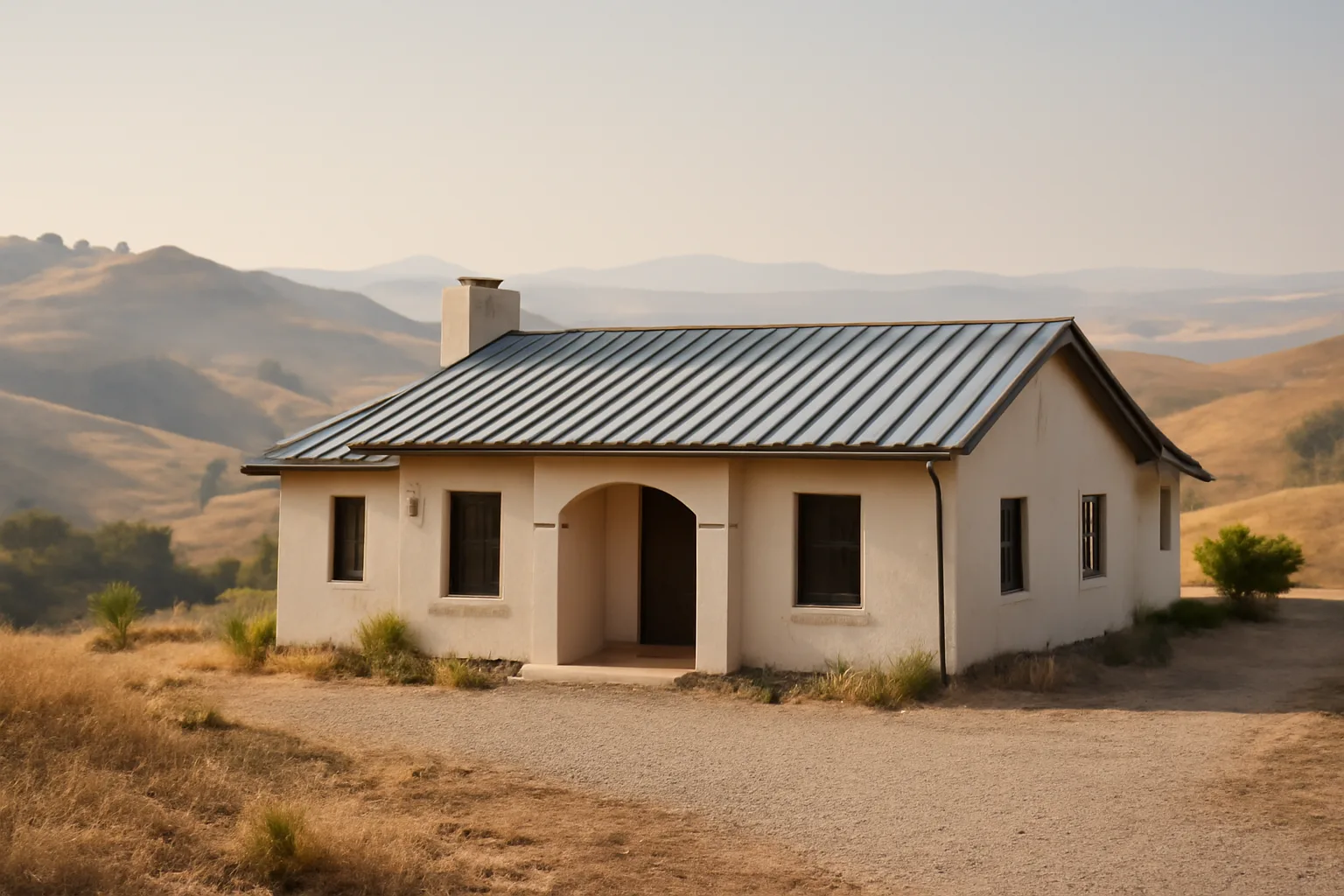
Picture the 5-foot ring around the foundation as gravel, rock, or bare soil, not mulch, not shrubs, not a woodpile. Move outward and the next 25 feet has widely spaced, low, well-irrigated plants with no continuous fuel path up into tree canopies. Beyond that, out to 100 feet, grass is mowed short, dead branches and leaf litter are cleared, and trees are limbed up 6 to 10 feet so ground fire can't climb into the crown. On the house itself: a Class A roof with no debris in the gutters, 1/8 inch metal vent screens on every attic and crawlspace vent, dual-pane windows, and a deck free of stored combustibles underneath. Address numbers are visible from the road for responding fire crews, which sounds minor but is specifically called out in many local ordinances because crews genuinely can't help a house they can't find in smoke and dark. That's the physical picture. The paper picture matters too: dated photos of all of the above, any professional inspection reports, and receipts for hardening work, organized somewhere you can actually find them when an insurer sends a renewal questionnaire or non-renewal notice.
What should you do first if you already got a non-renewal letter?
Read the letter carefully for the specific reason given, since insurers in California are required to provide one, and it often points to a specific defensible space or hardening deficiency you can actually fix. Take dated photos of your property's current condition before you start any work, so you have a clear before-and-after record. Then prioritize in this order: fix whatever the letter specifically cited, complete or update your 100-foot defensible space clearance, address the highest-risk hardening gaps (vents and roof first, since those are the most common ember entry points), and compile everything into a single document packet. California's FAIR Plan exists as a last-resort option if standard coverage isn't available, but it's not a substitute for having your own hardening and documentation in order, since it typically offers less coverage at a higher cost than standard policies. This is also where having a structured kit helps more than a folder of random phone photos. Our $99 Wildfire Insurance Survival Kit at /survival-kit-builder is built around exactly this documentation gap: organizing dated photos, inspection records, and hardening receipts into the format insurers ask for. We don't file the claim or talk to your insurer for you, we're not public adjusters, and we can't promise reinstatement or a discount. What we do is make sure the paperwork you send is complete and dated the first time, instead of trickling in over three follow-up requests.
How do you know if your defensible space actually meets code?
The only way to know for certain is a CAL FIRE or local fire district inspection, since requirements vary by jurisdiction, slope, and vegetation type even within the same 100-foot rule. Many counties offer free or low-cost defensible space inspections on request, and some require them before issuing a renewal for certain permits. Short of a formal inspection, CAL FIRE's defensible space checklist covers the core items: no dead vegetation within 5 feet of structures, trees limbed 6-10 feet up, propane tanks with 10 feet of clearance, and stacked firewood at least 30 feet from the house. Photograph each zone once you believe it's compliant; that documentation becomes useful both for insurer communication and as a baseline if a neighbor's overgrowth later creates risk on a shared property line. If your property backs onto wildland or a neighbor's unmaintained lot, know that PRC 4291 compliance is measured from your structure outward regardless of property lines, meaning you may need to work with a neighbor or request enforcement if their vegetation encroaches into your required clearance zone [1].
Frequently asked questions
When does the California defensible space law go into effect?
The 100-foot defensible space requirement under PRC 4291 has been law for years already. The newer "Zone 0" ember-resistant zone rule for the 0-5 foot ring, created by AB 3074 in 2020, has been repeatedly delayed in the regulatory process and was not finalized as of late 2025. Check your local fire district for current enforcement dates.
Why won't people follow the defensible space law in California?
Cost of clearing vegetation, inconsistent county-level enforcement, low awareness of the rule, and reluctance to remove mature trees and shrubs are the main reasons. Some fire districts only inspect on complaint, so many properties simply never get checked until after a fire or a non-renewal letter forces the issue.
How do you prevent wildfires from starting?
Since roughly 85-90% of US wildfires are human-caused per the National Interagency Fire Center, prevention mostly means never leaving campfires unattended, avoiding outdoor burning on windy or restricted days, not dragging trailer chains on pavement, and avoiding equipment use during red flag warnings.
How do you prepare for a wildfire?
Build your emergency kit and two evacuation routes per ready.gov guidance, then work outward from your house: harden the 5-foot ember zone, complete 100 feet of defensible space, fix vents and roofing, and compile dated photos and receipts documenting all of it before fire season starts.
How do you prevent forest fires at a larger scale?
Forest-level prevention relies on fuel reduction, prescribed burning, and mechanical thinning managed by agencies like the U.S. Forest Service and CAL FIRE. Individuals help by following burn restrictions, maintaining defensible space that breaks fuel continuity, and supporting rather than opposing local prescribed burn programs.
How do you avoid forest fires as an individual?
Follow local burn day restrictions, fully extinguish campfires (cold to the touch, more than no flame visible), never park hot vehicles over dry grass, and check trailer chains aren't dragging and sparking on roads. Most forest fire starts trace back to one of these preventable behaviors.
What fire-safe home rules take effect in 2026?
As of late 2025, California's Zone 0 ember-resistant zone regulation (the 5-foot ring around structures) has not been finalized into enforceable statewide code, despite earlier target dates. Some jurisdictions like parts of Berkeley and Oakland already enforce their own version. Check your local fire district directly rather than assuming a fixed 2026 date.
Is Santa Barbara safe from fire?
No, Santa Barbara County sits partly in a Very High Fire Hazard Severity Zone and experienced the 281,000-acre Thomas Fire in 2017 followed by a deadly debris flow. Homes there with proper defensible space and hardening fare meaningfully better, but the area isn't fire-safe by default; it requires active mitigation.
Can a house actually be made fireproof?
No house is truly fireproof. "Fire-hardened" is the accurate term: Class A roofing, ember-resistant vents, cleared defensible space, and non-combustible materials near the foundation dramatically reduce ignition risk from embers, which CAL FIRE identifies as the cause of most home losses in wildfires, but they don't guarantee survival.
What's the difference between Zone 0, Zone 1, and Zone 2?
Zone 0 is 0-5 feet from the structure (ember-resistant, non-combustible materials, pending state regulation). Zone 1 is 5-30 feet (lean, clean, and green vegetation spacing). Zone 2 is 30-100 feet (reduced fuel density, mowed grass, cleared dead vegetation). All fall under PRC 4291 except Zone 0's specific rule, still pending.
What should I do first after getting a wildfire insurance non-renewal letter?
Read the stated reason carefully, since insurers must provide one, take dated photos of current property conditions, then fix the specific deficiency cited plus complete your 100-foot defensible space and vent/roof hardening. Compile everything into one documented packet before responding or reapplying elsewhere.
Does the California FAIR Plan replace standard homeowners insurance?
No, the FAIR Plan is a last-resort option when standard coverage isn't available, and it typically provides less coverage at higher cost than a standard policy. It's not a substitute for defensible space compliance and home hardening, which remain the main levers for regaining standard market eligibility over time.
How much defensible space clearance does California require?
California Public Resources Code 4291 requires 100 feet of defensible space clearance around structures in State Responsibility Areas and applicable Local Responsibility Areas classified as Very High Fire Hazard Severity Zones, broken into a 0-30 foot zone and a 30-100 foot zone with different vegetation standards.
Sources
- California Public Resources Code Section 4291: 100 feet of defensible space is required around structures in State Responsibility Areas / Very High Fire Hazard Severity Zones
- California Assembly Bill 3074 (2020): AB 3074 directed the Board of Forestry and Fire Protection to develop ember-resistant zone (Zone 0) regulations for the 0-5 foot area around structures
- National Interagency Fire Center, Statistics: Approximately 85-90% of wildfires in the US are human-caused
- USDA Forest Service, Fire and Fuels Management: Fuel reduction, prescribed burns, and mechanical thinning are primary tools for reducing wildfire intensity and spread
- CAL FIRE, Thomas Fire Incident Archive: The 2017 Thomas Fire burned over 281,000 acres and was the largest wildfire in modern California history at the time
- California Department of Insurance, FAIR Plan: The California FAIR Plan is a last-resort insurance option offering less coverage at higher cost than standard policies