Last updated 2026-07-25
TL;DR
A fire-resistant home safe rated UL 350 for one hour keeps interior temperatures below 350°F for that period, enough to protect paper but not always electronics or media. In a wildfire, house fires can burn well past that rating, so a safe is a backup, not a substitute for taking your documents and a go-bag with you when you evacuate.
what does a fire resistant safe actually protect against
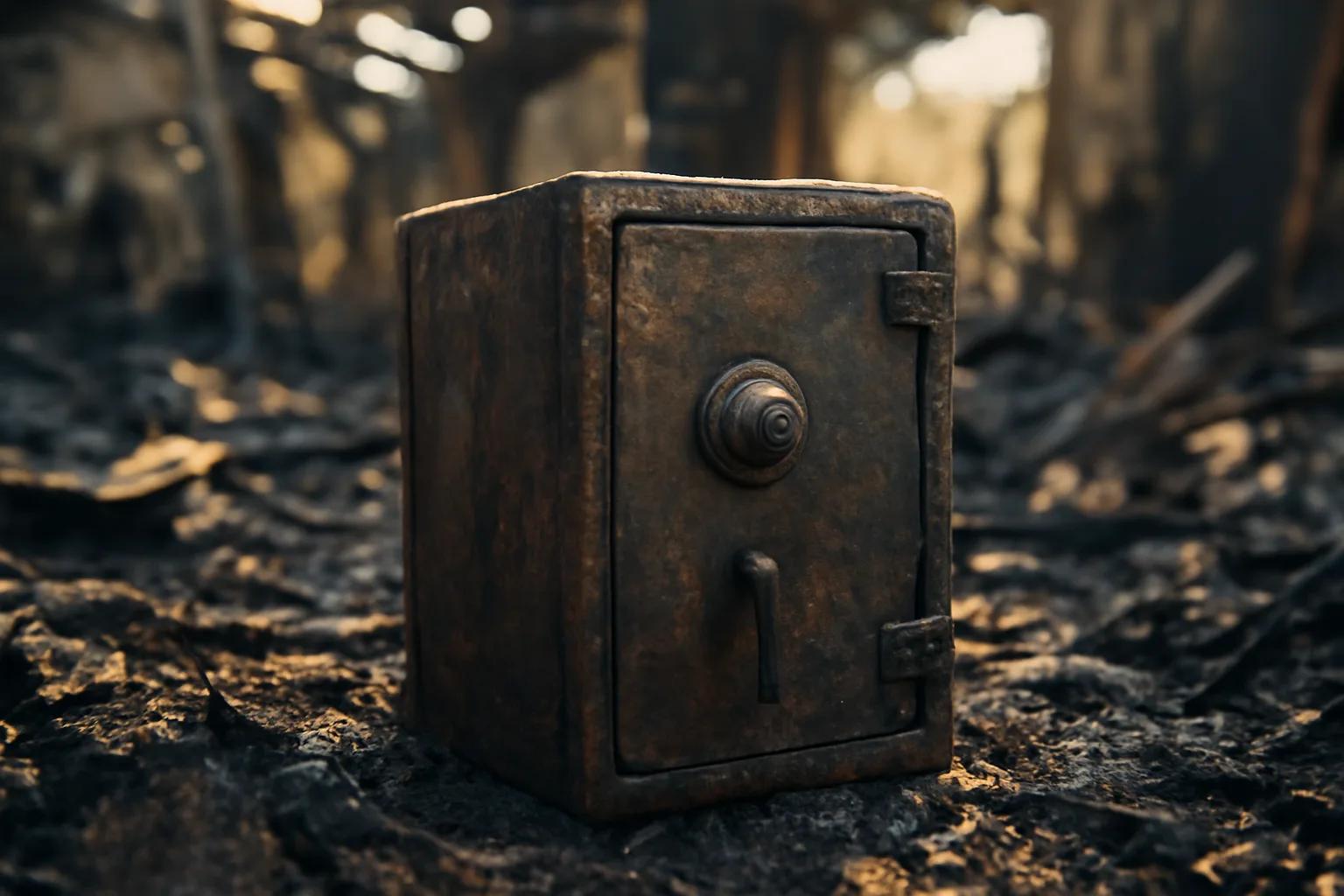
A fire-resistant home safe is built to slow heat transfer to whatever is inside, not to stop fire entirely. The most common independent standard is UL 350, from Underwriters Laboratories, which tests whether the interior of a safe stays below 350°F for a set duration (commonly 30 minutes, 1 hour, or 2 hours) while the outside is exposed to fire temperatures that can exceed 1,550°F. Paper chars around 400 to 450°F, so a safe that holds its interior under 350°F for the tested duration protects documents, but the same safe may not protect thumb drives, hard drives, or photographic film, which need lower thresholds. Some manufacturers sell separate "media safes" rated to keep interiors below 125°F for that reason. Here's the part people miss: the UL rating is a lab test, not a promise about your house. It tells you how the safe performs in a controlled furnace test, dropped once from 30 feet to simulate a floor collapse, then reheated. It does not tell you how long your specific wildfire, or a structure fire following an ember intrusion, will burn at your house. A one-hour-rated safe in a room that burns for three hours because nobody could get water on it may still fail. So think of a fire safe as buying you time and probability, not certainty. It's one layer, alongside getting the actual documents out with you when you evacuate.
what fire rating do i actually need for a home safe
| UL 350 1-hour | 350°F for 1 hour | Paper documents, passports | |
|---|---|---|---|
| UL 350 2-hour | 350°F for 2 hours | Documents in high-risk, delayed-response areas | |
| UL 125 media rating | 125°F, low humidity | USB drives, external hard drives, film | |
| No UL label, "fire resistant" claim only | Untested | Treat as unverified | If you're in a wildfire-prone area with long response times because of narrow roads, one exit, or a fire district stretched thin during red flag days, lean toward the two-hour rating and a media-rated unit for backups, more than the cheapest UL 350 box at the hardware store. Check placement too. A safe on a wood floor in an upstairs closet will fall through if the floor burns, and the drop plus a new burn cycle at ground level is exactly the scenario UL's drop test tries to simulate, but real houses don't always match lab conditions. |
For most households, a UL 350 one-hour rated safe is the practical minimum, and a two-hour rating is better if you live somewhere fire crews may be delayed or unable to reach your block during a wildfire evacuation. Look for the UL label itself, more than marketing language like "fireproof," which isn't a real testing category. A rough guide: | Rating | Interior stays below | Typical use |
how to prepare for a wildfire before you get an evacuation order
Preparation for a wildfire has two tracks: what you do to the house and land, and what you do with your documents and go-bag. Ready.gov, the federal disaster preparedness site, recommends assembling a go-bag with copies of insurance policies, identification, medical information, and a list of household belongings before wildfire season starts, not during an active evacuation. CAL FIRE's Ready For Wildfire program breaks preparation into three stages: Ready (harden your home and prep an evacuation kit year-round), Set (when a wildfire threat is developing in your area, load your car and stay alert to alerts), and Go (leave immediately when told, don't wait to see if the fire actually reaches you) [1]. A fire safe fits into the Ready stage, but originals of the most critical documents (passports, deeds, medical directives) should go in your car during Set, not stay locked in a safe you're hoping survives. A practical prep list: - Keep a fireproof document bag or the safe stocked with copies of insurance declarations pages, deeds, and ID, updated at least once a year
- Photograph every room and your exterior for a documented home inventory, store it off-site (cloud, a relative's house) as well as in the safe
- Store a go-bag near an exit door with medications, phone chargers, and the original documents you'd grab in 5 minutes
- Know your evacuation routes before red flag warnings, not during one For a broader walkthrough of what to document and how insurers actually want to see it, DefensibleHome's $99 Wildfire Insurance Survival Kit is built around exactly this gap: a structured way to photograph, log, and store your home inventory so you have something concrete to hand an adjuster, whether or not the paper version in your safe makes it out.
how to prevent wildfires from starting near your home
Most wildfires that threaten homes in the U.S. are human-caused. Roughly 85% of wildfires nationally are started by people, according to the National Interagency Fire Center data cited by the U.S. Forest Service, through causes like unattended campfires, debris burning, equipment sparks, and downed power lines [2]. Preventing wildfires at the household level means managing ignition sources on your own property and immediately around it. The practical actions: never burn debris on windy or red flag days, keep chainsaws, mowers, and trimmers away from dry grass (a mower blade striking a rock is a documented ignition source in several state investigations), maintain vehicle spark arrestors if you drive off-road near dry vegetation, and fully extinguish campfires and cigarettes, drowning and stirring ash rather than just dousing the visible flame. Utility-caused fires from downed lines or vegetation contact with power equipment are a smaller but serious share, which is part of why many states now require utilities to file wildfire mitigation plans. At the property level, prevention overlaps heavily with defensible space work: clearing dead vegetation, spacing shrubs, and keeping gutters free of needles reduces the chance that an ember landing near your house finds fuel to ignite. For the landscaping side of this, see fire safe landscaping California next to house.
how to prevent forest fires and avoid forest fires on public land
Preventing forest fires on public land comes down to campfire discipline, vehicle and equipment care, and following local fire restrictions, which change by season and by district. The U.S. Forest Service and CAL FIRE both publish "only you can prevent wildfires" style guidance built around a short list: build campfires only in designated rings, keep them small, never leave them unattended, and drown, stir, and feel the ash before leaving [1] [2]. Avoiding forest fires as a visitor or resident near wildland areas also means checking local burn bans before any outdoor burning, since many counties suspend debris burning permits entirely during dry months, and the rules differ by fire district, so check with your local fire authority before burning anything. Smokey Bear's ignition-prevention messaging, run by the Forest Service since 1944, is still the most widely cited public campaign because the underlying behaviors it targets (unattended fires, tossed cigarettes, fireworks in dry grass) remain the top preventable causes decade after decade [2]. For homeowners specifically, the overlap between "prevent forest fires" and "protect my house" is defensible space. A forest fire only becomes a house fire if there's a fuel path from the wildland to your structure. See defensible for the zone-by-zone breakdown, and only you can prevent wildfires for the campaign history and current guidance.
when does the california defensible space law go into effect
California's core defensible space requirement, Public Resources Code 4291, has been in effect for years and currently requires 100 feet of defensible space clearance around structures in State Responsibility Areas and designated Very High Fire Hazard Severity Zones (or to the property line, whichever is less) [3]. What's newer, and what people mean when they ask about a 2026 law, is the ember-resistant "Zone 0" rule. California's SB 63 (2024) and the underlying Board of Forestry rulemaking under Government Code 51182 direct the state fire marshal and Board of Forestry to adopt regulations for an ember-resistant zone within 5 feet of structures, commonly called Zone 0. As of publication, the Board of Forestry has been developing this regulation through a formal rulemaking process, and the state has targeted an effective date around 2026 for enforcement in the highest-risk zones, though the exact compliance and enforcement start date is set through the regulatory process and has shifted before [4]. Because this is genuinely in motion, check the current status directly with the Board of Forestry and Fire Protection or your local fire district before assuming a specific date applies to your parcel; rulemaking timelines are not the same as final enforcement dates. The underlying 100-foot defensible space rule under PRC 4291, by contrast, is already active and is what CAL FIRE inspectors check today: "a person that owns, leases, controls, operates, or maintains a building or structure in a state responsibility area... shall at all times maintain defensible space" within 100 feet [3].
why won't people follow the defensible space law in california
Compliance with defensible space rules is inconsistent for reasons that are more practical than willful. Cost is one: clearing 100 feet around a home on a sloped, heavily wooded lot can run into thousands of dollars if a homeowner hires a contractor rather than doing the work themselves, and repeat annual maintenance (grass regrows, needles refall) makes it an ongoing expense, not a one-time fix. Other common reasons include confusion about the actual zone boundaries and species-specific rules, disagreement with neighbors over shared property lines and who clears what, physical inability to do labor-intensive brush clearing (older or disabled homeowners), and simple lack of enforcement follow-through, since violations are typically found through self-certification, complaint-driven inspection, or periodic CAL FIRE and local fire department inspections rather than universal annual checks. There's also a documented tension between defensible space clearing and other land-use goals: some homeowners resist removing mature trees or native vegetation for aesthetic, shade, or erosion-control reasons, and some local ordinances around tree protection can conflict with clearance requirements, which local fire districts generally resolve case by case. CAL FIRE's own guidance acknowledges defensible space is graduated by zone, not a single clear-cut: "Zone 1 extends 30 feet from buildings... Zone 2 extends 100 feet from buildings," with different vegetation spacing and height rules in each. That nuance means a lot of homeowners genuinely aren't sure what compliance looks like on their specific lot, which is a big part of why voluntary compliance lags. If you've gotten a non-renewal or inspection letter citing defensible space, your local fire district's specific checklist matters more than the general state rule, so confirm zone boundaries and species lists with them directly.
what fire safe rules take effect in 2026
The most significant 2026-adjacent change homeowners in wildfire zones are asking about is California's Zone 0 ember-resistant zone rule, not a change to fire-resistant safes themselves (there's no new national or state standard for home safes scheduled for 2026). Under SB 63 and the Board of Forestry's rulemaking authority, the ember-resistant zone within 5 feet of a home is intended to restrict combustible mulch, vegetation, and stored materials directly against the structure, since ember intrusion into that 5-foot zone is one of the most common ways homes ignite during wildfires [4]. Separately, insurers operating under California's updated Sustainable Insurance Strategy framework (a set of 2024 regulatory reforms from the California Department of Insurance) are beginning to factor in catastrophe modeling and wildfire mitigation discounts tied to actions like defensible space compliance and home hardening, with phased implementation running through the mid-2020s [5]. None of this is a "safe" regulation in the sense of fireproof boxes; it's structure and landscaping regulation. If you saw a claim online about a 2026 "fire safe" law specifically for home safes, that's very likely a conflation with the Zone 0 defensible space rule, and it's worth checking your state fire marshal's site directly rather than relying on secondhand summaries.
is santa barbara safe from fire
No location in California's coastal or foothill wildland-urban interface, including Santa Barbara, is free of wildfire risk, and Santa Barbara County has a documented history of major fires, including the 2017 Thomas Fire (which at the time was the largest wildfire in modern California history) and the debris flow that followed in January 2018 [6]. Parts of Santa Barbara County are mapped by CAL FIRE as Very High Fire Hazard Severity Zones, particularly in the foothill communities adjacent to the Los Padres National Forest. "Safe" isn't really the right frame for any specific city; risk varies block by block based on slope, vegetation, prevailing wind corridors, and distance from wildland fuel. A homeowner in a coastal, well-irrigated flat lot in Santa Barbara faces meaningfully lower risk than one in a foothill canyon home with dense chaparral uphill. CAL FIRE's Fire Hazard Severity Zone maps let you check your specific parcel rather than relying on a citywide label [7]. If you've received a non-renewal or inspection letter referencing Santa Barbara or another California wildfire-zone address, that letter is almost always tied to your specific parcel's mapped hazard zone and any defensible space violations found, not a blanket citywide designation, so pull your parcel's Fire Hazard Severity Zone status directly.
how to prepare for forest fires if you live near wildland
Preparing for forest fires near your property combines defensible space work, home hardening, and a documented evacuation plan, and CAL FIRE structures this as the same Ready, Set, Go framework used for general wildfire prep [1]. The forest-fire-specific pieces homeowners near wildland-urban interface often miss: monitoring local fire restriction levels (these change through the season and vary by ranger district or fire authority), knowing whether your area has a reverse-911 or wireless emergency alert system and confirming you're registered for it, and identifying at least two evacuation routes since a single-road-out situation is one of the most common ways evacuations become dangerous. On the property side, the priorities in order of cost-effectiveness are usually: clear the 5-foot ember zone immediately around the structure, address roof and gutter debris (a huge share of home ignitions start from ember accumulation in gutters and on roofs), then work outward through the 30-foot and 100-foot zones. Home hardening upgrades like ember-resistant vents, enclosed eaves, and dual-pane windows matter more over a multi-year horizon than any single safe or go-bag purchase, but they cost real money, so most homeowners phase this work over several seasons rather than doing it all at once. For the specific mechanics of getting defensible space cleared under contract rather than DIY, see wildfire defensible space clearing contracts Washington State DNR for one state's model, and check your own state fire marshal for equivalent programs.
what to actually keep in your fire safe versus your go-bag
The single biggest mistake homeowners make with a fire safe is treating it as the only copy. A safe is a second layer behind an off-site or cloud copy and a go-bag original, not the primary defense. A workable split: - In the go-bag (leaves with you every evacuation): passports, driver's licenses, birth certificates, medication list, a printed or digital home inventory, insurance policy declarations page
- In the fire safe (backup if the go-bag copy is somehow lost or incomplete): copies of deeds, vehicle titles, marriage and death certificates, a backup drive with photos of every room and possession
- Off-site or cloud (survives even if the house is a total loss): scanned copies of everything above, stored with a relative, in a bank safe deposit box, or in encrypted cloud storage This is where a lot of the post-fire insurance friction actually starts. Adjusters ask for proof of what you owned, when you bought it, and what it was worth, and homeowners who can only say "it was in the safe and the safe didn't make it" are in a much weaker position than homeowners with a dated, photographed inventory stored in three places. If you've already gotten a non-renewal letter and are trying to build that kind of documentation before a fire happens rather than after, that's the exact gap DefensibleHome's Wildfire Insurance Survival Kit is built to close, a $99 one-time structured system for photographing, logging, and storing your inventory so you have it whether or not any single physical copy survives. To be clear: DefensibleHome doesn't file claims or deal with your insurer on your behalf; the kit helps you build the documentation you'd send yourself.
where fire resistant safes fit next to home hardening and defensible space
A fire safe protects documents and small valuables. It does nothing to stop your house from burning in the first place. If you're working through a non-renewal letter or trying to get ahead of one, the order of priorities most fire-mitigation professionals and CAL FIRE guidance suggest is: defensible space clearing first (it's often required by law and it's what inspectors check), then home hardening (roof, vents, eaves, windows), then documentation and preparedness gear like safes and go-bags [1] [3]. That's not because documentation doesn't matter, it's because a safe can't save a house, and insurers are increasingly underwriting based on structure and landscape mitigation, not on whether you own a fireproof box. For background on what a full house fire does to a structure and why hardening matters more than any single product, see house fire and fire at a house. If your insurer's letter specifically flags defensible space, the fastest path to a defensible re-inspection is usually clearing Zone 1 (the 30 feet closest to the structure) first, since that's typically both the cheapest to fix and the most heavily weighted in inspections.
Frequently asked questions
When does the California defensible space law go into effect?
The core 100-foot defensible space requirement under Public Resources Code 4291 is already in effect and enforced today in State Responsibility Areas and Very High Fire Hazard Severity Zones. The newer Zone 0 ember-resistant 5-foot rule, from SB 63 and Board of Forestry rulemaking, has a targeted enforcement timeline around 2026, but check the Board of Forestry directly since rulemaking dates shift.
Why won't people follow the defensible space law in California?
Cost, physical labor demands, confusion over zone boundaries and species rules, neighbor disputes over shared property lines, and inconsistent enforcement (much of it complaint-driven rather than universal inspection) are the main reasons. It's rarely pure defiance; it's usually a mix of expense and unclear guidance about what compliance actually requires on a specific lot.
How do I prevent wildfires from starting on or near my property?
Avoid burning debris on windy or red flag days, keep mowers and equipment away from dry grass, fully drown and stir campfires and cigarette butts, maintain vehicle spark arrestors, and clear dead vegetation near structures. Roughly 85% of U.S. wildfires are human-caused according to Forest Service data, so ignition-source discipline matters as much as landscaping.
How do I prepare for a wildfire if I get an evacuation warning?
Follow CAL FIRE's Ready, Set, Go framework: keep a go-bag with documents, medications, and chargers ready year-round (Ready), load your car and stay alert once a threat develops nearby (Set), and leave immediately when ordered, without waiting to see if the fire actually reaches you (Go).
What fire safe rules take effect in 2026?
There's no new 2026 standard for home safes specifically. The relevant 2026-adjacent rule is California's Zone 0 ember-resistant zone requirement (5 feet around structures) under SB 63, which restricts combustible materials near the home. People often confuse this defensible-space rule with a rule about fireproof safes; it's not the same thing.
Is Santa Barbara safe from fire?
No part of Santa Barbara County is fire-free; it has a documented history including the 2017 Thomas Fire and the 2018 debris flow, and parts of the county are mapped Very High Fire Hazard Severity Zones. Risk varies block by block based on slope, vegetation, and distance from wildland, so check your specific parcel on CAL FIRE's hazard maps rather than a citywide label.
What UL rating should I look for in a home fire safe?
Look for a UL 350 rating of at least one hour for paper documents, and two hours if you're in a high-risk area with potential delayed fire response. For electronics, USB drives, or film, get a separately rated media safe (often UL 125), since paper-rated safes don't keep interiors cool enough to protect digital media.
Can a fire resistant safe survive a full house fire?
It depends on the rating, the actual fire duration and intensity, and where the safe is located. A UL 350 one-hour safe is tested to keep contents below 350°F for one hour in lab conditions, but a real house fire, especially one with delayed response, can burn far longer and hotter than the test parameters.
What documents should I keep in a fire safe versus take with me when evacuating?
Take your go-bag with passports, IDs, medication lists, and your insurance declarations page with you every evacuation; those are your primary originals. Keep backup copies of deeds, titles, and inventory records in the fire safe as a second layer, and store a third copy off-site or in the cloud in case both are lost.
How can we prevent forest fires on public land?
Build campfires only in designated rings, keep them small, never leave them unattended, and fully drown and stir the ash before leaving. Follow current local fire restrictions, which change seasonally and by district, and avoid parking vehicles with hot undercarriages on dry grass, a documented ignition source in several state fire investigations.
Does a fire safe protect against wildfire embers specifically?
A fire safe protects contents from heat exposure during a structure fire, regardless of whether the fire started from embers, direct flame contact, or another source. It doesn't stop embers from entering your house in the first place; that's a home-hardening issue (vents, eaves, roofing), not something a safe addresses.
How much defensible space does California actually require around a home?
California Public Resources Code 4291 requires 100 feet of defensible space around structures in State Responsibility Areas and Very High Fire Hazard Severity Zones, or to the property line if it's closer, split into Zone 1 (0-30 feet, more intensive clearing) and Zone 2 (30-100 feet, reduced fuel spacing).
Where can I check if my specific home is in a high fire hazard zone?
CAL FIRE publishes Fire Hazard Severity Zone maps that let you search by address or parcel to see your specific designation (Moderate, High, or Very High). Your local fire district or state fire marshal's office can also confirm current zone status and any local ordinances that apply beyond the state minimum.
Sources
- CAL FIRE, Ready Set Go program: Ready, Set, Go framework for wildfire preparation stages
- USDA Forest Service, wildfire prevention and Smokey Bear program history: Human-caused wildfire statistics and prevention guidance
- California Public Resources Code Section 4291: 100-foot defensible space requirement around structures in State Responsibility Areas
- California SB 63 (2024), Zone 0 ember-resistant zone legislation: Ember-resistant zone rulemaking directive within 5 feet of structures
- California Department of Insurance, Sustainable Insurance Strategy: 2024 regulatory reforms tying wildfire mitigation to insurance underwriting factors
- CAL FIRE, Thomas Fire incident record: 2017 Thomas Fire history in Santa Barbara and Ventura counties
- CAL FIRE, Fire Hazard Severity Zone Maps: Parcel-level Fire Hazard Severity Zone designation lookup