Last updated 2026-07-25
TL;DR
Wildfire mitigation means clearing the 5 feet closest to your house, hardening vents and roofs against embers, and thinning vegetation out to 100 feet, in that order. CAL FIRE's ember-resistant zone rule (Zone 0) is finalized but enforcement timing depends on your local fire district. Start with the cheapest, highest-impact fixes first.
What actually mitigates wildfire risk to a home?
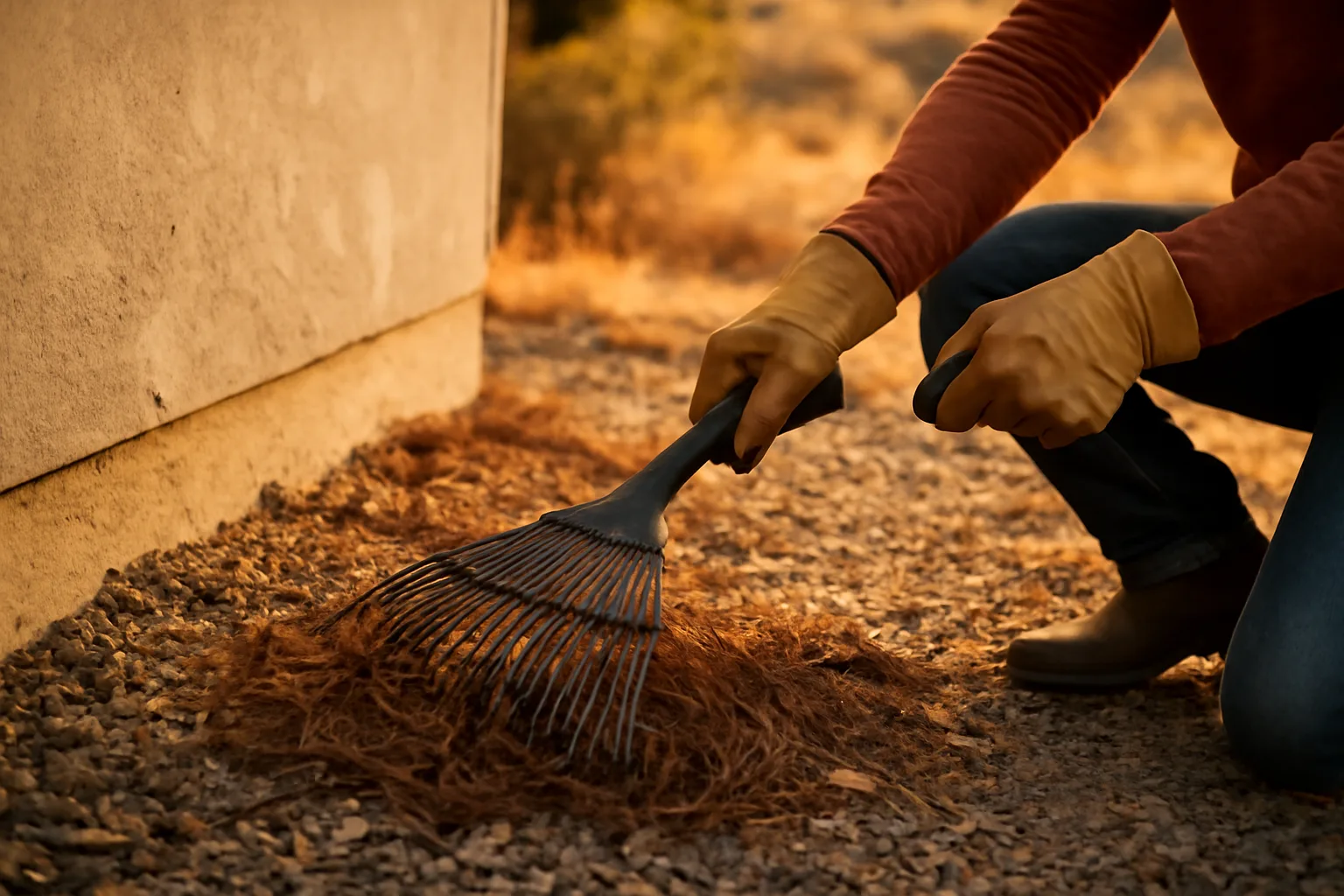
Wildfire mitigation for a home comes down to three things: stopping embers from getting in, keeping flames away from the structure, and giving firefighters room to work. Research from the Insurance Institute for Business & Home Safety (IBHS) and CAL FIRE both point to the same conclusion: most homes that burn in wildfires don't burn because a wall of flame rolled through. They burn because embers, sometimes landing 20 minutes to an hour ahead of the main fire front, get into vents, gutters, or landed on dry mulch touching the siding [1]. That means the highest-value mitigation isn't necessarily clearing your whole property. It's the first 5 feet around your foundation (CAL FIRE calls this Zone 0), your vents, your roof material, and anything flammable stacked against the house. A woodpile against the siding or a dry doormat can undo thousands of dollars spent thinning trees 80 feet away. If you're starting from zero, work inward to outward in your head but outward to inward with your labor: fix the 0-5 foot zone first, then vents and roof, then move out to 30 feet, then 100 feet if you have the land. For a full zone-by-zone breakdown, see defensible space zones.
When does the California defensible space law go into effect?
California's core defensible space law (Public Resources Code 4291) has been in effect since it was last amended in 2020, requiring 100 feet of defensible space clearance around homes in State Responsibility Areas and some designated areas [2]. That part isn't new and isn't waiting on anything. What's newer, and what people usually mean when they ask this, is the ember-resistant Zone 0 rule. The California Board of Forestry and Fire Protection was directed under SB 63 (2021) and AB 3074 (2020) to write regulations for a 0-5 foot ember-resistant zone immediately around structures in high fire severity zones [3]. The Board finalized draft Zone 0 regulations in 2023-2025, but as of this writing, the regulation's formal effective date and enforcement mechanism are still being finalized through the state's rulemaking process, and CAL FIRE's own site has repeatedly said an effective date will be announced once adopted [4]. Practically: don't wait for an enforcement date to do Zone 0 work. Insurers are already asking about it in inspection letters, and the general 100-foot defensible space requirement is enforceable right now under PRC 4291. If you get an inspection notice from your local fire department citing 4291, that's the current law, not a future one.
What fire-safe home rules take effect in 2026?
There's no single nationwide "2026 wildfire code" that flips on for every home. What's accurate is that California's Zone 0 (ember-resistant zone) regulations, once formally adopted by the Board of Forestry and Fire Protection, are expected to apply to homes in Very High Fire Hazard Severity Zones, and the Board's own rulemaking materials have referenced phased compliance windows in past drafts [3] [4]. Because the exact adoption and compliance dates depend on final rulemaking, check your specific fire district's current requirement rather than assume a fixed date. Separately, insurers operating in California are subject to the Department of Insurance's Sustainable Insurance Strategy, which since 2024 has required insurers writing more policies in high-risk areas to factor in a homeowner's wildfire mitigation actions, including participation in the Safer from Wildfires program, when setting rates [5]. That's a real, dated regulatory change already underway, distinct from the building code question. Bottom line: treat any specific "2026 law" claim about your address with skepticism until you confirm it with your county or fire district. Use the guided fill-in below and call your local fire marshal's office directly. Local rule check (fill in for your address):
- Fire district / county: ______________________
- Fire Hazard Severity Zone classification: ______________________
- Current defensible space requirement (feet): ______________________
- Zone 0 (ember-resistant zone) enforcement status locally: ______________________
- Last inspection date / next inspection due: ______________________
Why won't people follow the defensible space law in California?
Cost, labor, and confusion are the three real reasons, and none of them are irrational. Clearing 100 feet of vegetation on a sloped, wooded lot can run into thousands of dollars if you hire it out, and CAL FIRE's own defensible space guidance acknowledges that maintenance is an ongoing yearly task, not a one-time project. For a retired homeowner on a fixed income with two acres of manzanita, that's a real barrier, not laziness. There's also a genuine values conflict. Some homeowners bought their property specifically for mature trees and privacy screening, and clearing brush 100 feet from the house can feel like undoing the reason they moved there. Others simply don't believe defensible space will matter if a major fire comes through, a belief that isn't entirely wrong (defensible space improves survival odds, it doesn't guarantee them) but that gets used to justify doing nothing. And some of it is plain confusion about what's actually required. PRC 4291 lays out the 100-foot standard, but the specific zone-by-zone rules (how much clearance, what plants are allowed, spacing between shrubs) come from CAL FIRE guidance and local fire district amendments that vary by jurisdiction [2]. A homeowner who gets a vague inspection letter with no diagram is far less likely to act than one who gets a marked-up aerial photo of their own lot. If enforcement and clarity are the gap, the fix is documentation: photograph your property, mark your zones, and know exactly what your local district requires before the inspector shows up. See fire safe landscaping next to your house for zone-specific plant choices.
How to prevent wildfires from starting near your home
Most wildfires that threaten homes are human-caused. The National Interagency Fire Center and CAL FIRE both attribute the large majority of wildfire ignitions nationally to human activity (equipment use, debris burning, arson, unattended campfires, vehicle sparks) rather than lightning, though the exact split varies by state and year [6]. That means a meaningful share of prevention is behavioral, more than structural. Around your own property, the biggest ignition risks are usually mundane: a lawnmower blade hitting a rock in dry grass, a dragging trailer chain sparking on asphalt, an unattended debris pile burn on a windy day, or a cigarette tossed from a car window onto roadside grass. CAL FIRE's "Ready for Wildfire" campaign specifically flags outdoor equipment use during red flag warning days as a top preventable ignition source [7]. Practical prevention steps:
- Mow before 10am and avoid mowing on windy, low-humidity days.
- Keep a shovel and water source nearby during any outdoor equipment work.
- Never burn debris on red flag warning days; check with your local fire department for burn permit rules.
- Maintain spark arrestors on chainsaws, generators, and off-road vehicles.
- Report unattended campfires or suspicious smoke immediately; CAL FIRE's fire prevention page has a reporting number for your region [7]. None of this replaces defensible space work. But a huge share of "wildfire prevention" that homeowners can actually control happens before a fire ever starts, on your own equipment and your own habits.
How to prevent forest fires and avoid forest fires more broadly
"Preventing forest fires" and "protecting my house from wildfire" are related but different questions, and it's worth separating them. Forest fire prevention at the landscape level involves fuel management on public land, prescribed burns, and reducing ignition sources in recreation areas, which is largely the job of agencies like the U.S. Forest Service and CAL FIRE, not individual homeowners [1]. What an individual can actually do to avoid contributing to forest fire risk:
- Follow all campfire rules exactly: dead out means cold to the touch, more than no visible flame. The USDA Forest Service's guidance is specific that a fire isn't out until you've stirred the ashes, added water, and felt for heat with the back of your hand [8].
- Never drive or park with a hot undercarriage over dry grass; catalytic converters can reach temperatures that ignite vegetation in seconds.
- Avoid target shooting with steel-core or tracer ammunition in dry grass or brush areas; sparks from bullet fragmentation on rock are a documented ignition source in several Western wildfires.
- Support and don't interfere with prescribed burns conducted by land management agencies; these reduce the fuel load that turns a small fire into a catastrophic one. The Smokey Bear campaign's message ("only you can prevent wildfires") oversimplifies a complex problem, since lightning, drought, and fuel buildup on public land aren't things any one homeowner controls. But on the human-ignition side, it's not wrong. See only you can prevent wildfires for more on that history and what the slogan actually gets right and wrong.
How to prepare for a wildfire before one starts
Preparation splits into two tracks that both matter: getting your house physically ready, and getting your paperwork and evacuation plan ready. Most people over-focus on one and skip the other. On the house side, Ready.gov's wildfire preparedness guidance recommends creating defensible space, using ember-resistant vents, and keeping gutters and roof valleys clear of leaves and needles year-round, more than before fire season. A go-bag with medications, copies of insurance documents, and chargers should live somewhere you can grab it in under two minutes. On the documentation side, this is where a lot of homeowners get burned twice: once by the fire, once by a claims process that's harder without proof of what they owned and what mitigation work they'd done. Photograph every room, every major appliance, and your defensible space work with dated photos, before fire season starts. If you've had brush cleared, vents replaced, or a roof upgraded, keep receipts and before/after photos. This is exactly the gap the $99 Wildfire Insurance Survival Kit is built to close: a structured way to document your home and mitigation work before you need it, so you're not reconstructing your life from memory after a loss. To be clear, that kit doesn't file claims or represent you in a claims dispute; it just helps you build the record you'll want to have ready. Ready.gov also recommends signing up for local emergency alerts and knowing at least two evacuation routes from your neighborhood, since a single blocked road during a fast-moving fire is a common reason evacuations go badly.
How to prepare for forest fires when you live near wildland
If your property backs onto national forest, state forest, or open wildland, your prep list is a superset of standard wildfire prep, because you're closer to where fires actually start and fuel loads tend to be higher and less managed. Check with your local ranger district or state forestry office about recent fuel treatment or prescribed burn history near your property; areas that haven't seen fire or thinning in decades carry more fuel. Ask whether your area has a Community Wildfire Protection Plan (CWPP), a formal document many counties and fire districts maintain that identifies high-risk zones and priority mitigation areas; CAL FIRE and USDA both list CWPPs as a foundational tool for wildland-urban interface communities [1]. Practical wildland-adjacent steps:
- Extend your defensible space assessment to the full 100 feet required under PRC 4291 where the law applies, and further if your slope is steep (fire moves faster uphill) [2].
- Coordinate with neighbors; defensible space on your lot means less if your neighbor's dead pine stand is 15 feet from your fence line. Some fire districts run cost-share chipping programs specifically to make neighborhood-wide clearing affordable.
- Know your evacuation trigger points in advance (a specific ridge visible from your property, a specific smoke color, a specific alert tier) rather than waiting to decide in the moment. For renters or landlords managing rural property from a distance, contractor-based clearing programs exist in several states; see wildfire defensible space clearing contracts in Washington state for one example of how a state DNR structures that work.
How can we prevent forest fires at the community level?
Individual home hardening matters, but wildfire behavior in a neighborhood is genuinely collective: one poorly maintained lot with dead vegetation next to a fence line can ignite a whole block regardless of what everyone else did. This is well documented in post-fire analyses from IBHS and CAL FIRE, both of which point to structure-to-structure ignition (one burning house igniting the next through radiant heat or ember showers) as a major driver of total home loss in wildland-urban interface fires [1]. Community-level actions that move the needle:
- Firewise USA, run through the National Fire Protection Association, provides a formal framework for neighborhoods to get recognized status by completing group risk assessments and annual mitigation work; recognized communities often see coordinated chipping days and grant funding [9].
- HOAs and neighborhood groups can negotiate group rates for brush clearing contractors, cutting individual costs substantially compared to hiring alone.
- Pushing for local fire district inspection programs with clear, mapped requirements per lot (not vague letters) increases compliance, as noted earlier.
- Supporting local Community Wildfire Protection Plan funding and prescribed burn programs on adjacent public land, even when it means short-term smoke and inconvenience. None of this replaces PRC 4291 compliance on your own lot. But if you're asking how "we" prevent forest fires rather than just "I," the honest answer is that it requires your neighbors doing their part too, and organizing to make that easier (cost-sharing, group chipping days, shared contractor scheduling) is often more effective than individual education campaigns alone.
Is Santa Barbara safe from fire?
No. No California coastal community, including Santa Barbara, is "safe" from wildfire in any absolute sense, and the region's own history argues against complacency. The Thomas Fire (2017) burned over 281,000 acres and was, at the time, the largest wildfire in modern California history, followed within weeks by the Montecito debris flow that killed 23 people when rain hit the burned hillside above the town [10]. The 1990 Painted Cave Fire and 2008 Tea Fire also burned into Santa Barbara's urban edge. Much of Santa Barbara County sits directly against the Los Padres National Forest, and large sections of the hillside neighborhoods (Montecito, San Roque, the Riviera, upper State Street areas) are mapped by CAL FIRE within Very High Fire Hazard Severity Zones [11]. That classification carries real consequences: it's what triggers PRC 4291's 100-foot defensible space requirement and increasingly, insurance non-renewal notices. So the honest answer is that Santa Barbara is a wildland-urban interface community with a documented history of major fires, not a place that's been spared, and homeowners there should treat defensible space and home hardening as standard maintenance, not optional. Check your specific address against CAL FIRE's Fire Hazard Severity Zone viewer rather than relying on general reputation about the area's safety.
What order should mitigation work happen in, and what's worth the money?
| Zone 0 clearing (DIY) | Low ($0-300) | High | |
|---|---|---|---|
| Ember-resistant vent mesh | Low-Medium ($200-800) | High | |
| Class A roof replacement | High ($8,000-25,000+) | High (if roof is aging/wood shake) | |
| Zone 1 vegetation thinning | Medium ($500-3,000 DIY-hired) | Medium-High | |
| Zone 2 full clearing (large lot, hired) | Medium-High ($1,500-6,000+) | Medium | Cost ranges above are general estimates based on typical residential contractor rates and vary hugely by region, lot size, and vegetation density; get local quotes rather than treating these as fixed. For more on prioritizing this work against an inspection deadline, see defensible space zones and fire at a house for what happens when this work doesn't get done in time. |
Given limited time and budget, this is the order that maps to actual fire behavior research, not the order most people instinctively pick (which is usually "the trees look scary, cut those first"): 1. Zone 0 (0-5 feet from structure): remove all combustibles, mulch, dry plants, stored firewood. This is the cheapest zone to fix and the highest-leverage, since it's where ember ignition of the structure itself most often starts. 2. Vents and openings: install 1/8-inch or smaller ember-resistant mesh on attic and foundation vents. IBHS testing found standard vents are a common ember entry point during real wildfires. 3. Roof and gutters: clear debris, and if replacing a roof, choose Class A fire-rated materials. 4. Zone 1 (5-30 feet): thin and space vegetation, remove ladder fuels (low branches that let ground fire climb into tree canopies). 5. Zone 2 (30-100 feet): reduce fuel continuity, space trees, mow tall grass. | Mitigation step | Approx. relative cost | Impact on ember ignition risk |
Frequently asked questions
When does the California defensible space law go into effect?
The core 100-foot defensible space requirement under Public Resources Code 4291 is already in effect and has been since its 2020 amendment. The newer Zone 0 ember-resistant zone rule (0-5 feet from structures) is finalized in draft form by the Board of Forestry and Fire Protection but its formal enforcement date depends on final rulemaking; check with your local fire district for current status.
Why won't people follow the defensible space law in California?
Cost, ongoing maintenance burden, unclear or vague inspection notices, and personal attachment to mature landscaping are the main reasons. CAL FIRE's own guidance notes defensible space requires yearly upkeep, not a one-time fix, which becomes a real barrier for homeowners on fixed incomes or with large wooded lots.
How do I prevent wildfires from starting on my own property?
Avoid mowing dry grass on windy days, keep equipment spark arrestors maintained, never burn debris during red flag warnings, and keep a water source nearby during any outdoor power tool use. Most wildfires nationally are human-caused, so equipment and behavior around your property matter as much as vegetation clearing.
How do I prepare for a wildfire if I get an evacuation warning?
Have a go-bag with medications, ID, and insurance documents ready in under two minutes, know two evacuation routes out of your neighborhood, and sign up for local emergency alerts in advance. Ready.gov recommends creating this plan before fire season, not when smoke is already visible.
What fire-safe home rules take effect in 2026?
There's no single confirmed 2026 nationwide rule. California's Zone 0 ember-resistant zone regulation is in the rulemaking pipeline with expected phased compliance for homes in Very High Fire Hazard Severity Zones, but the exact adoption date wasn't finalized as of this writing. Confirm directly with your county fire marshal rather than assuming a fixed date.
Is Santa Barbara safe from fire?
No. Santa Barbara County has a documented history of major fires, including the 2017 Thomas Fire (over 281,000 acres) and the 1990 Painted Cave Fire, and large hillside neighborhoods are mapped in CAL FIRE's Very High Fire Hazard Severity Zones. Homeowners there should treat defensible space and home hardening as required maintenance.
How can we prevent forest fires as a community, more than individually?
Join or start a Firewise USA recognized community group through the National Fire Protection Association, coordinate group brush-clearing contractor rates with neighbors, and push your local fire district for clear, mapped inspection requirements. Structure-to-structure ignition means one neglected lot can undermine everyone's individual mitigation work.
What's the single most cost-effective wildfire mitigation step?
Clearing the 0-5 foot zone immediately around your foundation (removing mulch, stored firewood, and dry plants touching the house) and installing ember-resistant vent mesh. Both are low-cost compared to roof replacement or large-scale vegetation removal, and both directly target how most homes actually ignite: ember intrusion, not direct flame contact.
Does defensible space guarantee my house won't burn?
No. Defensible space and home hardening improve survival odds significantly according to CAL FIRE and IBHS research, but neither guarantees a structure survives a wildfire, especially under extreme wind-driven fire conditions. It reduces risk; it doesn't eliminate it.
How often do I need to redo defensible space clearing?
CAL FIRE guidance treats defensible space as an annual maintenance task, not a one-time project, since vegetation regrows and dead material accumulates every season. Most fire districts expect clearance to be maintained year-round, with inspections typically timed before peak fire season in late spring or early summer.
What's the difference between forest fire prevention and home wildfire mitigation?
Forest fire prevention refers to reducing ignition sources and fuel loads at the landscape level, largely the job of agencies like CAL FIRE and the U.S. Forest Service through prescribed burns and fuel management. Home wildfire mitigation is what an individual homeowner does on their own property: defensible space, vent screening, and roof upgrades.
Can I get in trouble for not clearing defensible space in California?
Yes. Under PRC 4291, local fire officials can inspect properties in State Responsibility Areas and issue notices requiring compliance; failure to comply can lead to citations, fines, or in some cases the local agency performing the work and billing the owner. Requirements and enforcement details vary by fire district, so confirm specifics locally.
Sources
- CAL FIRE, Fire Prevention Programs: Fuel management and structure ignition patterns in wildland-urban interface fires
- California Public Resources Code Section 4291: 100 feet of defensible space clearance required around structures in State Responsibility Areas
- California SB 63 (2021): Directive to Board of Forestry and Fire Protection to develop ember-resistant Zone 0 regulations
- California Board of Forestry and Fire Protection, Zone 0 Rulemaking: Zone 0 ember-resistant zone regulations status and rulemaking process
- California Department of Insurance, Sustainable Insurance Strategy: Insurers must factor wildfire mitigation actions including Safer from Wildfires program participation into rating
- National Interagency Fire Center, Statistics: Majority of U.S. wildfire ignitions are human-caused rather than lightning-caused
- CAL FIRE, Ready for Wildfire: Outdoor equipment use during red flag warnings is a flagged ignition risk
- USDA Forest Service, Campfire Safety: A campfire is not fully out until stirred, doused with water, and cold to the touch
- National Fire Protection Association, Firewise USA: Firewise USA framework for community wildfire risk reduction recognition
- CAL FIRE, Thomas Fire Incident Archive: Thomas Fire (2017) burned over 281,000 acres, at the time the largest wildfire in modern California history
- CAL FIRE, Fire Hazard Severity Zone Viewer: Santa Barbara County hillside areas mapped within Very High Fire Hazard Severity Zones