Last updated 2026-07-25
TL;DR
Wildfire consulting means paying a professional (often $150-$500/hr, or flat fees of $300-$1,500 for a home assessment) to evaluate your defensible space, structure hardening, and fire district compliance. Many of the same checks are free through CAL FIRE, your local fire department, or state extension programs. A consultant earns their fee when your property is complicated or you need a signed report for an insurer or lender.
what does a wildfire consultant actually do
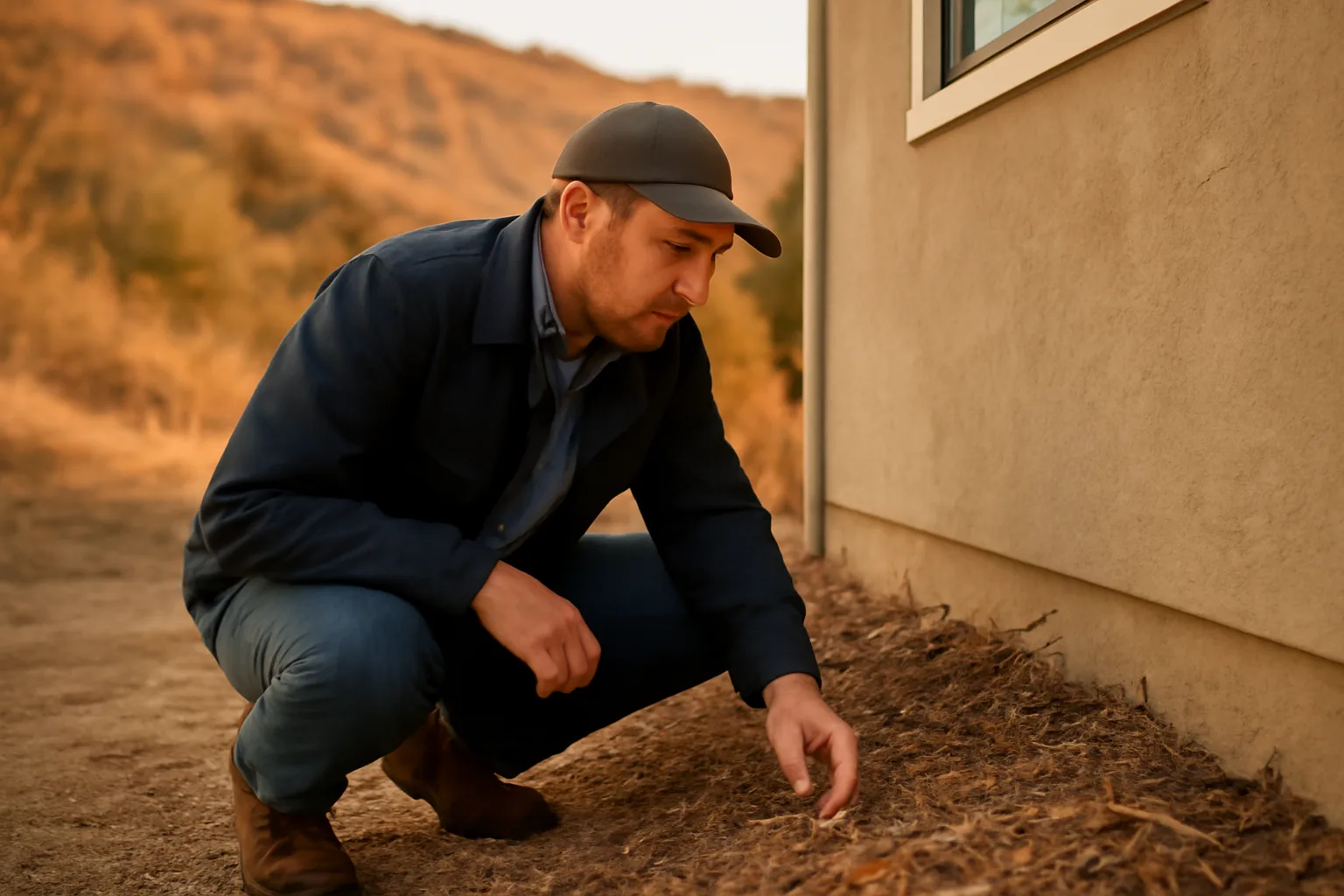
A wildfire consultant walks your property, measures your defensible space zones, checks your roof and vent construction against your state's wildland-urban interface code, and hands you a written report with prioritized fixes. Some also help you photograph and organize that work into something an insurer can actually read. The good ones are usually retired fire marshals, former CAL FIRE defensible space inspectors, or credentialed foresters. They know the difference between what a fire code technically requires and what an underwriter is actually scanning for when they decide whether to renew you. That distinction matters more than most homeowners realize, because a property can be fully code-compliant and still get flagged by an insurance inspection for something the code doesn't even mention, like a wood fence touching the house. Pricing is all over the map. Independent consultants commonly charge $150 to $500 an hour, or a flat fee of $300 to $1,500 for a single-property assessment, depending on lot size and how detailed the report is. Larger consulting firms that work with HOAs or FireWise communities charge per-acre or per-project rates that can run into the thousands. None of that is regulated pricing, it's just market rate, so get two or three quotes before you sign anything. What you're really paying for is judgment and a signature. CAL FIRE's own defensible space checklist is free and covers the same 100-foot zone structure a paid consultant uses. The value-add of a paid consultant is translating that checklist into a report formatted the way your insurer or mortgage lender wants to see it, and catching site-specific issues (slope, wind corridor, neighboring vegetation) that a generic checklist can't.
do i actually need to pay for a wildfire consultant
Not always. If your property is straightforward (flat lot, standard vegetation, no dispute with your insurer yet), you can do a defensible space self-assessment using CAL FIRE's free checklist and probably get 80% of the value a paid consultant would give you. Pay for a consultant when: you've already received a non-renewal or inspection notice and need a report with a signature on it, your lot has complicated terrain (steep slope, canyon adjacency, dense native vegetation you're not sure you're allowed to remove), or you're applying to a state FAIR Plan and need documentation that looks professional rather than homeowner-assembled. Skip the paid consultant if you just want a starting checklist. Start with your county's local fire agency defensible space inspection, which many California fire districts run for free or low cost as part of the annual inspection cycle. Los Angeles County Fire, for example, runs a Brush Clearance Unit that inspects properties in high fire severity zones every year [1] and will tell you exactly what's out of compliance at no charge. A reasonable middle path: do the free self-assessment first, fix what's obvious and cheap (dead vegetation, roof debris, wood piles against the house), then bring in a paid consultant only for the harder judgment calls, like whether a specific oak canopy needs to come down or whether your fence material counts as combustible under your local code.
when does the california defensible space law go into effect
California's core defensible space law, Public Resources Code 4291, has been in effect since 2005 and currently requires 100 feet of defensible space clearance (or to the property line, whichever is less) around structures in State Responsibility Areas and designated high fire severity zones [2]. This isn't a future law, it's already the enforceable standard. What's newer and still rolling out is the "ember-resistant zone" (Zone 0) requirement, the 0-to-5-foot zone immediately next to structures. The California Board of Forestry and Fire Protection has been developing Zone 0 regulations under SB 63 (2023) and earlier direction from AB 3074 (2020), which amended PRC 4291 to add the ember-resistant zone concept [3]. As of the 2025 rulemaking cycle, the Board has been working through the formal regulatory process, and enforcement dates have shifted more than once, so treat any specific "2025" or "2026" date you see online as provisional until CAL FIRE or the Board of Forestry publishes a final adopted regulation. Check the Board of Forestry's active rulemaking page directly before you plan around a date, because this is a moving target and secondhand blog posts (including, frankly, most of what shows up in search results) have been wrong about the timeline more than once.
what fire-safe home rules take effect in 2026
There's no single nationwide "2026 fire-safe home" rule. What's actually happening is a patchwork: California's Zone 0 ember-resistant zone regulation is moving through the Board of Forestry's rulemaking process, and several fire districts and insurers are independently tightening their own inspection standards ahead of whatever the state finalizes. Outside California, Oregon's defensible space and home hardening requirements under SB 762 (2021) have also been phased in over several years, with the Oregon Department of Forestry maintaining the wildfire risk map and defensible space code that local jurisdictions enforce. Colorado and Arizona don't have a single statewide defensible space statute like California's PRC 4291; instead, requirements vary by county and fire protection district, so "what applies to me in 2026" genuinely depends on which fire district your parcel sits in. Guided fill-in: check your specific fire district's current defensible space ordinance here: ______________. Insurance underwriting standards (which often move faster and stricter than government code) are a separate thing entirely; your insurer's non-renewal letter may cite standards from the Insurance Institute for Business & Home Safety Wildfire Prepared Home program rather than any state statute at all. The practical move: don't wait for a final 2026 date to act. Insurers are already inspecting to Zone 0 style standards in many California markets right now, ahead of the regulation being finalized.
why won't people follow the defensible space law in california
Cost, labor, and disagreement about what's actually required are the three biggest reasons compliance lags. CAL FIRE's own reporting has noted that a large share of properties inspected in high fire severity zones fail initial defensible space inspections, often for issues that require real money or physical labor to fix, like removing mature trees within 5 feet of a structure or replacing a wood fence section [4]. Some homeowners genuinely don't know the law applies to them. PRC 4291 applies to State Responsibility Area parcels and some Very High Fire Hazard Severity Zones within Local Responsibility Areas, and a lot of people bought their home without ever being told which zone they're in. Others know but can't afford it: clearing a heavily wooded 1-acre lot to 100 feet can run into the thousands of dollars, and there's no statewide subsidy that fully covers it, though some counties and fire safe councils offer chipper days or cost-share grants. There's also a real tension between defensible space rules and other values homeowners hold, privacy screening, shade, erosion control on slopes, and in some cases actual habitat or heritage tree protections that conflict with clearance requirements. None of that makes non-compliance a good idea (CAL FIRE can issue citations and, in extreme cases, order the work done and bill the property owner), but it explains why the gap between law and practice persists year after year. For a broader look at how these obligations interact with fire codes at the structure level, see house fire risk factors and how they connect back to defensible space compliance.
how to prevent wildfires (what actually reduces risk)
Wildfire prevention at the individual property level comes down to three things: eliminating ignition sources, breaking up fuel continuity, and hardening the structure itself so an ember can't get a foothold. Nothing else matters as much as those three. CAL FIRE's data consistently shows that most home losses in wildfires happen from ember ignition, not direct flame contact, meaning embers landing on roofs, in gutters, or against combustible siding well before the fire front arrives. That's why the "Zone 0" concept exists: the first 5 feet around your house needs to have nothing that can catch an ember and hold it. At the community and forest level, prevention looks different: reducing human-caused ignitions (debris burning, equipment sparks, unextinguished campfires, dragging trailer chains) accounts for the large majority of wildfire starts nationally, according to the National Interagency Fire Center's annual statistics [5]. Preventing forest fires broadly means fuel reduction projects (prescribed burns, mechanical thinning) on public land, paired with defensible space compliance on private parcels adjacent to that public land, since fires move across that boundary in both directions. For specific landscaping choices that reduce ignition risk without stripping your yard bare, see fire safe landscaping California next to house.
how to prepare for a wildfire (before, during, evacuation)
Preparing for a wildfire means building a go-bag and evacuation plan before fire season starts, not during an evacuation warning. Ready.gov recommends assembling supplies for at least 72 hours (water, medications, important documents, a battery radio) and knowing two ways out of your neighborhood in case one route is blocked . Before fire season: sign up for your county's emergency alert system, photograph your home's exterior and interior for insurance documentation, and confirm your homeowner's or renter's policy covers wildfire loss of use. During an active threat: follow your local fire agency's evacuation orders immediately, don't wait for a "mandatory" order if a "warning" has been issued and conditions look bad, and turn on exterior lights and close windows/doors before you leave to reduce ember intrusion. Ready.gov's wildfire guidance specifically states: "If advised to evacuate, do so immediately" , which sounds obvious but is the single most common thing people delay on, often because they're waiting to see how bad it gets. Don't wait. A documentation packet (photos, receipts for hardening work, your defensible space inspection records) is worth assembling now, not after a claim. This is the gap a lot of homeowners find themselves in after a non-renewal notice: they have no organized proof of the mitigation work they've actually done. Our $99 Wildfire Insurance Survival Kit is built specifically to help you organize that evidence into a packet you send yourself; we don't file claims for you, this is your documentation, assembled properly.
how to prevent forest fires and how to avoid them at scale
Preventing forest fires at a landscape level relies mostly on managing ignition sources and fuel loads, since most forest fires are started by people, not lightning. The National Interagency Fire Center reports that human activity causes a large majority of wildfires nationally, with lightning responsible for a much smaller share, though lightning-caused fires tend to burn larger acreage in remote terrain because they're harder to detect and reach quickly [5]. Practical individual actions that avoid starting one: never leave a campfire unattended and drown it completely (stir the ashes, feel for heat) before leaving, don't park or idle vehicles on dry grass (catalytic converters routinely start roadside fires), follow local burn permit rules for debris burning, and maintain equipment (chainsaws, mowers, trimmers) that can throw sparks; many fire agencies restrict daytime mowing during red flag warnings for exactly this reason. At the policy level, the U.S. Forest Service and state agencies use prescribed burning and mechanical thinning to reduce the dense fuel loads that turn a manageable fire into a catastrophic one; this is a genuinely different tool than defensible space, which protects individual structures rather than reducing overall fuel across a landscape. For the classic public-awareness angle on ignition prevention, see only you can prevent wildfires, which traces the messaging campaign that's shaped fire prevention behavior for decades.
is santa barbara safe from fire
No coastal California community, including Santa Barbara, is meaningfully safe from wildfire, and the region's own fire history proves it: the 2017 Thomas Fire burned into Santa Barbara County and was followed by the deadly Montecito debris flow in January 2018 that killed 23 people, a disaster directly tied to the burn scar left by the fire . Much of the hillside area above Santa Barbara and Montecito sits in a CAL FIRE-designated Very High Fire Hazard Severity Zone . That said, "safe" is relative and depends heavily on where in the county you mean. Downtown Santa Barbara near the waterfront carries much lower wildfire exposure than the foothill and mountain-adjacent neighborhoods in Montecito, Mission Canyon, or the San Roque foothills, where homes back directly onto chaparral and steep terrain that burns hot and fast. If you own property in the Santa Barbara foothills or anywhere in a Very High Fire Hazard Severity Zone, check your specific zone designation on CAL FIRE's FHSZ viewer rather than relying on general reputation, and confirm your local fire district's defensible space and brush clearance requirements, since Santa Barbara County and the city itself may layer additional local ordinances on top of the state PRC 4291 minimum. Guided fill-in: confirm your parcel's fire hazard severity zone and local brush clearance deadline here: ______________.
how do i document my mitigation work for an insurer
Insurers and state FAIR Plans want dated photos, receipts, and a clear before/after record, more than a verbal claim that you "did the work." Take wide shots of each defensible space zone, close-ups of vents and roof edges, and keep every invoice from tree removal, brush clearing, or vent screening contractors. Organize it by zone (immediate 0-5 ft, intermediate 5-30 ft, extended 30-100 ft) matching the structure CAL FIRE uses in its defensible space guidance, because that's the framework most inspectors and adjusters already think in. A packet that mirrors their mental model gets read faster and taken more seriously than a random folder of photos. This is exactly the gap our $99 one-time Wildfire Insurance Survival Kit closes: it's a structured way to build that documentation packet yourself, zone by zone, so you have something insurer-ready before you need it, not scrambled together after a non-renewal letter arrives. To be clear: we don't file claims on your behalf, and we don't promise coverage, reinstatement, or discounts. You prepare the documentation, and you send it. This isn't legal or insurance advice, and every fire district has its own specific mitigation rules, so confirm yours before you finalize anything. Guided fill-in: your local fire district's specific documentation requirements for insurance purposes: ______________.
what does a defensible space inspection actually check
A defensible space inspection walks the three zones around your home (0-5 ft, 5-30 ft, 30-100 ft) checking vegetation spacing, roof and gutter debris, vent screening, and the condition of any wood fencing or decking that touches the structure. CAL FIRE's Ready Set Go program and county-level Fire Safe Council inspectors use largely the same checklist. Common fail points, based on what shows up repeatedly in county inspection summaries: dead or dying vegetation left standing, tree canopies overhanging the roof, firewood stacked against an exterior wall, dense shrubs planted directly under windows, and combustible mulch (bark, wood chips) within 5 feet of the foundation. None of these are exotic; they're the ordinary landscaping choices most homes had before the current wave of wildfire scrutiny. For a full breakdown of what falls in each zone and how to sequence the work, see defensible and the zone-specific planning guidance there. If your property backs onto a slope or dense native vegetation, professional clearing crews (sometimes contracted through state or county programs) may be worth it; see how wildfire defensible space clearing contracts Washington State DNR structures that work as one model, even if you're outside Washington, since the contracting approach translates across states.
Frequently asked questions
When does the California defensible space law go into effect?
California's core defensible space law, Public Resources Code 4291, has been in effect since 2005 and currently requires 100 feet of clearance in State Responsibility Areas. The newer Zone 0 ember-resistant zone rule (the 0-5 ft area) is still moving through Board of Forestry rulemaking as of 2025; check the Board's active rulemaking page for the final adopted date before planning around any specific year.
Why won't people follow the defensible space law in California?
Mostly cost and labor. Clearing a wooded lot to 100 feet can cost thousands of dollars, and some homeowners don't know which zone their parcel falls in. CAL FIRE inspection data shows a substantial share of properties in high fire severity zones fail on first inspection, often for fixes (tree removal, fence replacement) that require real money to complete.
How do I prevent wildfires around my own home?
Focus on ember ignition, not flame contact, since embers cause most home losses. Clear the 5 feet immediately around your structure of anything combustible, screen your vents, clean gutters and roof debris regularly, and keep vegetation spaced and pruned through the 30-foot and 100-foot zones per CAL FIRE's defensible space guidance.
How do I prepare for a wildfire if I get an evacuation warning?
Have a go-bag ready with 72 hours of supplies, medications, and documents before fire season starts, per Ready.gov guidance. Know two evacuation routes out of your neighborhood. If a warning (not yet mandatory) is issued and conditions look serious, leave immediately rather than waiting for a mandatory order.
How can we prevent forest fires at a larger scale?
Since most forest fires are human-caused, the biggest lever is reducing ignition sources: fully extinguishing campfires, avoiding parking on dry grass, following local burn permit rules, and maintaining spark-prone equipment. Public land agencies also use prescribed burns and mechanical thinning to reduce fuel loads that turn small fires into major ones.
Is Santa Barbara safe from wildfire?
No. Santa Barbara County has significant Very High Fire Hazard Severity Zone acreage in its foothill and mountain-adjacent neighborhoods, and the 2017 Thomas Fire burn scar directly caused the deadly 2018 Montecito debris flow. Downtown/waterfront areas carry lower exposure than foothill neighborhoods like Montecito or Mission Canyon; check your specific parcel on CAL FIRE's zone viewer.
What fire-safe home rules take effect in 2026?
There's no single national 2026 rule. California's Zone 0 ember-resistant zone regulation is in active Board of Forestry rulemaking with a shifting timeline. Oregon's SB 762 defensible space requirements have phased in since 2021. Other states set requirements at the county or fire district level, so check your specific district's current ordinance rather than assuming a 2026 date applies.
How much does a wildfire consultant cost?
Independent consultants typically charge $150 to $500 per hour, or flat fees of $300 to $1,500 for a single-property defensible space and hardening assessment, depending on lot size and report detail. Larger firms working with HOAs or FireWise communities may charge per-acre project rates. Get multiple quotes since pricing isn't regulated.
Can I do a defensible space assessment myself for free?
Yes. CAL FIRE publishes a free defensible space checklist covering the same 100-foot zone structure paid consultants use, and many county fire departments (like LA County's Brush Clearance Unit) run free annual inspections in high fire severity zones. Start there and only pay for a consultant if you need a formal signed report or face a complicated property.
What's the difference between defensible space and home hardening?
Defensible space is vegetation and fuel management around your property in three zones out to 100 feet. Home hardening is physical construction changes to the structure itself, ember-resistant vents, Class A roofing, enclosed eaves, dual-pane windows, that stop embers and radiant heat from igniting the building. You need both; one without the other leaves a real gap.
Does CAL FIRE fine you for not complying with defensible space law?
Yes, CAL FIRE and local fire agencies can issue citations for non-compliance with PRC 4291 in State Responsibility Areas, and in some cases order the work done with the cost billed back to the property owner. Enforcement intensity varies significantly by county and fire district, so check your local agency's current enforcement practice.
Will hiring a wildfire consultant get my insurance reinstated?
Not directly, and no consultant or documentation service can promise that. A consultant's report or your own documentation packet shows an insurer or FAIR Plan the mitigation work you've completed, but reinstatement decisions belong entirely to the insurer. Nobody, including public adjusters or consultants, can guarantee a specific outcome.
Sources
- California Public Resources Code Section 4291: 100-foot defensible space clearance requirement around structures in State Responsibility Areas, in effect since 2005
- California SB 63 (2023), Board of Forestry and Fire Protection: Legislative basis for the ember-resistant Zone 0 rulemaking currently in progress
- Insurance Institute for Business & Home Safety, Wildfire Prepared Home: Insurer wildfire inspection standards often reference IBHS Wildfire Prepared Home criteria separate from state statute
- National Interagency Fire Center, Wildfire Statistics: Human activity causes the large majority of wildfires nationally; lightning causes a smaller share but larger average acreage
- CAL FIRE, Fire Hazard Severity Zone Viewer: Santa Barbara County foothill areas are designated Very High Fire Hazard Severity Zones