Last updated 2026-07-25
TL;DR
Wildfire prevention works in layers: clear the first 5 feet around your home (zone 0), maintain defensible space out to 100 feet, harden your roof and vents, and keep documentation ready for insurers. California's zone 0 ember-resistant zone rule, originally set for 2023, is still pending final regulations as of 2026 with no enforced statewide deadline yet.
How do you actually prevent wildfires from destroying your home?
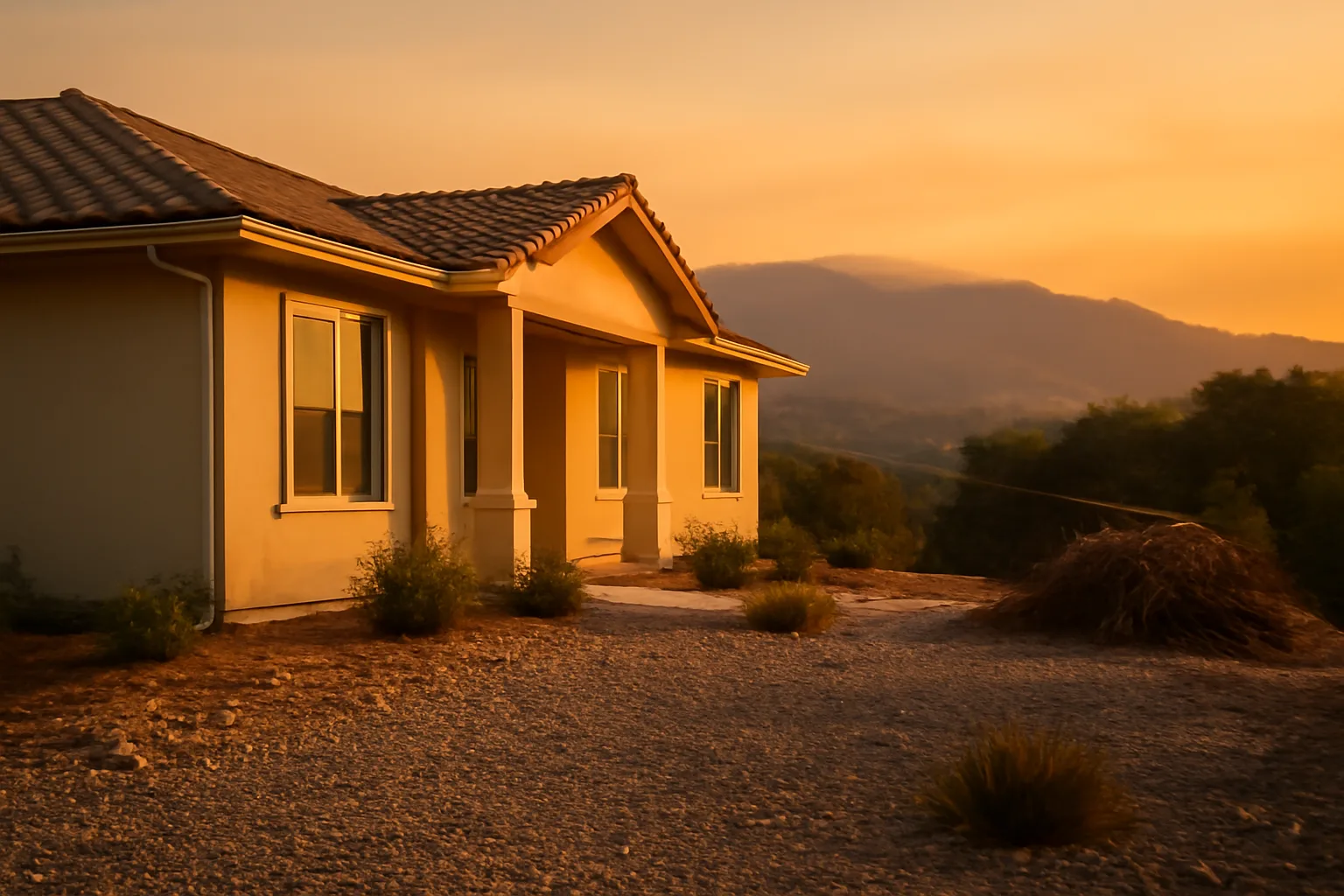
Home survival in a wildfire comes down to embers, not walls of flame. Research from the Insurance Institute for Business & Home Safety (IBHS) has found that most homes ignite from wind-blown embers landing in vulnerable spots: gutters full of leaves, mulch beds against siding, vents without screens, and gaps under decks. That means prevention isn't one thing. It's a stack of smaller fixes that each cut your odds a little. CAL FIRE frames it as "Ready, Set, Go": get your property ready before fire season, stay alert when conditions turn dangerous, and evacuate early when told to go. The "ready" part is almost entirely defensible space and home hardening, the two levers you actually control. Think of your property in rings. The first 5 feet around your foundation (what California calls Zone 0) matters more than any other zone, because that's where embers pile up and ignite siding, eaves, and anything flammable stacked against the house. Beyond that, Zone 1 runs to 30 feet and Zone 2 out to 100 feet, each with different maintenance goals. For a full breakdown of what goes in each ring, see defensible space zones. None of this eliminates risk. Nothing does. But CAL FIRE and multiple post-fire damage assessments (Camp Fire, Tubbs Fire) have consistently found that homes with cleared space and hardened features survive at meaningfully higher rates than neighbors without them, even on the same block, hit by the same fire.
When does the California defensible space law (Zone 0) go into effect?
As of early 2026, California's Zone 0 ember-resistant zone requirement has not taken effect. The law authorizing it, SB 63 (2020) and later amendments, directed the Board of Forestry and Fire Protection to draft regulations for a 0-5 foot ember-resistant zone around structures in State Responsibility Areas and designated Very High Fire Hazard Severity Zones [1]. The original target was 2023, then it slipped. The Board of Forestry has been working through a formal rulemaking process, including public comment periods, that as of this writing has not produced final adopted regulations with a hard compliance date. Homeowners should check the Board of Forestry and Fire Protection's active rulemaking page directly, because the timeline has moved before and will likely move again [1]. Here's the honest uncertainty: multiple fire agencies and insurance groups have referenced a possible 2026 start for enforcement in various planning documents, but nothing found here confirms a finalized, statewide effective date as of this writing. If you've seen a specific year mentioned by your local fire district or insurer, treat that as the authority, not a blog post, because [mitigation rules vary by fire district: check with local fire authority] for your parcel's exact requirements. Even without a legal mandate yet, doing Zone 0 work now is smart. Insurers doing wildfire risk scoring already reward it, and if the rule finalizes, you won't be scrambling. For the specific plant and material choices that work in that 5-foot ring, see fire safe landscaping next to your house.
What fire-safe home rules take effect in 2026?
There isn't one single national "2026 fire code" everyone should know. Instead, several state-level actions are converging around that year, and here's what's actually documented: California's Zone 0 regulations (see above) remain in the rulemaking pipeline, with the Board of Forestry continuing to refine language on what counts as "ember-resistant" material and how existing landscaping gets grandfathered or must be modified [1]. Colorado passed its own wildfire mitigation measures in recent years affecting insurance disclosure and defensible space incentives, administered through the Colorado Division of Fire Prevention and Control, though specifics vary by county and fire district. Oregon's wildfire risk map and defensible space code requirements, tied to Senate Bill 762 (2021), have gone through multiple revisions after public pushback over risk classifications; check the Oregon Department of Forestry's current map and code status directly, since Oregon has already revised its approach once after backlash [2]. The pattern across all these states: rules get proposed, get pushed back by property owners and industry groups, then get revised or delayed. If you're planning improvements around a specific compliance deadline, verify the current status with your state fire marshal's office before you spend money chasing a date that might move.
Why won't people follow the defensible space law in California?
Cost, confusion, and inconsistent enforcement are the three big reasons, and it's worth being honest about all three instead of just saying people are careless. Cost is real. Clearing brush, removing overhanging trees, and replacing wood mulch with gravel or stone on a typical suburban lot can run from a few hundred dollars in DIY labor and material to several thousand dollars for professional clearing crews and haul-away, depending on lot size and vegetation density. For homeowners who just got hit with an insurance non-renewal, finding another few thousand dollars for landscaping isn't simple. Confusion is also real. CAL FIRE's own defensible space guidance runs to detailed zone-by-zone specifications that most homeowners have never read in full. Local fire districts sometimes layer on their own stricter rules, so what your neighbor did in a different jurisdiction may not satisfy your inspector. Enforcement is inconsistent. Defensible space inspections happen on varying schedules depending on the county and fire district, and citations for non-compliance aren't universal or immediate everywhere. Some homeowners simply haven't been checked yet. That doesn't mean the risk isn't real, it means the paper consequence hasn't landed, which is a very different motivator than the actual wildfire risk. There's also a psychological piece nobody likes to say out loud: people who've lived somewhere for twenty years without a fire reaching them develop a kind of normalized risk tolerance. It's not stupidity, it's how humans process infrequent, high-consequence events. The fix isn't shaming, it's making compliance cheap and clear, which is exactly where documentation and phased project planning help.
How do you prepare for a wildfire, step by step?
Start with defensible space, move to structure hardening, then build your evacuation and documentation plan. Skipping the order wastes money, because a hardened roof means less if a wood pile sits against your siding. Step one: clear Zone 0 (0-5 feet from structures). Remove all combustible mulch, stacked wood, dry vegetation, and anything flammable touching your walls, deck, or under eaves. This is the single highest-leverage move according to post-fire structure assessments. Step two: work outward through Zone 1 (5-30 feet) and Zone 2 (30-100 feet), thinning vegetation, spacing tree canopies, and mowing dry grass short. Ready.gov recommends maintaining this spacing specifically to slow flame spread before it reaches the structure [3]. Step three: harden the structure itself. Priority order based on ember entry points: vents (1/8 inch metal mesh screens), roof (Class A rated materials), gutters (metal, kept clear of debris), windows (dual-pane tempered glass reduces heat-crack risk), and decks (ember-resistant or non-combustible decking, enclosed undersides). Step four: build your go-kit and evacuation plan. Ready.gov recommends a kit that covers at least the basics for several days, plus copies of key documents (insurance policy, ID, deed) stored somewhere you can grab fast or access digitally [3]. Step five: document everything before fire season starts, not after a loss. Photos and video of your home's exterior, defensible space work, and any hardening upgrades give you a paper trail if you ever need to show an insurer what condition your property was in. This is exactly the gap a lot of homeowners discover only after a non-renewal letter arrives, when it's too late to prove what you'd already done. Building that file now, rather than scrambling later, is the whole idea behind a $99 Wildfire Insurance Survival Kit, a one-time tool for organizing the photos, receipts, and property records insurers actually want to see.
How do you prevent forest fires from starting in the first place?
Most wildfires are human-caused, not lightning-caused, which means individual behavior matters more than people think. National Interagency Fire Center and U.S. Forest Service data have repeatedly shown that the large majority of wildfires nationally trace back to human activity: unattended campfires, vehicle sparks, debris burning, equipment malfunctions, and arson. The basics, straight from Smokey Bear / USDA Forest Service guidance: fully extinguish campfires (drown, stir, drown again, feel for heat before leaving), never park hot vehicles on dry grass, avoid outdoor burning on red flag warning days, keep chainsaws and mowers away from dry vegetation during peak heat hours, and check local burn ban status before any debris burning [4]. On your own property, the prevention angle overlaps heavily with defensible space work. A cleared, irrigated zone around structures doesn't just protect your house from an approaching fire, it also reduces the odds that a spark from your own equipment, grill, or fire pit ignites something that spreads. If you live near wildland areas, know your local burn restrictions. Many counties tie burn permits to fire weather conditions that change day to day, and violating a burn ban during red flag conditions is both dangerous and often a citable offense.
How do you avoid forest fires when you're recreating outdoors?
Campfire discipline is the single biggest lever for outdoor prevention. Build fires only in established rings, keep them small, never leave them unattended even for a few minutes, and put them fully out (more than smoldering) before you leave. Check fire restrictions before you go, not when you arrive. National forests and state parks post current fire danger levels and any temporary bans on their individual unit websites, and these change fast during dry, windy stretches. Vehicle and equipment sparks cause a surprising number of ignitions. Dragging chains, dry grass under a hot exhaust or catalytic converter, and mechanical sparks from ATVs or chainsaws have all been documented as ignition sources in wildfire investigation reports. Pull off pavement, not into tall dry grass, and give equipment time to cool before setting it in vegetation. Smoking materials matter too: never toss a cigarette from a vehicle or discard one in dry brush. It sounds obvious until you remember how many roadside fires start exactly that way every fire season.
How do you prepare for forest fires as a rural or wildland-adjacent property owner?
Rural properties need everything suburban homes need, plus water access, equipment readiness, and a longer buffer zone because response times run longer outside city limits. Water access is often the biggest gap. If you're on well water, know whether your pump works without grid power (a fire can knock out electricity before it reaches your property) and consider a generator or battery backup sized for your pump. If you have a pond, tank, or cistern, make sure fire crews can actually reach it; unmarked or overgrown access points don't help anyone. Defensible space at 100 feet is often not enough on larger rural parcels with heavy fuel loads. CAL FIRE guidance notes that on slopes and in high-fuel terrain, effective clearance may need to extend further, and local fire district requirements sometimes reflect that with stricter minimums than the state baseline. [Mitigation rules vary by fire district: confirm your parcel's exact required clearance distance with your local fire marshal or district office]. Access roads matter as much as vegetation. Fire trucks need turnaround space and road widths that many older rural driveways don't meet. If your address isn't clearly marked and visible from the road, especially at night, that's a fixable problem worth solving before you need it solved. Equipment readiness: keep a shovel, rake, hose long enough to reach your roofline, and a full water source check as part of seasonal prep, not something you think about only when smoke is visible.
Is Santa Barbara safe from fire?
No location in California's wildland-urban interface is "safe" in an absolute sense, and Santa Barbara County has a documented history of major fires. The Thomas Fire (2017) burned over 280,000 acres and was, at the time, the largest wildfire in modern California history, directly threatening Santa Barbara and Ventura communities and triggering the deadly Montecito debris flow that followed months later [5]. The Jesusita Fire (2009) and Tea Fire (2008) also burned into Santa Barbara neighborhoods. Much of the Santa Barbara foothill area sits within a CAL FIRE-designated Very High Fire Hazard Severity Zone, meaning the state itself classifies parts of the area as high risk, not low . That classification affects defensible space requirements and, increasingly, insurance availability. What that means practically: if you own property in or near Santa Barbara's foothills or wildland-urban interface, you're in a real risk zone regardless of how the weather has looked the last few years. Insurance non-renewals in the region have followed the same pattern seen across California's WUI zones, and the same defensible space and hardening priorities covered in this article apply directly. Check your specific parcel's hazard severity zone designation on CAL FIRE's map tool rather than relying on general reputation, because risk varies block to block, more than city to city .
How can we prevent forest fires at the community level?
Individual home hardening only goes so far when neighboring properties are unmanaged. Firewise USA, a National Fire Protection Association program, organizes neighborhoods into recognized communities that coordinate defensible space work, share equipment and cost-share resources, and often qualify for reduced insurance consideration in participating states . Community chipping days, where neighborhoods pool cleared brush for a shared chipping service rather than individual haul-away, cut costs significantly compared to doing it property by property. Many county fire departments and resource conservation districts sponsor these events seasonally; check with your county fire department or local RCD for scheduling. Shared evacuation planning matters too. Knowing your neighborhood's routes, meeting points, and which neighbors might need help evacuating (elderly residents, people without vehicles) closes gaps that individual planning misses. Advocacy also counts as prevention. Attending Board of Forestry public comment periods, or your local fire district's budget hearings, is how the rules discussed earlier in this article (Zone 0 timelines, inspection schedules) actually get shaped. Homeowners who show up tend to get rules that reflect real cost and feasibility concerns, more than theoretical ones.
What does a wildfire home hardening checklist actually cost?
| Vent screens (1/8-inch metal mesh) | $50-$300 DIY per home | High (cheap, high impact) | |
|---|---|---|---|
| Gutter guards / cleaning | $100-$1,000 | High | |
| Zone 0 clearing (mulch removal, gravel) | $300-$3,000 | Highest | |
| Class A roof upgrade (full replace) | $8,000-$25,000+ | High, but plan around normal roof lifespan | |
| Ember-resistant deck/skirting | $500-$5,000 | Medium | |
| Dual-pane tempered windows (full home) | $5,000-$20,000+ | Medium, often bundled with other renovations | |
| Defensible space brush clearing (0.5-1 acre) | $500-$5,000 | Highest | These ranges reflect general contractor and hardware cost patterns reported by fire-adapted community programs and CAL FIRE's home hardening guidance, not a fixed price list, and your actual quotes will vary by region and vendor. The honest advice: do the cheap, high-impact items first (vent screens, gutter cleaning, Zone 0 clearing) even if you can't afford a full roof or window replacement this year. Insurers evaluating wildfire risk scores often weight defensible space and vent screening heavily, and those are the items you can finish in a weekend for under a few hundred dollars. |
Costs vary enormously by home size, existing materials, and region, so treat these as rough planning ranges rather than quotes. | Upgrade | Rough cost range | Priority |
What should you do if you already got a non-renewal or inspection letter?
Read the letter closely for the specific reason cited, whether it's defensible space, roofing material, distance to vegetation, or something else, because the response differs by reason. Insurers and fire districts don't always use identical language, so if the letter references a fire district inspection, contact that district directly for the specific findings. Document your property's current condition immediately: photos of your roof, vents, gutters, defensible space zones, and any recent hardening work. Insurers reviewing an appeal or considering renewal want to see current, dated evidence, not a description. Do the highest-leverage fixes first (Zone 0 clearing, vent screens, gutter cleaning) since these are visible, relatively cheap, and directly address what most inspection checklists flag first. Keep every receipt and before/after photo set organized somewhere you can produce quickly. This isn't about negotiating with your insurer or promising a specific outcome (we don't do that, and no one legitimately can promise reinstatement). It's about having your own clean, organized record of what condition your property is actually in, which is useful if you're appealing a non-renewal, shopping for new coverage, or just want proof for your own records. That's the specific gap the $99 Wildfire Insurance Survival Kit is built to close: a structured way to compile your defensible space photos, hardening receipts, and property documents into one file, without us touching your claim or your policy. For more on what's actually driving these letters, see house fire risk factors and fire at a house causes that insurers track most closely.
What are the most common defensible space mistakes homeowners make?
Stacking firewood against the house is the single most common mistake inspectors report, and it's an easy fix. Firewood, lumber, and propane tanks belong at least 30 feet from structures, not tucked against a wall for convenience. Using bark or wood mulch right up against the foundation is another frequent flag. Within Zone 0, non-combustible materials like gravel, rock, or pavers are the safer choice; save the wood mulch for beds well outside the 5-foot ring. Overhanging tree limbs near or touching the roofline create a direct fuel ladder from ground vegetation to your structure. CAL FIRE guidance calls for at least 10 feet of clearance between tree canopies and any structure, chimney, or other trees within Zone 1. Dry leaves and needles left in gutters and on roofs are a classic ember catch point. This is free to fix (a ladder and an hour) and is one of the first things structure assessment teams point to after a loss. For a full guide to the plant choices and layout that avoid these traps from the start, see fire safe landscaping next to your house, and for the state-by-state variation in defensible space and clearing contract rules, see wildfire defensible space clearing contracts in Washington state.
Frequently asked questions
When does the California defensible space Zone 0 law go into effect?
As of early 2026, no final enforced statewide deadline exists. SB 63 directed the Board of Forestry to write Zone 0 (0-5 foot ember-resistant zone) regulations, originally targeted for 2023, but the rulemaking process is still active. Check the Board of Forestry and Fire Protection's site for the current status, since the timeline has already shifted more than once.
Why won't people follow California's defensible space law?
Mainly cost, confusion over zone-specific requirements, and inconsistent inspection enforcement across counties. Clearing and hardening can run from a few hundred dollars in DIY labor to several thousand for professional work, and many homeowners haven't had a formal inspection yet, which reduces the immediate pressure to act even though the underlying fire risk is real.
How do I prevent wildfires from reaching my home?
Clear all combustible material within 5 feet of your structure (Zone 0), maintain thinned, irrigated defensible space out to 100 feet, and harden ember entry points: vents, gutters, roof, and decks. CAL FIRE's Ready, Set, Go program frames this as ongoing seasonal maintenance, not a one-time task.
How do I prepare for a wildfire evacuation?
Build a go-kit per Ready.gov guidance covering several days of essentials, keep copies of your ID, insurance policy, and deed accessible digitally or physically, and know at least two evacuation routes. Do this before fire season, not when smoke is already visible, since evacuation orders can come with very little notice.
What's the single most effective wildfire prevention step for a home?
Clearing Zone 0, the 0-5 foot ring around your structure, of all combustible material (mulch, firewood, dry vegetation). Post-fire structure assessments consistently point to ember ignition in this zone as a leading cause of home loss, and it's also one of the cheapest fixes on this list.
How do most forest fires actually start?
The large majority of wildfires nationally are human-caused: unattended campfires, vehicle and equipment sparks, debris burning, and arson, according to U.S. Forest Service and National Interagency Fire Center reporting. Lightning causes a smaller share, though lightning-caused fires can burn larger acreage in remote terrain.
Is Santa Barbara at high risk for wildfire?
Yes, parts of Santa Barbara's foothill and wildland-urban interface areas fall within CAL FIRE's Very High Fire Hazard Severity Zone designation. The county has a documented history of major fires including the 2017 Thomas Fire, one of California's largest on record at the time. Check CAL FIRE's hazard zone map for your specific parcel.
What fire-safe home rules are changing in 2026?
No single confirmed nationwide 2026 rule exists. California's Zone 0 regulations remain in rulemaking without a finalized statewide date as of this writing. Colorado and Oregon have separate state-level wildfire mitigation and disclosure rules moving through their own timelines. Confirm current status with your state fire marshal, since dates have shifted before.
How much does defensible space clearing cost?
Rough ranges run from $300 to $3,000 for a typical suburban lot's Zone 0 clearing and mulch replacement, and $500 to $5,000 for larger brush clearing on a half-acre to full acre. Costs depend heavily on vegetation density, slope, and whether you DIY or hire a crew.
What should I do first if I got a wildfire insurance non-renewal letter?
Read the letter for the specific cited reason, document your property's current condition with dated photos, and complete the cheapest high-impact fixes first: Zone 0 clearing, vent screens, gutter cleaning. Keep organized records of everything, since you'll want them whether appealing, shopping new coverage, or just protecting yourself going forward.
How can communities prevent forest fires together?
Firewise USA, a National Fire Protection Association program, helps neighborhoods coordinate defensible space work, share chipping and clearing costs, and build shared evacuation plans. Community-level coordination closes gaps that individual home hardening can't, since one unmanaged neighboring lot affects everyone nearby.
Do vent screens really make a difference in wildfire survival?
Yes. Embers entering unscreened vents are a well-documented ignition path for home fires during wildfires. Installing 1/8-inch metal mesh screens costs roughly $50 to $300 per home and is one of the cheapest, highest-impact upgrades on any home hardening checklist.
How far should defensible space extend around a rural property?
California's baseline is 100 feet (Zones 0 through 2), but CAL FIRE notes that steep slopes and heavy fuel loads may require more. Local fire district rules vary, so confirm your parcel's specific required clearance distance with your fire marshal or district office rather than assuming the state minimum applies.
Sources
- California Board of Forestry and Fire Protection, Zone 0 rulemaking: Status of SB 63 Zone 0 ember-resistant zone regulations and rulemaking timeline
- CAL FIRE, Defensible Space (PRC 4291) guidance: Zone-by-zone defensible space specifications, clearance distances, and home hardening priorities
- USDA Forest Service / Smokey Bear, wildfire prevention: Campfire extinguishing steps and human-caused wildfire prevention guidance
- CAL FIRE, Fire Hazard Severity Zone Viewer: Very High Fire Hazard Severity Zone designations covering parts of Santa Barbara County
- National Fire Protection Association, Firewise USA: Firewise USA program structure for community-level wildfire mitigation coordination