Last updated 2026-07-25
TL;DR
Creating defensible space means clearing and modifying vegetation in three zones around your home (0-5 ft, 5-30 ft, 30-100 ft) to slow fire spread and give firefighters a place to work. California's ember-resistant Zone 0 rule is in rulemaking now, with an effective date CAL FIRE has not yet finalized as of this writing. Start with Zone 0 regardless; embers, not flame fronts, destroy most homes.
What is defensible space, exactly?
Defensible space is the buffer you create between your house and any grass, brush, trees, or other combustible material around it. The idea isn't to make your yard fireproof. It's to slow a fire down and reduce the odds that flame or heat ignites your house directly, so firefighters have a safer spot to defend it (or so the house survives with nobody defending it at all, which is increasingly the reality in bad fire years). California law (Public Resources Code 4291) requires defensible space of 100 feet around structures in State Responsibility Areas and many Local Responsible Areas, or to the property line if it's closer [1]. CAL FIRE breaks that 100 feet into zones, and the zone closest to your house matters more than people think. Most homes that burn don't get torched by a wall of flame. They ignite from embers landing in gutters, on wood decks, in mulch beds pushed right up against siding, or through vents. That's the whole logic behind the newer Zone 0 concept: the first 5 feet around the structure gets treated almost like an extension of the house itself, not like landscaping.
What are the defensible space zones (0, 1, and 2)?
| Zone 0 | 0-5 ft | Stop ember ignition | No mulch, no plants touching house, clear under decks | |
|---|---|---|---|---|
| Zone 1 | 5-30 ft | Lean, clean, green | Mow grass, space shrubs, prune tree limbs up 6-10 ft | |
| Zone 2 | 30-100 ft | Reduce fuel continuity | Cut grass, remove dead brush, thin tree clusters | For plant selection inside these zones, fire safe landscaping next to your house covers species and spacing choices in more depth than we can here. |
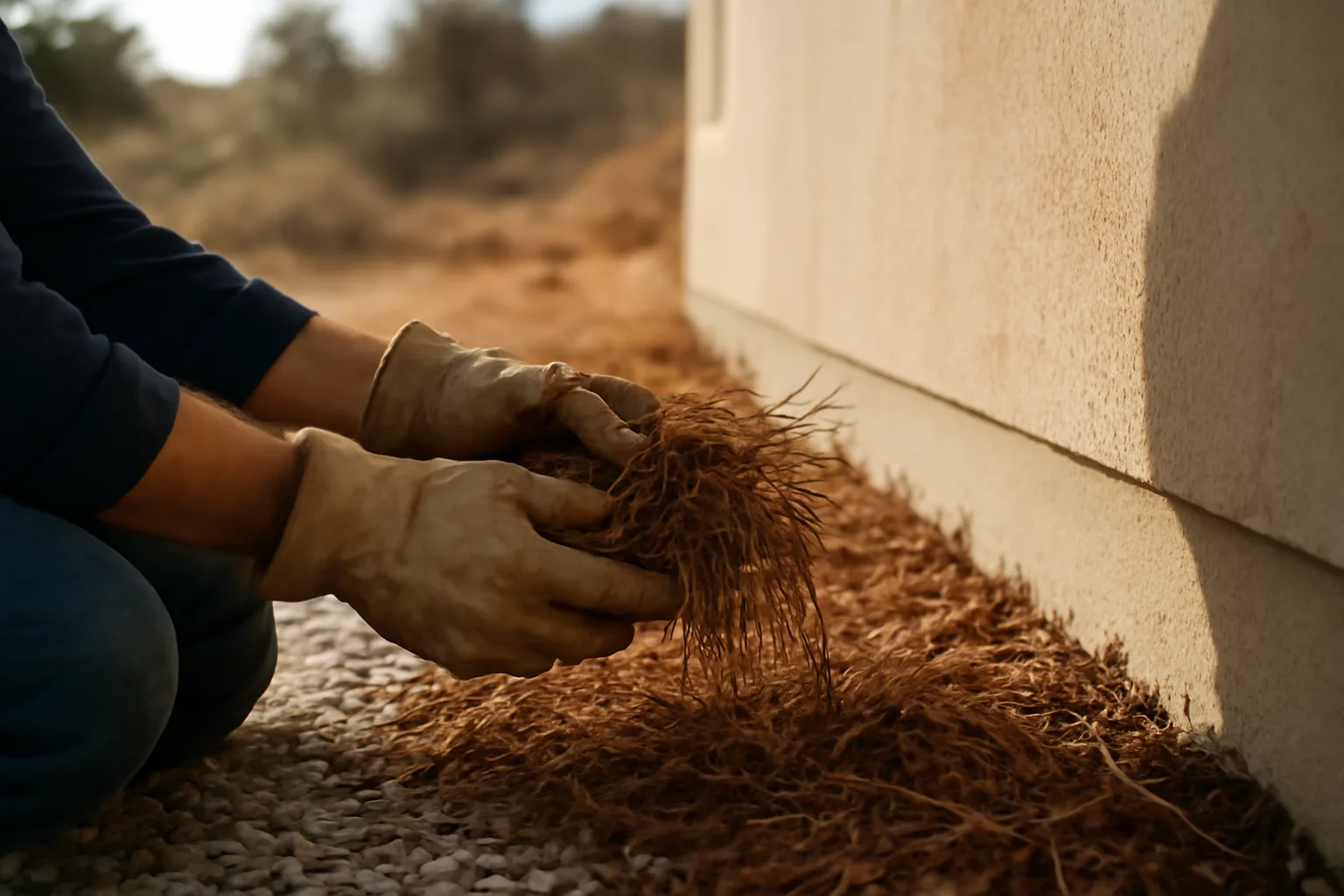
CAL FIRE defines three zones, and each one has a different job. Zone 0 (0-5 feet from structures): the ember-resistant zone. No combustible mulch, no stored firewood, no plants touching the house, nothing flammable under decks or against fences that attach to the house. Zone 1 (5-30 feet): lean, clean, and green. Remove dead plants and debris, keep grass mowed to 4 inches or less, create horizontal and vertical space between shrubs and trees ("ladder fuel" reduction), and keep tree canopies at least 10 feet from your roof and chimney. Zone 2 (30-100 feet): reduced fuel, not bare dirt. Cut annual grass down to 4 inches, space out clumps of vegetation, and remove dead and downed material. You're managing fuel continuity here, not landscaping for aesthetics. Here's a quick reference: | Zone | Distance | Main goal | Key actions |
When does the California defensible space law go into effect?
The base 100-foot defensible space requirement under PRC 4291 has been law since a 2005 update expanded it from 30 feet to 100 feet, and it's active today [1]. That part isn't new and isn't changing. What's still pending is the Zone 0 ember-resistant zone regulation, which California directed the Board of Forestry and Fire Protection to develop under Assembly Bill 3074 (2020) [2]. As of this writing, the Board has been working through formal rulemaking on the Zone 0 standards, and CAL FIRE's own guidance has stated an intended effective date, but the regulation has moved through multiple draft and comment cycles and the state has pushed the timeline before. Check CAL FIRE's defensible space page directly before you assume a hard date, because this is the one part of the law still in motion. Our practical advice: don't wait for the ink to dry. Treat your first 5 feet as Zone 0 now. Insurers are already asking about it in underwriting questionnaires in several states, law or no law.
What fire-safe home rules take effect in 2026?
This is the question everyone in a wildfire zone is asking right now, and the honest answer is: it depends which state you're in, because there's no single national 2026 rule. In California, the Zone 0 ember-resistant zone standard is the big one people mean when they say "2026 rule." The Board of Forestry has discussed phased effective dates in its rulemaking documents, with different compliance timelines potentially applying to new construction versus existing homes in high and very high fire hazard severity zones. Because this has shifted in prior drafts, verify the current effective date and applicability on CAL FIRE's Zone 0 information page before you plan around a specific month. Outside California, check your own state fire marshal. Oregon's defensible space and home hardening requirements grew out of Senate Bill 762 (2021) and have rolled out on their own schedule tied to the statewide wildfire risk map, administered through the Oregon Department of Forestry. Colorado and Arizona don't currently have a statewide mandatory defensible space statute comparable to California's; enforcement in those states runs mostly through county wildfire codes and individual fire district rules. That's a real gap and a real source of confusion, because "the state doesn't require it" doesn't mean your insurer doesn't. Local fire district requirement: _______________ (check with your local fire district or building department, since Zone 0 specifics and enforcement dates vary by jurisdiction).
Why won't people follow the defensible space law in California?
Compliance is genuinely uneven, and it's worth being honest about why instead of just scolding people. Cost is the first reason. Removing mature trees, regrading slopes, and hauling brush isn't cheap, and a lot of homeowners in fire-prone canyon and foothill communities are on fixed incomes or already stretched by rising insurance premiums. A homeowner facing a $3,000-$8,000 vegetation removal bill on top of a non-renewal notice is in a genuinely hard spot. Second, enforcement is spotty. CAL FIRE and local fire agencies are supposed to conduct defensible space inspections, but staffing hasn't kept pace with the number of parcels in State Responsibility Areas, and a lot of homes simply don't get inspected in a given year. Third, there's a real tension between defensible space rules and privacy, shade, and property values. Mature oak canopy and dense hedges are why some people bought the house in the first place. Telling someone to cut down a 40-year-old tree 12 feet from their porch is a hard conversation, and a lot of people quietly decide the risk is worth the shade. Fourth: genuine confusion about what's actually required. The zones, the species restrictions, and the enforcement mechanism differ by county and by whether you're in a State Responsibility Area or a Local Responsible Area with its own ordinance. People aren't lazy so much as unsure what the actual rule even is for their specific parcel.
How do I prepare for a wildfire, beyond just clearing vegetation?
Defensible space is necessary but it isn't the whole job. Preparing for a wildfire means treating the house, the yard, and the exit plan as three separate projects. On the house: harden vents with 1/8-inch metal mesh, clear gutters of leaf litter, replace wood decking or seal it against embers, and check that your roof has no gaps where embers can lodge. Ready.gov's wildfire preparedness guidance specifically calls out ember intrusion through vents and eaves as a leading cause of home ignition [3]. On the yard: work the zones described above, and don't forget the woodpile, propane tank clearance (CAL FIRE recommends 10 feet of clearance around propane tanks), and anything stored against exterior walls. On the exit: know two routes out of your neighborhood, not one. Register for your county's emergency alert system. Keep a go-bag with medications, documents, and a phone charger by the door. Ready.gov recommends practicing your evacuation plan before fire season, not during it [3]. Documentation matters here too, separate from mitigation. Before-and-after photos of your defensible space work, receipts for tree removal and vent screening, and dated records of what you did and when, all become the paper trail you'll want if you're contesting a non-renewal or trying to get reinstated with a new carrier. That's a different project from clearing brush, but it's just as important, and it's the whole idea behind our $99 Wildfire Insurance Survival Kit, which is built specifically to help homeowners assemble that documentation themselves. We don't file claims or contact your insurer on your behalf; you send your own file to your own carrier.
How can we prevent wildfires and forest fires from starting in the first place?
Prevention operates on two totally different scales, and it's worth separating them because the advice is different. At the individual level: most wildfires that threaten homes are human-caused, not lightning-caused. CAL FIRE notes that human activity, including unattended campfires, debris burning, equipment sparks, and downed power lines, accounts for the large majority of wildfire ignitions in California [4]. So the highest-leverage personal actions are boring but real: never leave a campfire unattended, don't burn debris on windy or dry days, keep vehicles off dry grass (catalytic converters and dragging chains start fires), and maintain equipment that could throw sparks. At the community and structural level, prevention shifts toward not letting an ignition become a home-to-home fire. This is where defensible space earns its keep. A neighborhood where every house has cleared its 5-foot ember zone and hardened its vents burns very differently than one where houses are packed close with cedar shake roofs and woodpiles against the siding. Fire behaves like a chain reaction in dense residential areas; each ignited home becomes a new ember source for the next one. Breaking that chain at the structure level is arguably the single most effective thing a community can do, more effective than most people assume, because it doesn't rely on stopping every spark, just stopping spread once one happens.
How do I avoid or prepare for a forest fire if I live near wildland?
If your property backs up to national forest, BLM land, or unmanaged open space, you're dealing with a different risk profile than a suburban tract home, and your defensible space plan should reflect that. Zone 2 (30-100 feet) does more work for wildland-adjacent homes because you're managing the transition between managed and unmanaged fuel. Coordinate with neighbors if possible; a single well-cleared lot surrounded by unmanaged brush on three sides is still exposed, because radiant heat and embers don't respect property lines. Check whether your land qualifies for cost-share programs. Many states run cooperative fuel reduction programs through state forestry agencies or USDA's NRCS, which can offset the cost of thinning and chipping on larger wooded parcels. Washington State's DNR, for instance, runs cost-share and contractor programs for defensible space clearing that homeowners in forested parcels can tap into; see wildfire defensible space clearing contracts through Washington State DNR for how that model works, since several other Western states run similar cost-share structures. If you're in a canyon or drainage that channels wind, know that fire moves uphill and through canyons much faster than across flat ground; local fire behavior specialists (your county fire department or CAL FIRE unit) can tell you if your specific lot sits in a known wind corridor.
Is Santa Barbara safe from fire?
No California coastal or foothill community, including Santa Barbara, is "safe" from wildfire in any absolute sense, and the area's own fire history makes that clear. The 2017 Thomas Fire burned over 281,000 acres across Ventura and Santa Barbara counties and was, at the time, the largest wildfire in modern California history, later surpassed by others [5]. The Thomas Fire's aftermath also triggered the Montecito debris flow in January 2018, which killed 23 people, a reminder that wildfire risk and post-fire flood/mudslide risk are linked, especially on the steep coastal terrain around Santa Barbara . Santa Barbara County sits largely within State Responsibility Area and Very High Fire Hazard Severity Zone designations in its foothill and wildland-urban interface communities (Montecito, Mission Canyon, the Riviera, and the hills above the city), meaning the 100-foot defensible space requirement applies directly to a large share of the county's housing stock [1]. Homeowners in these areas have seen real insurance market disruption; several major carriers have restricted new business or non-renewed policies across California's WUI zones broadly, and Santa Barbara foothill neighborhoods are squarely in that pattern. So: not "safe," but not hopeless either. Homes with real defensible space and hardened construction have measurably better survival odds in wildfire events, which is the entire reason this work matters even if you can't eliminate the risk.
What does a defensible space inspection actually check?
A CAL FIRE or local fire department defensible space inspection walks the same three zones described above and looks for specific, checkable items, not vague impressions. Inspectors typically check: grass and weed height (generally required to stay under 4 inches within 30 feet), distance from tree canopy to roofline and chimney (10 feet minimum), whether dead vegetation and debris have been removed, clearance around propane tanks and other fuel sources, condition of the roof and gutters, and whether anything combustible sits within that first 5-foot Zone 0 ring. Many insurers now run their own version of this inspection, sometimes via drone or satellite imagery, sometimes with a field adjuster, ahead of renewal decisions. That's a separate process from the fire agency inspection, uses different standards, and can result in a non-renewal notice even if you'd pass CAL FIRE's check. If you've gotten a letter citing vegetation, roof condition, or defensible space as a factor, our guide on what happens after a house fire and our broader defensible explainer both cover what documentation actually moves the needle with underwriters versus what's just noise. Either way, take your own photos before any inspection, dated and time-stamped, from the same angles you'd want an adjuster to see. It's the cheapest insurance you can buy against a bad-faith "you didn't comply" claim later.
What does defensible space cost, and is it worth doing all at once?
Costs vary enormously by lot size, slope, and how overgrown the property already is, so treat any number here as a range, not a quote. For a typical quarter-acre suburban lot, basic Zone 1 cleanup (mowing, pruning, debris removal) often runs a few hundred to low thousands of dollars if you hire it out, less if you do it yourself over a weekend. Larger wildland-adjacent parcels needing Zone 2 work, tree removal, and chipping can run into the tens of thousands, especially on steep terrain requiring specialized equipment. Do Zone 0 first regardless of budget. It's the cheapest zone to fix (mulch removal, moving firewood, clearing under the deck) and it's the zone most tied to actual home ignition in post-fire research. Fuel breaks 30-100 feet out matter, but a home with perfect Zone 2 and neglected Zone 0 still burns from ember intrusion at the foundation and eaves. If cost is the barrier, check with your county for chipper day programs (many California counties run free or subsidized green waste chipping events specifically timed to fire season) before assuming you have to pay full commercial removal rates.
Frequently asked questions
When does the California defensible space law go into effect?
The core 100-foot defensible space requirement under PRC 4291 is already in effect and has been since it was expanded in 2005. The newer Zone 0 ember-resistant zone standard, developed under AB 3074, is still moving through Board of Forestry rulemaking; check CAL FIRE's defensible space page for the current effective date before assuming a specific year.
Why won't some homeowners comply with California's defensible space law?
Cost, spotty enforcement, attachment to mature trees and shade, and genuine confusion over which zone rules apply to their specific parcel are the main reasons. Enforcement capacity hasn't kept pace with the number of parcels in State Responsibility Areas, so a lot of non-compliant properties simply never get inspected.
What is Zone 0 and why does it matter more than the outer zones?
Zone 0 is the 0-5 foot ember-resistant zone immediately around your house: no mulch, no plants touching siding, nothing combustible under decks. Post-fire research consistently shows homes ignite from windblown embers landing near the structure, not from direct flame contact, which makes this innermost zone the highest-leverage place to start.
How much does creating defensible space typically cost?
Basic Zone 1 cleanup on a quarter-acre lot often runs a few hundred to low thousands of dollars hired out. Larger wildland-adjacent parcels needing tree removal and Zone 2 thinning can run into the tens of thousands. Many counties offer free or subsidized chipper day programs that cut costs significantly.
How do I prevent wildfires from starting near my property?
Most wildfires are human-caused: unattended campfires, debris burning on dry or windy days, dragging chains or driving on dry grass, and faulty equipment. Never leave fire unattended, avoid outdoor burning during red flag warnings, and keep vehicles and mowers off dry vegetation, especially in late afternoon heat.
How do I prepare for a wildfire beyond clearing brush?
Harden vents with 1/8-inch metal mesh, clear gutters, treat wood decking, and maintain 10 feet of clearance around propane tanks. Separately, plan two evacuation routes, keep a go-bag ready, register for local emergency alerts, and document your property with dated photos in case you need proof of mitigation for insurance purposes.
What fire-safe home rules take effect in 2026?
There's no single nationwide 2026 rule. California's Zone 0 ember-resistant zone standard has a proposed timeline still in Board of Forestry rulemaking as of this writing; verify the current date on CAL FIRE's site. Other states like Oregon have their own rollout schedules tied to state wildfire risk maps, administered separately from California's system.
Is Santa Barbara safe from wildfire?
No. Santa Barbara County's foothill and wildland-urban interface communities sit in Very High Fire Hazard Severity Zones, and the county experienced the 281,000-acre Thomas Fire in 2017 followed by a deadly debris flow in Montecito in January 2018. Defensible space and home hardening measurably improve survival odds but don't make any property immune.
How can communities, more than individuals, help prevent forest fires?
Fire spreads home-to-home in dense neighborhoods when embers from one ignited structure land on the next. Coordinated defensible space across a whole block or wildland-urban interface community breaks that chain far more effectively than any single well-prepared house surrounded by neglected neighbors.
What plants should I avoid within 5 feet of my house?
Avoid resinous or oily plants (junipers, certain pines, rosemary in dense mass), anything with dead retained material, and any mulch made of bark or wood chips within Zone 0. Use gravel, pavers, or bare mineral soil instead, and keep any plantings low, isolated, and irrigated if you use them at all.
Do defensible space rules apply if I'm not in a State Responsibility Area?
California's PRC 4291 applies in State Responsibility Areas and many Local Responsible Areas with adopted ordinances, but requirements outside those zones depend entirely on your city or county fire code. Insurers, however, often apply their own defensible space standards regardless of which jurisdiction you're in, so check with your local fire district directly.
How often do I need to redo defensible space work?
Treat it as annual maintenance, not a one-time project. Grass and weeds regrow within weeks in spring, and dead material accumulates every season. Most fire agencies expect Zone 1 and Zone 0 maintained continuously through fire season, with a fuller cleanup pass at least once a year before conditions turn dry.
Sources
- California Public Resources Code Section 4291: 100-foot defensible space requirement around structures in State Responsibility Areas
- California Legislative Information, Assembly Bill 3074 (2020): AB 3074 directed the Board of Forestry to develop the Zone 0 ember-resistant zone regulation
- CAL FIRE, Top 20 Destructive Wildfires and Wildfire Prevention: Human activity accounts for the large majority of wildfire ignitions in California
- CAL FIRE, Thomas Fire incident archive: Thomas Fire burned over 281,000 acres in Ventura and Santa Barbara counties in 2017
- USGS, Emergency Assessment of Postfire Debris-Flow Hazards for the Thomas Fire: January 2018 Montecito debris flow following the Thomas Fire killed 23 people