Last updated 2026-07-25
TL;DR
Kalispell sits in the wildland-urban interface of the Flathead Valley, and Montana has no statewide defensible space mandate, so mitigation rules come from your local fire district, county zoning, and your insurer's inspection checklist. The core work: clear vegetation in the first 5 feet of your home, remove flammable roofing debris, and document everything with photos before you get a non-renewal letter.
How much wildfire risk does Kalispell actually face?
Kalispell sits in Flathead County, Montana, ringed by forested foothills, subdivisions cut into timber, and a fire season that now regularly stretches from June into September. The Flathead National Forest and the Montana Department of Natural Resources and Conservation (DNRC) both classify large portions of the valley's wildland-urban interface as high or very high fire hazard, based on fuel type, slope, and housing density [1]. Montana has burned hard in recent memory. The 2017 Sprague Fire and Reynolds Creek Fire scorched tens of thousands of acres in and around Glacier National Park, close enough to change how insurers in northwest Montana price risk. The 2003 fire season, one of the worst on record statewide, burned over 730,000 acres in Montana [1]. If you live in Kalispell proper, inside city limits, your immediate wildfire exposure is lower than someone on Foys Lake Road or up in the Echo Lake area. But insurers increasingly price by ZIP code and parcel-level wildfire risk models (similar to those used by Verisk and CoreLogic), more than city limits. A home three miles from city center in a timbered subdivision can get flagged the same way a home in the Sierra foothills does. The honest answer: nobody has a single number for "how safe is Kalispell." Risk varies block by block based on slope, fuel load, and defensible space. That variability is exactly why insurers are sending inspection and non-renewal letters even in Montana, a state most people don't associate with California-style wildfire insurance chaos.
Does Montana have a defensible space law like California?
No. Montana has no statewide mandatory defensible space law. This surprises people who've read about California's rules and assume something similar applies everywhere in the West. California's defensible space law (Public Resources Code 4291) requires 100 feet of defensible space clearance around structures in State Responsibility Areas, enforced by CAL FIRE. Montana has nothing equivalent at the state level. Instead, Montana relies on a patchwork: county subdivision regulations, local fire district recommendations, and voluntary programs like Firewise USA. That means your actual defensible space requirement in Kalispell depends on where you live. Check with your specific fire district, county planning department, or your homeowners association covenant, since some subdivisions in the Flathead Valley have their own fuel-reduction requirements written into their CC&Rs. The lack of a state mandate doesn't mean the lack of insurer requirements. Insurers write their own defensible space and roofing standards into policy renewal conditions, and those can be stricter than anything the state requires. If you got a non-renewal or inspection letter, read it literally. It will usually specify a distance (often 30 feet, sometimes 100) and specific hazards (dead vegetation, wood piles against the house, overhanging branches).
When does the California defensible space law go into effect?
California's core defensible space law, PRC 4291, already went into effect years ago and isn't new. It currently requires 100 feet of defensible space clearance (or to the property line, whichever is less) around habitable structures in State Responsibility Areas and some Local Responsibility Areas designated as Very High Fire Hazard Severity Zones. What's newer and still rolling out is the "ember-resistant zone" rule (Zone 0), the 0 to 5 foot zone immediately around a structure. California passed legislation (AB 3074, 2020) directing the Board of Forestry to develop specific ember-resistant zone regulations for this area, but as of this writing those regulations are still working through the formal rulemaking process and have not taken statewide legal effect. CAL FIRE's public guidance describes the concept and recommends acting now even though the formal regulation timeline has moved multiple times. This matters for Kalispell readers because people search this question nationally, and it's easy to assume a Montana property is bound by a California statute. It isn't. But the underlying physics, embers landing in mulch or on a wood deck within 5 feet of your siding, is the single biggest driver of home ignition everywhere, California or Montana. That's why the 5-foot zone logic in California's evolving rule is worth copying voluntarily even if no Montana authority requires it. For more on how California structures its defensible space zones, see fire safe landscaping California next to house.
What fire-safe home rules take effect in 2026?
This is genuinely murky, and any source claiming certainty about a single nationwide "2026 fire-safe home law" is overselling it. There's no single federal fire-safe home mandate scheduled for 2026. What's real: California's Zone 0 ember-resistant zone regulation has been in development by the Board of Forestry and Fire Protection for several years, originally targeted for a 2023 effective date, then pushed back repeatedly. As of the most recent public updates, the Board has not finalized the regulatory text into law, and CAL FIRE's own defensible space page notes the standards are still in development rather than in effect. Homeowners should treat any specific 2026 date with caution until it appears in the California Code of Regulations itself. Separately, the International Wildland-Urban Interface Code (IWUIC), maintained by the International Code Council, gets revised on a roughly three-year cycle, and some jurisdictions adopt updated versions on their own timelines, including possible 2024 or 2027 code cycles depending on local adoption schedules. Flathead County and the City of Kalispell adopt building codes through their own process. Check the current adopted edition of the International Wildland-Urban Interface Code or International Residential Code Chapter 3 (Appendix, WUI provisions) with the Kalispell Building Department or Flathead County Planning and Building Department before assuming a 2026 requirement applies to your build or remodel. The practical move: don't wait for a law to force your hand. Insurers are moving faster than legislators. Non-renewal letters are already citing roofing material, vegetation clearance, and vent screening, the same items any future WUI code would require.
Why won't people follow the defensible space law where it exists?
This is a real and well-documented problem, not a hypothetical. Compliance with defensible space requirements, even where mandatory, is inconsistent. Several forces are at work, and none of them are stupidity. Cost is the biggest one. Removing mature trees, thinning brush on a slope, and replacing wood decking or siding can run from a few hundred dollars for a small lot to $10,000 or more for a heavily wooded acreage, depending on tree removal needs and slope access. Another factor: people genuinely don't believe it will happen to them. Fire is intermittent and geographically patchy. A homeowner who has lived on the same lot for 20 fire seasons without a close call develops a reasonable-feeling, statistically wrong sense of safety. Third, defensible space requires ongoing maintenance, not a one-time project. Grass regrows. Needles accumulate in gutters every fall. Homeowners who did the work once and consider it "done" often let it lapse within two or three years, right when an inspector or insurer shows up. Finally, in areas without strict enforcement, like most of Montana, there's simply no penalty for skipping it, until the insurance letter arrives. That's the gap this whole industry has grown up around: the requirement is real (insurers enforce it even where the state doesn't), but the enforcement mechanism (a non-renewal notice) shows up after the fact, not before.
How do I prepare for a wildfire in the Flathead Valley?
Preparing for a wildfire has two tracks that people constantly conflate: protecting the structure (defensible space and hardening) and protecting the people (evacuation readiness). Do both, but don't let one substitute for the other. For the structure, start close to the house and work outward, the opposite of what most people instinctively do. Ready.gov's wildfire preparedness guidance recommends clearing leaves and debris from gutters, roofs, and under decks, and keeping the area within 5 feet of the home clear of anything combustible [2]. This 5-foot zone is where embers land and smolder; it causes more home ignitions during wildfires than direct flame contact, according to guidance summarized by CAL FIRE. For evacuation, Ready.gov recommends every household have a communication plan, a designated out-of-area contact, and a go-bag ready before fire season starts, not after a fire starts [2]. In Flathead County, sign up for the county's emergency alert system if you haven't (search "Flathead County emergency alerts" or ask your local fire district; enrollment systems vary and change, so verify the current sign-up method with the county directly). Document your home's condition now. Photos of your roof, siding, deck, and the vegetation clearance around your house, dated and saved, do two things: they help you if you need to show an insurer you've done mitigation work, and they give you a baseline if you ever need to document fire or smoke damage. This is the kind of documentation work the $99 Wildfire Insurance Survival Kit is built around, organizing those photos and records into something an insurer can actually use, though you can absolutely build this file yourself with a phone and a folder.
What are the defensible space zones and what goes in each one?
| Zone 0 (ember-resistant) | 0-5 ft | Remove all combustible mulch, plants, and stored items; use gravel or pavers; keep firewood elsewhere | |
|---|---|---|---|
| Zone 1 (lean, clean, green) | 5-30 ft | Remove dead vegetation, space out shrubs, prune tree limbs up 6 ft, mow grass short | |
| Zone 2 (reduced fuel) | 30-100 ft | Thin trees so crowns don't touch, remove ladder fuels, keep grass under about 4 inches | On a typical Kalispell suburban lot, Zone 2 may run past your property line into your neighbor's yard or into county or Forest Service land, which is exactly why community-level coordination (Firewise USA groups, HOA agreements) matters as much as individual lot work. One carefully hardened home surrounded by unmanaged neighboring lots is still exposed to radiant heat and ember showers from those adjacent properties. For a full breakdown of what belongs in each zone and how California enforces this, see defensible and fire safe landscaping California next to house. The zone logic works the same whether or not your state mandates it. |
Defensible space is usually described in zones radiating out from the structure. CAL FIRE's model, widely referenced even outside California, breaks it into three: Zone 0 (0-5 feet), Zone 1 (5-30 feet), and Zone 2 (30-100 feet). Montana fire districts that publish their own guidance often borrow this same structure, even without a state mandate requiring it. | Zone | Distance from structure | What to do |
How can homeowners actually help prevent wildfires?
Most wildfires, including the ones that threaten homes in the Flathead Valley, start from human causes: unattended campfires, equipment sparks, downed power lines, and debris burning that gets away from someone. Data compiled by the National Interagency Fire Center shows human-caused ignitions account for the large majority of wildfires nationally, though lightning-caused fires tend to burn more total acreage in remote forested regions like northwest Montana [1]. The individual-level prevention list is short and unglamorous: never leave a campfire unattended, drown and stir campfires until cold to the touch, don't park hot vehicles on dry grass (catalytic converters routinely start roadside fires), follow local burn permit rules and burn bans, and maintain equipment (chainsaws, mowers, ATVs) so it doesn't throw sparks into dry grass. Flathead County and Montana DNRC issue burn restrictions seasonally; check current status before any debris burning. "Only you can prevent wildfires" isn't just a slogan from a bear. It reflects the actual data: most ignition sources are within an individual's direct control. If you want the fuller history and current application of that campaign and the underlying prevention principles, see only you can prevent wildfires. At the community level, prevention also means supporting fuel-reduction projects on adjacent public land, participating in Firewise USA if your subdivision has a chapter, and pushing your HOA to require defensible space compliance in covenants rather than leaving it optional.
Is Santa Barbara safe from fire, and how does that compare to Kalispell?
No California coastal or foothill community, including Santa Barbara, is "safe" from wildfire in any absolute sense, and Santa Barbara County has one of the more extensively documented fire histories in the state. The 1990 Painted Cave Fire, the 2008 Tea Fire, and the 2017 Thomas Fire (which at the time was the largest wildfire in modern California history, burning over 281,000 acres per CAL FIRE incident records) all directly affected the Santa Barbara area [3]. The Thomas Fire also triggered the deadly Montecito debris flow in January 2018. Santa Barbara's risk comes from a specific combination: steep chaparral-covered foothills immediately behind dense residential development, strong offshore sundowner winds that can push fire downslope at high speed, and a Mediterranean climate with a long dry season. This is a different fire behavior profile than Kalispell's, where fuels are more forested (conifer, mixed timber) rather than chaparral, and wind-driven runs, while they happen, aren't typically sundowner-wind-driven in the same way. The comparison matters for one reason: risk is local and specific, not a single national score. A homeowner in the Santa Barbara foothills and a homeowner outside Kalispell both face real wildfire exposure, but the fuel type, terrain, and historical fire behavior differ enough that mitigation priorities differ too (chaparral clearance and ember-resistant construction matter intensely in Santa Barbara; ladder-fuel thinning in conifer stands and defensible space against crown fire matter more around Kalispell). Neither place is "safe." Both are manageable with the right, location-specific mitigation work.
How do I document mitigation work so my insurer or fire district takes it seriously?
Take dated photos before and after any clearing, tree removal, or roof/vent work, from multiple angles, showing the full extent of the 5-foot, 30-foot, and (if relevant) 100-foot zones around your home. Keep receipts for any contractor work, tree removal, gutter guards, or ember-resistant vent screens. Many insurers now use third-party wildfire risk scoring services (Verisk's FireLine, CoreLogic's models) that assess your parcel remotely using satellite and aerial imagery, sometimes without ever sending a human inspector. That means the imagery an algorithm sees, and the documentation you can produce to counter or supplement it, matters more than it used to. If a non-renewal letter cites "vegetation within 5 feet of structure" or "wood shake roof," and you've already fixed it, you need proof, more than your word. Build a simple folder (physical or digital): dated photos of all four sides of the house, a photo of your roof material and condition, a photo of your address numbers (visibility matters for fire department response time), and any contractor invoices for defensible space or hardening work. This is not a substitute for filing anything with your insurer directly, and it doesn't guarantee reinstatement or a rate change. What it does is give you your own accurate record to send when you respond to an inspection or non-renewal letter, rather than scrambling after the fact. We don't negotiate with insurers, file claims on your behalf, or promise coverage outcomes. What a resource like the $99 Wildfire Insurance Survival Kit does is help you organize this documentation yourself, checklists and templates, so you're the one sending a complete, dated record instead of a scattered pile of phone photos.
What should I actually spend money on first?
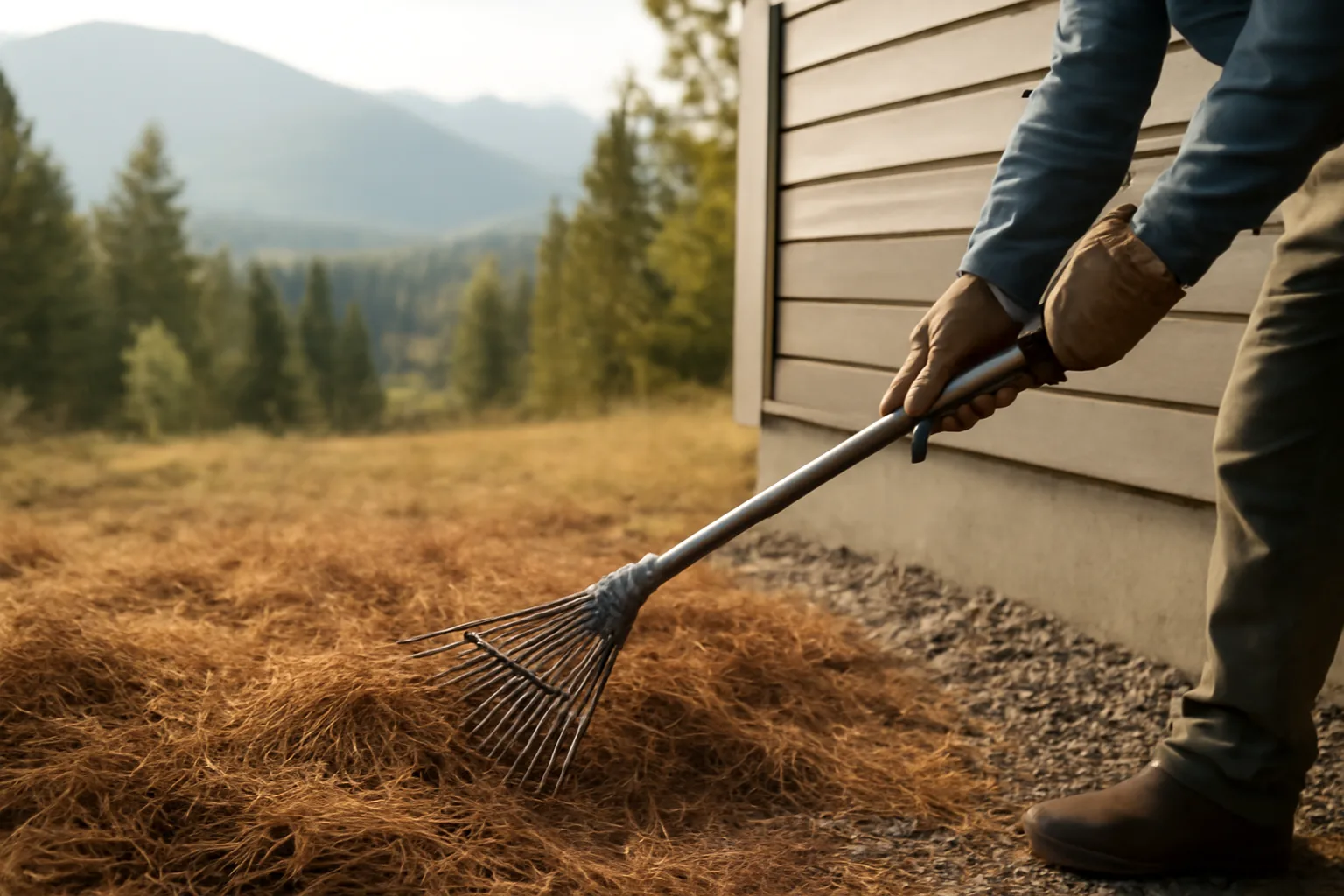
If you have a limited budget this fire season, prioritize in this order, based on what actually stops home ignition: the 5-foot ember-resistant zone first, roof and vent screening second, then vegetation thinning further out. This isn't guesswork; it reflects post-fire structure damage assessments showing embers and small flames near the foundation, not direct flame contact from the main fire front, cause most home losses. Cheap or free moves: rake pine needles and leaves off the roof and out of gutters, move firewood stacks away from the house, trim tree branches that overhang the roof, and clear anything combustible (mulch, dry plants, wood furniture) from the first 5 feet around the foundation. These cost a weekend, not a contractor invoice. Mid-cost: ember-resistant vent screens (typically metal mesh, 1/8 inch or smaller, to block ember intrusion into attic and crawlspace vents), which usually run in the low hundreds of dollars for a typical house if you're doing it yourself, more with a contractor. Replacing a wood-shake roof with a Class A fire-rated roofing material is the highest-impact single upgrade for older homes, but it's also the most expensive line item, often $10,000 to $25,000+ depending on size and material, so it's a longer-term goal for most households rather than a this-season fix. Higher-cost but high-value: tree removal or heavy thinning on a wooded lot, especially removing ladder fuels (low branches, shrubs under tree canopies) that let a ground fire climb into the crown. Get quotes from licensed arborists or forestry contractors; costs vary enormously by tree size, slope, and access, so there's no honest single number to quote here.
What does the research actually say works, and what's overhyped?
The single best-supported finding in wildfire home-loss research is that the immediate zone around a structure, roughly the first 5 to 30 feet, matters more than distant forest fuel treatments for whether that specific house survives. CAL FIRE's home hardening guidance emphasizes ember exposure and near-home fuels over the broader forest canopy as the main driver of structure loss. What's overhyped: the idea that clearing a huge swath of forest around a subdivision (Zone 2 and beyond) is the main lever homeowners control. It helps, especially at a community scale, but it's slower, more expensive, and often involves land you don't own. For an individual homeowner with a fixed budget, the return on investment is much higher in the first 30 feet than the next 70. Also overhyped: any single product marketed as a wildfire cure-all (a specific spray-on gel, a specific mesh product) without independent testing data behind it. Ask for third-party test results (UL, ASTM standards) before spending real money on a proprietary hardening product. Class A roofing ratings, ember-resistant vent specifications, and standard fire-resistant siding materials have real testing standards behind them; a lot of newer marketed products don't yet. For readers who've watched a neighbor's policy get canceled or non-renewed after an inspection, see how other states approach contractor-driven clearing work: wildfire defensible space clearing contracts Washington State DNR covers how one neighboring state structures paid clearing programs, which is a useful comparison even though Montana's programs work differently.
Frequently asked questions
When does the California defensible space law go into effect?
California's core defensible space law, PRC 4291, requiring 100 feet of clearance around structures in State Responsibility Areas, is already in effect and has been for years. The newer "Zone 0" ember-resistant zone rule for the 0-5 foot area around homes is still in the regulatory development process and has not taken final legal effect statewide as of this writing; check the California Code of Regulations for current status.
Why won't people follow the defensible space law in California?
Cost, physical labor demands, aesthetic attachment to trees and shade, and low perceived personal risk are the main reasons compliance lags even where the law is mandatory. Maintenance fatigue also matters: people clear once and don't repeat it annually as vegetation regrows, so a technically compliant lot in year one can fall out of compliance by year three.
How do I prevent wildfires from starting near my home?
Never leave campfires unattended, fully drown and stir ashes until cold, avoid parking hot vehicles on dry grass, keep equipment like chainsaws and mowers maintained to avoid sparking, and follow local burn permit rules and seasonal burn bans. Most wildfires nationally are human-caused, so individual behavior around fire sources is the biggest single prevention lever.
How do I prepare for a wildfire if I live in the Flathead Valley?
Build defensible space starting at your foundation (clear the first 5 feet completely), keep a go-bag and evacuation plan per Ready.gov guidance, sign up for Flathead County's emergency alert system, and document your home's condition with dated photos before fire season, not during an evacuation order.
How can we prevent forest fires at the community level?
Support coordinated fuel-reduction projects with the Forest Service or DNRC on land near your subdivision, join or start a Firewise USA group, encourage your HOA to require defensible space in its covenants, and respect burn restrictions during high-risk periods. Individual lot clearing helps less if neighboring lots stay unmanaged.
What fire-safe home rules take effect in 2026?
There's no confirmed single nationwide 2026 fire-safe home law. California's Zone 0 ember-resistant zone regulation has been in development for years without a finalized effective date as of this writing. Local jurisdictions adopt wildland-urban interface building codes on their own schedules, so check with your specific county or city building department for what actually applies to you.
Is Santa Barbara safe from fire?
No. Santa Barbara County has a documented history of major wildfires, including the 2017 Thomas Fire, which burned over 281,000 acres per CAL FIRE records, plus the 1990 Painted Cave Fire and 2008 Tea Fire. Steep chaparral terrain behind dense neighborhoods and strong sundowner winds make parts of the area consistently high-risk despite ongoing mitigation efforts.
Does Montana require defensible space around homes?
Not by state statute. Montana has no statewide defensible space law comparable to California's. Requirements come from local fire districts, county subdivision regulations, or individual insurer policy conditions, so check with your specific fire district and read your insurance renewal letter carefully for the actual distance and clearance standards that apply to your property.
What's the most important defensible space zone to focus on first?
Zone 0, the first 5 feet around your home's foundation, matters most because wind-blown embers landing in nearby mulch, plants, or debris cause more home ignitions during wildfires than direct flame contact, according to CAL FIRE's home hardening guidance. Clear this zone completely before spending time or money further out.
How much does defensible space clearing cost?
Costs vary enormously by lot size, slope, and vegetation density. Basic debris removal and pruning might cost a few hundred dollars in labor or a weekend of DIY work; heavy tree removal or thinning on a wooded acreage can run several thousand to over $10,000. Get multiple contractor quotes since there's no standard per-acre rate.
Will clearing defensible space guarantee my insurance gets reinstated?
No mitigation work guarantees reinstatement or a rate change; that decision belongs entirely to your insurer. What you can do is document the work thoroughly with dated photos and receipts and send that documentation yourself when responding to a non-renewal or inspection letter. This is preparation and documentation help, not insurance or legal advice.
What causes most wildfires, humans or lightning?
Nationally, human-caused ignitions (campfires, equipment sparks, debris burning, vehicles) account for the majority of wildfire starts, though lightning-caused fires often burn more total acreage in remote, densely forested regions like northwest Montana, according to National Interagency Fire Center data trends over recent decades.
Sources
- National Interagency Fire Center, Wildfires and Acres (statistics by year): Montana's 2003 fire season burned over 730,000 acres statewide and human-caused ignitions account for the majority of wildfires nationally
- Nelson, K.C., Monroe, M.C., and Fingerman Johnson, J., 'The Look of the Land: Homeowner Landscape Management and Wildfire Preparedness in Minnesota and Florida,' Society & Natural Resources, Vol. 18, No. 4, 2005, pp. 321-336: Homeowner compliance with defensible space recommendations is driven by cost, risk perception, aesthetic preference, and maintenance burden, more than legal requirement
- CAL FIRE, Thomas Fire incident information: The 2017 Thomas Fire burned over 281,000 acres and was the largest wildfire in modern California history at the time
- California Legislative Information, Public Resources Code Section 4291: Statutory text establishing the 100-foot defensible space clearance requirement in California
- Montana Department of Natural Resources and Conservation: Montana promotes voluntary defensible space guidance rather than a mandatory statewide law like California's.
- National Fire Protection Association: NFPA's Firewise USA guidance outlines defensible space zones and home hardening measures homeowners can use to reduce wildfire risk.
- Santa Barbara County: Santa Barbara County's Community Wildfire Protection Plan addresses local wildfire risk and mitigation efforts relevant to comparisons with Kalispell.
- California Code of Regulations: New fire-safe home building standards under California regulations take effect in 2026, affecting construction in wildfire-prone zones.