Last updated 2026-07-25
TL;DR
Brick is noncombustible and won't burn, but a brick home is not automatically fire-safe. Most wildfire homes are lost through embers entering vents, roofs, and gaps around windows, not from walls catching fire. Roofing material, vent screens, defensible space, and gutter maintenance matter more to survival than the wall material itself.
are brick homes fire resistant?
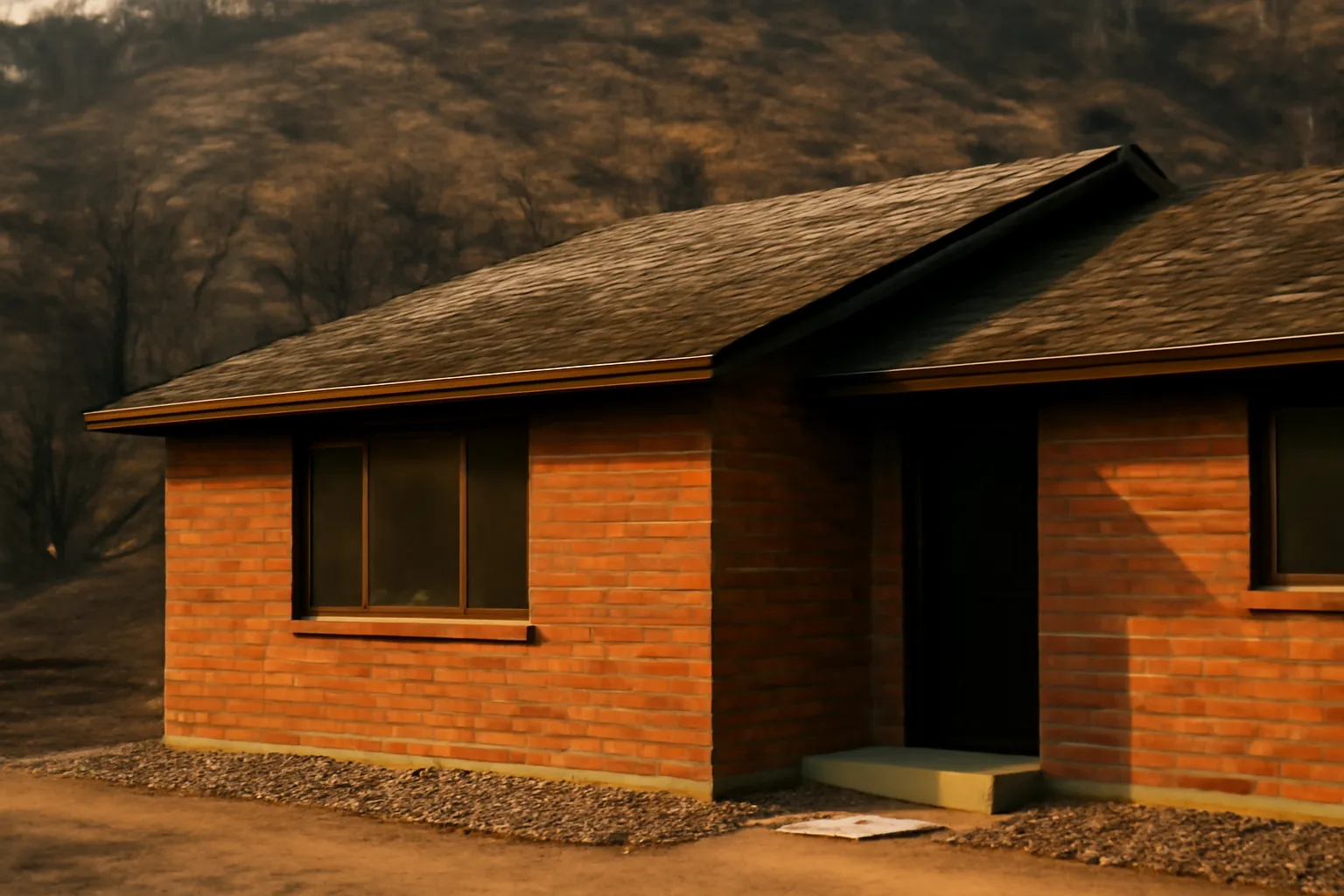
Brick itself does not burn. It's fired clay, and it has no fuel value, so a brick veneer or solid brick wall will not ignite the way wood siding does. But "fire resistant" and "wildfire survivable" are two different claims, and people mix them up constantly. A brick house with a wood shake roof, open eaves, and unscreened attic vents can burn to the ground in a wildfire while the brick walls are left standing, blackened, with nothing left inside. CAL FIRE's own research on home ignition points to embers and small flames as the dominant cause of home loss in wildfires, not direct flame contact with exterior walls. Think of brick as one layer in a system. It helps with the wall assembly. It does nothing for your roof, your vents, your deck, or the mulch bed six feet from your foundation. Those are the parts that actually decide whether your house survives, according to the research coming out of the Institute for Business & Home Safety and the Insurance Institute for Business & Home Safety's wildfire testing program.
why do brick homes still burn down in wildfires?
Brick homes burn down because wildfires rarely attack a house as a wall of flame. They attack it as a storm of embers, sometimes traveling a mile or more ahead of the fire front, according to CAL FIRE's home hardening guidance. Embers find every gap: a vent without 1/8-inch metal mesh, a soffit with an open seam, a window with single-pane glass that cracks from radiant heat, a wood fence that touches the house and carries fire straight to the siding. Once embers get inside an attic or wall cavity, the exterior material is irrelevant. A brick house with an unprotected attic vent burns from the inside out just like a stucco house does. The brick keeps standing. It's noncombustible, after all. But the house itself is a loss. Here's the part that surprises people: roofing material matters more than wall material in almost every wildfire home-loss study. A Class A fire-rated roof (asphalt shingle, tile, metal, or slate) dramatically outperforms wood shake, and CAL FIRE requires Class A roofing in the State Responsibility Area under Public Resources Code 4290 for new construction and reroofing [1]. If you've got brick walls and a wood shingle roof, you've built a house that looks fireproof and isn't.
what actually makes a home wildfire resistant?
| Roof | Wood shake, untreated wood | Class A rated: asphalt shingle, tile, metal [1] | |
|---|---|---|---|
| Vents | Open or standard insect screen | 1/8-inch noncombustible metal mesh, ember-resistant vents | |
| Windows | Single-pane | Dual-pane with one tempered pane | |
| Siding | Vinyl, untreated wood | Fiber cement, stucco, brick, or ignition-resistant material | |
| Decks | Wood, debris underneath | Ignition-resistant material, enclosed or screened underside | |
| Gutters | Open, full of leaves | Metal gutters, cleared regularly, gutter guards | Brick shows up in the siding row, and it's a good choice there. But it's one row out of six. A homeowner who spends money re-bricking a house while leaving a wood shake roof and open attic vents has spent money on the wrong line item. If you're mapping out priorities room by room and system by system, our home hardening guide walks through the order CAL FIRE recommends and what each upgrade actually costs. |
It's a system, not a single material. The order of priority, based on CAL FIRE's home hardening framework, runs roughly: roof, vents, windows, siding, decks, and gutters. | Component | High-risk version | Hardened version |
when does the california defensible space law go into effect?
California's defensible space requirement under Public Resources Code 4291 has been in effect for years already, it's not a future law. It currently requires 100 feet of defensible space clearance around structures in State Responsibility Areas (or as much as the property line allows), split into an ember-resistant zone within 5 feet of the structure and two additional zones out to 100 feet. What's changing is enforcement detail and the ember-resistant zone specifics. CAL FIRE has been developing "Zone 0" regulations, an ember-resistant zone within 5 feet of structures, following a 2020 legislative directive (AB 3074) that told the Board of Forestry to adopt specific standards for that zone [2]. As of this writing, the Board of Forestry has not finalized the Zone 0 regulation text into enforceable code; it has gone through rulemaking stages with proposed effective dates that have shifted more than once. Check the CAL FIRE defensible space page directly for the current rulemaking status in your area, because the timeline has moved and a fixed date here would go stale fast. Until Zone 0 rules are finalized and adopted, PRC 4291's existing 100-foot, two-zone structure is what's enforceable, and it already requires removing dead vegetation and dead grass, spacing plants, and keeping the 5-foot zone around structures clear of flammable material as a matter of general defensible space practice.
what fire safe rules for homes take effect in 2026?
This is genuinely a moving target, and any article that gives you a confident hard date is probably guessing. California's Zone 0 ember-resistant zone regulation, which would require homeowners in high fire hazard severity zones to remove combustible material within 5 feet of the home (things like bark mulch, wood fencing attached to the house, and stored firewood), has been in active rulemaking with the Board of Forestry and Fire Protection for several years, with proposed and then delayed effective dates [2]. Rather than repeat a date that may already be wrong by the time you read this, check CAL FIRE's defensible space page and your local fire district directly. Some counties and fire districts have already adopted stricter local ordinances ahead of the state Zone 0 rule, so your actual deadline depends heavily on where you live. Fill in your own timeline here: [Your fire district / county name] requires defensible space inspection by [date], and Zone 0-style ember zone rules in your area take effect [date, confirm with local fire marshal]. That's not us being vague for no reason, it's because this genuinely varies by jurisdiction and the state rule is still in motion.
why won't people follow the defensible space law in california?
Cost, labor, and inertia, mostly. Clearing 100 feet of defensible space on a sloped, brush-covered lot is real physical work, and hiring it out runs into real money, often several thousand dollars for a full property depending on lot size, vegetation density, and slope. Retired homeowners on fixed incomes and absentee owners of vacation properties are two groups that show up repeatedly in local reporting on non-compliance. There's also a genuine information gap. Some homeowners don't know the 100-foot rule applies to them because they're unclear on whether their parcel sits in a State Responsibility Area or a Local Responsibility Area, and the rules differ by jurisdiction. Others comply on paper (they got an inspection) but let vegetation regrow within a year or two, because defensible space isn't a one-time project, it's an annual maintenance obligation. And some people simply believe it won't happen to them, which is the same psychology that shows up in every disaster-preparedness gap, from earthquake retrofits to hurricane shutters. CAL FIRE inspectors report compliance rates that vary widely by county, and enforcement resources are thin relative to the number of parcels needing inspection. If you got a non-renewal notice specifically citing defensible space, our defensible space breakdown covers how to document your compliance in a way an insurer or inspector can actually verify.
how to prevent wildfires
Most wildfires in the U.S. are human-caused, not lightning-caused. Ready.gov and the U.S. Forest Service both point to unattended campfires, debris burning, equipment sparks, and discarded cigarettes as leading ignition sources, and Smokey Bear's long-running public message ("Only you can prevent forest fires") exists precisely because human ignition is the preventable half of the wildfire problem. Practical prevention at the individual level: never leave a campfire unattended and fully drown, stir, and feel it cold before leaving, per U.S. Forest Service guidance. Don't burn debris on windy or dry days, and check local burn permit rules first. Keep vehicles and equipment with hot exhaust off dry grass. Avoid mowing dry grass in the heat of the day, since a mower blade hitting a rock can throw a spark. Maintain chains on trailers so they don't drag and spark on pavement. At the community level, prevention also means defensible space and home hardening, because a wildfire that starts somewhere else becomes a structure fire when it reaches your property with no buffer. Our only you can prevent wildfires piece goes deeper on the human-ignition side of this if you want the full picture.
how to prevent forest fires / how to avoid forest fires
Forest fire prevention overlaps heavily with wildfire prevention generally, since most forest fires are wildfires by another name, just in a more forested fuel type. The core behaviors are the same: manage campfires completely, follow local burn bans, keep equipment maintained so it doesn't throw sparks, and report unattended fires or suspicious smoke immediately by calling 911. If you live adjacent to forest land (the wildland-urban interface), avoiding forest fire damage to your own property is really a defensible space and fuel-management question. Thinning dead trees and brush near your property line, keeping a mowed or irrigated buffer, and coordinating with neighbors on shared fuel breaks all reduce the chance that a forest fire reaches structures. One detail people miss: pile burning and agricultural burning are common forest fire causes in rural areas, and most states require permits for outdoor burning above a certain size, with restrictions during red flag warning days. Check your state fire marshal's office for current burn permit requirements before doing any debris burning, because rules shift seasonally with drought conditions.
how to prepare for a wildfire / how to prepare for forest fires
Ready.gov's wildfire preparedness guidance breaks this into three buckets: know your risk, prepare your home, and prepare your family and documents. Sign up for local emergency alerts (many counties use systems like Nixle or Genasys), know your evacuation zone, and identify two ways out of your neighborhood in case one route is blocked. For the home itself, that means the hardening priorities from earlier in this article: Class A roof, ember-resistant vents, cleared defensible space, and gutters free of debris. Keep a hose long enough to reach all sides of the house and know where your shutoff valves are. For your family, Ready.gov recommends an emergency supply kit with water, medications, important documents (copies of insurance policy, ID, deed), and a communication plan in case you're separated. Photograph the exterior and interior of your home, including serial numbers on major appliances and any recent renovation receipts, before fire season starts, not after a notice arrives. This documentation matters twice: once for your own recovery planning, and again if you ever need to show an insurer proof of your home's condition and improvements. That second use case is exactly why DefensibleHome built the $99 one-time Wildfire Insurance Survival Kit: a structured way to organize home hardening photos, defensible space records, and improvement receipts into the kind of documentation packet insurers and inspectors actually want to see. We don't file claims or represent you with your insurer, you send your own documentation, we just help you organize it before you need it.
is santa barbara safe from fire?
No area in California's coastal or foothill wildland-urban interface is "safe" from fire risk in an absolute sense, and Santa Barbara County has a documented history that argues against complacency. The 2017 Thomas Fire burned over 281,000 acres across Ventura and Santa Barbara counties and was, at the time, the largest wildfire in modern California history by acreage, per CAL FIRE incident records [3]. The subsequent Montecito debris flow in January 2018, triggered by rain falling on the Thomas Fire burn scar, killed 23 people, a grim reminder that wildfire risk doesn't end when the flames are out. Parts of Santa Barbara sit directly against the Los Padres National Forest and steep, chaparral-covered foothills, which is about as classic a wildland-urban interface fire risk profile as exists in the state. CAL FIRE's Fire Hazard Severity Zone maps show large sections of Santa Barbara County foothill communities rated Very High, the top hazard tier [4]. That said, "high risk" doesn't mean "guaranteed loss." Homes built or retrofitted to current wildfire codes, sited with real defensible space, and maintained annually have measurably better survival odds in the same fire events than homes without those features, which is the entire premise behind CAL FIRE's home hardening program. If you own property in Santa Barbara or any similarly rated area, check your specific parcel's Fire Hazard Severity Zone designation directly through CAL FIRE's mapping tool rather than relying on general reputation about the area.
how can we prevent forest fires? (community and policy level)
Beyond individual behavior, forest fire prevention at the community level runs through fuel management, prescribed burning, and building codes. The U.S. Forest Service and state agencies conduct prescribed burns and mechanical thinning specifically to reduce the dense fuel loads that turn a manageable fire into a catastrophic one; decades of fire suppression policy left many Western forests with far more fuel than historical fire regimes would have allowed. At the neighborhood level, community wildfire protection plans (CWPPs), fuel breaks, and coordinated defensible space compliance make a measurable difference, because a single non-compliant parcel can undermine an entire block's fire resistance. Firewise USA, a National Fire Protection Association program, recognizes communities that organize around shared risk-reduction work, and many insurers now ask whether a property sits in a recognized Firewise community as part of underwriting. Policy tools matter too. Building codes requiring Class A roofing and ember-resistant vents in high hazard zones (as California does under PRC 4290 for new construction), utility programs for power line clearance and public safety power shutoffs during extreme fire weather, and funding for defensible space cost-share programs that help lower-income homeowners comply, all add up. None of this is a single fix. It's a stack of smaller interventions that each reduce risk by some measurable percentage, and stacking enough of them is what actually moves the needle on structure loss rates.
so is brick actually worth it for wildfire protection?
Yes, as one piece of the system, and no, not as a standalone solution. If you're building new or doing a full re-siding project in a wildfire-prone area, brick, stucco, and fiber cement all outperform vinyl and untreated wood siding for wildfire ignition resistance, and brick has the added benefit of essentially zero maintenance and a very long service life. But if your budget is limited and you're choosing between re-siding in brick versus replacing a wood shake roof with Class A roofing, replace the roof first. If you're choosing between brick and screening your attic vents with 1/8-inch metal mesh, screen the vents first. Wall material sits fairly low on the list of things that determine whether a home survives an ember storm, even though it's the thing most people think of first when they hear "fireproof house." For a broader comparison of which building materials and construction choices actually move the needle on wildfire survival, our fire safe landscaping next to house guide and our defensible overview cover the landscaping and clearance side, which for most homes matters more than the wall material choice.
Frequently asked questions
Are brick homes fireproof?
No, brick is noncombustible, meaning it won't burn, but a brick home is not fireproof. Wildfires most often destroy homes through ember entry into vents, roofs, and gaps, not by igniting exterior walls. A brick house with a wood shake roof and unscreened vents can still burn down.
Is brick siding better than vinyl for wildfire protection?
Yes. Brick, stucco, and fiber cement all resist ignition far better than vinyl siding, which can melt and deform under radiant heat from a wildfire. But siding material ranks below roofing, vents, and defensible space in overall importance for survival, per CAL FIRE's home hardening priorities [2].
When does California's defensible space law take effect?
The core 100-foot defensible space requirement under Public Resources Code 4291 is already in effect and has been for years. A newer 5-foot ember-resistant "Zone 0" rule has been in rulemaking at the Board of Forestry for several years without a finalized effective date; check CAL FIRE's defensible space page for current status [4][5].
Why don't more homeowners comply with California's defensible space law?
Cost, labor, unclear jurisdiction (State vs Local Responsibility Area), and the fact that defensible space isn't a one-time job, it needs annual re-clearing as vegetation regrows. Enforcement resources are also thin relative to the number of parcels that need inspection each year.
What roofing material is required in California's high fire hazard zones?
Class A fire-rated roofing (asphalt shingle, tile, metal, or slate) is required for new construction and reroofing in State Responsibility Areas under Public Resources Code 4290 [3]. Wood shake and untreated wood roofs do not meet this standard.
How do I prevent wildfires from starting?
Fully extinguish campfires (drown, stir, feel cold before leaving), never burn debris on windy or dry days, keep vehicle exhaust and equipment off dry grass, maintain trailer chains so they don't spark on pavement, and follow local burn permit rules from your state fire marshal's office.
What's the best way to prepare for a wildfire?
Sign up for local emergency alerts, know your evacuation zone and two exit routes, harden your home (Class A roof, ember-resistant vents, cleared defensible space), and build a Ready.gov-style emergency kit with documents, medications, and water for your family [6].
Is Santa Barbara at high risk for wildfire?
Yes. Significant parts of Santa Barbara County's foothill communities are mapped as Very High Fire Hazard Severity Zone by CAL FIRE [8], and the area sits against the Los Padres National Forest. The 2017 Thomas Fire burned over 281,000 acres in the region [7].
What new fire safety rules take effect in 2026 in California?
As of this writing there's no confirmed statewide 2026 effective date to report accurately; California's Zone 0 ember-resistant zone rule has been delayed multiple times in Board of Forestry rulemaking. Check CAL FIRE's defensible space page and your local fire district for the current confirmed timeline [4].
Does brick veneer protect a house from wildfire the same as solid brick?
Both are noncombustible on the exterior surface, so both resist ignition from direct flame or radiant heat similarly. Neither protects the roof, vents, windows, or attic, which is where most wildfire home losses actually originate, so the difference between veneer and solid brick matters less than other hardening choices.
What's the number one cause of home loss in wildfires?
Embers and small flame contact, not direct wall-of-flame exposure, according to CAL FIRE's home ignition research [1]. Embers enter through unscreened vents, gaps in roofing, and combustible material within 5 feet of the structure, igniting the home from the inside or from small fuel sources against the walls.
How can communities help prevent forest fires?
Through coordinated fuel breaks, prescribed burning programs run by state and federal agencies, Firewise USA community organizing, and consistent neighborhood-wide defensible space compliance, since one non-compliant parcel can undermine a whole block's fire resistance.
Can I get insurance discounts for having a brick house?
Some insurers weight construction type in underwriting, but brick alone rarely qualifies a home for a wildfire-specific discount the way documented defensible space compliance or a Class A roof might. Ask your specific insurer what mitigation documentation they credit, since this varies by carrier and state.
Sources
- California Public Resources Code Section 4290: Class A fire-rated roofing required for new construction and reroofing in State Responsibility Areas
- California State Assembly Bill 3074 (2020): directed the Board of Forestry to adopt an ember-resistant Zone 0 regulation within 5 feet of structures
- CAL FIRE, Thomas Fire incident information: 2017 Thomas Fire burned over 281,000 acres across Ventura and Santa Barbara counties
- CAL FIRE, Fire Hazard Severity Zone Maps: Santa Barbara County foothill communities are mapped in Very High Fire Hazard Severity Zones
- National Fire Protection Association (NFPA): The Firewise USA program provides community-level guidance for reducing wildfire risk through structural and vegetation management.
- California Department of Forestry and Fire Protection (CAL FIRE): CAL FIRE provides defensible space guidelines detailing the zones and requirements homeowners must follow under California law.
- CAL FIRE / Ready for Wildfire: Home hardening measures such as ember-resistant vents, dual-pane windows, and non-combustible roofing are critical to wildfire resistance beyond wall material choice.
- USDA Forest Service: The U.S. Forest Service outlines wildfire prevention strategies including fuel reduction and prescribed burns to reduce forest fire risk.
- County of Santa Barbara: Santa Barbara County provides wildfire preparedness resources reflecting the region's ongoing wildfire risk.