Last updated 2026-07-25
TL;DR
Building a fire resistant home means treating the first 5 feet around the structure (zone 0), the roof, vents, and siding as the priority, in that order. California's zone 0 ember-resistant zone rule is expected to take effect for many parcels starting 2026, per CAL FIRE and the Board of Forestry. Vents and roofs matter more than most landscaping.
What does it actually mean to build a fire resistant home
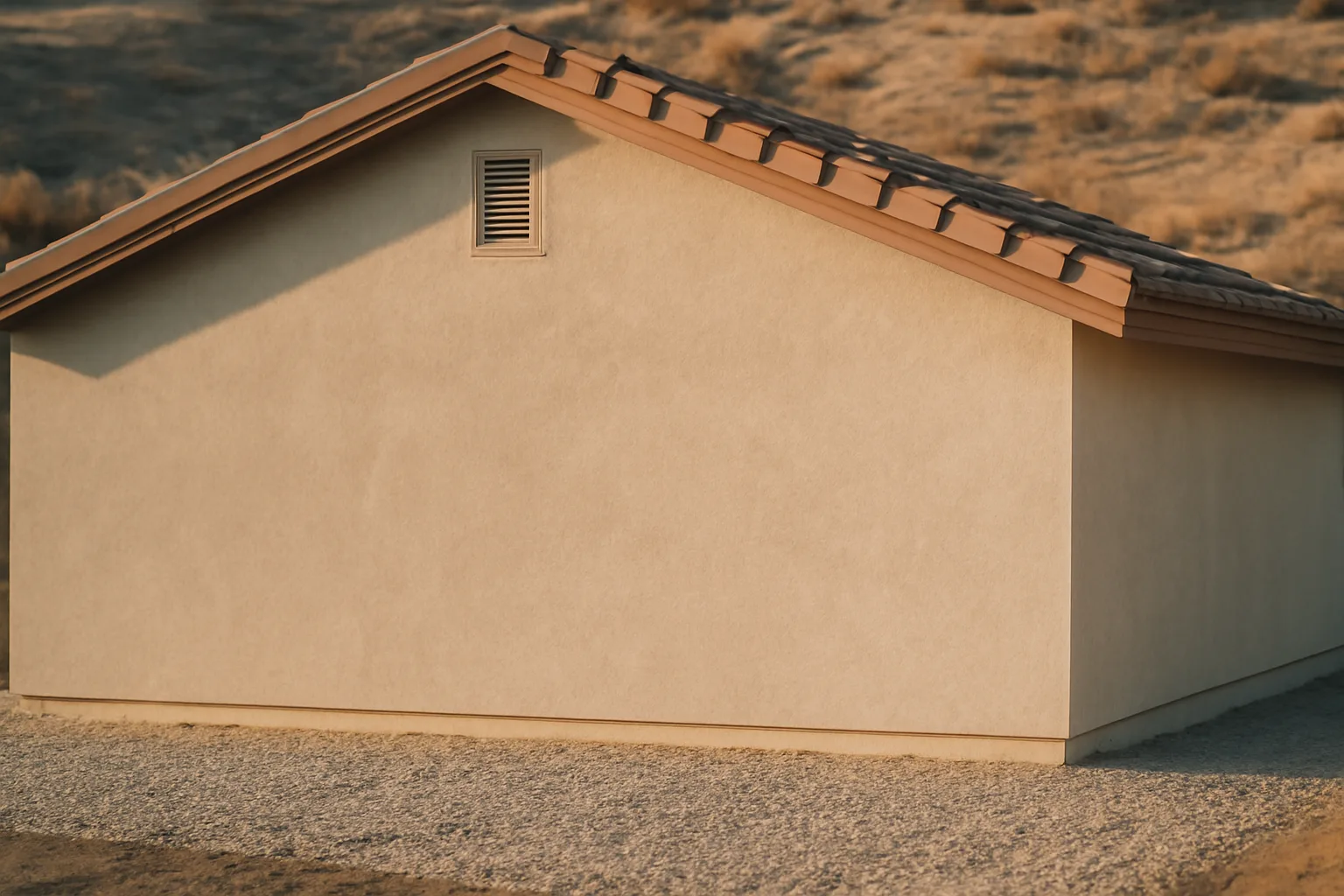
A fire resistant home is not a fireproof home. Nothing is fireproof. What building science actually shows is that most homes in wildfires don't burn because a wall of flame rolls over them. They burn because embers, sometimes traveling a mile or more ahead of the main fire, land in a vulnerable spot and smolder until the house catches [1]. That changes the whole strategy. If embers are the main threat, then the priority list looks different than what most people assume. Roof material and roof condition come first. Vents come second, because open or unscreened vents let embers straight into the attic or under-floor space. Then it's the first five feet around the foundation, since dead leaves in a gutter or mulch against a wall gives embers something to ignite. Siding, window glazing, and deck material come after that. The Insurance Institute for Business & Home Safety (IBHS) built its Wildfire Prepared Home standard around this ember-first logic, and it specifically requires ember-resistant vents, a Class A roof assembly, and a 5-foot noncombustible zone around the structure before a home can qualify. That's a useful checklist even if you never pursue the certification itself. So when someone asks "how do I make my house fire resistant," the honest answer is: start at the roofline and the vents, work outward to the first five feet, and only then think about the rest of the yard. Spending money on far-perimeter landscaping before you've screened your attic vents is backwards, and it's a mistake I see constantly. For a walkthrough of what a fire actually does to a structure once it reaches it, see house fire.
When does California's defensible space law (zone 0) go into effect
California's ember-resistant zone, commonly called Zone 0, is the 0 to 5 foot area immediately touching your home. Assembly Bill 3074 (2020) directed the Board of Forestry and Fire Protection to develop regulations for this zone, and the Board has been working through the formal rulemaking process since [2]. As of the most recent guidance, CAL FIRE and the Board of Forestry have targeted regulations to take effect for existing homes in the highest-risk areas (State Responsibility Area and Wildland-Urban Interface Fire Area parcels) with an anticipated compliance requirement phased in around 2026, though the exact effective date has moved before and depends on final rule adoption [3]. Because the timeline has shifted in past cycles, don't treat any single year as locked in until the Board publishes the final regulatory text; check the Board of Forestry's rulemaking page directly for the current status [3]. What the rule will likely require, based on the draft framework: no combustible mulch, no stored firewood, no combustible fencing attached to the house, and no plants directly against the structure within that 0-5 foot ring. Attached wood fencing has been flagged repeatedly in post-fire investigations as a wick that carries fire directly to the house, so expect that detail to survive into the final rule. This is different from the broader 100-foot defensible space requirement under Public Resources Code 4291, which already applies today and requires reduced fuels within 30 feet and reduced density within 100 feet of structures in State Responsibility Areas [4]. Zone 0 is a narrower, newer, and stricter add-on to that existing law, not a replacement for it. Mitigation specifics differ by local fire district and county ordinance, so confirm exact clearance distances and material rules with your local fire department or county fire marshal before doing work, since some jurisdictions layer stricter requirements on top of the state minimum.
Why won't people follow the defensible space law in California
Compliance with existing defensible space law is genuinely uneven, and it's not because homeowners don't care about their houses burning down. The reasons are more practical than that. Cost is the biggest one. Removing mature trees, regrading slopes, or replacing wood fencing near the house can run into the thousands of dollars, and many of the households living in the highest fire-risk zones are not wealthy. Retired residents on fixed incomes in fire-prone foothill communities often can't absorb a $3,000 to $8,000 clearance and hardening bill in a single season. Enforcement is also inconsistent. CAL FIRE and local fire agencies are supposed to inspect State Responsibility Area parcels, but staffing has never matched the number of parcels that need checking, so many properties go years without an inspection. Without a real chance of being cited, some homeowners deprioritize the work, especially when it competes with other bills. There's also a genuine information gap. Some homeowners believe defensible space means a sterile dirt yard, so they resist it because they don't want to lose every tree and shrub on the property. That's not what the law requires. Zone-based clearance (per CAL FIRE's zone 1 and zone 2 framework) still allows selective, spaced, well-maintained vegetation; it just requires removing the ladder fuels and continuous canopy that let fire climb and spread. And some people simply don't believe it will happen to them, or believe their homeowner's insurance will cover it regardless, right up until the non-renewal letter arrives. That letter is usually what finally triggers action, which is unfortunate because doing the work before the letter is both cheaper and more effective.
How to prevent wildfires from starting near your home
Most wildfires are not caused by lightning. Roughly 85 to 90% of wildfires in the U.S. are human-caused, according to the National Interagency Fire Center's long-running data on ignition sources [5]. That means prevention starts with controlling ignition sources on and around your own property, more than hardening the structure against fire that's already burning somewhere else. The practical list: never park a vehicle with a hot undercarriage on dry grass (catalytic converters routinely start roadside fires). Keep chainsaws and mowers off dry vegetation during red flag warning days. Fully extinguish campfires, drown them, stir them, and check for heat with the back of your hand, per Ready.gov's campfire safety guidance. Don't burn debris on windy days, and check local burn permit rules before any outdoor burning, since many counties restrict or ban it seasonally. Maintain equipment. A dragging trailer chain throwing sparks on asphalt has started real fires. Faulty power line equipment on a property, frayed extension cords run outdoors, and old generators running near dry brush are also common ignition points worth checking every spring. At a neighborhood level, this is also why the old "only you can prevent wildfires" message from Smokey Bear still holds up: individual behavior around ignition sources is the one lever ordinary people can actually pull, even though it doesn't get the same attention as home hardening (see only you can prevent wildfires for more on that history and what it means practically today).
How to prepare for a wildfire before it happens
Preparing for a wildfire means doing the boring stuff months before fire season, not during a red flag warning. Ready.gov's wildfire preparedness guidance breaks this into three buckets: know your risk, prepare your home, and prepare your family. Know your risk by checking whether your parcel sits in a State Responsibility Area or a locally designated Very High Fire Hazard Severity Zone; CAL FIRE maintains public hazard severity zone maps for this purpose [6]. That designation affects your defensible space obligations and often your insurance options. Prepare your home by working through the zone 0, zone 1, zone 2 clearance requirements (0-5 feet, 5-30 feet, 30-100 feet) and hardening the structure itself: Class A roof, ember-resistant vents, dual-pane tempered glass windows, and enclosed eaves. Document all of it with dated photos, receipts, and contractor invoices, because that paperwork is exactly what insurers ask for when they're deciding whether to renew a policy or when a FAIR Plan underwriter is evaluating a property. Prepare your family with a go-bag, a written evacuation plan with two routes out of the neighborhood, and a communication plan for reconnecting if cell networks go down. Ready.gov recommends practicing the evacuation route at least twice a year and keeping the go-bag near an exit, not in a closet upstairs. If you're assembling documentation for an insurer or building a home-hardening paper trail after a non-renewal notice, a structured folder saves real time later. That's the specific gap the $99 Wildfire Insurance Survival Kit is built to close: a template for organizing before/after photos, material receipts, and defensible space records into the format insurers and FAIR Plans actually want to see. It doesn't file claims or negotiate coverage for you; you send your own documentation.
How to prevent forest fires and avoid forest fires on public land
Preventing forest fires on public land comes down to the same human-ignition controls as preventing fires near your home, just applied at trailhead and campground scale. The U.S. Forest Service and NIFC both point to debris burning, campfires, equipment use, and arson as the largest human-caused categories, well ahead of lightning in most western states outside peak monsoon-lightning season [5]. If you're recreating in forested land: check current fire restrictions before you go, since many national forests impose seasonal campfire bans that are easy to miss if you're checking an outdated map or app. Use designated fire rings only. Never leave a fire unattended, even for ten minutes. Carry a shovel and water in the vehicle during fire season, more than at the campsite. How to avoid forest fires as a landowner adjacent to public forest land mostly means fuel management on your own side of the property line: thinning dense stands, removing dead and downed material, and maintaining a shaded fuel break where your land meets forest service or BLM land. Many states offer cost-share programs for this work through state forestry agencies; check your state fire marshal's office or state forestry department for current program availability, since funding and eligibility change year to year. For property owners specifically in Washington state working through professional defensible space clearing, the Washington Department of Natural Resources maintains contractor and cost-share guidance worth reviewing before hiring anyone (see wildfire defensible space clearing contracts Washington state DNR).
What fire safe home rules take effect in 2026
Several overlapping rule changes are converging around 2026, and it's worth separating them because they come from different agencies and apply to different things. California's Zone 0 ember-resistant zone regulation is the biggest one, with the Board of Forestry and Fire Protection targeting phased applicability starting with new construction and eventually extending to existing homes in the highest hazard zones; check the Board's current rulemaking status directly since dates have shifted [3]. Separately, California's Chapter 7A building code (the wildland-urban interface fire code within Title 24) already governs new construction materials in designated fire hazard severity zones, requiring things like ignition-resistant siding, dual-pane tempered windows, and ember-resistant vents for new builds and major remodels [7]. Insurance regulation is moving on a parallel track. California's Sustainable Insurance Strategy, developed under Insurance Commissioner Ricardo Lara, is phasing in new rules that let insurers use catastrophe modeling in exchange for writing more policies in high-risk areas, with implementation continuing through 2025 and 2026 [8]. This is separate from the defensible space rule but directly affects whether hardening work translates into a renewed policy or a FAIR Plan alternative. Other states are on their own timelines. Colorado, Oregon, and Arizona each have their own wildfire hazard mapping and building code processes running through their respective state forestry or fire marshal offices; there is no single national "2026 fire code" and homeowners outside California should check their state fire marshal's page directly rather than assume California's rules apply.
Is Santa Barbara safe from fire
No coastal or foothill California community, including Santa Barbara, can be called safe from wildfire, and the area's own history makes that clear. The Thomas Fire (2017) burned over 281,000 acres and was followed weeks later by the Montecito debris flow, which killed 23 people when saturated, denuded hillsides collapsed after rain hit the burn scar [9]. The 2009 Jesusita Fire and the 1990 Painted Cave Fire both burned directly into Santa Barbara neighborhoods. What makes the Santa Barbara area higher risk than it might look from the beach is the same topography that makes it beautiful: steep chaparral-covered foothills rising directly behind dense residential neighborhoods, combined with sundowner winds, a local wind pattern that reverses the usual onshore flow and pushes hot, dry air downslope toward the coast at high speed, exactly the conditions that drove the Thomas Fire's rapid spread [9]. That doesn't mean every Santa Barbara property carries equal risk. Homes right at the wildland edge in the foothills (Mission Canyon, upper Riviera, parts of Montecito) face materially higher exposure than homes closer to the flatter downtown grid. Anyone buying or insuring property there should check CAL FIRE's Fire Hazard Severity Zone maps for the specific parcel rather than judge risk by the city's reputation generally [6]. The practical takeaway for any wildland-urban interface community, more than Santa Barbara, is that "safe" is the wrong frame. The better question is whether the specific parcel, structure, and surrounding vegetation have been hardened to the current standard, and whether the defensible space zones are actually maintained year over year rather than done once and forgotten.
How can we prevent forest fires at a community level
Individual home hardening matters, but wildfires don't respect property lines, so community-level prevention has to work alongside it. Fire spreads structure to structure in dense WUI neighborhoods once it's already burning homes, which is why a single unhardened house on a block can put neighbors at risk even if everyone else did the work. Firewise USA, the National Fire Protection Association's community recognition program, organizes neighborhoods to do joint fuel reduction, share equipment and cost for chipping days, and coordinate defensible space work across property lines rather than leaving it to individual initiative [10]. Communities in the program report higher participation rates in defensible space maintenance than similar communities without organized programs, in part because peer pressure and shared work days lower the effective cost and hassle for each household. At a regulatory level, community-scale prevention also means supporting (or at least not blocking) prescribed burns and mechanical thinning projects on adjacent public land, since a lot of neighborhood risk comes from unmanaged fuel loads just outside the property line, not from anything homeowners control directly. And at a practical level, it means talking to neighbors, more than working on your own lot. If your neighbor has a wood fence connecting their yard to yours, or overgrown eucalyptus overhanging both properties, your zone 0 clearance doesn't fully protect you. For the landscaping choices that actually reduce this shared risk, see fire safe landscaping California next to house, and for a broader look at the concept, defensible space itself.
What to prioritize first if you have a limited budget
If money is tight, spend it in this order: vents, roof gaps and repair, then the 0-5 foot zone, then windows, then everything else. This order comes directly from the ember-intrusion research that IBHS and the Forest Service have both published, showing embers entering through vents and roof gaps as the dominant ignition pathway for homes that survive the initial fire front but burn later [1]. Ember-resistant vent retrofits typically cost $15 to $50 per vent for the mesh/baffle hardware, plus labor if you're not doing it yourself; a typical house has 6 to 12 vents. That's often a few hundred dollars total, among the cheapest high-impact fixes available. Clearing the first five feet, removing mulch, moving firewood stacks, cutting back plants touching the house, costs nothing but a weekend if you do it yourself, or a few hundred dollars for a single contractor visit. Roof repair and gutter guards vary enormously depending on roof condition, from under $200 for gutter guards to several thousand for patching gaps in tile or replacing damaged shingles. Full roof replacement to Class A material, if the current roof is a genuine liability, is a much bigger expense (often $10,000+) and should be weighed against the home's remaining life and the actual condition of the current roof rather than treated as an automatic must-do. Window and siding upgrades come last on a limited budget, not because they don't matter, but because they matter less than the first three items and cost more. If you can only do one thing this year, screen the vents and clear the first five feet. That combination addresses the two most common ignition pathways for a fraction of what a full retrofit costs.
Frequently asked questions
When does the California defensible space law go into effect for zone 0
California's Zone 0 ember-resistant zone rule (the 0-5 foot area around structures) has been in rulemaking since AB 3074 passed in 2020, with the Board of Forestry and Fire Protection targeting phased applicability around 2026 for new construction, extending later to existing homes in high-hazard zones. Check the Board's current rulemaking status directly, since dates have shifted before.
Why won't people follow the defensible space law in California
Cost, inconsistent enforcement, and misunderstanding are the main reasons. Clearance and hardening work can run thousands of dollars, inspections are inconsistent due to staffing limits, and some homeowners mistakenly believe defensible space means removing all vegetation, so they resist it. Many only act after receiving a non-renewal letter from their insurer.
How do I prevent wildfires from starting on my own property
Control ignition sources: never park a hot vehicle on dry grass, fully extinguish campfires and stir the ashes, avoid outdoor burning on windy or red-flag days, and check local burn permit rules. Roughly 85-90% of wildfires nationally are human-caused according to NIFC data, so behavior around ignition sources matters as much as home hardening.
How should I prepare for a wildfire if I live in a high-risk zone
Check your Fire Hazard Severity Zone designation on CAL FIRE's maps, complete zone 0/1/2 defensible space clearance, harden your roof and vents, and build a family evacuation plan with two routes practiced twice a year. Ready.gov recommends keeping a go-bag near an exit and documenting all hardening work with dated photos for insurance purposes.
What's the difference between preventing forest fires and preparing for wildfires
Preventing forest fires focuses on stopping ignition, controlling campfires, equipment sparks, and debris burning before a fire starts. Preparing for wildfires assumes a fire may happen regardless and focuses on hardening your home, clearing defensible space, and having an evacuation plan ready so you're not scrambling when one does start nearby.
How can we prevent forest fires as a community rather than individually
Join or start a Firewise USA program through the National Fire Protection Association, which organizes neighborhood fuel reduction days and shared costs for chipping and clearing across property lines. Individual hardening helps less when a neighbor's unmanaged fence, trees, or brush connects fire to your property, so coordinated neighborhood work matters.
What fire safe home rules take effect in 2026 in California
California's Zone 0 ember-resistant zone regulation is targeted for phased effect around 2026, alongside continued rollout of the Sustainable Insurance Strategy under Commissioner Lara, which lets insurers use catastrophe models in exchange for writing more high-risk policies. Existing Chapter 7A wildland-urban interface building code requirements already apply to new construction.
Is Santa Barbara safe from fire
No. Santa Barbara sits below steep chaparral foothills and experiences sundowner winds that can drive rapid fire spread, as seen in the 2017 Thomas Fire (281,000+ acres) and the 2009 Jesusita and 1990 Painted Cave fires. Foothill neighborhoods face materially higher risk than flatter areas; check CAL FIRE's hazard maps for your specific parcel.
What's the single most cost-effective fire hardening upgrade
Ember-resistant vent retrofits, typically $15 to $50 per vent for hardware, address one of the two dominant ember-intrusion pathways identified in IBHS research. Combined with clearing the first five feet around the foundation (often free if done yourself), this pair of fixes covers the most common ignition routes for far less than a full roof or siding replacement.
Does defensible space mean removing all trees and plants near my house
No. CAL FIRE's zone-based framework (zone 1: 0-30 feet, zone 2: 30-100 feet) allows well-spaced, maintained vegetation; it requires removing ladder fuels, dead material, and continuous canopy that let fire climb and spread, not a bare dirt yard. The newer Zone 0 (0-5 feet) rule is stricter and does require keeping that narrow ring free of plants touching the structure.
How is Zone 0 different from the existing 100-foot defensible space law
Public Resources Code 4291 already requires reduced fuels within 30 feet and reduced density within 100 feet of structures in State Responsibility Areas. Zone 0 is a newer, narrower rule specifically covering the 0-5 foot ring touching the house, banning combustible mulch, stored firewood, and attached wood fencing in that immediate zone.
What should I document for insurance if I've received a non-renewal letter
Photograph the roof, vents, the first five feet around the foundation, and any completed hardening work, dated and organized by category, along with contractor invoices and material receipts. Insurers and FAIR Plan underwriters respond to organized documentation; you send it yourself, since public adjusters and homeowners cannot file claims or negotiate coverage on your behalf without a licensed process.
Sources
- USDA Forest Service, ember research on structure ignition: Homes ignite primarily from wind-blown embers rather than direct flame contact
- California Legislature, AB 3074 (2020): AB 3074 directed the Board of Forestry to develop ember-resistant zone (Zone 0) regulations
- California Board of Forestry and Fire Protection, Zone 0 rulemaking: Zone 0 regulations are in active rulemaking with phased applicability targeted around 2026
- California Public Resources Code Section 4291: State law requires defensible space clearance within 30 and 100 feet of structures in State Responsibility Areas
- National Interagency Fire Center, wildfire statistics: The large majority of U.S. wildfires are human-caused rather than started by lightning
- CAL FIRE, Fire Hazard Severity Zone maps: CAL FIRE publishes parcel-level Fire Hazard Severity Zone designations used to determine defensible space obligations
- California Building Standards Commission, Title 24 Chapter 7A: Chapter 7A of the California Building Code sets wildland-urban interface material requirements for new construction in fire hazard zones
- California Department of Insurance, Sustainable Insurance Strategy: California's Sustainable Insurance Strategy phases in catastrophe modeling for insurers in exchange for expanded high-risk coverage, through 2025-2026
- Santa Barbara County, Thomas Fire and Montecito debris flow after-action information: The 2017 Thomas Fire burned over 281,000 acres and was followed by a debris flow that killed 23 people in Montecito
- National Fire Protection Association, Firewise USA program: Firewise USA organizes neighborhood-level fuel reduction and cost-sharing for defensible space work