Last updated 2026-07-25
TL;DR
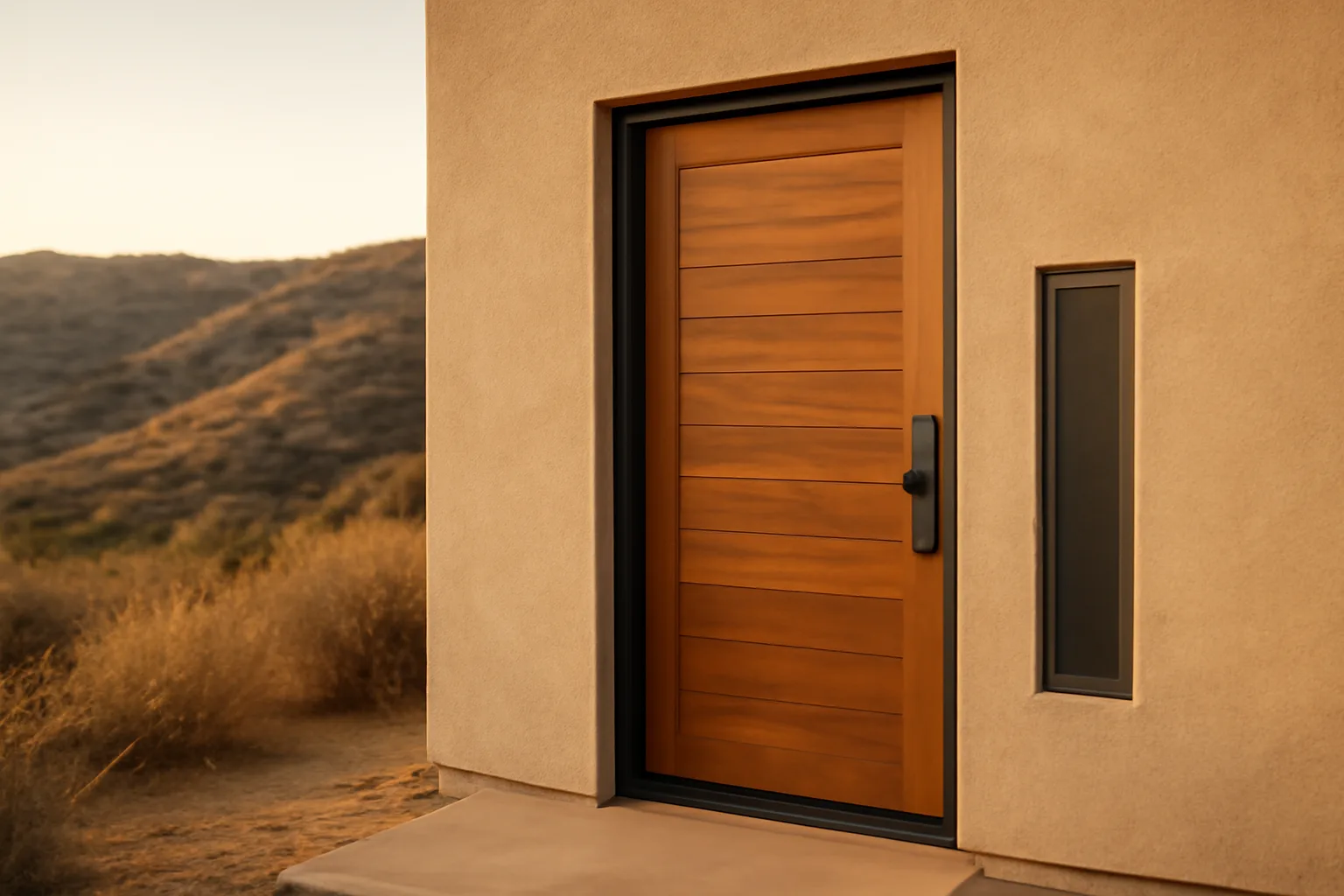
A fire-resistant front door means one of two things: a true fire-rated door (20-90 minute UL rating, mostly for garage-to-house openings) or an ignition-resistant exterior door (solid wood, metal-clad, or fiberglass with no combustible foam core, for wildfire embers). Most homeowners need the second type. Expect $250 to $2,500 per door installed, and pair it with ember-resistant vents and a 5-foot noncombustible zone around it.
what does "fire resistant door" actually mean for a house
People use this phrase to describe two very different products, and mixing them up wastes money. A fire-rated door is tested and labeled under UL 10B or UL 10C (or the newer NFPA 252 / NFPA 257 standards) and carries a time rating like 20-minute, 45-minute, 60-minute, or 90-minute. These live in building codes for garage-to-living-space openings, multifamily corridors, and commercial occupancies. The International Building Code and most state amendments require a minimum 20-minute rated door (self-closing, self-latching) between an attached garage and the house, because garages are a common ignition and fire-spread point [1]. An ignition-resistant or wildfire-hardened exterior door is a different animal. It is not usually UL fire-rated at all. It is built to resist ember intrusion and radiant heat during a wildfire: solid-core wood, steel, or fiberglass skins over a mineral or solid substrate, tight-fitting frames, and no foam-core construction that can off-gas or burn through in minutes. This is what CAL FIRE and most wildfire-hardening guides mean when they talk about "fire resistant doors" for the home's exterior. If you're prepping a house in a Wildland Urban Interface (WUI) zone, you almost certainly care about the second category for your front, back, and side entry doors, and the first category only for the garage. For the garage door itself (the rollup, not the man-door), most wildfire retrofit guidance recommends a solid door with weatherstripped, gasketed edges to block ember entry, since garages are rarely required to be UL fire-rated on the exterior side.
which door ratings and materials actually resist wildfire embers
| Hollow-core interior door used as exterior | Fails, not recommended | $150-$400 | |
|---|---|---|---|
| Solid wood (1-3/4") | Meets most WUI codes | $600-$1,800 | |
| Steel/fiberglass, solid or mineral core | Meets most WUI codes, low maintenance | $500-$2,000 | |
| 20-minute UL fire-rated door (garage entry) | Required by IBC/IRC for garage-house opening | $250-$700 | |
| 90-minute UL fire-rated door | Rare for residential, used in some commercial/multifamily | $1,500-$3,500 | Costs vary a lot by region, labor market, and whether you're replacing just the door slab or the whole frame and threshold. Get three local quotes before you budget a whole-house door retrofit. |
Embers don't need flame contact to ignite a house. They land in gaps, on debris, and against combustible surfaces, then smolder. A door's real wildfire performance depends on the frame gap, the door core, and what's stacked against it, more than a UL sticker. Solid wood doors (minimum 1-3/4 inch thick, no glass panels or small glass only) perform reasonably well against radiant heat and short ember exposure, which is why many wildfire building codes accept them as a baseline option alongside noncombustible materials [2]. Metal-clad (steel or aluminum skin over solid core) and fiberglass doors with solid or mineral cores also meet most WUI codes and often outperform wood on longevity, since they don't warp or develop gaps over time the way wood can in dry climates. What fails: hollow-core doors, foam-core doors without solid skins, and doors with large single-pane glass lites near ground level, since radiant heat can crack glass and let embers and flame through. California's Chapter 7A building code (the state's WUI construction standard) requires exterior doors other than garage doors to be either noncombustible, ignition-resistant, or solid-core wood with a minimum stile and rail thickness, or to meet a 20-minute fire rating per ASTM E2074 or comparable test [2]. | Door type | Typical WUI performance | Rough installed cost |
do i need a fire-rated door for my garage
Yes, almost certainly, if the garage is attached to living space. Most state building codes, adopted from the International Residential Code (IRC), require the door between an attached garage and the house to be a minimum 20-minute fire-rated, solid-wood (minimum 1-3/8 inch), or solid or honeycomb-core steel door, and it must be self-closing and self-latching [1]. This rule is not new and is not wildfire-specific. It exists because garages store gasoline, propane, solvents, and often the car itself, all of which burn hot and fast. The 20-minute door buys occupants time to get out and slows fire spread into the house. What trips people up in retrofits: swapping in a pre-hung fire door but leaving the old, non-latching hardware, or cutting a pet door into it later, which voids the rating entirely. If you're not sure your existing garage entry door is rated, check for a label on the door edge (top or hinge side) stamped with the UL or Warnock Hersey mark and the time rating. No label usually means no rating.
what makes an entry door "insurer-ready" documentation-wise
Insurers and wildfire mitigation inspectors are not grading your door's aesthetics. They want proof of material, installation, and how it fits into the broader hardening picture around the opening. Document the door product (manufacturer spec sheet or WUI/Chapter 7A compliance listing if California), the installation date, and photos showing the frame-to-wall seal and any weatherstripping or gasketing at the threshold and jambs. If your area requires a specific standard (many CA jurisdictions reference the State Fire Marshal's WUI Products Handbook), keep that reference handy. Mitigation credit programs and FAIR Plan-adjacent insurers vary district by district on what they'll actually credit for a door upgrade, so [check with your local fire district or insurer for the specific standard they recognize] before you assume a product qualifies. Some California insurers are starting to reference the Insurance Institute for Business & Home Safety's Wildfire Prepared Home standard, which does address door and opening protection as part of a broader assessment, not doors in isolation [3]. Keep receipts, before/after photos, and any compliance labels in one folder. This is exactly the kind of packet that speeds up a mitigation credit conversation or supports your side of a non-renewal appeal. We are not your insurance company and we don't file claims or negotiate coverage for you; the value is having your own clean, dated record ready when you need it.
how does a fire door fit into the rest of home hardening
A door is one opening among many. CAL FIRE's home hardening guidance treats doors, vents, windows, eaves, roofing, and the first 5 feet around the structure (Zone 0) as one connected system, because embers exploit the weakest link, not the average. A great door next to an unscreened attic vent or mulch bed pushed against the threshold does almost nothing. Before spending on door upgrades, walk the perimeter and check: is there a noncombustible 5-foot zone around every exterior door (no wood mulch, no shrubs touching the siding, no stored firewood)? Are vents within a few feet of doors ember-resistant (1/8 inch metal mesh or WUI-listed ember-resistant vents)? Is the door threshold gapped enough to let embers blow underneath? For a full walkthrough of that 5-foot rule and what belongs (and doesn't) right next to your house, see fire safe landscaping in California next to your house. If you want the bigger picture on what "defensible" actually means as a standard your property gets measured against, that's covered in defensible.
when does the california defensible space law go into effect
California's Zone 0 (ember-resistant zone within 5 feet of structures) requirement was created by Assembly Bill 3074 (2020), which directs the State Fire Marshal to develop regulations for this zone. As of 2025, CAL FIRE and the Office of the State Fire Marshal have been working through the regulatory process, and the enforceable Zone 0 rule has been delayed multiple times from its originally discussed 2023 target [4]. The most recent public guidance points to a target of no earlier than 2025-2026 for final regulatory adoption, with actual local enforcement timelines set district by district after that, since CAL FIRE and local fire agencies share defensible space enforcement authority under Public Resources Code Section 4291 [5]. [Check with your local fire district or the CAL FIRE Ready for Wildfire program for the current enforcement date in your specific county] because this keeps shifting and county-level rollout won't be simultaneous. What is NOT delayed: the existing 100-foot defensible space requirement under PRC 4291, which has been in effect and enforced for years and requires two zones of vegetation clearance around structures in State Responsibility Areas [5].
what fire safe rules for homes take effect in 2026
Nothing statewide and door-specific is confirmed to take effect exactly in 2026 as of this writing, and anyone telling you an exact hard date should be treated with skepticism, because the Zone 0 regulation has already slipped past earlier target dates [4]. What's more reliably on a 2025-2026 timeline: continued rollout of local ordinances in high-fire-hazard cities and counties that are moving ahead of the state Zone 0 rule on their own, and expanded insurer use of wildfire risk scoring tools (like the IBHS Wildfire Prepared Home standard) that increasingly reference defensible space and hardening details insurers didn't check five years ago [3]. [Check with your county building department or state fire marshal's office for the current adopted or proposed effective date], since this is a moving target and the honest answer right now is "soon, but not finalized statewide."
why won't people follow the defensible space law in california
A few real reasons keep showing up in CAL FIRE inspection data and local reporting, and none of them is simply "people don't care." Cost is the biggest one. Full defensible space work (tree removal, brush clearing, roof and gutter cleaning, vegetation spacing) can run into the thousands of dollars for larger lots, and low-income and elderly homeowners on fixed incomes often can't absorb that in one season. Confusion about what's actually required is another. The rules differ by zone (0-5 feet, 5-30 feet, 30-100 feet), by whether you're in a State Responsibility Area or a Local Responsibility Area, and by local ordinance on top of the state minimum. Many homeowners genuinely don't know which rules apply to their specific parcel. Enforcement capacity is limited. CAL FIRE inspects a large share of parcels in State Responsibility Areas annually, but not every parcel every year, and violations often result in a notice to correct rather than an immediate fine, which reduces the felt urgency for some owners. And some owners disagree on aesthetic or ecological grounds, wanting to keep mature trees or native brush close to the house, not realizing how vegetation spacing and "ladder fuel" removal specifically target the mechanism by which ground fire climbs into tree canopies.
how to prevent wildfires and forest fires (what actually moves the needle)
Most wildfires that threaten homes are human-caused at ignition, whether from equipment sparks, unattended campfires, downed power lines, or vehicle exhaust on dry grass. The U.S. Forest Service and CAL FIRE both report that the large majority of wildfires nationally are human-caused, though lightning-caused fires tend to burn more total acreage in remote areas [6]. At the individual level, prevention means: never leaving a campfire unattended and fully extinguishing it (drown, stir, drown again), avoiding mowing or using power equipment on dry grass during red flag warnings, keeping vehicles off dry grass (catalytic converters can ignite it), and maintaining spark arrestors on chainsaws and equipment as required by state law in high fire-hazard areas. At the home level, prevention is really about ignition resistance, which is the whole point of defensible space and hardening work: reduce what's near the structure that can catch an ember, and reduce what on the structure itself can ignite from an ember or radiant heat. Doors, vents, roofing, and the 5-foot zone are the highest-leverage items because they're where embers actually make contact. CAL FIRE's own framing: "Defensible space is the buffer you create between a building on your property and the grass, trees, shrubs, or any wildland area that surrounds it". That buffer plus hardened building materials is what the research (notably the post-fire damage assessments after the 2018 Camp Fire and 2020 fire season) consistently shows separates surviving homes from destroyed ones in the same neighborhood.
how to prepare for a wildfire (the practical checklist)
Preparation splits into three timeframes: year-round hardening, fire-season readiness, and the hours before an evacuation order. Year-round: complete defensible space clearing per your zone requirements, harden vents and doors, clean roof and gutters of debris, and store firewood at least 30 feet from structures. Ready.gov recommends assembling a go-bag with medications, documents, and supplies for at least 3 days per person, kept somewhere you can grab it fast. Fire-season (typically May through October in much of the West, though this is lengthening): sign up for local emergency alerts, know your evacuation routes (have two, since one may be blocked), and keep your vehicle fueled above half a tank during red flag warning periods. Hours before or during an active threat: close all windows and doors (this is where an ignition-resistant door actually earns its cost, since closing a hollow-core door does almost nothing against radiant heat, while a solid-core door genuinely slows heat transfer), remove flammable curtains and move furniture away from windows, turn on exterior lights so firefighters can see the structure in smoke, and leave early rather than waiting for a mandatory order if conditions look bad. For a broader walkthrough of what happens structurally when a home does catch fire, and why certain building assemblies fail faster than others, see house fire and fire at a house.
is santa barbara safe from fire
No California coastal or foothill community, including Santa Barbara, is meaningfully "safe" from wildfire risk, and the record backs that up directly. The Thomas Fire (2017) burned over 280,000 acres and was, at the time, the largest wildfire in modern California history, followed just weeks later by the Montecito debris flow that killed 23 people, a disaster directly tied to the burned, denuded hillsides above the community [7]. The Jesusita Fire (2009) and Tea Fire (2008) also burned into Santa Barbara's foothill neighborhoods. Santa Barbara County sits against steep, chaparral-covered mountains with strong seasonal sundowner winds, a combination that fire scientists consider one of the more dangerous wildfire settings in the state, not a safer one. Homes in the foothill and wildland-urban interface neighborhoods (Montecito, Mission Canyon, the Riviera, the San Roque foothills) face meaningfully higher exposure than flatland neighborhoods closer to the coast, but even those areas aren't fire-immune given ember transport distances that can exceed a mile in strong wind events. If you own property in or near Santa Barbara's WUI zones, defensible space and hardening work (including door and vent upgrades) matter more, not less, than the statewide average, and you should expect closer insurer scrutiny given the county's fire and post-fire debris flow history.
how much does a fire-resistant door installation actually cost
Budget by opening, not by house. A single solid-core or fiberglass exterior door with proper frame sealing typically runs $500 to $2,000 installed, depending on size, hardware, and whether the existing frame needs replacement or just the slab. A 20-minute fire-rated garage entry door (required by code in most jurisdictions) runs cheaper, often $250 to $700 installed, since it's a smaller, simpler door. Whole-house door retrofits (front, back, side, garage entry, and any patio slider replacement) commonly land between $2,000 and $8,000 for a typical single-family home with 3-4 exterior openings, though sliding glass doors and French doors cost meaningfully more to upgrade to WUI-compliant tempered or multi-pane glazing. Don't skip the frame and threshold. A $1,800 fire-resistant door slab installed into a warped, gapped old frame with no weatherstripping performs worse against embers than a cheaper door installed correctly with proper sealing. Ask your installer specifically about ember and gap sealing at the threshold, more than the door material. This is the kind of cost-and-documentation planning that's easy to lose track of across a multi-year hardening project. If you're managing this alongside insurance non-renewal pressure, the $99 Wildfire Insurance Survival Kit at /survival-kit-builder gives you a structured way to log completed upgrades, receipts, and photos in one place so you're not scrambling to reconstruct your hardening history when a policy renewal or appeal comes up.
how can we prevent forest fires at the community level
Individual door and defensible space work matters, but community-scale prevention closes the gaps that no single homeowner can. Coordinated fuel breaks, prescribed burns, and vegetation management across neighboring parcels reduce the total fuel load feeding a fire before it ever reaches a structure, which is why many high-risk areas now form Firewise USA communities or similar cooperative programs recognized by the National Fire Protection Association [8]. Utility-scale prevention (power line clearance, public safety power shutoffs during red flag conditions) addresses one of the most common ignition sources in California specifically, since utility equipment has been found to be the cause of several of the state's most destructive fires in the past decade. At a neighborhood level, the honest reality is that one hardened home surrounded by unmaintained lots is still vulnerable, since ember showers and radiant heat from a neighbor's burning structure or vegetation can ignite your home even if your own defensible space is perfect. This is part of why some California jurisdictions have moved toward inspecting and enforcing defensible space compliance at the neighborhood or block level, more than parcel by parcel. For households actively navigating this landscape (insurance non-renewal, inspection letters, neighborhood-level risk), understanding the broader Zone 0 and defensible space framework matters as much as any single product choice. See only you can prevent wildfires for the messaging history and civic prevention angle, and wildfire defensible space clearing contracts in Washington state if you're comparing how a neighboring state structures its clearing and contractor requirements.
Frequently asked questions
What UL rating do I need for a garage entry door?
Most state building codes (following the IRC) require a minimum 20-minute fire-rated door, self-closing and self-latching, between an attached garage and the house. Check for a UL or Warnock Hersey label on the door edge; if there's no label, it's likely not rated and should be replaced before you rely on it for code compliance or insurance documentation.
Do fire-resistant doors actually stop wildfire embers?
Solid-core, metal-clad, or fiberglass doors with proper frame sealing resist ember ignition and radiant heat far better than hollow-core doors, but no door is ember-proof if the surrounding 5-foot zone has combustible debris or vegetation pressed against the threshold. Door material is one part of a system that includes vents, roofing, and defensible space.
When does California's defensible space Zone 0 law go into effect?
As of 2025, the Zone 0 (5-foot ember-resistant zone) regulation from AB 3074 has not been finalized statewide and has already slipped past earlier target dates. Check with CAL FIRE's Ready for Wildfire program or your local fire district for the current adopted timeline, since enforcement will likely roll out district by district after state adoption.
Why don't more Californians follow the existing defensible space law?
Cost of clearing large lots, confusion over which zone rules (0-5, 5-30, 30-100 feet) apply to a specific parcel, limited annual inspection capacity by CAL FIRE and local agencies, and in some cases owner reluctance to remove mature trees or native vegetation near the home all contribute, based on CAL FIRE inspection and compliance reporting patterns.
How to prevent wildfires from starting on my property?
Never leave campfires unattended, avoid mowing dry grass during red flag warnings, keep vehicles off dry grass, maintain spark arrestors on equipment, and clear defensible space per your zone. Most wildfires are human-caused at ignition, so eliminating spark sources near dry fuel is the single highest-leverage prevention action for an individual property owner.
How do I prepare for a wildfire evacuation?
Build a go-bag with medications, documents, and 3+ days of supplies per Ready.gov guidance, know two evacuation routes, sign up for local emergency alerts, and keep your vehicle fueled during fire season. When a threat is active, close all doors and windows, remove flammable curtains, and leave early rather than waiting for a mandatory evacuation order.
What fire safety rules for homes take effect in 2026?
No single confirmed statewide 2026 deadline exists yet for a door-specific rule; California's Zone 0 regulation is targeted for 2025-2026 adoption but has slipped before. Some local jurisdictions and insurers (via standards like IBHS Wildfire Prepared Home) are moving ahead of the state on their own timelines, so check locally rather than assuming a single national date.
Is Santa Barbara, California safe from wildfire?
No. Santa Barbara has burned repeatedly (Tea Fire 2008, Jesusita Fire 2009, Thomas Fire 2017) and sits against steep chaparral terrain with dangerous sundowner wind conditions. Foothill neighborhoods like Montecito face elevated exposure, and the 2018 post-Thomas Fire debris flow that killed 23 people shows the compounding risk beyond the fire itself.
What's the difference between a fire-rated door and an ignition-resistant door?
A fire-rated door (UL 10B/10C, 20 to 90 minute ratings) is a tested product mainly required for garage-to-house openings and commercial uses. An ignition-resistant door is built to resist wildfire embers and radiant heat on a home's exterior, usually solid wood, metal-clad, or fiberglass, and it's typically not separately UL fire-rated at all.
How much does it cost to replace exterior doors with fire-resistant versions?
A single solid-core or fiberglass exterior door with proper installation runs roughly $500 to $2,000. A 20-minute rated garage entry door is cheaper, often $250 to $700. A full-house retrofit of 3-4 exterior openings typically lands between $2,000 and $8,000, more if sliding glass doors are involved.
How can communities prevent forest fires beyond individual homes?
Coordinated fuel breaks, prescribed burns, Firewise USA-style cooperative programs, and utility power line clearance and shutoffs during red flag conditions all reduce ignition sources and fuel load at a scale no single homeowner can address. Neighborhood-level defensible space compliance also matters, since ember showers from an unmaintained neighboring lot can ignite an otherwise well-hardened home.
Does a fire-resistant door affect my home insurance rate or renewal?
Some insurers and mitigation credit programs reference standards like IBHS Wildfire Prepared Home that assess door and opening protection as part of a broader hardening review, but this varies significantly by insurer and district. Document your door upgrades (product spec, install date, photos) and check with your specific insurer or local fire district on what they credit.
Can I install a fire-resistant door myself or do I need a contractor?
A licensed contractor is strongly recommended, since improper frame sealing or gapping undermines the door's ember resistance even with premium materials. If code compliance (like the 20-minute garage entry door requirement) is involved, a permitted, inspected installation also protects you during any future insurance or building department review.
Sources
- International Code Council, International Residential Code (garage separation requirements): 20-minute fire-rated, self-closing, self-latching door required between attached garage and house
- California Building Standards Commission, California Building Code Chapter 7A: Exterior door material requirements (noncombustible, ignition-resistant, solid-core wood, or 20-minute rated) in California WUI construction
- Insurance Institute for Business & Home Safety, Wildfire Prepared Home standard: Insurer-referenced wildfire mitigation standard that assesses openings including doors as part of overall home hardening
- California Legislature, Assembly Bill 3074 (2020): Legislation directing CAL FIRE/State Fire Marshal to create Zone 0 ember-resistant zone regulations
- California Public Resources Code Section 4291: Existing 100-foot defensible space clearance requirement around structures in State Responsibility Areas
- USDA Forest Service, Wildfire Causes and Evaluations: Majority of U.S. wildfires are human-caused at ignition, though lightning fires burn more remote acreage
- CAL FIRE, Thomas Fire incident archive: Thomas Fire (2017) burned over 280,000 acres, one of the largest wildfires in modern California history at the time
- National Fire Protection Association, Firewise USA program: Community-based cooperative wildfire risk reduction program recognized by NFPA