Last updated 2026-07-25
TL;DR
Home Depot sells Type X and Type C fire-resistant drywall (5/8-inch, roughly $13-$25 per 4x8 sheet) that slows fire spread through walls by 30-60 minutes. It helps with interior compartmentalization and some garage/attached-structure codes, but it does not stop ember entry or exterior wildfire ignition, which is what actually destroys most homes in wildfire-urban-interface fires.
What is fire-resistant drywall, and does Home Depot actually sell it?
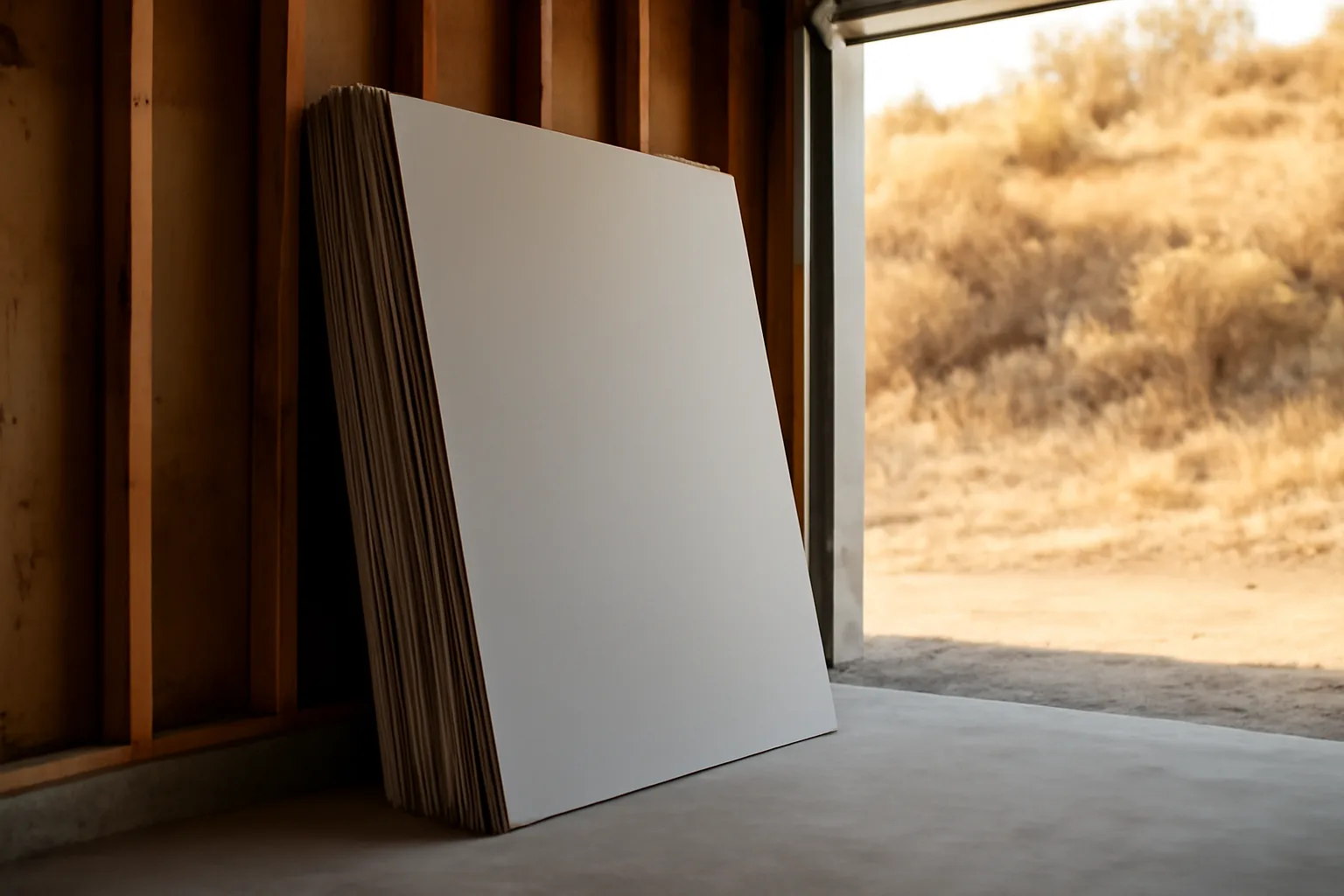
Yes. Home Depot stocks Type X and Type C gypsum board, both sold as "fire-resistant" or "fire-rated" drywall, usually in 5/8-inch thickness. A standard 4x8 sheet runs somewhere between $13 and $25 depending on your market and whether it's regular Type X or the moisture-resistant version, with prices fluctuating with lumber and gypsum costs. You'll find it in the drywall aisle, often labeled "Fireguard" or similar brand names from USG or National Gypsum. Type X drywall has glass fibers mixed into the gypsum core that slow heat transfer and keep the panel intact longer when exposed to fire. A standard half-inch sheet of regular drywall might hold for about 30 minutes under direct flame; 5/8-inch Type X is rated for roughly a one-hour fire-resistance assembly when installed correctly with the right framing and fastener spacing, per Underwriters Laboratories (UL) design listings. Type C is a newer formulation with added fibers that perform even better in fire tests, sometimes called "fireguard C" at Home Depot. Here's the catch that matters for wildfire readers specifically: this product is designed and tested for structure fires that start inside a building or spread through interior walls, like a kitchen fire or an electrical fire in the wall cavity. It is not an ember-resistant exterior material and it is not what CAL FIRE or any state fire marshal lists as a defensible-space or home-hardening requirement. If you're rebuilding a garage that shares a wall with living space, or updating a furnace room, Type X drywall is a legitimate, code-relevant upgrade. If you're trying to protect your house from a wildfire embers blowing in from a mile away, this product solves a different problem.
Does fire-resistant drywall actually stop a wildfire from reaching your house?
No, and this is the single most important thing to understand before you spend money at Home Depot on this. Wildfire home destruction in the wildland-urban interface happens overwhelmingly through embers, not direct flame contact. Research from the Insurance Institute for Business & Home Safety (IBHS) and federal wildfire scientists has repeatedly found that embers, sometimes traveling more than a mile ahead of a fire front, ignite homes through vents, gaps in siding, decks, and combustible landscaping touching the structure, not by burning through exterior walls the way a house fire does from the inside [1]. Type X drywall lives inside your walls. It doesn't touch your roof, your vents, your siding, or your deck, which are the parts of a home that actually determine whether embers get a foothold. The National Fire Protection Association's Firewise USA program and CAL FIRE's home hardening guidance both focus on exterior assemblies: Class A fiber-cement or metal roofing, ember-resistant vents with 1/8-inch mesh, non-combustible siding, and a 5-foot ember-resistant zone immediately around the foundation [2]. So if your insurer sent a non-renewal letter citing wildfire risk, drywall in your interior walls is not going to move the needle on that letter. What will move the needle is documented work on the exterior, the roof, the vents, and the 0-5 foot zone around your foundation. That's a different shopping list, and a different kind of documentation for your insurer.
When is fire-resistant drywall actually worth buying?
It's worth it in a handful of specific, code-driven situations, and mostly not for general wildfire hardening. Building codes in most states require Type X drywall on the garage side of any wall shared with living space, precisely because garages hold flammable materials like gas cans, paint, and cars, and a garage fire is a leading cause of house fires that start inside the structure. If you're finishing a garage, building an ADU, or replacing drywall after a house fire, Type X is often a permit requirement, not optional. It's also reasonable in a furnace or utility closet, around a fireplace surround (check manufacturer clearance specs), or in a shared wall between an attached rental unit and your main house. Some jurisdictions require it in accessory dwelling units close to property lines under one-hour fire-rated wall assemblies. What it's not good for: stopping an approaching wildfire, satisfying a defensible-space inspection, or convincing an insurer you've addressed wildfire risk. If a Home Depot associate or a contractor tells you fire-rated drywall will help with your wildfire insurance situation, that's not accurate, and you should ask them to point you to the specific code or standard they're referencing. If they can't, be skeptical.
How do I prepare my home for wildfire beyond drywall?
Start outside, because that's where wildfires actually attack a structure. CAL FIRE's defensible space and home hardening guidance breaks the property into zones and prioritizes the parts of the house embers can exploit. The first 5 feet around your foundation (Zone 0 in CAL FIRE's newer terminology) should have no combustible mulch, no wood piles, no dry vegetation touching siding, and ideally gravel or hardscape. Vents need 1/8-inch corrosion-resistant mesh or ember-resistant covers, since open vents are one of the most common ember entry points into attics and crawlspaces. Roofs should be Class A rated material, and gutters should be cleared of leaf litter that catches embers. Beyond the structure, defensible space clearing in the 5-30 foot and 30-100 foot zones (spacing trees, removing ladder fuels, keeping grass mowed) matters for slowing a fire's approach and giving firefighters room to work defensively. If you're in California and thinking about landscaping choices near the house, our guide on fire safe landscaping next to a house covers plant selection and spacing specifics. Document all of this. Photos with timestamps, receipts for vent replacements or roof work, before-and-after shots of cleared brush. If your insurer non-renews or threatens to, having a dated paper trail of hardening work is the strongest thing you can hand them, even though you're not filing a claim or negotiating coverage terms yourself.
How do I prepare for a wildfire if one is already threatening my area?
Preparation splits into two timeframes: the weeks and months before fire season, and the hours before an evacuation order. Ready.gov recommends creating a household evacuation plan, identifying two ways out of your neighborhood, and assembling a go-bag with medications, documents, and supplies for at least three days per person [3]. In the days when fire risk is elevated (red flag warnings, dry offshore wind events), close all windows and doors, remove flammable patio furniture and doormats, move propane tanks and firewood away from the house, and park your car facing out in the driveway for a fast exit. CAL FIRE's "Ready, Set, Go" framework asks residents to have their property "fire ready" year-round, be "set" to leave when a warning is issued, and "go" immediately when ordered, rather than waiting to see how close the fire gets. Inside the house, keep a fire extinguisher accessible, know your gas shutoff location, and if you have a shelter-in-place plan discussed with local fire officials, make sure everyone in the household knows it. Most jurisdictions strongly discourage shelter-in-place unless it's specifically part of an official plan for your area.
How can we prevent wildfires and forest fires in the first place?
Most wildfires in the U.S. are human-caused, not lightning-caused. Roughly 85% of wildfires are started by people, according to the National Interagency Fire Center's estimates cited by the U.S. Forest Service, through causes like unattended campfires, debris burning, downed power lines, dragging trailer chains, and discarded cigarettes [4]. The practical prevention steps are almost boring in their simplicity, which is probably why people skip them. Fully extinguish campfires with water, stirred until cold to the touch, more than doused once. Don't burn debris on windy or dry days, and check local burn-day restrictions first. Maintain vehicles and trailers so chains don't drag and spark on pavement. Keep chainsaws and mowers away from dry grass during hot afternoons, since a metal blade striking a rock can throw a spark hot enough to ignite dry fuel. At a policy level, prevention also means fuel reduction: prescribed burns, forest thinning, and utility grid hardening (undergrounding lines or upgrading equipment in high-risk corridors) reduce the ignition sources and fuel loads that turn a spark into a megafire. Individual homeowners don't control that part, but supporting and not obstructing prescribed burn programs in your area is one of the few systemic levers residents actually have. The Smokey Bear campaign's message, boiled down, still holds: only you can prevent wildfires that start from human activity, even if you can't control lightning strikes or utility equipment failures.
When does California's defensible space law actually take effect?
California's core defensible space requirement, Public Resources Code Section 4291, has been in effect for years and currently requires 100 feet of defensible space clearance around structures in State Responsibility Areas and some local agency areas, a distance extended from 30 feet by legislation signed in 2004 [5]. This isn't a future law; it's active now, and it's enforced through inspections by CAL FIRE and local fire agencies with fines or defensible-space violation notices for noncompliance. What's newer and still rolling out is the "Zone 0" ember-resistant zone rule. California's SB 63 (2020) directed the Board of Forestry and Fire Protection to develop regulations for a 0-5 foot ember-resistant zone immediately around structures in high fire hazard severity zones. As of the most recent Board of Forestry timeline, these Zone 0 regulations have been in development with proposed effective dates that have shifted; check the Board of Forestry and Fire Protection's official rulemaking page for the current status in your area, since this has moved more than once and the exact effective date depends on where the regulation is in the formal rulemaking process [6]. Because implementation dates and specific requirements differ by county and fire district, confirm your local timeline directly: [your local fire district's defensible space page, filled in here] and [your county's building department page for Zone 0 requirements, filled in here] are the two sources to check before you assume a date applies to your property.
Why won't people follow the defensible space law in California?
Cost, labor, and enforcement gaps are the three real reasons, not ignorance of the law. Clearing 100 feet of defensible space on a wooded lot can mean hiring a crew for tree trimming, brush removal, and debris hauling, and costs vary enormously based on lot size and vegetation density, often running into the low thousands of dollars for a moderately overgrown property. For homeowners already squeezed by insurance non-renewals or premium hikes, that's a hard expense to prioritize. Enforcement is also inconsistent. CAL FIRE and local fire departments conduct defensible space inspections, but staffing limits how many properties get checked each year, and in many rural areas self-certification or complaint-driven inspection is the norm rather than universal annual checks. Some homeowners genuinely don't know the 100-foot requirement applies to their parcel, especially newer residents in State Responsibility Areas who never received a clear inspection notice. There's also a real disagreement in some communities about what "clearance" means. Removing all vegetation within 100 feet isn't the rule; CAL FIRE's guidance describes zone-based thinning and spacing, not bare dirt, and some residents resist compliance because they misunderstand it as demanding a moonscape yard, which pushes back against homeowners who value privacy screening or established landscaping. Clearer public communication about what compliant defensible space actually looks like (spaced, maintained, fire-resistant plantings, not empty lots) would probably improve voluntary compliance more than stricter fines would.
What fire-safe building codes take effect in 2026?
There's no single nationwide "2026 fire code" that applies everywhere; building and fire codes are set state by state and often county by county, and 2026 effective dates depend on which jurisdiction you're asking about. The most reliable path is checking your state fire marshal's office directly, since several states update their fire and building codes on multi-year cycles tied to International Code Council (ICC) updates, and adoption dates for the 2024 or 2025 ICC code editions vary by state legislature or fire marshal rulemaking. California's Building Standards Commission updates the California Building Code and California Fire Code on a roughly three-year cycle, with the most recent major update effective January 1, 2023, and the next full cycle expected around 2026; confirm current status at the California State Fire Marshal's code adoption page before assuming a specific 2026 requirement applies to your permit [7]. Colorado, Oregon, and Arizona each have their own state fire marshal offices with separate adoption timelines, and county-level wildland-urban interface codes (like those in Boulder County, Colorado, or parts of unincorporated Los Angeles County) can be stricter than the state minimum. Because this genuinely varies, fill in your specifics here: [your state fire marshal's current code adoption page, linked here] and [your county building department's WUI code page, linked here]. Don't rely on a general internet claim about "2026 rules"; pull the actual adopted code text for your jurisdiction before budgeting for compliance work.
Is Santa Barbara safe from wildfire risk?
No community in California's wildland-urban interface is "safe" in an absolute sense, and Santa Barbara County has direct experience with this: the 2017 Thomas Fire burned over 281,000 acres and was followed by the deadly Montecito debris flow in January 2018, which killed 23 people after rain hit the fire-scarred hillsides above town . The county sits in classic WUI terrain, dense chaparral hillsides directly adjacent to residential neighborhoods, with strong sundowner winds that have historically driven fast-moving fires toward the coast. CAL FIRE's Fire Hazard Severity Zone maps classify large sections of the hills above Santa Barbara and Montecito as "Very High" hazard severity zones, the state's highest designation, which is why many properties there face defensible space inspection requirements and insurance scrutiny . That doesn't mean every house in Santa Barbara is equally at risk; homes lower in the flats, with more distance from wildland vegetation and better hardening, face meaningfully lower risk than homes tucked against undeveloped hillside. If you own or are considering property in the area, check the specific address against CAL FIRE's Fire Hazard Severity Zone viewer rather than relying on the town's general reputation, since risk varies block by block depending on slope, vegetation, and distance from wildland fuel.
What should I actually buy at Home Depot for wildfire hardening?
Skip the interior fire-rated drywall unless you have a specific code reason (garage wall, ADU, fireplace surround) and redirect that budget outside. The categories that actually move wildfire risk down, most of which Home Depot or a similar hardware store carries, are: ember-resistant vent covers with 1/8-inch metal mesh, Class A-rated roofing materials or roof coating products, non-combustible gutter guards, and exterior-grade caulk to seal gaps around siding, eaves, and where pipes penetrate walls. For the 0-5 foot zone, that means gravel, pavers, or other hardscape instead of bark mulch, and removing anything combustible (woodpiles, welcome mats, potted plants in plastic containers) from direct contact with the house. None of this is expensive individually, a bag of gravel and mesh vent covers might run under $200 total for a typical house, but it requires actually doing the work, more than buying the materials and letting them sit in the garage. One genuinely useful move if you're facing a non-renewal letter: build a documented record of what you've done, with dated photos and receipts, before you need it. That's the whole idea behind our $99 one-time Wildfire Insurance Survival Kit; it's a structured way to document hardening work and defensible space maintenance so you have something concrete to show an insurer, rather than starting from scratch after a letter arrives. We don't negotiate with insurers or file claims on your behalf; you send your own documentation, and the kit just helps you organize it.
How do fire-resistant drywall ratings compare to what wildfire codes actually require?
| Product/Requirement | What it protects against | Typical cost | Governing standard | |
|---|---|---|---|---|
| Type X drywall (5/8") | Interior structure fire spread, ~1 hour rating | $13-$20/sheet | UL fire-resistance design listings | |
| Type C drywall (5/8") | Interior structure fire, enhanced core | $18-$25/sheet | UL fire-resistance design listings | |
| Class A roofing | Ember ignition on roof surface | Varies widely by material | CAL FIRE home hardening guidance | |
| Ember-resistant vents | Ember entry into attic/crawlspace | $15-$40 per vent | CAL FIRE home hardening guidance | |
| Zone 0 (0-5 ft) clearance | Ember ignition at foundation | Labor-dependent | SB 63 / Board of Forestry rulemaking [6] | |
| 100-ft defensible space | Fire spread reaching structure | Labor-dependent, often $1,000+ | Public Resources Code 4291 [5] | The pattern is clear once you see it side by side: interior drywall products address a completely different failure mode than every wildfire-specific requirement. If your goal is satisfying an inspection or documenting hardening for an insurer, everything on the right side of that table is what matters, not the drywall aisle. |
Frequently asked questions
Does fire-resistant drywall from Home Depot stop wildfires?
No. Fire-resistant (Type X or Type C) drywall slows fire spread through interior wall cavities during a structure fire; it does not address ember entry, roof ignition, or exterior wall assemblies, which are how wildfires actually destroy homes in the wildland-urban interface. It's a code product for garages and interior walls, not a wildfire hardening product.
When does California's defensible space law take effect?
California's 100-foot defensible space requirement under Public Resources Code 4291 is already active and has been for years. What's newer is the Zone 0 (0-5 foot) ember-resistant zone rule from SB 63, which has been in Board of Forestry rulemaking with shifting timelines; check the Board's current rulemaking page for your area's effective date.
Why don't more Californians follow the defensible space law?
Mostly cost, labor availability, and inconsistent enforcement, not ignorance. Clearing 100 feet of vegetation can cost over a thousand dollars depending on lot density, inspection staffing is limited in many rural areas, and some residents misunderstand the rule as requiring bare dirt rather than spaced, maintained vegetation.
How to prevent wildfires from starting?
Fully extinguish campfires with water until cold, avoid debris burning on dry or windy days, maintain vehicles so chains don't drag and spark, and keep mowing equipment away from dry grass in hot conditions. About 85% of U.S. wildfires are human-caused, per National Interagency Fire Center data cited by the U.S. Forest Service.
How do I prepare for a wildfire evacuation?
Build a go-bag with medications, documents, and 3+ days of supplies per person, identify two evacuation routes out of your neighborhood, and follow Ready.gov's household emergency planning steps. When red flag warnings hit, remove flammable items from your yard, close windows, and park your car facing out for a fast exit.
Is Santa Barbara at high risk of wildfire?
Large parts of the hills above Santa Barbara and Montecito are mapped as Very High Fire Hazard Severity Zones by CAL FIRE. The county has already experienced major fire events, including the 2017 Thomas Fire (281,000+ acres). Risk varies significantly by exact location, slope, and distance from wildland vegetation, so check the parcel-specific hazard map rather than the town's general reputation.
What fire-safe building codes take effect in 2026?
There's no single national 2026 fire code; adoption dates vary by state and county. California's building and fire codes update roughly every three years, with the next major cycle expected around 2026, but you should confirm current adoption status directly with your state fire marshal's office rather than assume a specific date.
Is Type X drywall required by code anywhere?
Yes, commonly on garage walls shared with living space, in many one-hour fire-rated wall assemblies between units, and in some ADU construction near property lines. Check your local building code and permit requirements, since exact code triggers vary by jurisdiction.
What's the difference between Type X and Type C drywall?
Both are fire-resistant gypsum board with glass fiber reinforcement, but Type C has additional fiber content and shrinkage-resistant additives that give it a better fire-resistance rating in UL testing, especially in ceiling assemblies. Type C typically costs a few dollars more per sheet than Type X.
How can homeowners prevent forest fires near their property?
Maintain defensible space clearance, follow local burn-day restrictions before any debris burning, keep vehicles and equipment properly maintained to avoid sparking dry grass, and report unattended campfires or downed power lines. Individual prevention habits combined with community-level fuel reduction (prescribed burns, thinning) reduce both ignition sources and fire spread potential.
Does replacing interior drywall help with wildfire insurance non-renewal?
Generally no. Insurers assessing wildfire risk focus on exterior hardening (roof material, vents, defensible space, siding) and property location, not interior wall materials. Documentation of exterior hardening work and defensible space maintenance is what typically supports your case when responding to a non-renewal or inspection letter.
What is Zone 0 in California wildfire regulations?
Zone 0 is the 0-5 foot ember-resistant zone immediately surrounding a structure, created under SB 63 (2020) and developed through California Board of Forestry and Fire Protection rulemaking. It generally calls for removing combustible materials and vegetation directly against the house; exact requirements and effective dates are still being finalized, so check the Board's current status for your area.
Sources
- National Fire Protection Association, Firewise USA: Home hardening priorities focus on exterior assemblies: roofing, vents, siding, and ember-resistant zones
- International Code Council, International Residential Code garage separation requirements: Garage walls shared with living space commonly require fire-rated (Type X) gypsum board separation
- USDA Forest Service, wildfire causes and prevention statistics: Approximately 85% of U.S. wildfires are caused by human activity, per National Interagency Fire Center data
- California Legislative Information, Public Resources Code Section 4291: 100-foot defensible space clearance requirement around structures in State Responsibility Areas
- California Board of Forestry and Fire Protection, Zone 0 rulemaking: SB 63-directed development of 0-5 foot ember-resistant zone regulations and its evolving rulemaking timeline
- California State Fire Marshal, code adoption information: California Building and Fire Code update cycle and adoption timelines
- CAL FIRE, Fire Hazard Severity Zone Viewer: Santa Barbara County hillside areas classified as Very High Fire Hazard Severity Zones