Last updated 2026-07-25
TL;DR
Home Depot sells Type X and Type C fire-rated gypsum board, usually $15-$25 per 4x8 sheet (5/8-inch thick), which resists fire for roughly one hour per layer inside code-tested wall assemblies. It slows interior fire spread; it does not stop embers or exterior ignition, which is the bigger risk in wildfire zones. Pair it with ember-resistant vents and Class A roofing for real protection.
What is fire-resistant sheetrock and does Home Depot actually carry it?
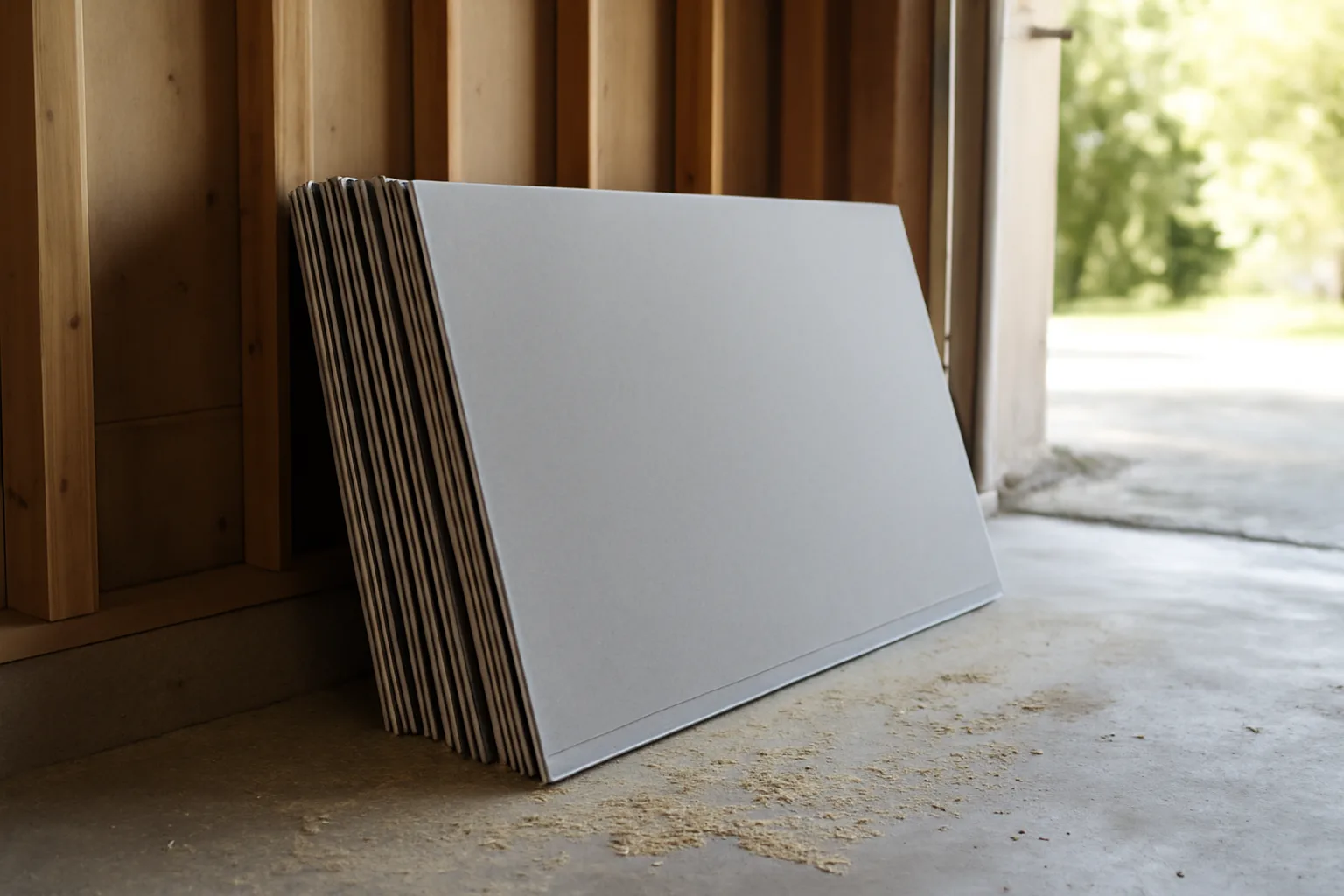
Yes, Home Depot carries fire-rated gypsum board, usually labeled "Type X" or the thicker "Type C," in the drywall aisle alongside standard 1/2-inch sheetrock. Type X is 5/8-inch thick and has glass fiber reinforcement mixed into the gypsum core, which helps it hold together longer when exposed to flame. Type C goes further, adding more glass fiber and sometimes vermiculite, and it's rated for slightly longer fire resistance in tested assemblies. Pricing at Home Depot for a standard 4x8 sheet of 5/8-inch Type X typically runs $15 to $25 depending on your market and whether it's moisture-resistant or standard paper-faced. That's roughly double the cost of basic 1/2-inch drywall, which usually runs $10 to $15 per sheet. For a typical 200-square-foot garage wall, you're looking at about 7 sheets, so the upcharge for fire-rated board over standard is maybe $70 to $100 total on a garage-size job. Not a huge line item in a broader hardening budget. The key thing to understand: "fire-resistant" doesn't mean fireproof, and a sheet of drywall by itself has no official fire rating. The rating comes from the tested wall assembly, meaning the specific combination of studs, insulation, sheetrock, and fasteners, tested together under a standard like ASTM E119 or UL's fire-resistance directory [1]. A single sheet sitting in your garage means nothing until it's installed as part of a system that's actually been tested.
How does fire-rated drywall actually perform in a fire?
Type X drywall is designed to give roughly one hour of fire resistance per layer in a properly built wall or ceiling assembly, based on UL-listed designs [1]. Type C can push that further in some assemblies, sometimes reaching 2-hour ratings when combined with double layers or specific stud spacing. The mechanism is simple: the gypsum core contains chemically bound water, and as flame hits the surface, that water has to boil off (a process called calcination) before the core temperature can rise enough to fail structurally. This buys time, not immunity. Where this matters most in a house is at fire-rated separations, the wall between an attached garage and living space, for example. Many building codes, including the International Residential Code as adopted in most western states, require a minimum 1/2-inch gypsum board (or equivalent) on the garage side of that shared wall, and often 5/8-inch Type X on the ceiling if there's living space above the garage. This is a code minimum for structure fires generally, not a wildfire-specific ember defense. Here's the honest caveat: fire-rated sheetrock protects against fire that has already breached your structure or is spreading within it, like a garage fire starting from a parked car or stored fuel. It does very little against the way wildfires actually destroy homes, which is embers landing on vulnerable exterior surfaces, vents, eaves, and decks. CAL FIRE's own research found that most home losses in wildfires come from ember intrusion and small flame contact at vulnerable points, not direct flame front contact with exterior walls.
Type X vs Type C vs regular drywall: what's the real difference?
| Feature | Regular drywall | Type X | Type C | |
|---|---|---|---|---|
| Typical thickness | 1/2 inch | 5/8 inch | 5/8 inch (sometimes 3/4) | |
| Core reinforcement | None | Glass fiber | Glass fiber, additional additives | |
| Fire resistance (tested assembly) | None rated | ~1 hour per layer | 1 to 2+ hours depending on assembly | |
| Home Depot price (4x8 sheet) | $10-$15 | $15-$25 | $20-$35, less common in stock | |
| Common use | Interior walls/ceilings | Garage walls, shared walls, code-required separations | High-rise, commercial, some multifamily | For a typical single-family home in a wildfire-prone area, Type X is the practical choice and what you'll find in stock at most Home Depot locations. Type C is often special-order or limited to certain markets, and it's overkill for residential garage separation in most jurisdictions. Check with your local building department or fire district, because required thickness and assembly design vary. |
Should wildfire-zone homeowners bother with fire-rated drywall at all?
If you're doing any drywall work in a garage, workshop, or attached structure, yes, use Type X instead of standard board. The cost difference is small and the fire-slowing benefit is real for structure fires and code compliance. But if you're prioritizing a limited hardening budget specifically against wildfire risk, interior drywall should not be near the top of your list. The research from CAL FIRE and the Insurance Institute for Business & Home Safety (IBHS) consistently points to exterior vulnerabilities as the priority: ember-resistant vents, Class A fire-rated roofing, ignition-resistant siding, and clearing combustible material within 5 feet of the foundation (California's "Zone 0" ember-resistant zone) [2]. Drywall only matters once fire or embers are already inside your walls or attic, which means something upstream already failed. Put it this way: money spent on ember-resistant vents or gutter guards prevents ignition. Money spent on interior fire-rated drywall slows a fire that's already started. Both matter, but if you have $500 to spend this year, spend it outside the house first.
When does the California defensible space law take effect and what does it require?
California's core defensible space law, Public Resources Code Section 4291, has been in effect for years and currently requires 100 feet of defensible space clearance around structures in State Responsibility Areas and many Local Responsibility Areas with a very high fire hazard severity zone designation [3]. This isn't a future law, it's active now, and it's enforced through inspections, often triggered by insurance non-renewal notices or local fire agency programs. What's newer and still rolling out is the "Zone 0" ember-resistant zone rule. California Senate Bill 63 (2020) directed the Board of Forestry and Fire Protection to develop regulations for the zone within 5 feet of structures, requiring it to be free of combustible materials, mulch, and vegetation that could carry embers to the home [4]. As of this writing, the Board has been developing draft regulations, and the target effective date has been pushed back multiple times. Check CAL FIRE's defensible space page directly for the current status in your area, because implementation timing has shifted before and enforcement often runs through local fire district guided fill-in: [insert your local fire district's current Zone 0 compliance deadline here]. The 100-foot requirement breaks into two zones: Zone 1 (0-30 feet from structures) requires removing dead vegetation and creating separation between plants, and Zone 2 (30-100 feet) requires reduced fuel volume, generally keeping grass under 4 inches and maintaining horizontal and vertical spacing between shrubs and trees [3]. For a full breakdown of what's required zone by zone, see defensible space zones.
Why won't people follow the defensible space law in California?
There isn't one single reason, but a few show up consistently in CAL FIRE inspection data and fire agency reporting. Cost is a big one: clearing 100 feet of brush on a sloped, oak-covered lot can run into thousands of dollars if you hire a contractor, and many homeowners, especially retirees on fixed incomes, simply can't absorb that expense every year since vegetation grows back. Another factor is confusion about what's actually required. The rules differ by zone (Zone 1 vs Zone 2), by whether you're in a State Responsibility Area or Local Responsibility Area, and sometimes by county overlay ordinances on top of the state minimum. Homeowners often don't know which rules apply to their specific parcel, and the guidance can look bureaucratic and hard to translate into a Saturday work list. There's also enforcement inconsistency. CAL FIRE and local fire departments do inspections, but staffing is limited relative to the number of parcels in wildland-urban interface areas, so many homes go years without a site visit. Compliance often becomes reactive, homeowners scramble to clear brush only after receiving a specific inspection notice or an insurance non-renewal letter, rather than treating it as an annual maintenance task. If you've received one of those letters, our guide on defensible space clearing contracts walks through how professional clearing crews price and schedule the work, even outside Washington state, the pricing logic transfers.
How do you actually prevent wildfires from starting in the first place?
Most wildfires are human-caused, not lightning-caused. National Interagency Fire Center data cited by federal agencies attributes roughly 85-90% of wildfires in the U.S. to human activity, including unattended campfires, debris burning, equipment sparks, and discarded cigarettes. Preventing wildfires at the source means controlling those specific behaviors: never leave a campfire unattended, drown and stir campfire ash until it's cold to the touch, avoid mowing dry grass during peak heat hours (mower blades striking rocks throw sparks), and keep vehicles off dry grass since a hot catalytic converter can ignite vegetation in under a minute. On your own property, prevention means removing the fuel and ignition sources that let a spark become a fire. That's dead leaves in gutters, dry pine needles under decks, propane tanks near vegetation, and stacked firewood against the house. CAL FIRE's "Ready for Wildfire" program and Ready.gov both frame this as year-round maintenance, not a one-time project [5] [6]. At a community level, prevention includes supporting local fuel-reduction programs, following local burn ban notices during red flag warnings, and reporting unattended fires or suspicious smoke immediately. Fire districts vary in what tools they use, some rely on prescribed burns, others on mechanical thinning, so check with your local fire district or state forestry agency for what's active in your area: [insert local fire district prevention program details here].
How do you prepare for a wildfire before it happens?
Preparation splits into two tracks: hardening your structure and getting your household ready to evacuate. On the structure side, Ready.gov and CAL FIRE both recommend prioritizing the roof (Class A fire rating), vents (ember-resistant, 1/8-inch mesh or listed ember-resistant vents), and the first 5 feet around the foundation (no mulch, no combustible plants, no stored materials) [5] [6]. On the household side, build a go-bag with medications, copies of insurance documents, chargers, and a change of clothes for each family member, and know two ways out of your neighborhood in case one route is blocked. Sign up for local emergency alerts (many counties use Nixle or a county-specific reverse-911 system) and know your evacuation zone designation in advance, not during the fire. Documentation matters more than people expect. Before a fire threat, walk through your home with your phone and video every room, closet, and the exterior, dated and saved somewhere off-site (cloud storage, a family member's house). This becomes the reference point if you ever need to reconstruct a home inventory for insurance purposes. This is also where a structured approach helps: pulling together the right photos, receipts, and hardening documentation into one packet is exactly what our $99 Wildfire Insurance Survival Kit is built for. It's a one-time purchase, not a subscription, and it's meant to help you organize documentation you send yourself. We don't negotiate with insurers, file claims for you, or promise any coverage outcome, that part is entirely between you and your insurer or agent.
How do you prevent and avoid forest fires as opposed to structure fires?
The mechanics overlap heavily with general wildfire prevention, but forest-specific fire prevention leans more on land management: mechanical thinning of overcrowded stands, prescribed burns during controlled conditions, and maintaining fuel breaks along ridgelines and roads. The U.S. Forest Service and state forestry agencies coordinate a lot of this work on public land, but private landowners with forested parcels have responsibilities too, often codified in state forest practice acts. For a homeowner near forested land rather than grassland, the practical prevention list looks similar to defensible space work but scaled to bigger fuel: remove ladder fuels (shrubs and low branches that let ground fire climb into tree canopies), space tree crowns so they're not touching, and keep a cleared perimeter of at least 30 feet, extending further on slopes since fire moves faster uphill. Avoiding forest fires as an individual also means respecting fire restrictions. During red flag warnings or extreme fire danger ratings, many state and federal agencies prohibit open flame entirely, including campfires and charcoal grills, even in developed campgrounds. Check current restrictions with your local ranger district or state fire marshal's office before any outdoor burning, restrictions change week to week during fire season.
What new fire-safe home rules take effect in 2026?
Several state-level regulatory efforts are targeting updates around 2025-2026, though exact dates have shifted before and you should verify current status directly with your state fire marshal or CAL FIRE. California's Zone 0 ember-resistant zone regulation (from SB 63) has been in a multi-year rulemaking process through the Board of Forestry and Fire Protection, and enforcement timelines have moved more than once since the bill passed in 2020 [4]. Separately, insurance-side changes are moving on a parallel track. California's Sustainable Insurance Strategy, implemented through the Department of Insurance, has been rolling out new rules allowing insurers to use catastrophe modeling in rate-setting in exchange for writing more policies in high-risk areas, with various compliance deadlines for insurers running through 2025 and into 2026 [7]. This isn't a building code change, but it directly affects whether homeowners in wildfire zones can get or keep coverage, and many carriers are tying renewal decisions to documented mitigation work. Because dates keep moving and rules vary by state and even by local fire district, don't rely on any single article, including this one, for the exact effective date. Check CAL FIRE's defensible space program page or your state fire marshal's office directly, and note here your local fire district's specific 2026 compliance requirements: [insert local fire district 2026 rule updates here].
Is Santa Barbara safe from wildfire risk?
No area in California's wildland-urban interface can be called fully safe from wildfire, and Santa Barbara County has a well-documented history that argues against complacency. The Thomas Fire in December 2017 burned over 281,000 acres and was, at the time, the largest wildfire in modern California history, directly threatening Santa Barbara and Ventura communities and triggering the debris flows that followed in January 2018 [8]. More recently, the region has seen repeated red flag warnings and evacuation orders tied to Santa Ana wind events. Much of Santa Barbara County, including hillside and foothill communities like Montecito, Mission Canyon, and the Riviera area, sits within CAL FIRE's Fire Hazard Severity Zone maps at "Very High" designation, which carries the strictest defensible space and building requirements under state law [9]. That designation isn't cosmetic, it triggers the 100-foot defensible space rule under PRC 4291 and stricter building code requirements under Chapter 7A of the California Building Code for new construction and major remodels. If you own property in or near Santa Barbara's wildland-urban interface, check your specific parcel against CAL FIRE's Fire Hazard Severity Zone viewer rather than relying on general reputation about the area. Zones change with updated mapping, and insurance non-renewal decisions increasingly track these designations closely.
How can communities prevent forest fires at scale, beyond individual homes?
Individual home hardening matters, but wildfire behavior in wind-driven events often overwhelms single-property defenses when neighboring properties aren't maintained. This is why several fire-adapted community programs, like Firewise USA (administered by the National Fire Protection Association) exist to coordinate defensible space and fuel reduction across entire neighborhoods rather than parcel by parcel. At a policy level, prevention scales through fuel break maintenance along wildland-urban interface boundaries, utility infrastructure hardening (undergrounding lines or upgrading to covered conductor in high-risk corridors), and public land management like prescribed burns and mechanical thinning on forest service and state land. California alone has set targets for treating over 1 million acres per year through a joint state-federal wildfire and forest resilience plan, though actual completed acreage has lagged behind stated targets in several reported years . For homeowners, participating in a Firewise community or a local Fire Safe Council gives you access to cost-share programs for clearing and sometimes group rates on contractors, since coordinated work across a neighborhood is cheaper per property than individual scattered projects. Ask your local fire district whether a Firewise community exists near you, or what it takes to start one: [insert local fire district Firewise/Fire Safe Council contact info here].
Where fire-rated drywall fits in your overall hardening priority list
If you're building a hardening budget from scratch, here's a rough priority order based on what CAL FIRE and IBHS research identifies as the highest-impact interventions, cheapest to most expensive isn't the same as most to least important: 1. Ember-resistant vents and gutter/roof debris removal (low cost, high impact) 2. Zone 0 clearance within 5 feet of the house (low cost, ongoing maintenance) 3. Class A roofing upgrades if your roof isn't already rated (high cost, high impact, often triggers insurance credit) 4. Ignition-resistant siding or exterior materials (moderate to high cost) 5. Interior fire-rated drywall in garages and shared walls (low incremental cost if already doing drywall work, moderate standalone impact) Fire-rated sheetrock from Home Depot sits toward the bottom of that list for wildfire-specific risk reduction, even though it's a legitimate, code-relevant material for structure fire containment. Don't skip it if you're already renovating a garage. Don't prioritize it over vents and roofing if you're working with a limited budget and a defensible space deadline. For a full walkthrough of exterior hardening priorities by zone, see fire safe landscaping next to the house and our broader guide on defensible space work.
Frequently asked questions
Does Home Depot sell fireproof drywall?
No drywall is truly fireproof. Home Depot sells fire-resistant Type X and occasionally Type C gypsum board, which slows fire spread for roughly one hour per layer in a tested assembly [1]. It's labeled "fire-rated" or "Type X" on the packaging, typically 5/8-inch thick, priced around $15-$25 per 4x8 sheet.
When does the California defensible space law go into effect?
The core 100-foot defensible space requirement under PRC 4291 is already in effect and has been enforced for years in State Responsibility Areas [5]. The newer Zone 0 ember-resistant zone rule (5 feet from structures) from SB 63 has been in a multi-year rulemaking process; check CAL FIRE directly for the current enforcement date in your area [6].
Why won't people follow the defensible space law in California?
Cost of ongoing brush clearing, confusion over which zone rules apply to their specific parcel, and inconsistent enforcement due to limited fire agency staffing are the most commonly cited reasons. Many homeowners only act after receiving a specific inspection notice or an insurance non-renewal letter rather than maintaining clearance year-round.
How can I prevent wildfires around my own home?
Remove dead vegetation, clear gutters and roof debris, keep the first 5 feet around your foundation free of mulch and combustible plants, store firewood away from structures, and never leave a campfire or debris burn unattended. Roughly 85-90% of wildfires are human-caused, so controlling ignition sources matters as much as clearing fuel [7].
How do I prepare for a wildfire if I get an evacuation warning?
Have a go-bag ready with medications, documents, and chargers, know two evacuation routes out of your neighborhood, and sign up for local emergency alerts in advance. Ready.gov recommends documenting your home's contents and structure with video before a threat arises, so you have a reference if you need it later [9].
What's the difference between preventing wildfires and preventing forest fires?
They overlap heavily but forest fire prevention leans more on land management: thinning overcrowded stands, maintaining fuel breaks, and prescribed burns. Homeowner-level prevention near forested land adds removing ladder fuels and spacing tree crowns, on top of the general defensible space and ignition-source controls that apply everywhere.
Is Santa Barbara safe from wildfire?
No, large parts of Santa Barbara County, including hillside communities, sit within CAL FIRE's "Very High" Fire Hazard Severity Zone designation [12]. The 2017 Thomas Fire burned over 281,000 acres and directly threatened the area [11]. Check your specific parcel on CAL FIRE's zone viewer rather than assuming general safety.
What new fire-safe home rules take effect in 2026?
California's Zone 0 ember-resistant zone rule and related insurance rate-setting reforms under the Sustainable Insurance Strategy have compliance timelines moving through 2025-2026, though exact dates have shifted before [6][10]. Verify current status with CAL FIRE or your state fire marshal, and check your local fire district for enforcement specifics.
Is Type X drywall required in garages in wildfire zones?
Type X (5/8-inch, fire-rated) gypsum board is commonly required by building code on garage-side walls and ceilings shared with living space, under the International Residential Code as adopted in most western states [2]. This is a general structure-fire code requirement, not a wildfire-specific ember defense measure.
Does fire-rated drywall stop embers from wildfires?
No. Fire-rated drywall addresses fire that has already breached your structure's interior. Embers ignite homes through vents, roof debris, and exterior gaps, which is why CAL FIRE and IBHS prioritize ember-resistant vents, Class A roofing, and Zone 0 clearance over interior materials for wildfire-specific risk [3][4].
How much does fire-resistant sheetrock cost compared to regular drywall?
Type X 5/8-inch sheets typically cost $15-$25 per 4x8 panel at Home Depot, versus $10-$15 for standard 1/2-inch drywall. For a 200-square-foot garage wall (about 7 sheets), the total upcharge for fire-rated board is roughly $70-$100, a small cost relative to the overall project.
How can communities prevent forest fires beyond individual homes?
Coordinated neighborhood programs like Firewise USA, administered by the National Fire Protection Association, help align defensible space work across adjacent properties [13]. State and federal agencies also maintain fuel breaks and conduct prescribed burns and mechanical thinning on public land bordering wildland-urban interface communities.
Sources
- International Code Council, International Residential Code: Garage separation walls shared with living space commonly require 1/2-inch gypsum board, with 5/8-inch Type X often required on ceilings below habitable space above the garage.
- California Public Resources Code Section 4291: California requires 100 feet of defensible space clearance around structures in State Responsibility Areas and qualifying Local Responsibility Areas.
- California Senate Bill 63 (2020): SB 63 directed the Board of Forestry and Fire Protection to develop ember-resistant Zone 0 regulations within 5 feet of structures.
- National Interagency Fire Center / USDA Forest Service: The large majority of U.S. wildfires, commonly cited around 85-90%, are human-caused rather than naturally ignited.
- CAL FIRE, Ready for Wildfire: CAL FIRE's defensible space guidance breaks required clearance into Zone 1 (0-30 feet) and Zone 2 (30-100 feet) with different vegetation management rules for each.
- California Department of Insurance, Sustainable Insurance Strategy: California's insurance regulatory reforms allow catastrophe modeling in rate-setting in exchange for insurer commitments to write more policies in high-risk wildfire areas, with phased compliance deadlines.
- CAL FIRE, Thomas Fire Incident Archive: The 2017 Thomas Fire burned over 281,000 acres and directly threatened Santa Barbara and Ventura County communities.
- CAL FIRE, Fire Hazard Severity Zone Maps: CAL FIRE and the Office of the State Fire Marshal designate Fire Hazard Severity Zones, including 'Very High' zones covering parts of Santa Barbara County's wildland-urban interface.
- National Fire Protection Association, Firewise USA: Firewise USA is a national program coordinating neighborhood-level defensible space and wildfire risk reduction across adjacent properties.