Last updated 2026-07-25
TL;DR
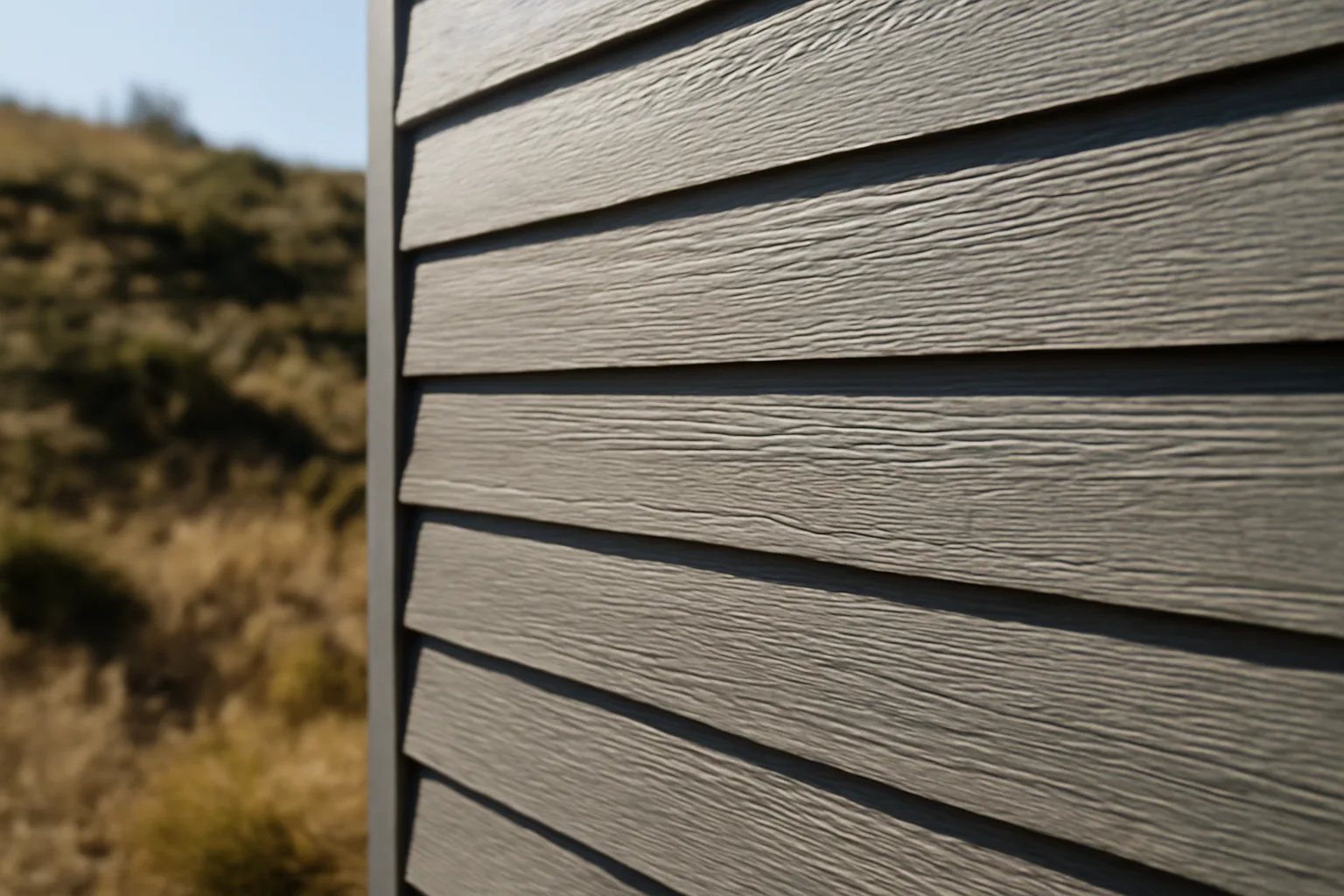
Fiber cement, stucco, and non-combustible metal siding are the top-performing fire-resistant siding materials, all tested to pass ASTM E84/E2707 assemblies used in California's Chapter 7A code. Vinyl and untreated wood siding are the weakest choices near a home ignition zone. Expect $6 to $16 per square foot installed, and document the product listing for your insurer.
What is fire resistant siding, and does it actually stop a house from burning?
Fire resistant siding is exterior wall cladding rated to resist ignition from radiant heat, direct flame, and (most importantly in real wildfires) embers that lodge in gaps, vents, and seams. No siding is fireproof. The honest framing insurers and fire marshals use is "ignition-resistant" or "noncombustible," not fireproof, because a long enough exposure to flame at close range will eventually damage almost anything. What actually matters in a wildfire is ember exposure, not a wall of flame marching up to your house. CAL FIRE's own research group, the Insurance Institute for Business & Home Safety (IBHS), has documented that most home ignitions in wildfires start small: embers land in mulch, pile up in a gutter, or work into a gap behind siding, and the fire builds from there rather than arriving as a wildfire front. That's why siding material choice matters less in isolation and more as part of an assembly: the siding, the water-resistive barrier behind it, the flashing at joints, and the gap (or lack of gap) at the ground and eaves. California's building code addresses this directly in Chapter 7A of the California Building Code, which governs "materials and construction methods for exterior wildfire exposure" in designated Wildland-Urban Interface Fire Areas [1]. Chapter 7A doesn't just bless a material; it requires assemblies (siding plus what's behind it) to pass ASTM E2707, a test that exposes a full-scale mockup to firebrand (ember) showers, radiant heat, and flame. That's a meaningfully different, and harder, test than a simple flame-spread rating on the siding material alone.
What are the best fire resistant siding materials, ranked?
| Stucco (3-coat) | Noncombustible, excellent | $7-$12 | Low, occasional patching | Cracks need sealing to stay ember-tight | |
|---|---|---|---|---|---|
| Fiber cement (e.g., HardiePlank) | Noncombustible core, strong performer | $6-$13 | Low, repaint every 10-15 yrs | Most common Chapter 7A-compliant retrofit choice | |
| Metal (steel/aluminum panel) | Noncombustible, excellent | $8-$16 | Low | Dents; check for ember gaps at laps | |
| Brick veneer | Noncombustible, excellent | $10-$20 | Very low | Heavy, needs structural support | |
| Treated wood (FR-rated) | Ignition-resistant, moderate | $8-$14 | Moderate, re-treatment cycles | Coating/treatment can degrade over decades | |
| Untreated wood siding | Combustible, poor | $5-$10 | High | Not permitted as sole cladding in CA WUI zones | |
| Vinyl siding | Combustible, poor, melts/deforms | $4-$8 | Low | Not Chapter 7A compliant without added protection | Fiber cement is the material most homeowners land on for retrofits because it's widely available, contractors already know how to install it, and it's genuinely noncombustible at its core (it's mostly Portland cement, sand, and cellulose fiber). Stucco performs just as well and is often already on the house in CA and AZ, so the retrofit question becomes about repairing cracks and gaps rather than replacing the whole wall. Vinyl siding is the one I'd flag hardest against. It's cheap and common, but it softens and drips at fairly low temperatures, and once it deforms it exposes the sheathing and any gaps behind it to direct ember contact. If you're in a WUI zone and currently have vinyl, that's a real vulnerability, not a cosmetic issue. |
Here's how the common options stack up, based on Chapter 7A compliance, ember resistance, cost, and maintenance burden. This isn't a lab report; it's a practical ranking for homeowners deciding what to install or replace. | Material | Fire performance | Installed cost (per sq ft) | Maintenance | Notes |
How much does fire resistant siding cost to install?
Expect $6 to $16 per square foot installed for the noncombustible options (fiber cement, stucco, metal), including labor, compared to $4 to $8 for basic vinyl. For an average 2,000 square foot home exterior (roughly 1,500-1,800 sq ft of actual wall surface after subtracting windows and doors), that puts a full re-side in the $10,000 to $25,000 range depending on material and region. That's a big number, and most homeowners aren't doing a full re-side purely for insurance reasons. The more common path is partial: replacing the most exposed sections first, typically the first several feet above grade, any wall facing a slope or dense vegetation, and areas around eaves and vents where embers concentrate. IBHS's wildfire research specifically calls out the base of walls and any combustible material within the first few feet of grade as a priority zone because embers and burning debris accumulate there. If your insurer sent a non-renewal or inspection letter citing exterior materials, ask them (or check the letter) whether they want documentation of the whole exterior or just the vulnerable sections. Many California FAIR Plan and admitted-market inspections focus heavily on the first 5 feet around the structure, called Zone 0, which California's SB 63 formalizes as its own defensible space category (more on the 2026 timeline below).
Does fire resistant siding actually reduce my home insurance risk score?
It can help, but no vendor or contractor should promise you a discount or reinstatement, and we don't either. Insurance underwriting models (including the CA FAIR Plan's own risk scoring and private carriers using Wildfire Risk models) weigh siding material as one factor among many: roof material, vent screening, defensible space clearance, roof-to-wall junctions, and deck material all get evaluated too. What you can control is documentation. If you install Chapter 7A-listed fiber cement or repair stucco cracks, keep the product spec sheet, the ICC-ES or state fire marshal listing number, contractor invoices, and dated photos. That paperwork is what you send to an insurer or adjuster when they ask for proof of hardening, not a verbal claim that "we upgraded the siding." We don't file claims or negotiate with insurers on your behalf; you assemble the record and you decide what to send. The DefensibleHome $99 Wildfire Insurance Survival Kit is built around exactly this gap: a structured way to document siding, roofing, vents, and defensible space work so you have something concrete ready before your renewal date, not scrambling after a non-renewal letter arrives. You can start one at survival-kit-builder.
When does the California defensible space law go into effect?
California's existing defensible space law (Public Resources Code 4291) has been in effect for years and currently requires 100 feet of defensible space clearance around structures in State Responsibility Areas and some Local Responsibility Areas, split into an inner zone (0-30 feet) and an outer zone (30-100 feet) with different vegetation management rules for each [2]. The newer piece homeowners are asking about is the "ember-resistant zone," Zone 0, created by SB 63 (2024), which directs CAL FIRE's State Board of Forestry and Fire Protection to adopt regulations for a 0-5 foot zone immediately around structures with stricter, near-noncombustible standards. As of this writing, the Board of Forestry has been developing draft regulations, and CAL FIRE's public guidance states the intent to have Zone 0 requirements in place with an anticipated compliance timeline extending into 2026 for existing structures, though the exact enforcement date depends on final regulatory adoption. Check CAL FIRE's Defensible Space page directly before assuming a hard date, because this has moved before and the effective date for existing (not new) structures is the piece still being finalized. If you want the current baseline requirements right now, not the pending Zone 0 rule, CAL FIRE's Defensible Space page lays out the two-zone system homeowners are already required to maintain [2].
What fire safe standards for homes take effect in 2026?
The clearest 2026-dated item is California's Zone 0 ember-resistant zone under SB 63, which the legislature directed the Board of Forestry to adopt regulations for, with guidance materials referencing a 2026 timeframe for existing home compliance once the regulation is finalized. This would require homeowners to remove combustible mulch, plants, and stored materials within 5 feet of the structure and replace them with noncombustible ground cover like gravel or pavers. Separately, Chapter 7A of the California Building Code already applies to new construction and substantial remodels in WUI-designated areas, and it isn't a 2026 change, it's ongoing. If you're building new or doing a major addition, Chapter 7A materials requirements (ignition-resistant siding, dual-pane tempered windows, ember-resistant vents, Class A roofing) already apply and aren't something to wait on [1]. Oregon and Colorado are moving on parallel but separate tracks. Oregon's SB 762 (2021) created a statewide wildfire risk map and defensible space standards tied to a Wildfire Hazard Zone map, administered through the Oregon Department of Forestry, though the mapping and rulemaking process has been revised multiple times after public pushback. Colorado doesn't have one statewide defensible space law; it's handled at the county and fire-district level, so [check your local fire district's current wildfire mitigation ordinance] before assuming a state standard applies to you.
Why won't people follow the defensible space law in California?
The honest answer involves cost, labor availability, and enforcement gaps, more than apathy. Clearing 100 feet of defensible space on a sloped, half-acre lot with mature oaks or brush isn't a weekend project; it commonly requires hired crews, chainsaw work, chipping, and disposal, which can run into the thousands of dollars for larger or overgrown lots. CAL FIRE and county fire agencies do inspections, but enforcement capacity is limited relative to the number of parcels in State Responsibility Areas, and PRC 4291 violations historically have carried modest penalties relative to the cost of full compliance, which reduces the deterrent effect for owners weighing cost against risk of citation. There's also a real subset of homeowners who genuinely don't know the rule applies to them, especially newer residents in SRA zones or people who moved in after their county's Local Responsibility Area rules were updated. And some resistance is aesthetic and ecological: mature landscaping, shade trees, and privacy screening take decades to grow, and residents don't want to cut a 40-year-old oak's lower limbs or clear native chaparral they value for wildlife. CAL FIRE's guidance tries to address this by distinguishing between removing all vegetation (not required) and reducing fuel continuity and "ladder fuels" that let ground fire climb into tree canopy (required) [2], but that nuance doesn't always survive word-of-mouth or a neighbor's bad experience with a contractor. For a walkthrough of what defensible space actually requires zone by zone, see defensible and fire safe landscaping next to your house.
How to prevent wildfires and forest fires around your own property
Roughly 85% of wildfires in the U.S. are human-caused, according to the National Interagency Fire Center's historical data cited by the U.S. Forest Service, and the leading causes include unattended campfires, debris burning, equipment sparks, and discarded cigarettes [3]. Preventing wildfires at a personal level means controlling the ignition sources you're actually responsible for. A few concrete habits matter more than people expect. Never leave a campfire unattended, and drown it, stir it, and drown it again until it's cold to the touch, more than no-longer-smoking; Ready.gov and the Forest Service both flag improperly extinguished campfires as a recurring, preventable cause [3]. Avoid mowing dry grass or using power equipment (chainsaws, angle grinders, trimmers) during red flag warning days, since a single spark from metal-on-rock contact can start a fire in dry fuel. Don't park or idle vehicles over dry grass, since catalytic converters run hot enough to ignite vegetation. And if you burn debris at all, check your county's local burn permit rules first; many California counties suspend burn permits entirely during fire season. At the property level, the same defensible space work that protects your house from an oncoming wildfire also reduces the odds that a spark on your land becomes a wildfire that spreads to your neighbors. It's a two-way relationship: home hardening protects you from the outside in, and fuel reduction protects everyone from the inside out.
How to prepare for a wildfire (a practical checklist)
Preparing for a wildfire means doing the hardening and defensible space work well before fire season, not during a red flag warning. Ready.gov's wildfire preparedness guidance breaks this into building an emergency kit, making a family evacuation plan with two ways out, and hardening the home itself. The home-hardening priorities, in the order I'd actually spend money on them: Class A roofing material or roof replacement if you have wood shakes, ember-resistant vent screens (1/8 inch mesh, no larger), gutter guards or regular gutter clearing, noncombustible siding or repair of gaps in existing siding, and dual-pane windows with tempered glass on the exterior pane. CAL FIRE's home hardening guidance ranks vents and roof-to-wall intersections among the most common ignition points because that's where embers accumulate and where gaps are easiest to miss. On the evacuation side, Ready.gov recommends having a "go bag" ready per household member, knowing at least two evacuation routes out of your neighborhood, and signing up for local emergency alerts before fire season starts, not when smoke is already visible. If you want a structured way to document both your hardening work and your evacuation plan in one place for insurance and personal use, that's the core of the Wildfire Insurance Survival Kit.
How can we prevent forest fires at a community level?
Community-level prevention leans on coordinated fuel breaks, prescribed burns, and shared defensible space, because one homeowner's hardened house surrounded by unmanaged neighboring lots is still exposed. Fire doesn't respect property lines, and CAL FIRE's guidance explicitly frames defensible space as a neighborhood-scale strategy, more than an individual one [2]. Practical community actions include forming or joining a Firewise USA community (a National Fire Protection Association program that helps neighborhoods coordinate fuel reduction and get recognized status, which some insurers and local programs look favorably on), coordinating with neighbors on shared fuel breaks along property lines, and supporting local prescribed burn programs run by CAL FIRE or the U.S. Forest Service, which reduce accumulated fuel loads before they become uncontrollable. If you're in Washington state, there are structured defensible space clearing contract programs through the state DNR that homeowners and communities can use rather than hiring ad hoc; see wildfire defensible space clearing contracts through Washington state DNR for how that program works.
Is Santa Barbara safe from fire risk right now?
No area in California's WUI is "safe" from fire risk in an absolute sense, and Santa Barbara County has a documented history of major fires, including the 1990 Painted Cave Fire and the 2017 Thomas Fire, which at the time was the largest wildfire in modern California history by acreage before later fires surpassed it [4]. The Thomas Fire also triggered the Montecito debris flow in January 2018, a reminder that wildfire risk in this region compounds with post-fire landslide risk on burned slopes. CAL FIRE maintains Fire Hazard Severity Zone maps by county, and large portions of the hillside and foothill communities around Santa Barbara (Montecito, Mission Canyon, the areas backing up to the Santa Ynez Mountains) are mapped as Very High Fire Hazard Severity Zones in the State Responsibility Area [5]. If you own property there, or anywhere in a mapped high-severity zone, check your specific parcel against CAL FIRE's FHSZ viewer rather than relying on a neighborhood's general reputation, since risk varies block by block based on slope, vegetation, and distance from wildland fuel.
How do I document siding and hardening work for my insurer?
Document the product, the installer, and the date, in that order, before you document anything else. For siding specifically: keep the manufacturer spec sheet showing the material's fire rating or ICC-ES evaluation report number, the contractor's invoice with the address and date of installation, and dated photos taken before, during, and after installation showing the material applied to the exterior walls, especially at the base of walls and around vents. If your insurer or the CA FAIR Plan sent an inspection or non-renewal letter, re-read it for the specific items they cited (siding, roof, vents, defensible space clearance, deck material are the common ones) and prioritize documenting those exact items first. We don't file claims, negotiate settlements, or promise reinstatement, that's between you and your carrier or a licensed public adjuster if you choose to hire one. What we do is help homeowners build the packet of evidence (photos, receipts, product listings, defensible space records) that you decide to send. For related hardening documentation, see house fire for what happens during an actual structure fire event and fire at a house for post-incident considerations, and only you can prevent wildfires for the Smokey Bear campaign's origin and current messaging from the Forest Service.
Frequently asked questions
When does the California defensible space law go into effect?
The core defensible space law, PRC 4291, is already in effect and has been for years, requiring 100 feet of clearance in State Responsibility Areas. The new Zone 0 ember-resistant zone (0-5 feet) from SB 63 is in rulemaking, with CAL FIRE guidance pointing toward a 2026 compliance timeline for existing homes once regulations are finalized. Check CAL FIRE's Defensible Space page for the current status.
Why won't people follow the defensible space law in California?
Cost is the biggest factor; clearing 100 feet on a large or sloped lot can cost thousands in labor. Limited enforcement capacity, low awareness among newer residents, and reluctance to remove mature trees or landscaping also contribute. CAL FIRE distinguishes reducing fuel continuity from removing all vegetation, but that nuance doesn't always reach homeowners clearly.
How to prevent wildfires from starting on my property?
Fully extinguish campfires (drown, stir, drown again), avoid mowing dry grass or using metal power tools on red flag days, don't idle vehicles over dry vegetation, and follow local burn permit rules. About 85% of U.S. wildfires are human-caused, per National Interagency Fire Center data cited by the U.S. Forest Service, so controllable ignition sources matter most.
How to prepare for a wildfire if I live in a high-risk zone?
Build an emergency kit and two-route evacuation plan (Ready.gov), then harden your home: Class A roof, ember-resistant vents, gutters cleared, noncombustible siding, and dual-pane tempered windows. Sign up for local emergency alerts before fire season, and clear defensible space in the required zones around your structure.
How to prevent forest fires beyond just my own house?
Support community-level fuel breaks, join or start a Firewise USA program in your neighborhood, and back local prescribed burn efforts through CAL FIRE or the U.S. Forest Service. Individual home hardening matters, but fire doesn't respect property lines, so coordinated neighborhood fuel reduction lowers risk for everyone nearby.
How to avoid forest fires when recreating outdoors?
Check local fire restrictions before camping or burning, keep campfires small and attended, use established fire rings, and fully extinguish fires with water, more than dirt. Avoid parking on dry grass, don't discard cigarettes on the ground, and postpone any spark-producing equipment use during red flag warnings.
How to prepare for forest fires as a household?
Create a family evacuation plan with two routes, pack a go bag per person, and know your community's alert system. Harden your home's roof, vents, and siding, and maintain defensible space clearance year-round, since prep done in advance of fire season is what actually reduces damage, not last-minute scrambling.
What fire safe standards for homes take effect in 2026?
California's SB 63 Zone 0 ember-resistant zone (0-5 feet around structures) is the clearest 2026-linked item, pending final Board of Forestry regulations. Chapter 7A building code requirements for new construction in WUI zones are already in effect, not new for 2026. Oregon and Colorado handle this through separate state or county-level processes.
Is Santa Barbara safe from fire risk?
No, large portions of Santa Barbara County's foothill and hillside communities are mapped as Very High Fire Hazard Severity Zones by CAL FIRE. The county has a documented history of major fires including the 2017 Thomas Fire. Check CAL FIRE's Fire Hazard Severity Zone viewer for your specific parcel rather than assuming general safety.
How can we prevent forest fires as a community?
Coordinate fuel breaks across property lines, join a Firewise USA community program, and support prescribed burn programs run by CAL FIRE or the U.S. Forest Service. Washington state also offers structured defensible space clearing contracts through its DNR that neighborhoods can use together rather than hiring separately.
What is the most fire resistant siding material available?
Noncombustible materials like stucco, fiber cement, and metal panel siding are the top performers, all capable of passing Chapter 7A assembly testing under ASTM E2707. Brick veneer performs similarly well but costs more and needs structural support. Vinyl and untreated wood are the weakest common options.
Does fiber cement siding meet California's Chapter 7A code?
Fiber cement siding products generally meet Chapter 7A requirements when installed as part of a tested assembly, but compliance depends on the specific product listing and installation method, not the material alone. Check the manufacturer's ICC-ES evaluation report or state fire marshal listing for your specific product before assuming compliance.
How much does it cost to replace siding with fire resistant material?
Expect $6 to $16 per square foot installed for fiber cement, stucco, or metal siding, versus $4 to $8 for basic vinyl. A full re-side on an average home often runs $10,000 to $25,000; many homeowners instead prioritize the most exposed wall sections first.
Sources
- California Building Standards Commission, California Building Code Chapter 7A: Chapter 7A governs materials and construction methods for exterior wildfire exposure in WUI Fire Areas and requires assembly-level ember, radiant heat, and flame testing
- CAL FIRE, Defensible Space (PRC 4291): California defensible space law requires 100 feet of clearance in two zones (0-30 ft and 30-100 ft) around structures in SRA
- USDA Forest Service, wildfire prevention statistics citing National Interagency Fire Center data: Approximately 85% of wildfires in the U.S. are human-caused
- CAL FIRE, Fire Hazard Severity Zone Maps: CAL FIRE and the Office of the State Fire Marshal maintain Fire Hazard Severity Zone maps identifying Very High severity zones including areas around Santa Barbara
- California Public Resources Code Section 4291: Statutory basis for defensible space clearance requirements around structures in State Responsibility Areas