Last updated 2026-07-25
TL;DR
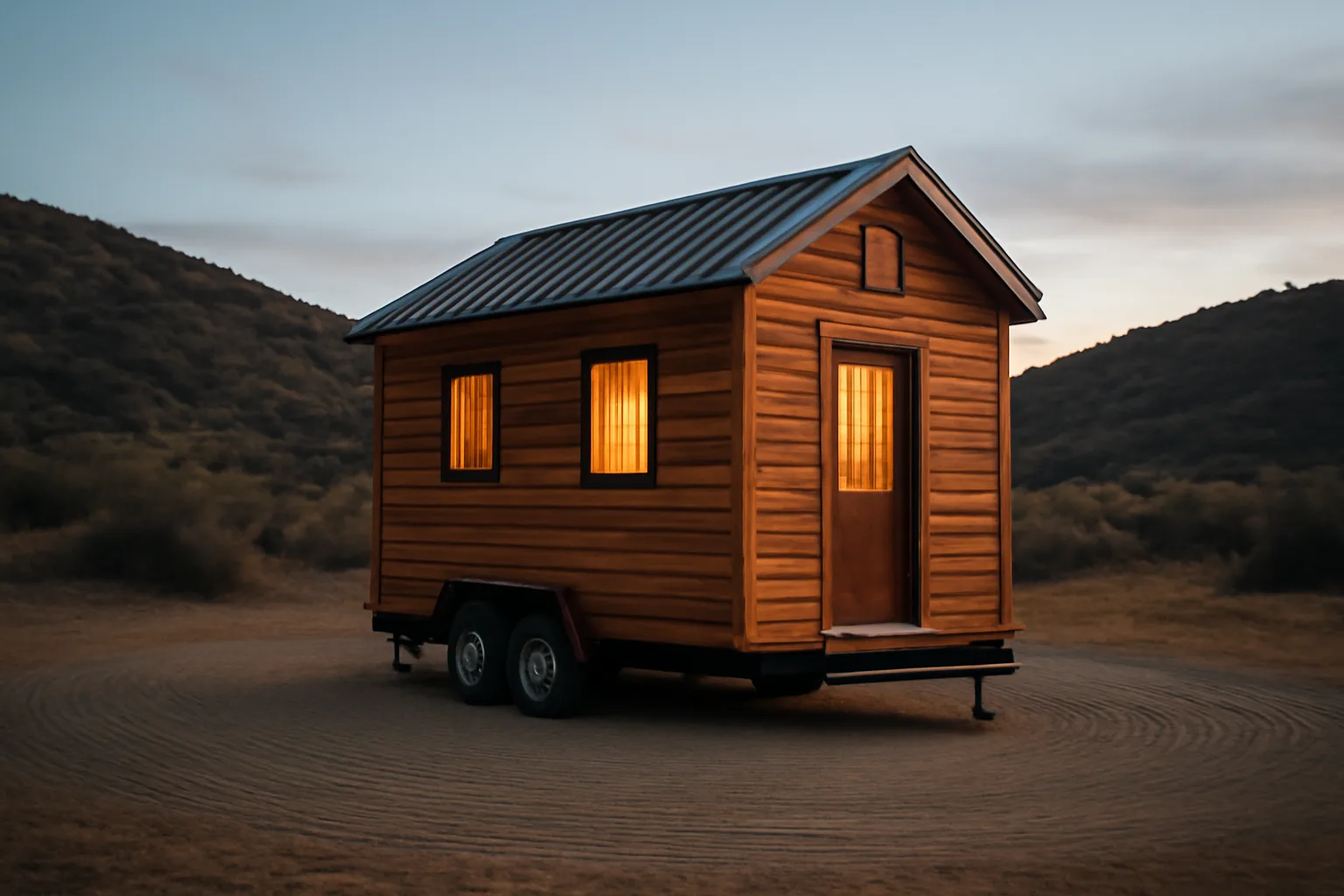
Fire resistant tiny homes rely on the same physics as full-size homes: a Class A roof, ignition-resistant siding, tempered dual-pane windows, and a 5-foot noncombustible zone around the structure (California's Zone 0 rule). Size doesn't protect a tiny home; ember exposure and material choice do. A well-built 400 sq ft tiny home with hardened details can outlast a poorly built 3,000 sq ft house next door.
Can a tiny home actually be fire resistant?
Yes, but not because it's small. Size has almost nothing to do with wildfire survival. What matters is what the structure is made of and what's touching it within the first few feet. CAL FIRE's research on home ignition during wildfires consistently points to embers, not the flame front, as the primary way structures ignite. The agency's own guidance states that most homes are lost when wind-blown embers land on or near combustible material and smolder into flame, sometimes hours after the fire front has passed. A tiny home built on a trailer with vinyl siding and an asphalt shingle roof surrounded by dry grass burns just as fast, maybe faster, as a stick-built house with the same problem. So "fire resistant tiny home" really means three things layered together: a roof assembly rated Class A, siding and skirting that won't ignite from ember contact, and a noncombustible buffer around the base. Get those three right and a tiny home has a real shot. Skip any one of them and square footage doesn't save you. Where tiny homes have an actual advantage is retrofit cost. Re-roofing 400 square feet costs a fraction of re-roofing 2,500 square feet, so owners can afford to go straight to metal or Class A composite roofing instead of compromising on cost.
What roof and siding materials hold up best?
| Standing seam metal roof | Class A | High | Higher upfront, near-zero maintenance | |
|---|---|---|---|---|
| Class A asphalt composite shingle | Class A | High | Moderate cost, widely available | |
| Wood shake (untreated) | C or unrated | Low | Banned or restricted in many WUI codes | |
| Fiber cement siding | N/A (siding) | High | Moderate cost, heavy, needs solid framing | |
| Vinyl siding | N/A (siding) | Low | Cheap, softens/ignites at low heat | |
| Untreated wood siding | N/A (siding) | Low | Common on rustic tiny homes, high risk | For a broader look at how these material choices apply to full-size homes, see fire safe landscaping California next to house and defensible. |
For roofing, metal (standing seam or metal shingle), fiberglass asphalt composition shingles rated Class A, and concrete or clay tile all pass Class A fire testing under ASTM E108 / UL 790, the standard building codes reference for roof coverings [1]. Class A is the highest ember- and flame-resistance rating a roof assembly can get; it means the roof passed a standardized burning-brand and flame spread test, not that it's fireproof. Wood shakes and untreated wood shingles are Class C or unrated in most configurations and are a documented weak point in wildfire losses; several fire-prone jurisdictions restrict or ban them outright in Wildland-Urban Interface zones. For siding, the safer categories are fiber cement board, stucco, brick veneer, and corrugated metal panel. Vinyl siding softens and drips at surprisingly low temperatures, well below flame contact, which lets embers accumulate in gaps and voids behind it. Untreated wood siding and log-cabin-style exteriors, common on tiny homes marketed for a rustic look, are among the worst choices for wildfire zones unless treated with a fire-retardant coating rated for exterior use. Skirting deserves specific attention because tiny homes on trailers or piers often have an open or lightly skirted underside where embers collect, exactly like the crawlspace vulnerability on manufactured homes. Metal skirting or concrete board skirting with no gaps closes that pathway. | Material | Roof Class | Ember resistance | Typical cost note |
What is Zone 0 and does it apply to tiny homes?
Zone 0 is California's ember-resistant zone rule requiring the first 5 feet around a structure to be free of combustible material, including mulch, wood fencing attached to the house, dry vegetation, and stored items like firewood or propane tanks. It applies to any structure in a designated Fire Hazard Severity Zone or State Responsibility Area, and a tiny home sitting in one of those zones is not exempt just because it's small or on wheels. California's Zone 0 requirement comes from Assembly Bill 3074 (2020), which directed the State Board of Forestry and Fire Protection to develop ember-resistant zone regulations for the 0-5 foot perimeter [2]. As of this writing, the Board has been working through the formal rulemaking process, and enforcement dates have moved; homeowners should check the current status directly with the Board of Forestry rather than assume a fixed date, because the regulation has been delayed more than once since the bill passed. A tiny home parked on gravel or pavers, with metal skirting and nothing flammable within 5 feet, already satisfies the intent of Zone 0 even before it's formally enforced everywhere. That's genuinely one of the cheaper mitigation wins available: gravel, decomposed granite, or pavers in a 5-foot ring cost far less than reroofing or residing. For tiny homes on wheels that move between locations (RV parks, family land, temporary sites), the owner needs to reassess the 5-foot zone every time the unit relocates. A gravel pad at the permanent site does nothing for a weekend spent parked in dry grass.
What fire-safe home rules take effect in 2026?
The honest answer here is: it depends which state and which specific code cycle you mean, and several relevant California rules have shifting effective dates. California's wildfire building code updates run on the standard triennial California Building Standards Code cycle, with the 2025 edition of Title 24 (including Chapter 7A, the wildland-urban interface fire provisions) generally taking effect January 1, 2026 for new construction and additions in applicable fire hazard zones [3]. Chapter 7A governs ignition-resistant construction requirements, roofing, vents, siding, and window glazing for homes built in State Responsibility Areas and Very High Fire Hazard Severity Zones. Zone 0 (the 5-foot ember-resistant zone discussed above) is separate from the Title 24 building code and has had its own, repeatedly delayed timeline. As of the most recent public updates, the Board of Forestry has not finalized a statewide enforcement date that applies uniformly; some local jurisdictions have adopted their own versions ahead of the state rule. Anyone planning a 2026 build or retrofit should call their local building department directly, because "2026" gets used loosely online for at least three different California wildfire rules that don't share a start date. Outside California, Oregon's statewide wildfire hazard map and defensible space requirements (under Senate Bill 762, 2021) have gone through their own multi-year rollout and legal challenges, and Colorado and Arizona largely leave defensible space and building material rules to county and local fire district ordinances rather than one statewide code. Guided fill-in: check your county fire district's current wildfire building code adoption date at [your county fire marshal's site] before assuming a statewide deadline applies to you.
When does the California defensible space law go into effect?
California's core defensible space law, requiring 100 feet of defensible space clearance around structures in State Responsibility Areas, is not new; it has been in effect since Public Resources Code Section 4291 was enacted, with the 100-foot standard set by amendment effective January 1, 2005 [4]. What's newer and still rolling out is Zone 0, the tighter 0-5 foot ember-resistant zone described above, created by AB 3074 in 2020 but still moving through rulemaking with no single confirmed enforcement date at publication time. So two different clocks are running: the 100-foot defensible space law that's been enforceable for two decades, and the newer 5-foot Zone 0 rule that's still being finalized. CAL FIRE's own defensible space page breaks the 100 feet into two zones: Zone 1 (0-30 feet, lean and clean) and Zone 2 (30-100 feet, reduced fuel). For a tiny home on a rural parcel, the 100-foot rule applies the same way it applies to a full-size house on that parcel; the law regulates the land around the structure, not the structure's square footage. See defensible space zones for the zone-by-zone breakdown.
Why won't people follow the defensible space law in California?
Cost, labor, and enforcement gaps are the three real reasons, and none of them are secret. CAL FIRE inspection data has repeatedly found significant portions of inspected parcels out of compliance with the 100-foot defensible space standard, and the agency's own messaging acknowledges compliance is inconsistent across the state. Clearing 100 feet of vegetation on a sloped, wooded, or brush-heavy rural parcel is physical labor that can run into thousands of dollars if hired out, and many rural and lower-income property owners simply don't have that money sitting around, especially if it needs redoing every year as vegetation regrows. Elderly or disabled homeowners on fixed incomes face the same problem without the physical capacity to do the clearing themselves. Enforcement is also uneven. Defensible space inspections are typically done by local fire agencies or CAL FIRE unit staff, and staffing shortfalls mean not every parcel gets inspected every year, so noncompliance can go unnoticed for seasons at a time. There's also a documented gap between awareness and action: people know the rule exists but underestimate their own risk, assume "it won't reach me," or defer the work because a fire season passes without incident. None of that changes the underlying physics. Defensible space works, and CAL FIRE materials cite it as one of the most effective single actions a property owner can take to improve a structure's survival odds during an approaching wildfire.
How do you prevent wildfires and forest fires from starting?
Human activity causes most wildfires. The National Interagency Fire Center and multiple federal wildfire reports attribute roughly 85-90% of wildfires in the U.S. to human causes, including unattended campfires, downed power lines, equipment sparks, arson, and debris burning, with the remainder from lightning [5]. Preventing forest fires and wildfires at the individual level means controlling those human-caused ignition sources. Ready.gov's wildfire preparedness guidance lists specific prevention actions: never leave a campfire unattended and fully extinguish it with water until it's cold to the touch, avoid parking or idling vehicles on dry grass (catalytic converters can ignite it), maintain equipment like chainsaws and mowers to avoid sparking, and follow local burn bans during red flag warning conditions. At the property level, prevention overlaps heavily with defensible space work: clearing dead vegetation, keeping gutters free of pine needles and leaves, and maintaining a 5-foot noncombustible zone reduces the odds that an ember landing on your property becomes a structure fire that then spreads further. CAL FIRE's "Ready, Set, Go" program frames this as reducing fuel available to a fire before it ever reaches a neighborhood [6]. On public and forest land specifically, following local fire restrictions, reporting smoke immediately, and avoiding fireworks or open burning during dry, windy conditions cover most of the human-controllable risk. For actions specific to your own home, house fire and fire at a house cover ignition sources inside the structure itself.
How should you prepare for a wildfire before it happens?
Preparing for a wildfire means having a go-bag, an evacuation plan, and hardened defensible space done well before fire season, not when a red flag warning is already posted. Ready.gov recommends preparing an emergency supply kit with water, medication, important documents, and a battery radio, and having two evacuation routes planned in advance since one route may be blocked by fire or traffic. CAL FIRE's "Ready, Set, Go" framework breaks preparation into stages: Ready means maintaining defensible space and having a plan year-round; Set means active preparation when fire risk is elevated (packing the car, moving valuables); Go means leaving immediately when told to evacuate, without waiting to see how bad it gets [6]. Waiting to "see how bad it gets" is consistently flagged as a major factor in fire fatalities and injuries. For tiny home owners specifically, the wheels are actually an asset here: if evacuation warnings come early enough, a tiny home on a trailer can sometimes be towed out entirely, something a stick-built house obviously can't do. That only works if the tow vehicle, hitch, and route are ready in advance, not scrambled together during an active evacuation order. Documentation matters too, separate from the physical prep. Photograph the exterior, the roof, the defensible space zone, and any fire-hardening upgrades before fire season starts. If you ever need to show an insurer what mitigation work was done, dated photos are the difference between a claim that's easy to support and one where you're arguing from memory. This is where a resource like DefensibleHome's $99 Wildfire Insurance Survival Kit Builder can help homeowners organize that documentation into an insurer-ready format ahead of time (find it at /survival-kit-builder); we don't file claims or negotiate with insurers on your behalf, we just help you get your own paperwork in order before you need it.
What tiny-home-specific mitigation steps matter most?
Skirting, tie-downs, propane placement, and vent screening are the four details unique to tiny homes and manufactured units that standard house-hardening checklists don't always cover. Skirting needs to be solid, noncombustible material (metal or cement board) with no gaps, closing off the open underside where embers collect exactly the way they do under raised manufactured homes. An open or lattice-skirted underside is one of the more overlooked ember traps in wildland-urban interface losses. Propane tanks, common on off-grid tiny homes, should sit well outside the 5-foot zone (CAL FIRE and most local fire codes recommend significant separation from structures generally, and further from any dense vegetation) and never be tucked against the tiny home's siding for convenience. Vents (foundation, soffit, and gable vents where present) should carry 1/8-inch or smaller noncombustible mesh screening, matching the ember-resistant vent standard used in Chapter 7A construction, since standard 1/4-inch hardware cloth lets embers through. Tie-downs and anchoring matter for wind-driven fire events specifically; a fire-generated wind event can move an unanchored trailer, and stability during an active fire isn't the moment to discover the unit isn't properly secured to its pad.
Is Santa Barbara safe from fire?
No location in California's wildland-urban interface is "safe from fire" in an absolute sense, and Santa Barbara County specifically has a documented history of major destructive wildfires, including the 1990 Painted Cave Fire and the 2017 Thomas Fire, which was, at the time, the largest wildfire in modern California history before being surpassed by later fires, followed by the deadly Montecito debris flow in January 2018 [7]. Much of Santa Barbara County, particularly the foothill communities along the Santa Ynez Mountains (Montecito, Mission Canyon, the Riviera), sits in mapped Very High Fire Hazard Severity Zones under CAL FIRE's Fire Hazard Severity Zone maps, which trigger the state's building code and defensible space requirements . The combination of steep terrain, chaparral fuel, and seasonal Santa Ana-type sundowner winds makes the area fire-prone by geography, more than by bad luck. That doesn't mean every property in Santa Barbara is equally at risk; a home deep in a dense urban grid downtown faces different exposure than a hillside home backing onto open chaparral. Anyone buying or building in the area should check the parcel's specific Fire Hazard Severity Zone designation on CAL FIRE's maps rather than relying on the city's general reputation either way.
Is a tiny home cheaper to fire-harden than a full-size house?
Usually yes, mostly because of surface area. Reroofing, residing, and window replacement are priced largely by square footage, and a tiny home's 200-500 square foot footprint means even premium fire-rated materials cost a fraction of what the same upgrade costs on a 2,000+ square foot house. Where costs even out is in per-unit fixed items: a single tiny home still needs full sets of dual-pane tempered or fire-rated windows, a complete skirting job, and the same 5-foot Zone 0 clearing effort as a bigger structure, and none of those get cheaper just because the building is smaller. A 400 square foot tiny home and a 4,000 square foot house both need their gutters cleared and their vents screened; that labor doesn't scale down proportionally. The other cost consideration is total replacement value. Insurers price wildfire risk against rebuild cost, and a lower-value tiny home may have a harder time finding coverage at all in a non-renewal environment, independent of how well it's hardened, simply because some carriers have pulled back from wildfire zones broadly rather than pricing individual mitigation. For background on how insurers and the state FAIR plans are handling wildfire zone coverage generally, see only you can prevent wildfires.
Frequently asked questions
When does the California defensible space law go into effect?
The core 100-foot defensible space requirement (Public Resources Code 4291) has been in effect since a 2005 amendment set the current 100-foot standard. The newer 5-foot Zone 0 ember-resistant zone rule, created by AB 3074 in 2020, is still in the Board of Forestry's rulemaking process with no single confirmed statewide enforcement date as of this writing; check with your local fire agency for current status.
Why won't people follow the defensible space law in California?
Cost and labor are the main reasons; clearing 100 feet of vegetation on a rural parcel can cost thousands of dollars and needs redoing yearly. CAL FIRE inspection data has consistently found meaningful noncompliance rates, driven by fixed incomes, physical limitations, uneven enforcement staffing, and a documented gap between knowing the rule exists and believing it applies to your own property.
How do you prevent wildfires?
Most wildfires are human-caused (roughly 85-90% per National Interagency Fire Center data), so prevention means fully extinguishing campfires, avoiding parking on dry grass, maintaining spark-prone equipment, following local burn restrictions, and keeping your property's defensible space clear so any ember that lands doesn't ignite a structure fire.
How do you prepare for a wildfire?
Build a go-bag with water, medication, and documents, plan two evacuation routes in advance, and maintain defensible space year-round following CAL FIRE's Ready, Set, Go framework. Photograph your home's exterior and mitigation upgrades before fire season so you have dated records if you ever need to document conditions to an insurer.
How can we prevent forest fires?
Follow campfire and burn restrictions, especially during red flag warning conditions, keep vehicles off dry grass, maintain equipment that could spark, and report smoke immediately rather than assuming someone else has. Since most forest fires start from human activity, individual caution during dry, windy periods is the single biggest lever most people control.
What fire-safe home rules take effect in 2026?
California's 2025 Title 24 building code, including Chapter 7A wildfire construction provisions, generally takes effect January 1, 2026 for new construction in applicable fire hazard zones. The separate Zone 0 ember-resistant zone rule has a different, still-unconfirmed timeline. Confirm with your local building department which specific rule and date applies to your project.
Is Santa Barbara safe from fire?
No; Santa Barbara County has a documented history of destructive wildfires, including the 2017 Thomas Fire, and much of the foothill area sits in CAL FIRE-mapped Very High Fire Hazard Severity Zones. Risk varies significantly by exact location within the county, so check the parcel-specific Fire Hazard Severity Zone map rather than the city's general reputation.
Can a tiny home meet California's wildfire building code?
Yes, if it uses Chapter 7A-compliant materials: a Class A roof assembly, ignition-resistant siding, dual-pane tempered windows, and 1/8-inch ember-resistant vent screening. Compliance depends on where the tiny home is sited (State Responsibility Area or Very High Fire Hazard Severity Zone) and how it's permitted, since manufactured and mobile units can fall under different code pathways than site-built structures.
Does skirting matter for tiny home fire safety?
Yes, significantly. An open or lattice-style skirted underside lets wind-blown embers collect and smolder against the structure's floor framing, a well-documented ignition pathway for manufactured and mobile homes. Solid metal or cement board skirting with no gaps closes that pathway and is one of the cheaper upgrades available relative to reroofing or residing.
What roofing material is best for a fire resistant tiny home?
Standing seam metal roofing and Class A-rated composite asphalt shingles both pass the ASTM E108/UL 790 burning brand test at the highest rating. Metal has near-zero maintenance and the longest lifespan; Class A asphalt composite costs less upfront and is more widely available for tiny home builders working with standard suppliers.
Do tiny homes need the same 100-foot defensible space as regular houses?
Yes. California's Public Resources Code 4291 defensible space requirement applies to the parcel and structure, not the structure's size, so a tiny home in a State Responsibility Area needs the same 100-foot clearance (Zone 1: 0-30 feet lean and clean; Zone 2: 30-100 feet reduced fuel) as any other home on that land.
Is it cheaper to fire-harden a tiny home than a full-size house?
Usually, because reroofing and residing costs scale with square footage and tiny homes have far less surface area. Fixed-cost items like a full window replacement, complete skirting, and defensible space clearing don't scale down proportionally though, so the savings are real but smaller than the size difference alone would suggest.
Sources
- ASTM International / UL, Standard Test Methods for Fire Tests of Roof Coverings: Class A roof rating is determined by ASTM E108/UL 790 burning brand and flame spread testing
- California Legislative Information, Assembly Bill 3074 (2020): AB 3074 directed the Board of Forestry to create ember-resistant zone (Zone 0) regulations for the 0-5 foot perimeter around structures
- California Department of Housing and Community Development, 2025 California Building Standards Code adoption: The 2025 California Building Standards Code, including Chapter 7A wildfire provisions, takes effect January 1, 2026
- California Public Resources Code Section 4291: California's 100-foot defensible space clearance requirement around structures in State Responsibility Areas
- National Interagency Fire Center, wildfire cause statistics: Roughly 85-90% of wildfires in the U.S. are human-caused
- CAL FIRE, Ready Set Go program: The Ready, Set, Go framework for staged wildfire evacuation preparedness
- CAL FIRE, Fire Hazard Severity Zone Maps: Portions of Santa Barbara County foothill communities are designated Very High Fire Hazard Severity Zones