Last updated 2026-07-25
TL;DR
Home Depot sells fire-resistant tarps (typically vinyl-coated or silicone-coated fiberglass) for roofs, woodpiles, and equipment covers, usually $20 to $150 depending on size and rating. They can slow ignition from embers but are not a substitute for defensible space clearing, ember-resistant vents, or Class A roofing, which is what CAL FIRE and most insurers actually check.
what does a fire-resistant tarp from home depot actually do
A fire-resistant tarp sold at Home Depot is usually made of vinyl-coated polyester or silicone-coated fiberglass, treated or woven to resist ignition from direct flame contact and to slow melting compared to a standard polyethylene tarp. Brands like Signature Fence, Xtarps, and various welding-blanket style covers show up in the fire-resistant category, priced anywhere from about $20 for a small 6x8 utility cover to $150 or more for heavier fiberglass tarps meant to sit near heat sources. These tarps are built for jobs like covering a woodpile near a welding station, protecting equipment during grinding work, or draping over something you don't want to catch a stray spark. They resist flame contact and radiant heat for a period, but none of them are rated to stop a wildfire, and none are certified building materials under the California Building Code Chapter 7A, which governs ignition-resistant construction in the wildland-urban interface [1]. If you're picturing draping one over your roof during a fire, don't. That's not what these products are designed for, and CAL FIRE's own guidance never mentions tarps as part of defensible space or home hardening at all. A regular polyethylene tarp will melt and possibly drip flaming plastic. A fire-resistant one resists ignition longer, but 'longer' still isn't 'through a wildfire.'
can a tarp protect my roof during a wildfire
No. Covering a roof with any tarp, fire-resistant or not, during an active wildfire is not a recognized protective measure and creates real risks: it can trap heat, catch wind and tear loose, or ignite from embers landing on top of it and then transfer flame to the roof surface underneath. CAL FIRE's home hardening guidance for roofs focuses on Class A fire-rated roofing materials (asphalt shingle, tile, metal) and keeping gutters and roof valleys clear of debris, not temporary covers. Embers are the primary way homes ignite in wildfires, landing in gutters, in roof valleys, under eaves, and in vents. A study cited by the Insurance Institute for Business & Home Safety found that ember exposure, not direct flame contact, causes the majority of home losses in wildfires. A loose tarp on a roof gives embers somewhere new to collect and smolder. What actually helps: a Class A roof assembly, metal or ember-resistant mesh over vents (typically 1/8 inch mesh per California building code, sometimes tighter depending on local amendments), and a clean roof surface. None of that is a tarp job. If your roof material itself is the problem (wood shake, old asphalt with gaps), a tarp is a stopgap for weather, not fire.
what are fire-resistant tarps actually good for around a home
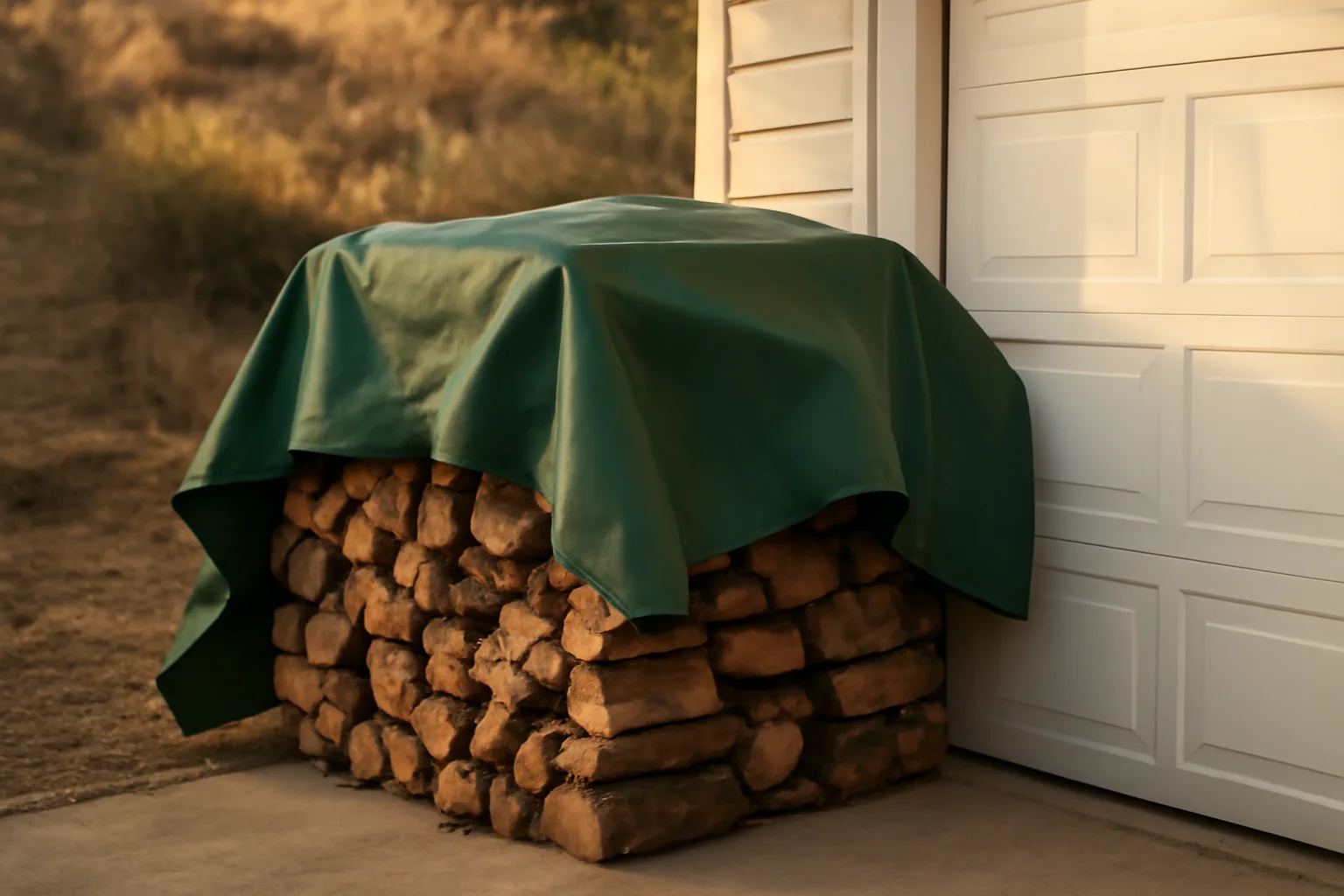
The legitimate use cases are narrower than the name suggests: covering firewood stacks that sit inside your defensible space zones, protecting a generator or equipment during ember-fall, or as a temporary cover on outdoor furniture or a woodpile you can't relocate before a red flag warning. Some property owners use them as temporary ground cover during brush clearing work to catch debris and reduce ignition risk from cutting sparks. CAL FIRE's Zone 0 guidance (the 0-5 foot zone immediately around a structure) calls for removing combustible material entirely, not covering it. If you have a woodpile within 30 feet of your house, the real fix is to move it, not tarp it. A fire-resistant tarp on a woodpile you were going to relocate anyway during red flag season is reasonable. A fire-resistant tarp as a permanent substitute for proper storage is not. For sheds, propane tanks, or vehicles you can't move, a rated tarp can reduce the chance of a stray ember catching something instantly, buying you time. But time is the key word. These are seconds-to-minutes products, not something that survives sustained flame contact or radiant heat from a structure fire nearby.
when does the california defensible space law go into effect
California's defensible space requirement under Public Resources Code 4291 already applies today for property in State Responsibility Areas and, per local ordinance, in many Local Responsibility Areas; it requires 100 feet of defensible space clearance around structures (or to the property line, whichever is less) [2]. What's newer and often confused with a fresh law is the Zone 0 (ember-resistant zone, 0-5 feet from structures) regulation. The Board of Forestry and Fire Protection has been developing Zone 0 regulations under SB 63 (2020) and related statute, and as of this writing the regulation has been through rulemaking stages but final adoption and enforcement timing has shifted more than once. Check the Board of Forestry and Fire Protection's official rulemaking page for the current status before assuming a hard date [3]. Enforcement start dates for Zone 0 specifically have not been finalized as of late 2024/2025 filings, so if you see a firm date claimed elsewhere, verify it against the Board's own page, not a secondary source. The baseline 100-foot defensible space law, by contrast, is already in force and has been since 2005 amendments to PRC 4291, with inspections handled by CAL FIRE or local fire agencies depending on jurisdiction [2]. Local rules vary. Some California counties add stricter clearance or vegetation-type restrictions. Check with your local fire district or CAL FIRE unit for the specific requirements over the state minimum where you live.
why won't people follow the defensible space law in california
The honest answer is a mix of cost, labor, aesthetics, and enforcement gaps. Clearing 100 feet of defensible space on a wooded lot can mean removing mature trees, thinning brush, and ongoing annual maintenance, and for homeowners on fixed incomes or large rural parcels that can run into thousands of dollars a year in contractor costs. CAL FIRE inspection data has repeatedly shown compliance rates below what the agency wants; inspections in some counties have found roughly half or fewer of properties fully meeting defensible space standards on first visit, though rates vary widely by county and year, and CAL FIRE publishes county-level assessment results rather than one national compliance number, so check your local unit's most recent report for numbers specific to your area [2]. Some homeowners also just don't know the rule exists until they get a notice, or misunderstand it as something that only applies deep in fire country, not to suburban WUI edges. Others disagree with the aesthetic tradeoff (fewer trees, different landscaping) or worry it lowers property value or privacy. Enforcement also varies. In many jurisdictions, a first notice leads to a re-inspection window (commonly 30 to 90 days depending on local ordinance) before fines, and fines themselves vary by county, so the practical pressure to comply differs a lot depending on where you live and how aggressively your local fire department follows up. For a broader look at how defensible space requirements are structured and enforced, see defensible space rules.
how to prevent wildfires from starting near your home
Most wildfires near homes start from human causes: equipment sparks, downed power lines, unattended campfires, vehicle exhaust on dry grass, and debris burning that gets away from someone. The U.S. Forest Service and National Interagency Fire Center have both noted that roughly 85-90% of wildfires nationally are human-caused, though the exact percentage shifts year to year and varies by region [4]. On your own property, the highest-value prevention steps are: keep mowers and equipment away from dry grass during peak heat hours, never park a hot vehicle on dry vegetation (catalytic converters can exceed 1,000°F), maintain spark arrestors on chainsaws and other gas equipment, and follow local burn permit rules exactly, including checking for burn bans before any debris burning. Ready.gov's wildfire preparedness page recommends creating and maintaining defensible space and using fire-resistant building materials as the two most effective steps homeowners can take before fire season starts. If you live near power infrastructure, report sagging lines or exposed transformers to your utility immediately; utility equipment has caused some of the largest and most destructive wildfires in California history, including fires investigated by CAL FIRE and utility regulators.
how to prepare for a wildfire before it happens
Wildfire prep breaks into three buckets: the structure, the property, and the paperwork. On the structure, that means Class A roofing, ember-resistant vents, and enclosed eaves, the same items CAL FIRE lists as top structural priorities. On the property, it means defensible space zones (Zone 0 near the house, Zone 1 out to 30 feet, Zone 2 out to 100 feet) kept clear of dead vegetation and ladder fuels. The paperwork side gets skipped constantly and it's the part that matters most when you're filing an insurance claim or trying to prove you did the work before a non-renewal notice. Photograph your defensible space work with dates. Keep receipts for any hardening upgrades (vents, roofing, gutter guards). Keep a home inventory. Ready.gov specifically recommends assembling a go-bag with documents, medication, and a communication plan before fire season, not during an evacuation warning. This is genuinely where a prepared folder of dated photos, receipts, and inspection records earns its keep. We built a $99 one-time Wildfire Insurance Survival Kit for exactly this gap: a structured way to document defensible space work, hardening upgrades, and home condition so you have something concrete to hand an inspector or attach to your own claim paperwork. We don't negotiate with insurers, file claims for you, or promise coverage outcomes. You still do the work and send your own documentation; the kit just makes sure you have it organized before you need it.
how to prevent forest fires on a larger scale
Beyond your own lot, forest fire prevention is largely about fuel management and ignition source control at a landscape level. Prescribed burns, mechanical thinning, and grazing programs reduce the fuel load that lets a small ignition become a large fire. The U.S. Forest Service's wildfire crisis strategy specifically targets fuel reduction treatment across tens of millions of acres in high-risk firesheds identified by federal risk assessment [5]. At the community level, participating in a Firewise USA program (run through the National Fire Protection Association) coordinates neighborhood-wide fuel reduction, which matters because a single hardened home surrounded by unmanaged neighboring lots is still exposed to ember cast and radiant heat from those adjacent properties. CAL FIRE and most state forestry agencies encourage this kind of neighborhood coordination specifically because individual defensible space work loses effectiveness when neighbors don't participate. Reporting fire hazards (illegal burning, downed lines, abandoned campfires) to local fire authorities quickly is one of the few individual actions with outsized impact, since early detection and response time correlates strongly with final fire size in most incident data.
how to avoid forest fires when you're outdoors
Campfire and equipment discipline is where most preventable ignitions happen. Only build fires in designated fire rings, never leave them unattended, and drown, stir, and feel for heat before walking away; the U.S. Forest Service states a fire isn't fully out until it's cold to the touch [6]. Check local and state fire restrictions before any outdoor burning; many areas impose seasonal bans on campfires, charcoal grills, and even smoking outside vehicles during red flag conditions. For vehicles and equipment, avoid driving or parking on dry grass, since catalytic converter and exhaust system temperatures can ignite vegetation almost instantly. Chainsaws and other combustion equipment used in wildland areas should have spark arrestors, required by law on National Forest System lands under 36 CFR 261.52 in many use zones [7]. If you see smoke or an unattended fire, call 911 or the appropriate local fire dispatch immediately rather than trying to handle it yourself; early reporting is consistently the single biggest factor in final fire size according to incident response data tracked by state forestry agencies.
how to prepare for forest fires as a property owner near wildland
If your property borders wildland or open space, your prep list is the same defensible space and hardening work as anyone in the WUI, but the margin for error is smaller because fire can reach you faster and from more directions. Maintain the full 100-foot defensible space zone required under PRC 4291 where it applies, and go further than the minimum if your lot backs onto heavy fuel like chaparral or dense timber [2]. Check your evacuation routes in advance and know at least two ways out; wildfire evacuation orders have repeatedly shown that single-route neighborhoods create dangerous bottlenecks, a pattern documented after fires like the 2018 Camp Fire in Paradise, California. Sign up for your county's emergency alert system before fire season, not after a red flag warning is already posted. For landscaping specifically, the plant choices right next to your house matter as much as clearance distance. See fire safe landscaping next to your house for species and placement guidance that goes beyond simple removal.
what fire safety rules for homes take effect in 2026
The most talked-about pending rule is California's Zone 0 (ember-resistant zone) regulation, which the Board of Forestry and Fire Protection has been working through rulemaking on for several years. As of the most recent public filings, exact enforcement start dates have moved, and the Board's own regulatory status page is the only reliable source for a current date, not blog posts or secondary articles repeating an older projected timeline [3]. Separately, some insurers and the California Department of Insurance have been rolling out incentive-based programs, like the Safer from Wildfires framework, that give partial premium credit for specific hardening steps (Class A roof, ember-resistant vents, enclosed eaves, Zone 0 compliance) even before any regulation formally requires them [8]. If you're trying to plan hardening spend around a 2026 deadline, the safest approach is to do the work that qualifies for insurer credit under Safer from Wildfires now, since that program's criteria are published and stable, rather than waiting on a regulatory date that keeps shifting. Check your state fire marshal's office and the Board of Forestry and Fire Protection's site directly before making purchase decisions based on any specific 2026 date claim you see online, including this one; regulatory timelines in this space have a track record of slipping.
is santa barbara safe from fire
No area in California's wildland-urban interface is fully safe from fire risk, and Santa Barbara County has direct experience with this: the 2017 Thomas Fire burned over 280,000 acres and was followed by the deadly Montecito debris flow in January 2018 that killed 23 people, a disaster directly tied to the fire's destruction of hillside vegetation [9]. The 2018 Whittier Fire and 2016 Sherpa Fire also burned in the county in the years just before. Santa Barbara County is mapped with extensive Very High Fire Hazard Severity Zones by CAL FIRE, particularly in the foothill communities like Montecito, Santa Barbara's east side, and the San Marcos foothills, where chaparral fuel and Santa Ana/sundowner wind events create conditions CAL FIRE and Cal OES have flagged repeatedly . Wind-driven fires in this terrain can move faster than typical evacuation timelines account for, which is part of why Montecito's debris flow warning system was strengthened after 2018. If you live in Santa Barbara County's WUI zones, defensible space and hardening work matter more, not less, given the terrain and wind pattern, and evacuation route planning is not optional. Check your specific parcel against CAL FIRE's Fire Hazard Severity Zone viewer rather than relying on general reputation about the area.
how can we prevent forest fires as individuals and communities
Individually: maintain defensible space, follow burn restrictions, keep equipment spark-arrested, and report hazards fast. Collectively: participate in Firewise USA or similar community wildfire protection planning, support local fuel reduction projects even when they mean visible thinning near your neighborhood, and push for consistent code enforcement rather than one-off compliance. The data is fairly consistent that human-caused ignitions dominate national wildfire statistics, meaning individual behavior genuinely moves the needle, unlike some environmental problems where individual action is mostly symbolic [4]. That's a real point of control: campfire discipline, equipment maintenance, and defensible space compliance are boring, unglamorous, and they work. At the policy level, supporting funding for prescribed burn programs and fuel treatment in high-risk firesheds (identified in the Forest Service's Wildfire Crisis Strategy) addresses the fuel buildup problem that decades of fire suppression created in Western forests [5]. Neither individual nor collective action alone solves this; both layers matter, and skipping either one leaves gaps fire will eventually find.
Frequently asked questions
Are fire-resistant tarps from Home Depot rated for wildfire protection?
No. They resist ignition from sparks and brief flame contact better than standard poly tarps, but none carry a wildfire protection rating or meet California's Chapter 7A ignition-resistant building material standards. Use them for woodpiles or equipment covers, not as a wildfire defense strategy for your roof or structure.
When does the California defensible space law go into effect?
The base 100-foot defensible space requirement under PRC 4291 is already in effect and has applied in State Responsibility Areas for years. The newer Zone 0 (ember-resistant zone) regulation is still moving through Board of Forestry rulemaking; check the Board's official page for the current status before assuming a specific date.
Why won't people follow California's defensible space law?
Mostly cost, labor, and awareness gaps. Clearing 100 feet on a wooded lot can cost thousands annually in contractor fees, some homeowners don't know the rule applies to them until they get a notice, and enforcement intensity varies a lot by county and fire district.
How do you prevent wildfires from starting on your own property?
Keep equipment away from dry grass, maintain spark arrestors on chainsaws and mowers, never park hot vehicles on vegetation, follow local burn permit rules exactly, and report sagging power lines or exposed electrical equipment to your utility immediately.
What's the single most important thing to prepare for a wildfire?
Defensible space and structural hardening (Class A roof, ember-resistant vents) matter most for the home itself, but documentation (dated photos, receipts, home inventory) matters most for what happens after, when you're dealing with insurance non-renewal or a claim.
How can individuals help prevent forest fires?
Since most wildfires are human-caused, individual behavior has real impact: extinguish campfires completely, use spark arrestors, avoid parking on dry grass, follow burn bans, and report unattended fires or hazards immediately rather than waiting.
What new fire safety rules take effect in 2026?
California's Zone 0 ember-resistant zone regulation has been the most anticipated rule, but its exact enforcement date has shifted multiple times through Board of Forestry rulemaking. Check the Board's official regulatory status page directly rather than relying on a fixed date from a secondary source.
Is Santa Barbara safe from wildfire risk?
No area in Santa Barbara County's wildland-urban interface is fully safe. The county has experienced major fires (Thomas Fire 2017, Sherpa Fire 2016, Whittier Fire 2018) and CAL FIRE maps extensive Very High Fire Hazard Severity Zones in the foothill communities, especially around Montecito.
Can I use a regular tarp instead of a fire-resistant one?
Standard polyethylene tarps melt and can drip flaming plastic when exposed to sparks or heat, so they're a worse choice near any ignition source. A fire-resistant vinyl or fiberglass tarp resists ignition longer, but neither type replaces proper defensible space clearance or structural hardening.
What is Zone 0 and why does it matter for tarps and covers?
Zone 0 is the 0-5 foot ember-resistant zone immediately around a structure under California's evolving Board of Forestry regulations. It calls for removing combustible material, including woodpiles, not covering them with a tarp. A tarp in Zone 0 is a temporary stopgap, not compliance.
How much does a fire-resistant tarp cost at Home Depot?
Prices generally range from about $20 for a small utility-size fire-resistant tarp to $150 or more for heavier fiberglass or silicone-coated versions meant for equipment or welding-adjacent use. Exact pricing varies by size, material, and current stock.
Does CAL FIRE recommend tarps as part of defensible space or home hardening?
No. CAL FIRE's official home hardening and defensible space guidance focuses on Class A roofing, ember-resistant vents, enclosed eaves, and vegetation clearance in specific zones. Tarps are not part of any published CAL FIRE structural or landscape recommendation.
Sources
- California Building Standards Commission, Building Code Chapter 7A: Chapter 7A governs ignition-resistant construction materials in the wildland-urban interface
- California Public Resources Code Section 4291: 100 feet of defensible space clearance required around structures in State Responsibility Areas
- California Board of Forestry and Fire Protection, Zone 0 Rulemaking: Zone 0 ember-resistant zone regulation status and rulemaking timeline
- National Interagency Fire Center, Statistics: Majority of wildfires nationally are human-caused
- USDA Forest Service, Wildfire Crisis Strategy: Federal fuel reduction treatment targets across high-risk firesheds
- USDA Forest Service, Campfire Safety: A campfire is not out until it is cold to the touch
- 36 CFR 261.52, Fire: Spark arrestor requirements for equipment on National Forest System lands
- California Department of Insurance, Safer from Wildfires: Insurer premium credit framework tied to specific wildfire hardening actions
- CAL FIRE, Fire Hazard Severity Zone Viewer: Very High Fire Hazard Severity Zone mapping applies to Santa Barbara County foothill communities