Last updated 2026-07-25
TL;DR
California's expanded defensible space law (the 5-foot ember-resistant Zone 0) is set to take effect January 1, 2026, though enforcement details are still being finalized by CAL FIRE. Homeowners in CA, CO, OR, and AZ fire zones should prioritize hardening the first 5 feet around the house, clearing gutters and roofs, and documenting everything before an insurer's inspector shows up.
When does the California defensible space law go into effect?
The short answer: the Zone 0 requirement under California Government Code Section 51182 is legally on the books now, but CAL FIRE's implementing regulations, which set the actual enforcement standards, have been delayed multiple times. As of this writing, the target for regulations to be finalized and enforceable is 2026, though CAL FIRE has pushed the timeline before and could again. Here's the legislative history in plain terms. AB 3074 (2020) amended Government Code 51182 to create a new "Zone 0" ember-resistant zone extending 5 feet from a structure, on top of the existing 30-foot and 100-foot defensible space zones. The law directed the State Board of Forestry and Fire Protection to adopt regulations defining exactly what's required in that zone. Those regulations have gone through multiple draft cycles since 2023. As of early 2025, the Board of Forestry's rulemaking package for Zone 0 was still in progress, with CAL FIRE stating the regulations were expected to be finalized with an effective date to follow adoption, widely reported in trade and news coverage as targeting 2026 [1]. Nothing is enforceable as building code until the regulation is formally adopted and filed with the Secretary of State. If you live in a Very High Fire Hazard Severity Zone in California, don't wait for the ink to dry. Insurers and CAL FIRE inspectors are already asking about the space right next to your foundation, regardless of whether the formal Zone 0 rule has taken effect in your county yet. What's already law, right now, is the broader 100-foot defensible space requirement under Public Resources Code 4291 and Government Code 51182, which CAL FIRE has enforced for years. That's the part most homeowners actually get inspected on today. For a walk-through of what each zone actually requires, see defensible space.
What fire-safe home rules take effect in 2026?
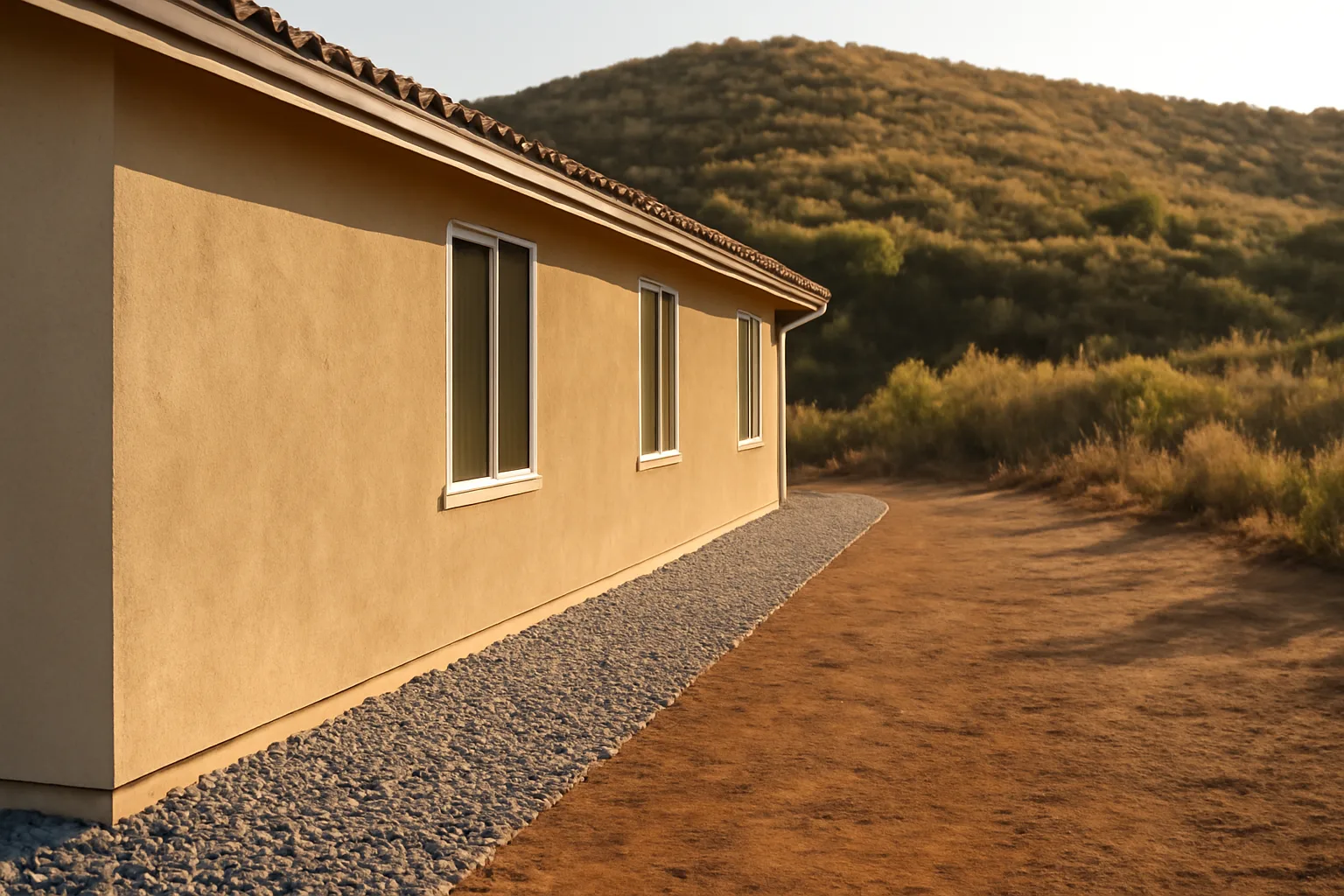
The most-discussed 2026 rule is California's Zone 0 (0 to 5 feet from the structure), which is expected to require homeowners to remove combustible mulch, dead vegetation, wood fencing attached to the house, stored firewood, and anything else that can carry an ember into contact with siding or eaves, within that 5-foot ring [1]. Because the regulation was still being finalized as of this writing, the exact list of prohibited and permitted items in Zone 0 could change before adoption. What CAL FIRE's draft guidance and public statements have consistently pointed toward: no combustible mulch touching the structure, no wood fences directly attached to the house within the zone, and non-flammable ground cover (rock, pavers, bare soil, or well-irrigated low-growing plants) as the likely standard [1]. A few things to know about scope. The law as written applies to homes in the State Responsibility Area and in Very High Fire Hazard Severity Zones within Local Responsibility Areas. It does not automatically apply to every home in California. Check your parcel's zone designation with your county or on CAL FIRE's hazard severity zone viewer before assuming it applies to you. Colorado, Oregon, and Arizona don't have an identical statewide Zone 0 mandate as of 2026, but Oregon's wildfire risk map and defensible space code (following SB 762) has been rolling out county by county, and Colorado leaves most defensible space rules to county and fire district ordinances. Because mitigation rules vary by fire district, check your specific county or fire district's current defensible space ordinance before doing any work: [enter your county/fire district ordinance here].
How to prepare for a wildfire (the homeowner checklist)
Preparing for a wildfire is really three separate jobs: hardening the structure, clearing the land around it, and getting your documentation and evacuation plan in order. Most homeowners do one of these and skip the other two. Structure hardening first. Class A fire-rated roofing, ember-resistant vents (look for vents tested to the flame and ember intrusion test in California's Building Code Chapter 7A), and enclosed eaves matter more than almost anything else you can do, because most homes that burn in wildfires ignite from wind-blown embers landing on or in the structure, not from direct flame contact with an advancing fire front [2]. Ready.gov's wildfire preparation guidance specifically recommends covering exterior attic vents with metal wire mesh no larger than 1/8 inch to keep embers out. Second, defensible space. Clear the 5 feet immediately around your home of anything combustible, keep the 5 to 30 foot zone lean and low with spaced-out, well-maintained vegetation, and thin trees and brush out to 100 feet where terrain allows. CAL FIRE's defensible space guidance breaks this into the same three zones and is the standard most insurers reference. Third, documentation and evacuation readiness. Photograph your defensible space work, your roof material, your vents, and any hardening upgrades, dated and organized, so you have proof if your insurer challenges your renewal or an adjuster disputes a claim later. Ready.gov recommends every household have a written evacuation plan with two routes out of the neighborhood, a family communication plan, and a go-bag ready year-round in high-risk season. A lot of homeowners in wildfire zones stop at the yard work and never touch the vents, the eaves, or the paperwork. That's the gap that costs people either their coverage or their claim.
Why won't people follow the defensible space law in California?
Nobody has a clean survey answer on this, but CAL FIRE inspection data and local reporting point to a few consistent reasons: cost, confusion about what's required, and a belief that the fire won't reach their specific property. Cost is real. Removing mature trees, regrading slopes, or replacing wood fencing that touches the house isn't cheap, and some homeowners, especially those on fixed incomes or in older homes, simply defer it. CAL FIRE's own compliance data from county inspection programs has shown non-compliance rates for full defensible space requirements running well above 50% in some inspected areas in past years, though exact figures vary widely by county and are not tracked in one central statewide dataset. Confusion is the second big driver. The three-zone system, plus a still-not-fully-finalized Zone 0 rule, plus different requirements in different fire districts, means a lot of homeowners genuinely don't know what "compliant" looks like on their specific lot. That's part of why we recommend documenting your work against your specific county's checklist rather than a generic national standard. The third reason is psychological, not regulatory: people who haven't been through a wildfire evacuation tend to underestimate their own risk, even when they live in a mapped Very High Fire Hazard Severity Zone. This is a well-documented pattern in disaster preparedness research generally, though there's no single CAL FIRE study that quantifies it precisely for California defensible space specifically. Whatever the reason, non-compliance has a direct cost now: insurers increasingly require proof of defensible space work as a condition of renewal, and in California, insurers participating in the FAIR Plan's Safer from Wildfires program are required to offer premium discounts for documented mitigation meeting specific standards [3].
How to prevent wildfires (what actually works vs. what's a myth)
Wildfire prevention splits into two categories: preventing ignition in the first place, and preventing a started fire from becoming a home-destroying event. Homeowners have real control over the second category, and some control over the first. On ignition: the U.S. Forest Service and CAL FIRE both note that the vast majority of wildfires nationally are human-caused, from things like unattended campfires, debris burning, equipment sparks, and downed power lines, not lightning [4]. On your own property, that means not burning debris on red flag warning days, keeping mowing and equipment use to cooler morning hours during fire season, and maintaining vehicles and equipment (chains dragging on pavement, hot mufflers on dry grass) that can throw sparks. On spread prevention, the highest-leverage moves are the same ones we cover throughout this article: defensible space clearing, ember-resistant construction, and community-level coordination (your neighbors' defensible space work protects your house too, and vice versa). A single unmitigated lot in an otherwise well-prepared neighborhood can still be the ignition point that takes out multiple homes. One myth worth killing: clearing every tree and shrub off your property doesn't make you safe, and can actually increase erosion and heat exposure in some climates. CAL FIRE's guidance is specifically about spacing, pruning, and reducing "ladder fuels" (the low brush and branches that let ground fire climb into tree canopies), not scorched-earth clearing. For a plant-by-plant guide to what to keep and space out, see fire safe landscaping next to your house.
How to prevent forest fires (and how that differs from home fire safety)
Preventing forest fires at the landscape level is mostly a public land management and public behavior problem, not a homeowner problem, but the two connect at your property line. The U.S. Forest Service's Smokey Bear program (yes, it's real, and it's the longest-running public service ad campaign in U.S. history) still centers on the same three behaviors: never leave a campfire unattended, fully extinguish it (drown, stir, feel for heat, repeat), and check local fire restrictions before burning anything outdoors [5]. Most forest fires that threaten residential areas start from exactly these kinds of small human ignitions spreading into wildland fuel, not from lightning in dry brush near homes. Where homeowners actually connect to forest fire prevention: if you live adjacent to wildland (a WUI, or wildland-urban interface, property), your defensible space work isn't just protecting your house, it's also reducing the fuel load that lets a forest fire jump from wildland into a neighborhood and then spread house to house. That house-to-house spread, driven by ember showers and radiant heat between structures, is a documented and increasingly studied part of how wildfires destroy whole subdivisions, more than isolated homes. If your property borders open space, check with your local fire district or CAL FIRE unit about whether a fuel break or shaded fuel break program exists nearby, and whether your defensible space clearing needs to coordinate with an adjacent land manager's fuel reduction schedule.
How to avoid forest fires as a homeowner near wildland
If your lot backs up to open space, forest, or grassland, avoiding a forest fire reaching your home comes down to three things: reducing fuel continuity, managing ignition sources, and knowing your evacuation triggers before you need them. Fuel continuity means breaking up the unbroken path of burnable material from wildland to your house. That's the whole point of the 100-foot defensible space zone under Public Resources Code 4291: thinning trees so canopies don't touch, removing dead and downed material, and mowing dry grass down to 4 inches or less during fire season. Ignition source management on a wildland-adjacent lot means extra caution with anything that throws a spark: chainsaws, mowers, grinders, even vehicle catalytic converters parked over dry grass. CAL FIRE and most county fire codes restrict or ban outdoor equipment use and debris burning during declared red flag warning conditions. Knowing your evacuation triggers means deciding, in advance, what conditions get you and your family in the car. Waiting for an official evacuation order in fast-moving wind-driven fires (the kind that destroyed most of the homes in the 2018 Camp Fire and the 2023 Maui fires) can leave too little time. Ready.gov recommends identifying your evacuation triggers and routes before fire season starts, not during an active incident.
Is Santa Barbara safe from fire?
No California coastal community with wildland or steep chaparral terrain nearby is fully "safe" from fire, and Santa Barbara County has a well-documented history of destructive wildfires, including the 1990 Painted Cave Fire, the 2008 Tea Fire, and the 2017 Thomas Fire, which was followed by the deadly Montecito debris flow in January 2018 [6]. Santa Barbara city and county sit against steep, fire-adapted chaparral hillsides with a Mediterranean climate of dry summers and strong offshore Sundowner winds, conditions that CAL FIRE and local fire agencies have repeatedly flagged as high risk. Large portions of the county's foothill and mountain-adjacent communities are mapped by CAL FIRE as Very High Fire Hazard Severity Zones. That said, "high risk" doesn't mean every home burns. Homes with strong defensible space, ember-resistant construction, and community-level fuel breaks have measurably better survival odds in wildfire events, which is exactly why the state's defensible space law and Zone 0 rule exist. If you live in or near Santa Barbara's WUI zones (Montecito, the Riviera, Mission Canyon, the San Roque foothills, and similar areas), check your specific parcel's hazard zone designation with Santa Barbara County Fire, and treat defensible space and hardening as non-optional, not precautionary.
How can we prevent forest fires at the community level?
Individual defensible space work matters, but wildfires that destroy whole neighborhoods are usually a community-scale failure, more than one homeowner's bad landscaping. Community-level prevention has three real levers: coordinated fuel reduction, Firewise-style neighborhood programs, and local ordinance enforcement. Coordinated fuel reduction means neighbors and HOAs working with local fire districts on shared fuel breaks, roadside clearing, and vegetation management on common areas, more than individual lots. A single unmanaged greenbelt or HOA-owned open space parcel can undo dozens of individually hardened homes. The National Fire Protection Association's Firewise USA program is the main structured framework for this, giving neighborhoods a process to assess risk collectively and qualify for recognition (and sometimes insurance consideration) as a community. It's free to join and mostly requires an annual community wildfire risk assessment and a documented mitigation plan [7]. Local ordinance enforcement is the least glamorous lever but arguably the most important: fire districts that actually inspect and cite non-compliant properties see better compliance than those that rely on voluntary reporting. If your HOA or fire district doesn't currently do compliance inspections, that's worth raising at the next meeting, because one non-compliant lot on a shared ridge can put an entire block's insurance eligibility at risk.
What should homeowners document before an inspector or insurer shows up?
Documentation is the part almost everyone skips, and it's the part that decides whether your insurance renewal survives an inspection or a claim gets paid without a fight. At minimum, photograph and date: your roof material and condition, all vents (with mesh size visible if possible), the 5-foot zone around your foundation, the 5-to-30-foot zone, gutters (cleared, with or without guards), any defensible space clearing work with before/after shots, and receipts for any contractor work. Keep copies off-site or in cloud storage, more than on a phone that could be lost in an evacuation. This is exactly the gap our $99 one-time Wildfire Insurance Survival Kit is built to close: a structured way to document your defensible space and hardening work in the format insurers and CAL FIRE inspectors actually want to see, before you're standing in front of an inspector scrambling to remember what you did two years ago. We don't file claims on your behalf or promise any discount or reinstatement. What we do is help you build the documentation packet yourself, so you're the one walking in prepared. If you've already had a fire loss or a home fire unrelated to wildfire, the documentation standard is similar: see our house fire and fire at a house guides for what to photograph and preserve immediately after.
What does defensible space actually require, zone by zone?
| Zone | Distance from structure | Core requirement | Governing rule | |
|---|---|---|---|---|
| Zone 0 | 0-5 ft | Ember-resistant, non-combustible materials immediately against structure | Gov. Code 51182, regs pending as of 2025-2026 [1] | |
| Zone 1 | 5-30 ft | Lean, clean, and green: spaced plants, no ladder fuels, mowed grass | Public Resources Code 4291 | |
| Zone 2 | 30-100 ft | Reduced fuel volume, thinned trees, cleared dead material | Public Resources Code 4291 | This table reflects California's structure specifically. Colorado, Oregon, and Arizona have similar concepts (often called "home ignition zones," a term originated by fire scientist Jack Cohen's research for the U.S. Forest Service) but codify them differently by county and fire district. Always confirm your local fire district's specific distances and material requirements: [enter your county/fire district ordinance here]. For the full zone-by-zone walkthrough with plant lists and material specs, see defensible space and fire safe landscaping. |
What's the single most cost-effective fire safety upgrade for homeowners?
If you can only do one thing this year, do the vents and the 5-foot zone. It's the highest-leverage combination for the money. Ember-resistant vent mesh (1/8 inch metal mesh, sometimes paired with baffled vent products tested under California's SFM 12-7A-1 standard) typically costs a few hundred dollars per home to retrofit, far less than a full Class A roof replacement, and directly addresses the primary way homes ignite in wildfires: wind-blown embers entering attics and crawlspaces [2]. Clearing the 5-foot zone around your foundation, removing mulch, stored wood, and combustible plants right against the house, costs little more than a weekend of labor for most homes and directly targets the same failure mode. Together, these two moves address ember intrusion, which multiple post-fire damage assessments (including CAL FIRE and U.S. Forest Service after-action studies following major California and Colorado wildfires) have identified as a leading cause of home ignition, ahead of direct flame contact from the main fire front in many wind-driven events [2]. Roof replacement, full defensible space to 100 feet, and exterior siding upgrades all matter and all belong on a longer-term plan. But if budget forces a choice, vents and Zone 0 come first.
Frequently asked questions
When does the California defensible space law go into effect?
The underlying defensible space law (Government Code 51182, Public Resources Code 4291) has been in effect for years. The new Zone 0 ember-resistant zone requirement was targeted for 2026, but as of this writing CAL FIRE's implementing regulations were still being finalized, so check CAL FIRE's site for the current adoption status before assuming enforcement has started in your area.
Why won't people follow the defensible space law in California?
Cost, confusion about the three-zone system (especially the not-yet-finalized Zone 0), and underestimating personal risk are the most commonly cited reasons in county compliance data and local reporting. Non-compliance rates have run well above 50% in some inspected California counties in past years, though there's no single statewide tracking dataset.
How do I prevent wildfires from starting on my own property?
Avoid outdoor burning and equipment sparks (mowers, grinders, chainsaws) during red flag warnings, keep vehicles and equipment away from dry grass, and fully extinguish any campfire or debris burn. Most wildfires nationally are human-caused, per the U.S. Forest Service, not lightning-started, which means homeowner behavior is a real prevention lever.
How do I prepare for a wildfire if I live in a high-risk zone?
Harden your structure (Class A roof, ember-resistant vents, enclosed eaves), clear defensible space in all three zones out to 100 feet, and build a written evacuation plan with two routes and a go-bag, per Ready.gov guidance. Document everything with dated photos before fire season starts.
How can we prevent forest fires at a neighborhood level?
Coordinate fuel reduction on shared HOA or greenbelt land, join a Firewise USA-style community program, and push your local fire district to actually inspect and enforce defensible space compliance rather than relying on voluntary reporting. One unmanaged shared parcel can undo many individually hardened homes.
How do I avoid forest fires reaching my home if I live near wildland?
Break the fuel path from wildland to your house by thinning trees and clearing dead material out to 100 feet, avoid spark-producing equipment use during red flag conditions, and decide your evacuation triggers before fire season, since wind-driven fires can outrun last-minute evacuation decisions.
Is Santa Barbara safe from fire?
No coastal community backed by chaparral hillsides is fully safe. Santa Barbara County has had major fires including the 1990 Painted Cave Fire, 2008 Tea Fire, and 2017 Thomas Fire. Large foothill areas are mapped Very High Fire Hazard Severity Zones, so defensible space and home hardening are essential, not optional, for WUI-adjacent properties.
What fire-safe home rules take effect in 2026?
California's Zone 0 rule, requiring an ember-resistant 5-foot zone with no combustible mulch or attached wood fencing against the structure, is the main one expected around 2026, though final adoption timing depends on the Board of Forestry's rulemaking process. It applies mainly to homes in Very High Fire Hazard Severity Zones and State Responsibility Areas.
Does defensible space clearing guarantee my home won't burn?
No. Defensible space and home hardening measurably improve survival odds in wildfire events but don't guarantee anything, especially in extreme wind-driven fires. They reduce ember intrusion and radiant heat exposure, the two leading causes of home ignition identified in post-fire damage studies.
What's the difference between Zone 0, Zone 1, and Zone 2?
Zone 0 is 0-5 feet from the structure and requires ember-resistant, non-combustible material directly against the house. Zone 1 is 5-30 feet, requiring spaced, low, well-maintained vegetation. Zone 2 is 30-100 feet, requiring reduced fuel volume and thinned trees. All three come from California's Public Resources Code 4291 and Government Code 51182.
Do Colorado, Oregon, and Arizona have the same defensible space rules as California?
No. Each state handles it differently: Colorado mostly leaves defensible space rules to county and fire district ordinances, Oregon has been rolling out a statewide wildfire risk map and code requirements county by county following SB 762, and Arizona's requirements vary by fire district. Always check your specific local ordinance.
What should I photograph before a home insurance wildfire inspection?
Photograph and date your roof material, all attic and foundation vents, the 5-foot zone around your house, the 5-30 foot zone, cleared gutters, and any contractor receipts for hardening or clearing work. Keep copies stored off-site or in the cloud in case you need to evacuate.
What's the single most important thing I can do for fire safety this year?
Retrofit ember-resistant vent mesh and clear the 5-foot zone around your foundation. These two moves cost far less than a roof replacement and directly target the leading cause of home ignition in wildfires: wind-blown embers entering vents and igniting material against the structure.
Sources
- California Board of Forestry and Fire Protection, Zone 0 rulemaking status: Status and timeline of the Zone 0 ember-resistant zone regulation rulemaking process targeting 2026
- USDA Forest Service, Jack Cohen research on home ignition from embers: Wind-blown embers, not direct flame contact, are the primary way homes ignite in wildfires
- California Department of Insurance, Safer from Wildfires: Insurers must offer premium discounts for documented wildfire mitigation meeting the Safer from Wildfires standards
- USDA Forest Service, wildfire causes: Most wildfires nationally are human-caused rather than started by lightning
- Smokey Bear / USDA Forest Service, campfire safety: Core wildfire prevention behaviors: never leave a campfire unattended and fully extinguish before leaving
- CAL FIRE, Thomas Fire incident information: The 2017 Thomas Fire in Santa Barbara and Ventura counties and its scale
- National Fire Protection Association, Firewise USA program: Firewise USA community wildfire risk assessment and recognition program structure
- California Government Code Section 51182: Statutory basis for defensible space requirements and the Zone 0 ember-resistant zone mandate