Last updated 2026-07-25
TL;DR
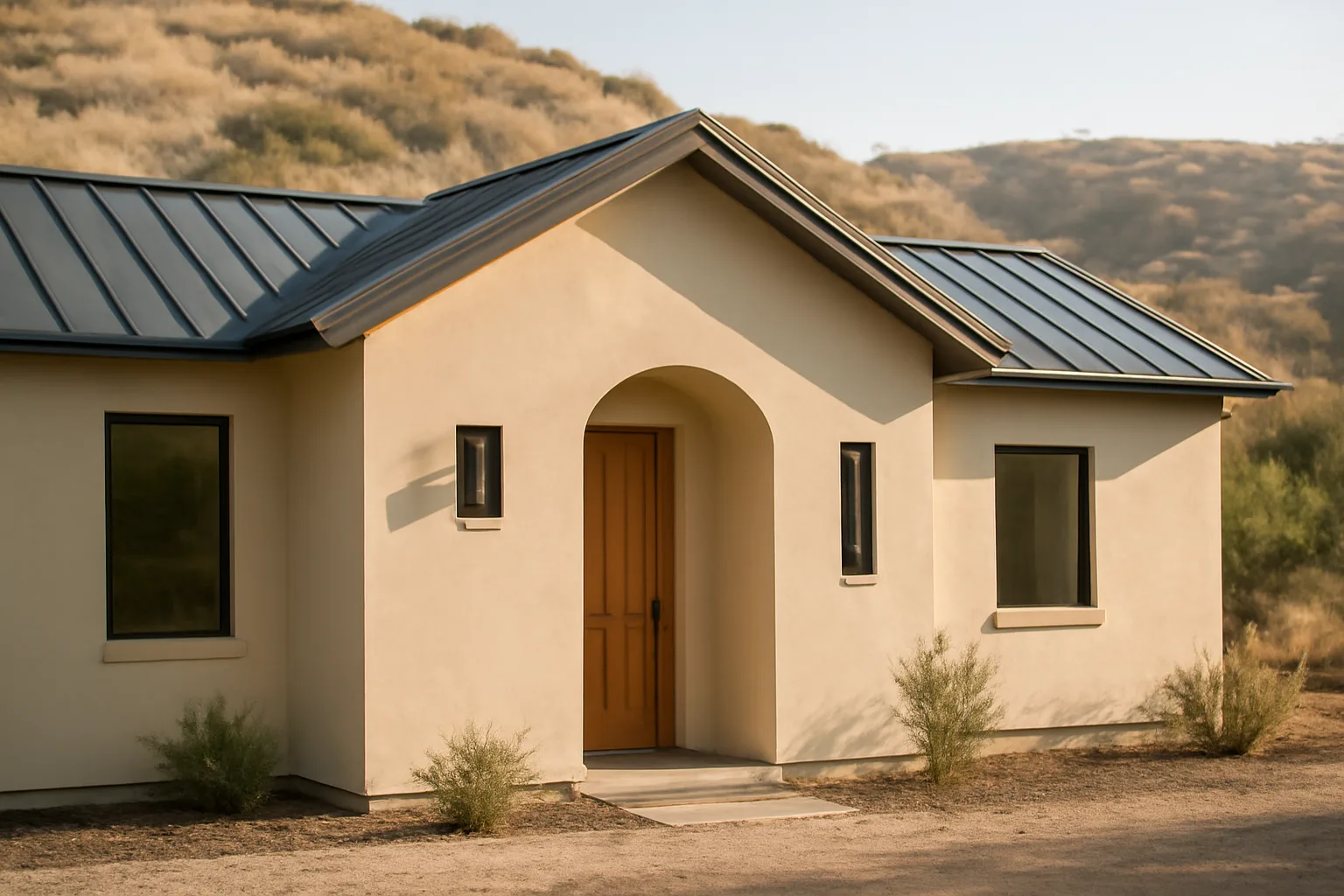
Nothing is 100% fireproof. Materials are rated fire-resistant, meaning they resist ignition and slow flame spread for a measured time. Concrete, stucco, fiber cement, metal roofing, and tempered dual-pane glass are the closest options homeowners can buy. CAL FIRE and building codes call these Class A or ignition-resistant, not fireproof.
Is any building material actually fireproof?
No. Every material has a temperature and exposure duration at which it ignites, melts, cracks, or fails structurally. What the fire science and building code world actually rate is fire resistance: how long a material or assembly holds up under a standardized fire test before it fails. Even steel, which doesn't burn, loses about half its structural strength around 1,100°F (593°C) and can buckle in a sustained fire, according to the National Institute of Standards and Technology's work on structural fire performance [1]. Concrete doesn't burn either, but it spalls (chips and cracks) under intense, rapid heat. Glass shatters when one side heats faster than the other. So when someone asks 'what's fireproof,' the honest answer is: nothing, but some materials buy you a lot more time and are much harder to ignite than others. That distinction matters for insurance too. Adjusters and wildfire risk models look at ignition resistance, not fireproofing, when they score a home. This is why the language on your CAL FIRE inspection letter says 'ignition-resistant construction,' not 'fireproof.'
What building materials are the most fire-resistant?
| Concrete / ICF | Non-combustible, high heat tolerance, can spall under extreme heat | Foundations, walls | 5-10% over wood framing |
|---|---|---|---|
| Fiber cement siding | Non-combustible, holds Class A rating in siding assemblies | Exterior siding | Comparable to or less than wood siding |
| Stucco (3-coat) | Non-combustible cladding, common in CA/AZ wildfire retrofits | Exterior walls | Similar to fiber cement |
| Metal roofing (steel, aluminum) | Non-combustible, Class A assembly rating | Roofing | 2-3x asphalt shingles installed |
The materials that consistently perform best in wildfire and structure fire testing share one trait: they don't have an organic (carbon-based) component that can combust. Here's how the common options stack up. | Material | Fire performance | Common use | Rough cost premium vs. standard |
What does Class A fire rating actually mean?
Class A is the highest of three fire-resistance ratings for roof coverings under the ASTM E108 / UL 790 test standards, referenced in the International Building Code and adopted by California's Chapter 7A wildfire construction requirements [2]. Class A roofs resist severe fire exposure, don't produce flying brands, and show only limited flame spread across the surface. Class A does not mean the roof is fireproof or that it will survive direct flame contact indefinitely. It means the roof passed a specific lab test simulating burning brand exposure, flame spread, and intermittent flame. Asphalt composition shingles, concrete tile, clay tile, and most metal roofing systems can all achieve Class A when installed as a complete assembly (underlayment matters as much as the surface material). California's Chapter 7A building code, which governs construction in Wildland-Urban Interface Fire Areas, requires Class A roof assemblies, ignition-resistant siding, dual-pane tempered glass, and ember-resistant vents for new construction and major remodels in designated high-hazard zones [2].
When does the California defensible space law go into effect?
California's core defensible space law, Public Resources Code 4291, has been in effect since it was substantially amended in 2005, requiring 100 feet of defensible space clearance around structures in State Responsibility Areas and designated wildland-urban interface zones [3]. This isn't a new law taking effect on some future date; it's already enforceable, and CAL FIRE and local fire departments conduct inspections under it every year. What is changing is the added ember-resistant "Zone 0" requirement (the 0-5 foot zone immediately around the structure). California's Board of Forestry adopted regulations for Zone 0 under SB 63 and related legislation, with California's own timeline pointing to enforcement starting in 2026 for homes in the highest-hazard zones, though the exact effective date has been pushed back before and depends on final regulatory adoption [4]. Check your local fire district's current guidance, because implementation dates have shifted at least once already. [Guided fill-in: contact your local fire district or CAL FIRE Unit for the current Zone 0 compliance deadline in your specific area, since enforcement timing varies by jurisdiction.]
What fire-safe home rules take effect in 2026?
The most significant 2026-linked change is California's Zone 0 (ember-resistant zone) requirement, which applies to the 5 feet immediately surrounding a home or attached structure. Under the proposed and adopted Board of Forestry regulations, that zone must be cleared of combustible mulch, vegetation, stored wood, and other ignitable materials, with hardscape (gravel, pavers, concrete) recommended instead [4]. Separately, some insurers and the California FAIR Plan have started tying renewal decisions to compliance with existing Chapter 7A hardening standards, even on older homes not legally required to retrofit. That's a market pressure, not a new statute, but it functions like one for homeowners trying to keep coverage. Oregon, Colorado, and Arizona each have their own timelines and none mirror California's exactly. Oregon's wildfire hazard map and defensible space code (under SB 762) has gone through multiple delays and revisions since 2021. Colorado relies more on county-level wildfire codes than a single statewide mandate. Arizona leans on its Department of Forestry and Fire Management's homeowner guidance rather than a hard statutory clearance requirement. Don't assume your state follows California's dates. [Guided fill-in: check your state fire marshal's office for the current adoption status of wildfire building codes in your county, since several states have codes that apply only in mapped hazard zones.]
Why won't people follow the defensible space law in California?
Cost, labor, and belief are the three real reasons, and none of them are irrational even if the outcome is risky. Clearing 100 feet of defensible space on a sloped, brush-covered lot can run into thousands of dollars if you hire it out, and CAL FIRE's own compliance data has shown inspection failure rates above 40% in some Units in recent years. Some homeowners genuinely don't know the rule applies to them; PRC 4291 covers State Responsibility Areas and adjacent wildland-urban interface land, and property lines don't always make that obvious. Others have followed it for years without a fire ever reaching their property, and normalize the risk. And some just can't do the physical labor themselves and can't afford a contractor, especially older or fixed-income homeowners on large rural parcels. Enforcement is also uneven. Not every county issues citations aggressively, and CAL FIRE inspectors often prioritize education over fines on a first pass. That soft enforcement, combined with real cost barriers, is why compliance lags even in areas with catastrophic fire history.
How do you prevent wildfires from starting near your home?
Most wildfires near homes start from something specific and preventable: a mower hitting a rock, a dragging trailer chain, an unattended debris burn, or a downed power line. CAL FIRE's own cause data attributes the large majority of California wildfires to human activity, not lightning. Practical prevention around a property: don't mow dry grass midday in fire season (do it early morning when humidity is higher), keep chainsaws and mowers away from dry vegetation when possible, never leave a campfire or burn pile unattended, and maintain vehicles so exhaust systems and chains aren't dragging sparks. Check local burn permit rules before any outdoor burning; most fire districts require a permit and restrict burning during red flag warnings. At the structure level, the highest-leverage single action is clearing the first 5 feet around your home (the ember zone) of anything combustible: mulch, dry leaves, stored firewood, and low shrubs against siding. Embers, not walls of flame, ignite most homes lost in wildfires, according to research from the Insurance Institute for Business & Home Safety on the Wildland-Urban Interface.
How can we prevent forest fires more broadly?
Beyond individual homes, forest fire prevention works at three levels: reducing ignition sources, managing fuel loads, and enforcing burn restrictions during high-risk periods. Reducing ignitions means public education (this is the literal origin of Smokey Bear's "only you can prevent wildfires" campaign, still run by the USDA Forest Service) plus utility infrastructure hardening, since powerline failures have caused some of the largest and most destructive fires in California history, including the 2018 Camp Fire. Managing fuel loads means prescribed burns and mechanical thinning on public land, done by agencies like the U.S. Forest Service and CAL FIRE during controlled conditions to remove the dead brush and small trees that let fires spread explosively. At the individual level, the same rules apply as home prevention: follow local burn bans, report unattended fires, and support (or don't oppose) prescribed burn programs in your area, since public pushback has historically slowed fuel reduction work that reduces future fire severity. For a home-level breakdown of clearance zones and what to plant instead of flammable landscaping, see our fire safe landscaping guide for California homes.
How do you prepare for a wildfire before it happens?
Preparation splits into three buckets: the house, the documents, and the exit plan. Skipping any one of them is the common mistake people regret. For the house: clear Zone 0 (0-5 feet) and Zone 1 (5-30 feet) per your local fire district's requirements, install ember-resistant vents, and check that your roof is a Class A assembly. Ready.gov recommends keeping gutters clear of debris and storing firewood at least 30 feet from structures [5]. For documents: photograph every room, every major appliance, and your home's exterior from all four sides, and store those photos somewhere off-property (cloud storage, a relative's house, or a physical kit you can grab in 5 minutes). This is exactly the gap our $99 Wildfire Insurance Survival Kit is built to close: a pre-built way to document your home's condition and mitigation work before a non-renewal letter or a fire forces you to reconstruct it from memory. We don't file claims for you; you send your own documentation, but having it organized before a loss changes what you can prove afterward. For the exit plan: know two routes out of your neighborhood, keep your car's gas tank at least half full during fire season, and have a go-bag ready per Ready.gov's checklist [5]. Practice the drive at least once.
Is Santa Barbara safe from fire?
No area in California's wildland-urban interface is "safe" from fire risk, and Santa Barbara County has a documented history that argues against complacency. The Thomas Fire (2017) burned into Santa Barbara County and was, at the time, the largest wildfire in modern California history by acreage, later surpassed by others [6]. The subsequent Montecito debris flow in January 2018, triggered by rain on the Thomas Fire burn scar, killed 23 people, a reminder that wildfire risk doesn't end when the flames go out. Santa Barbara city itself sits in a mapped Fire Hazard Severity Zone in parts of its wildland-urban interface, per CAL FIRE's official hazard severity zone maps, which any resident can check by address . Front-country neighborhoods near the foothills carry meaningfully higher risk than flatter areas closer to the coast. If you live in or near Santa Barbara, check your specific parcel against CAL FIRE's Fire Hazard Severity Zone viewer rather than relying on the city's general reputation. Risk varies block by block based on slope, vegetation, and distance to open wildland.
How to prevent forest fires and avoid them spreading to homes
The clearest, most defensible action for a homeowner is treating your property as three concentric rings, matching the structure CAL FIRE itself uses in its defensible space guidance [3]: - Zone 0 (0-5 ft): noncombustible surfaces only, no mulch, no stored materials
- Zone 1 (5-30 ft): lean, clean, and green; widely spaced plants, mowed grass
- Zone 2 (30-100 ft): reduced fuel, thinned trees, no ladder fuels connecting ground brush to tree canopy This structure is what separates "preventing forest fires" (a landscape-scale, multi-agency problem) from "avoiding forest fires reaching your house" (something one homeowner has real control over). You can't stop a wildfire from starting three ridgelines away. You can control whether embers landing in your gutter or against your fence have anything to ignite. For documentation purposes, take dated photos of your defensible space work each year. If you ever get a non-renewal or inspection letter, that timestamped record of ongoing maintenance is often the single most useful thing you can hand an inspector or include with an appeal. See our guide on what to do when defensible space rules trigger a fire district inspection for more on that documentation process.
How to prepare for forest fires as a homeowner near wildland
If you live adjacent to forest or open wildland rather than in a denser suburban WUI zone, your preparation has extra weight on the 30-100 foot zone. This is where most agencies recommend thinning small trees, removing dead brush, and separating tree canopies so fire can't leap crown-to-crown. Ready.gov's wildfire preparedness page recommends creating a "defensible space" and hardening your home with ember-resistant vents, enclosed eaves, and non-combustible siding as the two paired strategies, since defensible space without hardening (or vice versa) leaves an obvious failure point [5]. Practically: schedule an annual walk of your property before fire season starts (April-May in most of the West), remove anything that's grown into your Zone 0 over winter, and check that no firewood, propane tanks, or wood fencing touches the structure directly. A wood fence that runs straight into your house is a textbook ember highway; break it with a metal gate section at the last 5 feet. If your home has burned before, or a neighbor's has, read our breakdown of what actually happens during and after a house fire and what documentation matters most for rebuilding and insurance.
Frequently asked questions
What is the most fireproof building material?
No material is truly fireproof, but concrete, fiber cement, stucco, and metal roofing come closest because they're non-combustible. They still fail eventually (concrete spalls, metal warps) but resist ignition far better than wood, vinyl, or asphalt shingles under wildfire ember exposure.
When does the California defensible space law go into effect?
The core law, Public Resources Code 4291, has been enforceable since its 2005 amendment requiring 100 feet of clearance. The newer Zone 0 ember-resistant zone requirement is targeting 2026 enforcement in high-hazard areas, but the exact date depends on final Board of Forestry regulatory adoption and can shift.
Why won't people follow the defensible space law in California?
Mostly cost and labor. Clearing 100 feet on a brushy lot can cost thousands if hired out, and CAL FIRE compliance inspections have shown failure rates above 40% in some Units. Uneven enforcement and homeowners not realizing the law applies to their specific property also matter.
How do you prevent wildfires from starting?
Avoid mowing dry grass during peak heat, never leave campfires or debris burns unattended, maintain vehicles so chains don't drag sparks, and follow local burn permit rules. CAL FIRE data shows most California wildfires are human-caused, not lightning-caused.
How do you prepare for a wildfire?
Clear defensible space zones per your fire district's rules, install ember-resistant vents, photograph your home's condition and store the photos off-property, pack a go-bag per Ready.gov's checklist, and plan two evacuation routes. Do this before fire season starts, not during a red flag warning.
How can we prevent forest fires at the community level?
Support prescribed burns and mechanical fuel thinning on public land, harden utility infrastructure against powerline-caused ignitions, follow local burn bans, and report unattended fires. Individual home hardening matters too, since it reduces how a forest fire converts into a structure fire.
What fire-safe home rules take effect in 2026?
California's Zone 0 ember-resistant zone rule (0-5 feet around the structure) is the major change tied to a 2026 timeline, requiring noncombustible surfaces immediately against the home. Other states (Oregon, Colorado, Arizona) have separate, non-aligned timelines; check your state fire marshal for current status.
Is Santa Barbara safe from fire?
No, parts of Santa Barbara County sit in mapped Fire Hazard Severity Zones, and the area experienced the 2017 Thomas Fire and the deadly 2018 Montecito debris flow that followed it. Check CAL FIRE's Fire Hazard Severity Zone viewer for your specific address rather than assuming general safety.
What does Class A fire rating mean for roofing?
Class A is the highest fire-resistance rating under ASTM E108/UL 790 testing, meaning the roof assembly resisted severe fire exposure, limited flame spread, and didn't produce flying brands in lab tests. It doesn't mean fireproof; it means it passed a specific standardized burn test.
Is concrete really fireproof?
Concrete doesn't burn, but it isn't fireproof in the absolute sense. Under intense, rapid heat it can spall (crack and chip) and lose structural strength. It's still one of the best available options and is standard in ICF construction for wildfire-prone areas.
What's the difference between fire-resistant and fireproof?
Fireproof implies total immunity to fire damage, which doesn't exist. Fire-resistant means a material or assembly resists ignition and slows flame spread for a measured, tested duration (like a 1-hour or 2-hour fire rating), after which it can still fail.
Do ember-resistant vents actually matter?
Yes. Research from the Insurance Institute for Business & Home Safety found embers, not direct flame contact, ignite most homes lost in wildland-urban interface fires. Standard vents let embers into attics and crawlspaces; ember-resistant vents use mesh and baffles to block that entry point.
Sources
- California Building Standards Commission, Chapter 7A: Chapter 7A requires Class A roof assemblies and ignition-resistant construction in WUI fire areas
- California Public Resources Code Section 4291: 100 feet of defensible space clearance required around structures in State Responsibility Areas
- CAL FIRE, Zone 0 Ember-Resistant Zone regulation status: Zone 0 ember-resistant zone regulations targeting enforcement in high-hazard zones, timeline subject to change
- CAL FIRE, Defensible Space Inspections data: Defensible space inspection compliance and failure rate data by CAL FIRE Unit
- CAL FIRE, Thomas Fire incident record: Thomas Fire (2017) burned into Santa Barbara County and was the largest California wildfire by acreage at the time
- CAL FIRE, Fire Hazard Severity Zone Maps: Parts of Santa Barbara County are mapped as Fire Hazard Severity Zones