Last updated 2026-07-25
TL;DR
CAL FIRE enforces defensible space under Public Resources Code 4291: 0-30 feet (or to your property line) around structures in State Responsibility Areas and many Local Responsibility Areas. A stricter "Zone 0" ember-resistant rule (0-5 feet, no combustibles) was passed in 2020 but its effective date keeps slipping; as of mid-2025 the Board of Forestry has not finalized the regulation, so 2026 is the earliest realistic start, not a guarantee.
What is the CAL FIRE defensible space plan, exactly?
| Zone 1 | 0-30 ft from structure | Remove dead plants, dead vegetation, and debris; keep tree limbs 10 ft from other trees and chimneys; remove flammable vegetation | |
|---|---|---|---|
| Zone 2 | 30-100 ft from structure | Reduce fuel volume: cut annual grass to 4 inches, space out shrubs, remove fallen leaves and needles periodically | |
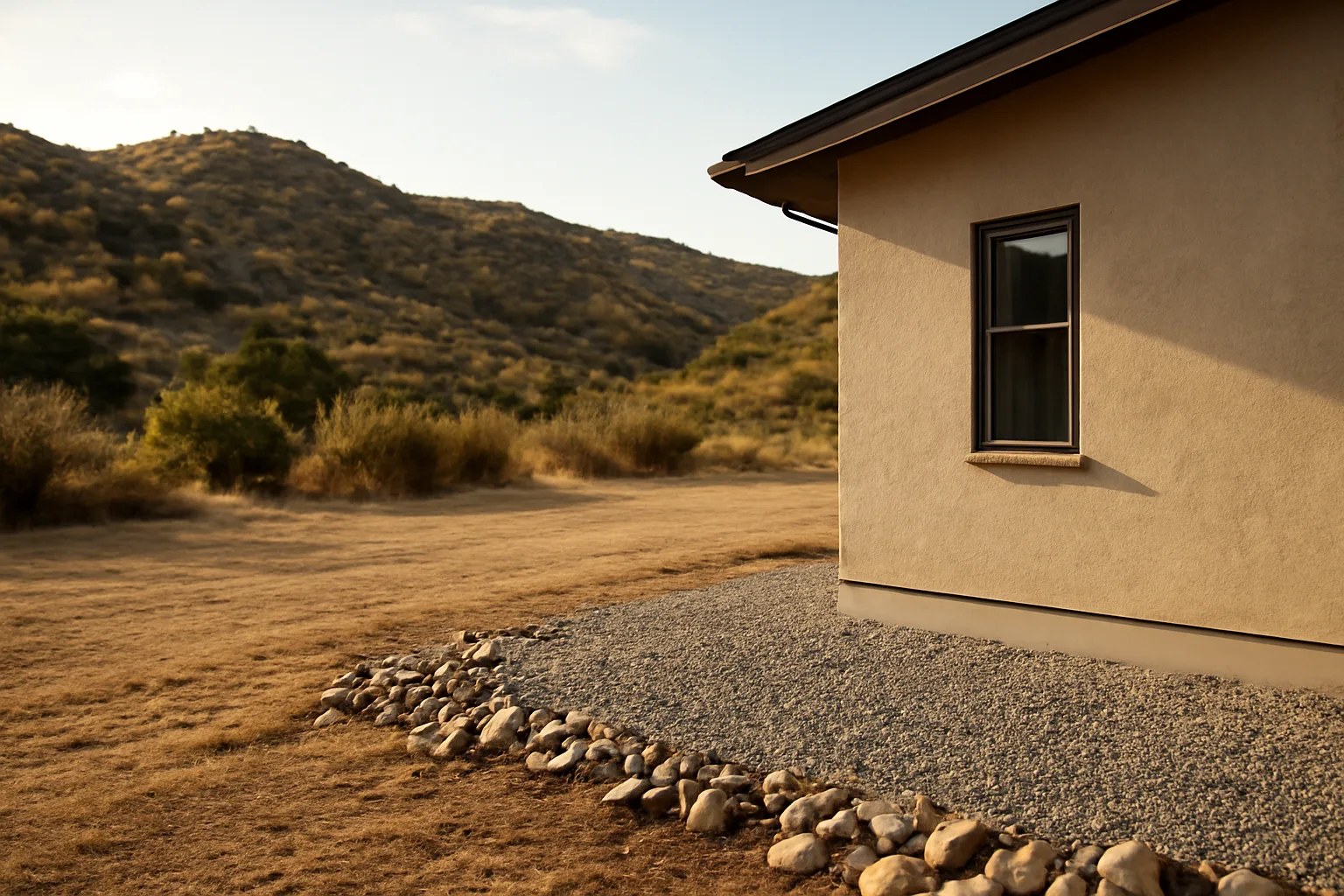
| Zone 0 (proposed) | 0-5 ft from structure | Ember-resistant zone, no combustible mulch, no wood fencing attached to the house, no stored items against walls | Source for zone structure: CAL FIRE, "Defensible Space" program page, and Board of Forestry Zone 0 rulemaking file [2]. |
The "CAL FIRE plan" people search for is really Public Resources Code Section 4291, the state's defensible space law, plus the Board of Forestry's implementing regulations in Title 14 of the California Code of Regulations. It's not a single document you download. It's a legal requirement, a set of zone definitions, and a home hardening reference standard that CAL FIRE and local fire agencies use during inspections. The law requires anyone who owns, leases, controls, operates, or maintains a building in a State Responsibility Area (SRA), or in a Local Responsibility Area (LRA) with a Very High Fire Hazard Severity Zone designation, to clear and maintain defensible space out to 100 feet from the structure or to the property line, whichever is closer [1]. CAL FIRE's own summary states the requirement plainly: "California law requires 100 feet of defensible space around homes and structures in the SRA". Inside that 100 feet, the work is split into two zones with different rules, which is where most of the actual homeowner confusion starts. | Zone | Distance | Core requirement |
When does the California defensible space law go into effect?
The core defensible space law, PRC 4291, has been in effect for decades and applies right now, every year, not on some future start date. If your home sits in a State Responsibility Area or a Very High Fire Hazard Severity Zone in an LRA, you are already required to maintain the 0-30 and 30-100 foot zones described above [1]. What's genuinely new, and genuinely delayed, is Zone 0. Assembly Bill 3074 (2020) directed the Board of Forestry and Fire Protection to develop an ember-resistant zone regulation for the 0-5 foot ring around structures [3]. The law set an original target date, but rulemaking has slipped repeatedly. As of the Board's 2024-2025 rulemaking calendar, the Zone 0 regulation was still in draft and public comment stages, with the Board itself stating the earliest applicability would follow standard regulatory adoption timelines, likely no sooner than 2026 for new construction and later for existing homes with a phase-in period [2]. If you're asking "what fire safe home rules take effect in 2026," the honest answer is: nobody outside the Board of Forestry can promise an exact date yet, because the regulation has not been through final adoption as of this writing. Treat 2026 as the earliest plausible window, not a locked-in deadline. Check the Board of Forestry's current rulemaking status page before you assume anything is final [2], and check with your local fire district, since some cities (Santa Barbara among them) have already adopted stricter local ember-zone ordinances ahead of the state.
Why won't people follow the defensible space law in California?
Enforcement is real but uneven, and that gap is exactly why insurers stopped waiting for it. CAL FIRE and local fire agencies conduct defensible space inspections, and failure to comply can bring a notice to correct, a fine, and in repeat cases a misdemeanor citation under PRC 4291 [1]. In practice, though, inspection capacity is limited relative to the number of parcels in SRA and VHFHSZ zones, and rural counties in particular can go years between visits to a given property. Cost is the biggest reason compliance lags. Full defensible space work on a rural half-acre lot with dense brush can run into thousands of dollars for tree removal, chipping, and grading, and it has to be redone every year as vegetation regrows. Retired homeowners on fixed incomes and absentee owners of vacation cabins are the two groups CAL FIRE inspectors most often cite as chronically out of compliance. There's also a knowledge gap. Many owners genuinely don't know their parcel sits in an SRA or VHFHSZ until a non-renewal letter or an inspection notice arrives. CAL FIRE's Fire Hazard Severity Zone maps are public [4], but almost nobody checks them until something forces the issue. Finally, some owners push back because they misjudge the actual fire behavior defensible space interrupts. The intent isn't to stop a wall of flame, it's to reduce ember ignition and radiant heat close to the structure so firefighters have a survivable space to defend and so the house itself is less likely to self-ignite from a spot fire. Insurers now underwrite against exactly that mechanism, which is why non-renewal letters increasingly reference specific vegetation clearance, more than "wildfire risk" in general.
How to prevent wildfires (what actually works vs. what's noise)
At the household level, wildfire prevention is mostly about reducing ignition sources and interrupting ember pathways, not about stopping a fire once it's a 500-acre blowup. The two things with the best evidence behind them are hardening the first 5 feet of your home's perimeter and clearing dead vegetation within 30 feet. CAL FIRE's structure survival research after the 2007 and 2017-2018 California fire seasons repeatedly points to embers, not direct flame contact, as the dominant cause of home ignition in wildland-urban interface fires. That's the entire logic behind Zone 0: keep flammable mulch, dry leaves, wood piles, and combustible fencing away from the wall, vents, and eaves, because a single ember landing in bark mulch against a stucco wall can ignite the house even when the fire front itself never reaches the property. At the community level, prevention also means not starting fires in the first place. Roughly 95% of wildfires in California are human-caused, according to CAL FIRE's incident statistics reporting on causes like equipment use, vehicles, campfires, and arson [5]. That means basic behavior, like not parking a hot catalytic converter over dry grass, checking trailer chains for sparks, and following local burn permit rules, prevents more fires than any single piece of home hardening. For a walkthrough of what defensible space clearing contracts typically include and cost, see wildfire defensible space clearing contracts, which covers contractor scopes that translate directly to California work even though the citation is Washington-specific.
How to prepare for a wildfire (a realistic homeowner checklist)
Preparation splits into three timelines: year-round maintenance, red-flag-day actions, and the go-bag you grab in the last ten minutes. Most guides blur these together, which is why people freeze when a warning actually comes. Year-round, your job is defensible space maintenance (both zones, redone at least annually before fire season), roof and gutter clearing, and closing obvious ember entry points like open eave vents. Ready.gov's wildfire preparedness guidance recommends creating a "defensible space" and using fire-resistant building materials, and specifically tells homeowners to "clean roof and gutters of dead leaves, debris and pine needles" as an ongoing task, not a one-time job. On a red-flag warning day, close all windows and doors (including pet doors), shut off gas at the meter if you're evacuating, move patio furniture and doormats inside or away from the house, and turn on exterior lights so firefighters can see the structure through smoke. Soak or remove any mulch within 5 feet of the foundation if you haven't already converted to gravel or rock. For the go-bag: Ready.gov recommends every household keep a basic emergency supply kit with water (one gallon per person per day for several days), a battery or hand-crank radio, a flashlight, a first aid kit, and copies of important documents, and to build a family communication plan before an evacuation order, not during one. Add to that, specifically for wildfire, N95 masks for smoke, a physical map (cell networks fail), and printed photos of each room and your exterior for insurance documentation, since you may not have reliable phone service to snap them on the way out. That documentation piece matters more than people think. If your home survives but suffers smoke or ember damage, or if you're fighting a non-renewal decision, dated photos of your cleared defensible space and hardened features are the evidence an adjuster or underwriter actually wants to see. This is the one place a prebuilt system helps: DefensibleHome's $99 Wildfire Insurance Survival Kit is a one-time purchase that walks you through photographing and organizing exactly this evidence, structured the way insurers actually request it, at /survival-kit-builder. You still send your own documentation; we don't file claims or represent you in disputes with your insurer.
How to prevent forest fires and how to avoid forest fires
These two phrasings usually mean the same thing to search engines, but they split into two real behaviors: what you do as an individual in or near forest land, and what agencies do at a landscape scale. Both matter, and conflating them is why a lot of advice online feels useless. Individually, the highest-leverage actions are: never leave a campfire unattended and fully drown and stir it until it's cold to the touch; don't drive or park on dry grass (catalytic converters run over 500°F); check state and local burn permit requirements before any outdoor burning, since permit rules vary by county and change seasonally; and report unattended fires or suspicious smoke immediately to 911 or CAL FIRE's reporting line rather than assuming someone else already called. At the landscape level, prevention is fuel management: prescribed burns, mechanical thinning, and grazing programs that reduce the dense, dry vegetation that lets a small ignition become a running crown fire. CAL FIRE's Vegetation Treatment Program and the U.S. Forest Service's hazardous fuels reduction work both operate on this principle, and California's wildfire and forest resilience funding has directed money specifically at fuel breaks near communities, more than deep wilderness. The uncomfortable truth is that no amount of individual caution eliminates forest fire risk in a landscape that evolved to burn periodically and now carries a century of accumulated fuel. The goal isn't zero fires, it's fewer human-caused ignitions and fewer catastrophic, uncontrolled runs through communities.
How to prepare for forest fires if you live near wildland
If your property backs directly onto forest, national forest land, or unmanaged wildland-urban interface, your prep list is the same as general wildfire prep but with tighter tolerances and shorter warning windows. Fires burning uphill through timber can move faster than fires in grass under the right wind conditions, and forested terrain often has worse cell coverage and fewer evacuation routes. Know your exit routes before you need them, plural, not singular. Ask your local fire district or county OES which roads are the designated evacuation routes for your area and whether there's a secondary route if the primary is blocked by fire or gridlock. Sign up for your county's emergency alert system directly (many are opt-in, not automatic) since relying on cell broadcast alone has failed in several past California evacuations when cell towers burned or lost power. Extend your defensible space thinking to the 100-foot zone seriously, more than the 30-foot zone near the house. In forested terrain, CAL FIRE's Zone 2 guidance (30-100 feet) calling for reduced fuel volume and spaced-out shrub "islands" is doing real work: it's what breaks a continuous fuel ladder from ground grass to shrub to tree canopy that lets fire climb into crowns and spot embers a quarter mile ahead of the front. If you're rebuilding or renovating near timber, look at the fire safe landscaping California approach to plant selection and spacing for the zone immediately around the house, and pair it with the broader defensible space planning guidance for how the two zones interact on a forested lot.
What fire-safe home rules take effect in 2026?
The honest, current-as-of-writing answer: the Zone 0 ember-resistant zone regulation (0-5 feet around structures) is the rule most likely to take effect around 2026, but it is not finalized, and homeowners should not treat any specific 2026 date as locked in without checking the Board of Forestry's rulemaking page directly [2]. Here's the timeline as it actually stands. AB 3074 in 2020 directed the Board of Forestry and Fire Protection to adopt Zone 0 regulations [3]. Rulemaking proceeded slower than the bill's original target, with draft regulatory text going through multiple public comment periods through 2023 and 2024. As of the most recent public Board of Forestry updates, the regulation was expected to apply first to new construction in high hazard zones, with a longer compliance runway for existing homes, likely several years, mirroring how other defensible space mandates have phased in historically. Separately, California's building code already has wildfire-specific standards under Chapter 7A of the California Building Code, covering ignition-resistant construction (vents, eaves, siding, windows) for new construction in Wildland-Urban Interface Fire Areas. Those requirements are already in effect for new builds and major remodels; Zone 0 vegetation/clearance rules are the piece that's still pending. Until Zone 0 is formally adopted, the safest move for a homeowner asking "what changes in 2026" is to just build to the strictest version now: treat your first 5 feet as if the ember-resistant standard already applies, since almost every version of the draft regulation lands on the same core asks (no combustible mulch against the house, no wood fencing attached directly to siding, gravel or hardscape instead of bark within 5 feet). Doing that now costs the same whether the rule is finalized in 2026 or 2028.
Is Santa Barbara safe from fire?
No California community backed by chaparral and canyon terrain is "safe" from fire in an absolute sense, and Santa Barbara County has the wildfire history to prove it: the 2017 Thomas Fire burned over 281,000 acres and was, at the time, the largest wildfire in modern California history, followed within weeks by the Montecito debris flow that killed 23 people when rain hit the Thomas Fire burn scar . The 1990 Painted Cave Fire and 2008 Tea Fire also burned into Santa Barbara's foothill neighborhoods directly. What Santa Barbara does have is above-average local regulation. The City of Santa Barbara and Montecito Fire Protection District have adopted defensible space and vegetation management ordinances that in some cases exceed the state PRC 4291 baseline, and local fire agencies conduct more frequent inspections in the highest-risk foothill zones than many rural counties can manage. That's meaningfully better than nothing, but it does not make the area fire-proof, and insurers have treated Santa Barbara County foothill and wildland-adjacent zip codes as high risk for FAIR Plan and non-renewal purposes for years. If you own property in the Santa Barbara foothills, Montecito, or similar terrain (steep canyons, chaparral, one or two-lane access roads), check directly with Santa Barbara County Fire or Montecito Fire Protection District for the specific local defensible space ordinance that applies to your parcel; state PRC 4291 is the floor, not necessarily what your district actually enforces.
How can we prevent forest fires as a community, more than a household?
Individual defensible space work matters, but wildfire behavior in the wildland-urban interface is a neighborhood-level problem: embers from one under-maintained property can ignite a neighbor's home even if that neighbor did everything right. This is why several California counties and fire safe councils have moved toward coordinated, block-by-block defensible space programs rather than leaving it purely to individual compliance. Fire Safe Councils, which exist in most California counties, organize community chipper days, group vegetation removal, and shared funding applications for fuel breaks that no single homeowner could justify alone. If your neighborhood doesn't have one, starting an informal version, even just three or four neighbors coordinating clearance schedules and sharing a chipper rental, measurably reduces the ember load a fire can throw between properties. At a policy level, California's Fire Hazard Severity Zone maps (last substantially updated for SRA in 2007 and undergoing revision since) drive where the 100-foot defensible space requirement legally applies, so pushing your county to keep those maps current, and pushing for consistent inspection funding, does more for community-wide prevention than any individual homeowner action ever could [4]. Prevention at scale is a funding and enforcement problem as much as a landscaping one. For a broader look at how these rules compare to other states, or how enforcement differs across fire districts, the state-rules hub is a good next stop, along with the reminder that only you can prevent wildfires is more than a Smokey Bear slogan: it reflects the actual 95% human-caused ignition statistic CAL FIRE reports every year [5].
Frequently asked questions
When does the California defensible space law go into effect?
PRC 4291's core defensible space requirements (0-30 ft and 30-100 ft zones) are already in effect and have been for years; they apply annually to homes in State Responsibility Areas and Very High Fire Hazard Severity Zones. The newer Zone 0 (0-5 ft ember-resistant zone) rule, from AB 3074, has not been finalized as of this writing; 2026 is the earliest plausible start, pending Board of Forestry adoption.
Why won't people follow California's defensible space law?
Mostly cost, inconsistent enforcement, and lack of awareness. Full brush clearance on a rural lot can cost thousands of dollars and needs redoing annually. CAL FIRE and local agencies inspect, but capacity is limited in rural counties, and many owners don't realize their parcel sits in an SRA or Very High Fire Hazard Severity Zone until a notice or non-renewal letter arrives.
What fire-safe home rules take effect in 2026?
The California Board of Forestry's Zone 0 regulation, requiring an ember-resistant 0-5 foot zone with no combustible mulch or attached wood fencing, is expected around 2026 but was not finalized as of this writing. Chapter 7A building code standards for ignition-resistant new construction are already in effect; Zone 0 is the pending piece.
Is Santa Barbara safe from fire?
No. Santa Barbara County has burned repeatedly, including the 2017 Thomas Fire (over 281,000 acres) followed by the deadly Montecito debris flow. Local fire districts enforce defensible space rules that sometimes exceed state minimums, which helps, but chaparral-and-canyon terrain around Santa Barbara remains genuinely high fire risk, especially in foothill and Montecito-area zip codes.
How do I prevent wildfires around my own home?
Clear dead vegetation within 30 feet of the structure, keep the first 5 feet free of combustible mulch and stored items, clean roof and gutters of leaves and needles, and space out shrubs and trees so fire can't ladder into the canopy. CAL FIRE's defensible space program covers the full zone-by-zone requirements at fire.ca.gov.
How do I prepare for a wildfire evacuation?
Build a go-bag with water, a battery radio, flashlight, first aid kit, and copies of key documents per Ready.gov guidance. Know at least two evacuation routes, sign up for your county's alert system directly, and keep dated photos of your home's exterior and defensible space for insurance documentation in case you need to prove conditions later.
How can we prevent forest fires as individuals?
Never leave campfires unattended, drown and stir ashes until cold, avoid parking or driving on dry grass, and follow local burn permit rules, which vary by county and season. CAL FIRE data attributes roughly 95% of California wildfires to human causes, so individual ignition-source discipline prevents more fires than any single piece of home hardening.
What is Zone 0 and is it required now?
Zone 0 is the proposed 0-5 foot ember-resistant zone around structures, mandated by AB 3074 (2020) but not yet finalized by California's Board of Forestry as of this writing. It's not legally required yet, but building to its likely standard now (no mulch or wood fencing against the house) costs nothing extra and prepares you for whenever it's adopted.
What's the difference between Zone 1 and Zone 2 defensible space?
Zone 1 covers 0-30 feet from the structure and requires removing dead vegetation and debris and keeping tree limbs 10 feet apart. Zone 2 covers 30-100 feet and focuses on reducing overall fuel volume, cutting grass to 4 inches, and spacing shrubs, rather than full clearance.
Does defensible space guarantee my house won't burn?
No. Defensible space reduces ignition probability from embers and radiant heat and creates space for firefighters to defend the structure; it does not guarantee survival against a direct, sustained flame front, especially in extreme wind-driven fire events. It measurably improves the odds, which is why insurers increasingly require documentation of it.
Who enforces California's defensible space law?
CAL FIRE enforces PRC 4291 in State Responsibility Areas, and local fire departments or fire protection districts enforce it (often with stricter local ordinances) in Local Responsibility Areas with Very High Fire Hazard Severity Zone designations. Non-compliance can result in a correction notice, fines, and in repeat cases a misdemeanor citation.
How do I know if my property is in a State Responsibility Area?
CAL FIRE publishes Fire Hazard Severity Zone maps online covering SRA and LRA designations by parcel and county. Check your county assessor's parcel viewer or CAL FIRE's FHSZ map directly; don't assume based on how rural or urban your area feels, since some suburban foothill zones are designated Very High severity.
What should go in a wildfire preparedness kit?
Per Ready.gov: water for several days, a battery or hand-crank radio, flashlight, first aid kit, and copies of important documents. For wildfire specifically, add N95 masks, a paper map, medication supplies, and dated photos of your home's exterior and cleared defensible space for insurance documentation purposes.
Sources
- California Public Resources Code Section 4291: Legal requirement for 100 feet of defensible space clearance around structures in SRA/VHFHSZ areas
- California Board of Forestry and Fire Protection, Zone 0 rulemaking: Status and timeline of the proposed ember-resistant Zone 0 regulation
- California Assembly Bill 3074 (2020): Legislative mandate directing Board of Forestry to develop the Zone 0 ember-resistant zone regulation
- CAL FIRE, Fire Hazard Severity Zone Maps: Public mapping of SRA and Very High Fire Hazard Severity Zones that trigger defensible space requirements
- CAL FIRE, Wildfire statistics and incident data: Approximately 95% of California wildfires are human-caused