Last updated 2026-07-25
TL;DR
Eagle County, Colorado sits in a high wildfire-hazard zone shaped by beetle-killed forest, steep terrain, and drought. There's no single Eagle County wildfire law like California's; instead, county and fire-district defensible space rules apply. Colorado's WUI building code provisions phase in locally, and California's SB 63 zone expands defensible space to 5 feet by 2026. Homeowners everywhere should treat non-renewal notices as a prep deadline, not a paperwork problem.
What is the wildfire risk in Eagle County, Colorado?
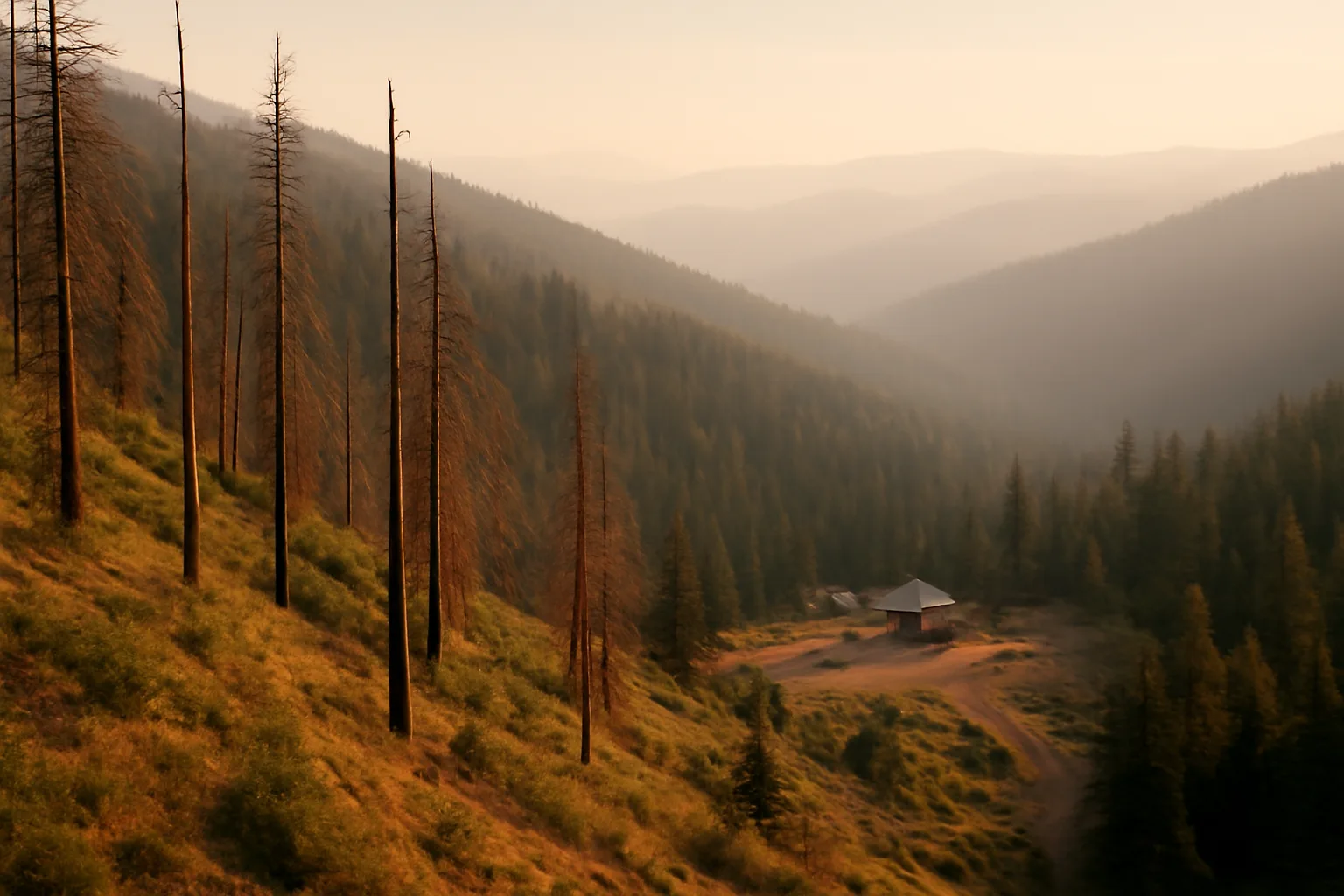
Eagle County, home to Vail, Avon, and Edwards, sits in what foresters call a mixed conifer and lodgepole pine zone with heavy beetle-kill fuel loading, meaning a lot of standing dead wood that burns hot and fast. The Colorado State Forest Service has flagged large parts of the Western Slope, including Eagle County, as having elevated wildfire hazard because of this beetle-kill legacy combined with steep slopes and long dry summers. The county doesn't have one uniform "Eagle County wildfire law." Instead, mitigation requirements come from a patchwork: the county's own land use code, individual fire protection districts (Eagle River Fire Protection District, Greater Eagle Fire Protection District), and the Colorado State Forest Service's Wildfire Risk Assessment (Colorado wildfire risk maps) that many mountain counties use to set defensible space guidance. If you own property in Eagle County, the honest first step isn't Googling a statute number. It's calling your local fire district and asking for their current defensible space standard, because these get updated and they vary block to block depending on slope and fuel type. [Guided fill-in: contact your Eagle County fire district for the current zone-by-zone defensible space requirement before doing any brush clearing.] This pattern isn't unique to Colorado. Insurers and adjusters increasingly look at whether a property has done recognized defensible space work regardless of whether a specific ordinance mandates it, because the underlying fire behavior science is the same everywhere.
When does the California defensible space law go into effect?
California's existing 100-foot defensible space law (Public Resources Code Section 4291) has been in effect for years and requires property owners in State Responsibility Areas and some Local Responsibility Areas to maintain defensible space around structures [1]. What's changing is the "ember-resistant zone." Senate Bill 63, signed in 2025, extends the required ember-resistant zone from the first 5 feet around a home (Zone 0, established by earlier legislation) and sets a framework for CAL FIRE and the Board of Forestry to expand defensible space requirements, with implementation and local enforcement phasing in over the following years rather than a single flip-the-switch date [2]. CAL FIRE's own guidance describes Zone 0 as the "ember-resistant zone" within 5 feet of a structure, where the recommendation is bare mineral soil, gravel, pavers, or non-combustible hardscape, no bark mulch, no wood piles, no combustible furniture. The practical answer for homeowners: the 100-foot defensible space law is already enforceable today. The Zone 0 ember-resistant requirements are being formalized through rulemaking, and CAL FIRE has said final regulations will follow before mandatory enforcement begins, so don't wait for a hard date to start ripping out mulch beds against your siding. Do it now. For a room-by-room breakdown of what belongs in each zone, see fire safe landscaping California next to house.
What fire-safe home rules take effect in 2026?
Several states have rule changes landing around 2026, and it's worth separating what's actually confirmed from what's still proposed. In California, SB 63's Zone 0 ember-resistant zone provisions are moving through Board of Forestry rulemaking, with the law directing implementation timelines that stretch into the mid-2020s for different property types (new construction gets stricter, faster timelines than existing homes) [2]. Colorado does not have a statewide WUI building code; instead, the state authorizes counties to adopt their own wildland-urban interface codes, and some mountain counties (including parts of the I-70 corridor near Eagle County) have adopted or are updating theirs based on the 2021 International Wildland-Urban Interface Code, but adoption dates vary by jurisdiction [3]. [Guided fill-in: confirm with Eagle County Community Development whether your parcel falls under an adopted WUI code and what its 2026 compliance deadline is, if any.] Oregon's statewide wildfire risk map and defensible space code requirements, tied to Senate Bill 762, have had a rocky rollout, with the original map withdrawn in 2022 after public backlash and a revised version and rulemaking process continuing since [4]. Arizona doesn't have a statewide defensible space mandate; requirements come from individual fire districts and some county ordinances in areas like Coconino and Yavapai counties. Bottom line: if someone tells you "2026 fire codes" as if it's one national rule, they're oversimplifying. Check your specific state fire marshal's office and county building department for the actual applicable date. [Guided fill-in: insert your state fire marshal contact and the specific code adoption date for your jurisdiction.]
Why won't people follow the defensible space law in California?
Compliance gaps are well documented and the reasons are pretty mundane: cost, labor availability, confusion about what's actually required, and, frankly, a belief among some homeowners that a fire won't reach them specifically. A 2021 Legislative Analyst's Office report on California wildfire preparedness noted that CAL FIRE inspections have historically found significant portions of inspected parcels out of compliance with defensible space requirements in some years, and that enforcement capacity (the number of inspectors relative to the number of parcels) is a real constraint [5]. Many rural and wildland-adjacent parcels are large, forested, and owned by people who don't do this work themselves; hiring a crew to clear 100 feet of vegetation on a sloped, wooded acre can run into the thousands of dollars, and that cost is a real barrier for fixed-income and rural homeowners. There's also a genuine information gap. Defensible space isn't just "cut back bushes." It's zone-specific: Zone 0 (0-5 feet) wants near-zero combustibles, Zone 1 (5-30 feet) wants spaced, low, well-irrigated plants, and Zone 2 (30-100 feet) is about fuel reduction, not bare dirt. Homeowners who clear the wrong zone, or clear once and never maintain it, aren't defying the law on purpose. They just didn't get clear guidance. And some people simply don't believe defensible space works, despite research from the Insurance Institute for Business & Home Safety and CAL FIRE showing that home hardening and defensible space combined dramatically improve survival odds in ember-driven fires (the actual mechanism of most home loss in wildfires, according to CAL FIRE, is ember intrusion into vents, gaps, and combustible material touching the structure, not a wall of flame). That's a communication failure as much as a compliance one.
How to prevent wildfires from starting in the first place
Roughly 85 percent of wildfires in the United States are human-caused, according to the National Interagency Fire Center, meaning most ignitions are preventable through basic behavior changes, not luck. The highest-value actions: never leave a campfire unattended and drown it fully (stir the ashes, feel for heat) before leaving; don't park or drive vehicles over dry grass, since a hot catalytic converter can ignite vegetation in seconds; maintain chains on trailers so they don't drag and spark on pavement; avoid outdoor burning during red flag warnings issued by the National Weather Service; and don't use fireworks in wildland-adjacent areas, ever, regardless of local legality. On your own property, keep mowers and trimmers off dry grass during peak heat, and don't operate equipment that can throw sparks (grinders, welders, chainsaws hitting rock) on red-flag days. Ready.gov's wildfire prevention guidance specifically flags debris burning and equipment use as major contributors to human-caused starts and recommends checking local burn restrictions before any outdoor fire activity [6].
How to prepare for a wildfire (the practical checklist)
Preparation splits into three buckets: the house itself, the property around it, and your household's evacuation plan. Skipping any one of these leaves a real gap. For the house: address roof and vent vulnerabilities first, since embers entering attic and crawlspace vents cause a large share of home ignitions in wildfires, according to CAL FIRE's home hardening guidance. Class A fire-rated roofing, ember-resistant vents (1/8-inch mesh minimum, or purpose-built ember-blocking vents), and enclosed eaves matter more than almost anything else you can spend money on. For the property: work outward in zones. Zone 0 (0-5 feet from structure) should have no combustible mulch, no wood piles, no plants touching siding. Zone 1 (5-30 feet) wants spaced, low-growing, irrigated plants with no "ladder fuels" connecting ground vegetation to tree canopies. Zone 2 (30-100 feet) is about thinning, not bare-earth clearing. If you haven't mapped your zones yet, our defensible space clearing contracts guide walks through how to scope and price this work with a contractor even outside Washington. For evacuation: Ready.gov recommends every household build a go-bag, identify two evacuation routes, and sign up for local emergency alerts before fire season, not during it [6]. Photograph your home's exterior and interior, and your defensible space work, before fire season starts; that documentation matters later for insurance conversations, which is a separate topic from prevention but just as important. This is where a lot of homeowners get caught flat-footed: they do the mitigation work but never document it, and when a non-renewal letter or a claim conversation happens, they have nothing to show. A Wildfire Insurance Survival Kit is built around exactly this gap: a one-time $99 tool to organize your defensible space photos, receipts, and inspection records into the kind of packet an insurer or adjuster actually wants to see. It doesn't file claims or contact your insurer for you; it just helps you build your own documentation before you need it.
How to prevent forest fires as a hiker, camper, or land manager
Prevention in forested and backcountry settings follows the same core principle as home prevention: control ignition sources and know the local restrictions before you go. Check current fire restrictions and permit requirements for the specific forest or park before any trip; the U.S. Forest Service and CAL FIRE both post active restriction levels by unit, and these change fast during dry stretches. Use established fire rings only, keep campfires small, and never leave one burning while you sleep or leave camp. Smokey Bear's official prevention guidance (a genuinely useful, non-corny resource run by the Forest Service and Ad Council) emphasizes fully extinguishing fires: drown, stir, feel, repeat until cold to the touch [7]. If you're a landowner managing forested acreage, coordinate with your state forest service on prescribed burn timing and permits rather than doing unauthorized burning; escaped debris and agricultural burns are a recurring cause of large wildfires.
How to avoid forest fires on your own property or land
Avoiding forest fires on private land comes down to fuel management and ignition control, applied consistently, not as a one-time project. Remove dead and downed trees, especially beetle-kill in areas like Eagle County where standing dead lodgepole and ponderosa pine create continuous fuel. Space remaining trees so canopies don't touch (crown spacing reduces the chance of fire jumping tree to tree). Clear pine needles and leaf litter from gutters, decks, and within 5 feet of structures regularly, more than once a year. Store firewood at least 30 feet from any structure, and keep propane tanks clear of vegetation. If you burn debris at all, follow your local burn permit rules exactly (many counties require a permit, specific wind and humidity conditions, and a water source on hand), and never burn during a burn ban. Most Western states publish current burn ban status on their state forestry or fire marshal website; check it the day of, not the week before.
How to prepare for forest fires if you live near wildland
Living near forest or wildland means preparation has to account for shorter warning times than a suburban fire might allow, since wildland fire can move faster than people expect, especially with wind-driven spread. Build defensible space per your local fire district's standard (Eagle County residents, again, should call Eagle River Fire Protection District or Greater Eagle Fire Protection District directly, since standards can differ by district). Harden the home's most vulnerable points: vents, eaves, and any deck or fence that touches the structure and could carry fire directly to it. Keep a battery or solar radio for alerts if cell service drops, since wildfire can knock out cell towers and power simultaneously. Sign up for reverse-911 or CodeRED style emergency notification systems if your county offers them; Eagle County and most Colorado mountain counties do. Know your evacuation routes both ways, because wildfire can close one direction unexpectedly, and rehearse the drive with your household at least once.
How can we prevent forest fires at a community level?
Individual prep matters, but wildfire risk is genuinely a neighborhood-level problem: one neglected property with dead brush and combustible debris can undermine everyone else's defensible space work on the same block or ridge. Community-level prevention that actually works: coordinated fuel reduction projects (many counties and fire districts offer chipper days or cost-share programs for defensible space work), Firewise USA recognition through the National Fire Protection Association, which organizes neighborhoods around shared mitigation standards and can factor into insurance conversations, and community wildfire protection plans (CWPPs) that identify shared evacuation routes and fuel breaks [8]. If your neighborhood doesn't have a Firewise USA chapter or a CWPP, reaching out to your county's wildfire mitigation coordinator or state forest service extension office is the practical starting point; Colorado State University Extension and the Colorado State Forest Service both offer guidance for starting one.
Is Santa Barbara safe from fire?
No California coastal or foothill community, including Santa Barbara, is "safe" from wildfire in any absolute sense; the region has a documented history of major destructive fires and sits partly within State Responsibility Area and Very High Fire Hazard Severity Zone mapping from CAL FIRE . Santa Barbara County has experienced multiple large, damaging wildfires in the past two decades, including the Thomas Fire (2017), which burned into Santa Barbara County and was, at the time, one of the largest fires in modern California history, and the subsequent Montecito debris flow, which killed 23 people, a tragedy directly tied to the burned, denuded slopes above the community . CAL FIRE's Fire Hazard Severity Zone maps show large areas of the Santa Barbara foothills and adjacent wildland-urban interface rated Very High, the state's highest hazard category . That doesn't mean every property in Santa Barbara faces equal risk; risk depends heavily on specific location, slope, vegetation, and distance from wildland. But "Santa Barbara is safe from fire" isn't a claim CAL FIRE's own hazard mapping supports for large parts of the county, and homeowners there should treat defensible space compliance as seriously as anyone in the Sierra foothills or Eagle County's mountain subdivisions.
What should you do if you got a wildfire non-renewal or inspection letter?
Non-renewal letters are increasingly common in California, Colorado, Oregon, and Arizona wildfire zones, and the letter itself is usually a compliance and documentation problem you can address, not a permanent verdict on your home. First, read exactly what the letter cites: most non-renewals reference specific hazards (vegetation clearance, roof condition, deck material, wood pile proximity) rather than "wildfire risk" in the abstract. Address those specific items first. Second, document everything: dated photos of completed defensible space work, receipts for tree removal or vent replacement, any inspection reports from your local fire district. Third, understand your state's protections; California, for example, has a one-year moratorium on non-renewals for homes in or adjacent to a declared wildfire disaster area under certain conditions (California Insurance Code Section 675.1), though it doesn't apply broadly to all non-renewals . We don't contact insurers on your behalf, file claims, or promise reinstatement or discounts; that's not something any third party can ethically guarantee, and be skeptical of anyone who does. What you can control is building a clean, dated documentation packet of your mitigation work and sending it yourself. That's the entire idea behind organizing a Wildfire Insurance Survival Kit: a $99 one-time tool for putting your own defensible space photos, receipts, and inspection notes into the format insurers actually ask for, so you're not scrambling when the renewal window closes. If you're rebuilding after a total loss instead, our guide on house fire recovery documentation covers a related but distinct process.
What's the difference between defensible space rules across CA, CO, OR, and AZ?
State | Statewide mandate | Key mechanism | 2026 status ---|---|---|--- California | Yes, PRC 4291 | 100-ft defensible space + Zone 0 ember-resistant zone (SB 63) | Zone 0 rulemaking ongoing, enforcement phasing in [1] [2] Colorado | No statewide code | County/fire district adoption of WUI code | Varies by county, check locally [3] Oregon | Yes, SB 762 framework | State wildfire risk map + defensible space code by risk class | Map revised after 2022 rollback, rulemaking continuing [4] Arizona | No statewide mandate | County ordinances and fire district rules (Coconino, Yavapai, etc.) | No statewide 2026 deadline identified The practical takeaway: California homeowners have the clearest statewide legal floor, Colorado and Arizona homeowners need to check county and fire district rules directly (there is no shortcut), and Oregon homeowners should watch for updates to their property's risk classification since that map has changed once already and could again. For a broader look at how these four states stack up on cost, enforcement, and insurance impact, see our state rules comparison.
Frequently asked questions
When does the California defensible space law go into effect?
The core 100-foot defensible space law (PRC 4291) is already in effect and has been for years. The newer Zone 0 ember-resistant zone requirement under SB 63 (signed 2025) is being implemented through CAL FIRE and Board of Forestry rulemaking, with phased timelines rather than one fixed date. Start Zone 0 work now regardless.
Why won't people follow the defensible space law in California?
Cost is the biggest barrier; clearing wooded, sloped parcels can cost thousands of dollars. Confusion about zone-specific requirements and limited CAL FIRE inspection capacity relative to the number of parcels statewide also contribute, according to a 2021 Legislative Analyst's Office report on wildfire preparedness.
How to prevent wildfires from starting?
About 85 percent of U.S. wildfires are human-caused, per the National Interagency Fire Center. Fully extinguish campfires, avoid parking on dry grass, maintain trailer chains, skip fireworks near wildland, and check local burn restrictions before any outdoor burning, especially during red flag warnings.
How to prepare for a wildfire if I live in a high-risk zone?
Harden your roof and vents, build zone-based defensible space (0-5, 5-30, 30-100 feet), pack a go-bag, identify two evacuation routes, and sign up for local emergency alerts. Photograph your home and mitigation work before fire season for insurance documentation purposes.
What fire-safe home rules take effect in 2026?
There's no single national 2026 rule. California's SB 63 Zone 0 provisions are phasing in through rulemaking. Colorado has no statewide code; counties adopt their own. Oregon's SB 762 wildfire risk map continues rulemaking after a 2022 revision. Check your specific state fire marshal and county for actual dates.
Is Santa Barbara safe from fire?
No. CAL FIRE's Fire Hazard Severity Zone maps rate large parts of Santa Barbara County's foothills as Very High, the state's top category. The 2017 Thomas Fire and the 2018 Montecito debris flow, which killed 23 people, show the real risk to this area.
How can we prevent forest fires at a neighborhood level?
Coordinate fuel reduction with neighbors, join or start a Firewise USA (NFPA) chapter, and support a community wildfire protection plan that maps shared evacuation routes and fuel breaks. One uncleared property can undermine everyone else's defensible space work nearby.
What is the wildfire risk in Eagle County, Colorado specifically?
Eagle County has elevated wildfire hazard from heavy beetle-kill fuel loads, steep terrain, and dry summers, per Colorado State Forest Service risk assessments. There's no single county-wide defensible space law; requirements come from local fire districts like Eagle River Fire Protection District, so check locally.
Does Colorado have a statewide wildfire building code?
No. Colorado doesn't mandate a statewide wildland-urban interface (WUI) building code. Counties can adopt their own, often based on the 2021 International WUI Code, but adoption and enforcement dates vary significantly by county and even by fire district within a county.
What should I do if my insurer sent a non-renewal or inspection letter?
Read the letter for specific cited hazards (vegetation, roof, vents, decking) and address those directly. Document all mitigation work with dated photos and receipts. Check your state's protections, such as California's one-year non-renewal moratorium under certain disaster-area conditions (Insurance Code Section 675.1).
How to avoid forest fires on my own rural property?
Remove dead and beetle-killed trees, space tree canopies so fire can't jump crown to crown, clear needles and litter from gutters and decks regularly, store firewood 30+ feet from structures, and follow local burn permit rules exactly if you burn debris at all.
Can I get my insurance reinstated after non-renewal by doing defensible space work?
Completing recognized mitigation work and documenting it can support your case with an insurer, but no one can promise reinstatement, and be wary of anyone who claims they can. You (or your agent) submit your own documentation; a documentation kit organizes that process but doesn't file claims or speak to insurers for you.
Sources
- California Public Resources Code Section 4291: 100-foot defensible space requirement for State Responsibility Area properties
- California SB 63 (2025), Legislative Information: SB 63 extends and formalizes the ember-resistant Zone 0 defensible space requirement with phased implementation
- International Code Council, 2021 International Wildland-Urban Interface Code: Model WUI code that Colorado counties may adopt locally since there is no statewide mandate
- California Legislative Analyst's Office, wildfire preparedness report: Defensible space compliance gaps and CAL FIRE inspection capacity constraints
- National Interagency Fire Center, wildfire statistics: Approximately 85 percent of U.S. wildfires are human-caused
- Smokey Bear / USDA Forest Service, campfire safety guidance: Drown, stir, feel method for fully extinguishing campfires
- National Fire Protection Association, Firewise USA program: Firewise USA organizes neighborhood-level wildfire mitigation and recognition
- California Insurance Code Section 675.1: One-year moratorium on insurance non-renewal for properties in or adjacent to a declared wildfire disaster area under specified conditions