Last updated 2026-07-25
TL;DR
Fire resistant housing means construction materials, roof/vent design, and a 5-foot noncombustible zone around the structure that stop embers from igniting the home. California's updated Zone 0 ember-resistant space rules are expected to phase in around 2026, but as of this writing they are not yet finalized statute; check fire.ca.gov and your local fire marshal before relying on any date.
What does "fire resistant housing" actually mean?
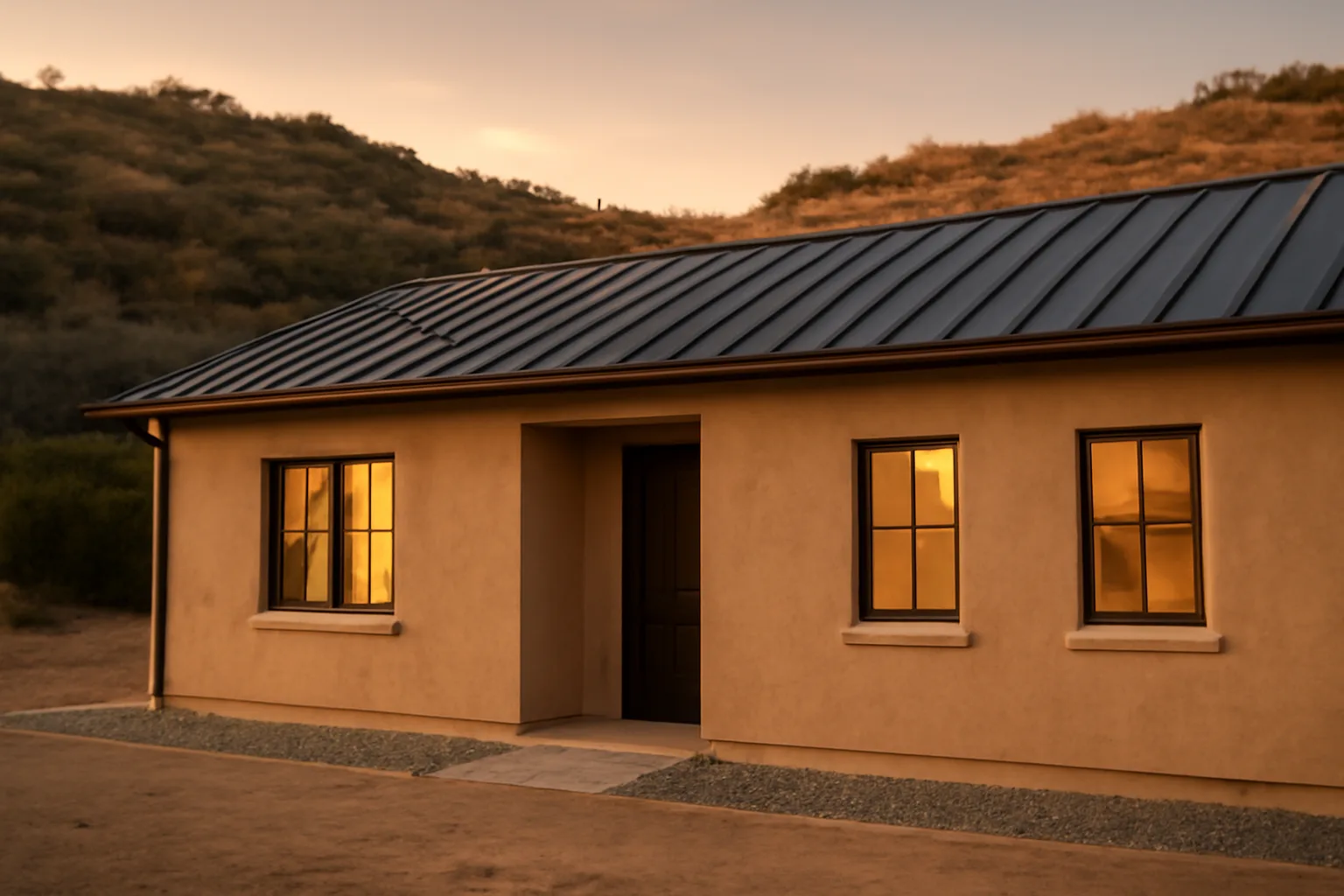
Fire resistant housing isn't one product, it's a system: the roof, the vents, the siding, the windows, and the ground within a few feet of the walls all have to work together to stop embers from getting in. Most homes that burn in wildfires don't burn because a wall of flame rolled through. They burn because a wind-blown ember landed in a gutter full of pine needles, or slipped through a vented attic, or ignited mulch pressed against a wood fence that ran straight to the siding. CAL FIRE's own research program has said for years that ember intrusion, not direct flame contact, is the dominant cause of home ignition in wildfires, which is why building codes have shifted hard toward ember-resistant vents, Class A roofing, and noncombustible zones right at the foundation [1]. The state's Wildland Urban Interface (WUI) building code, Chapter 7A of the California Building Code, already requires ignition-resistant materials for new construction and major remodels in high fire hazard severity zones [2]. So when someone says "fire resistant housing," they usually mean some mix of: a Class A fire-rated roof, ember-resistant (1/8-inch mesh, baffled) vents, dual-pane tempered glass windows, noncombustible siding or fire-rated stucco, and a 5-foot noncombustible buffer at the base of the exterior walls. None of those pieces alone makes a home fireproof. Together, they change the odds a lot.
When does the California defensible space law go into effect?
California's core defensible space law, Public Resources Code 4291, has been in effect since the 1960s and was substantially updated in 2020 to require 100 feet of defensible space (or to the property line) around structures in State Responsibility Areas and some Local Responsibility Areas [3]. That part isn't new and isn't changing in 2026. What is changing, or at least has been proposed for years now, is "Zone 0," the 0-to-5-foot ember-resistant zone immediately next to the home. Assembly Bill 3074 (2020) directed the Board of Forestry and Fire Protection to develop regulations for this zone, and the Board has been working through the rulemaking process since then [4]. As of this writing, the Zone 0 regulation has not been finalized into an enforceable statewide requirement with a locked effective date. CAL FIRE's Board of Forestry page tracks the rulemaking status directly, and that's the authoritative place to check before you assume a hard 2026 deadline applies to your specific property. Here's the honest answer to "what fire safe home rules take effect in 2026": nobody outside the Board of Forestry can give you a locked date with total confidence right now, because the regulation has moved through multiple comment periods and delays already. Treat any "2026 deadline" you read (including on this page) as a planning target, not a locked-in date, until your county or CAL FIRE confirms it in writing for your parcel. If you got a non-renewal letter, don't wait on the regulation. Build Zone 0 defensible space now, because insurers and inspectors are already scoring properties against something close to that standard.
Why won't people follow the defensible space law in California?
A few reasons keep coming up, and they're not all about laziness. Cost is a real barrier: removing brush, limbing trees, and replacing wood mulch with gravel or hardscape in a 5-foot zone can run from a few hundred dollars for a small suburban lot to several thousand for a larger rural parcel with heavy vegetation, and CAL FIRE doesn't subsidize the labor. Enforcement is also inconsistent. Public Resources Code 4291 gives fire agencies inspection and citation authority, but staffing varies wildly by county, and many rural parcels haven't been inspected in years. A property owner in a Local Responsibility Area might genuinely not know their county has a defensible space ordinance at all, versus someone in a State Responsibility Area where CAL FIRE conducts routine inspections. There's also a mismatch between what people think "clearing" means and what the law actually asks for. Zone 1 (0-30 feet) and Zone 2 (30-100 feet) don't require a bare dirt lot. CAL FIRE's own guidance describes "lean, clean, and green" landscaping, not total vegetation removal, and a lot of the pushback comes from people who assume the rule means bulldozing every tree, which it doesn't [3]. Finally, some homeowners are simply skeptical it will make a difference, especially after watching entire neighborhoods burn regardless of individual prep. That skepticism isn't crazy, but it's not well supported: post-fire assessments from events like the 2018 Camp Fire found that structures with defensible space and ignition-resistant construction survived at meaningfully higher rates than neighbors without it, even in the same firestorm.
How to prevent wildfires (what actually reduces risk)
Roughly 85% of wildfires in the U.S. are human-caused, according to the National Interagency Fire Center's long-running analysis of fire cause data, and that number holds up across most Western states in most years. That means the single biggest lever on wildfire prevention isn't building codes, it's behavior: campfire management, equipment spark arrestors, not parking hot vehicles on dry grass, and following local burn bans. For homeowners specifically, prevention has two layers. The first is community-level: reporting unattended fires, following red flag warning restrictions, and not doing yard work with power equipment on high-wind red flag days. The second is property-level, and that's where defensible space and home hardening come in, because even if you can't stop a wildfire from starting three ridgelines away, you can control whether embers from it find fuel on your property. CAL FIRE's "Ready for Wildfire" program organizes this into the same three zones referenced above: the ember-resistant zone at 0-5 feet, lean-and-green from 5-30 feet, and reduced fuel from 30-100 feet [3]. Ready.gov's wildfire preparedness page adds the household side: an emergency supply kit, a family communication plan, and a go-bag ready before fire season starts, not after a red flag warning is issued [5].
How to prepare for a wildfire (the practical checklist)
Preparing for a wildfire means doing the defensible space and hardening work before smoke is on the horizon, then having a fast, boring evacuation plan for the day it matters. Ready.gov recommends assembling an emergency kit with at least a 3-day supply of food and water per person, a battery-powered radio, medications, and copies of important documents, well before fire season starts [5]. On the house itself: clear the 5-foot zone of anything combustible (mulch, stored firewood, patio furniture cushions), clean gutters and roof valleys of dry leaves and needles, and check that vents have ember-resistant mesh. Move propane tanks and firewood stacks at least 30 feet from the structure per most local fire codes. On the paperwork side, this is where a lot of homeowners get caught flat-footed after a fire: insurers and FAIR Plan adjusters ask for proof of the mitigation work you did, and "I definitely did it" isn't documentation. Dated photos of your cleared zones, receipts for any brush removal or hardening work, and a written inventory of major belongings all matter more after a loss than most people expect going in. That's the specific gap the $99 Wildfire Insurance Survival Kit is built around: a structured way to document defensible space work and home inventory before you need it, not after.
How to prevent forest fires and how to avoid forest fires (same question, two phrasings)
These get asked separately online but the answer is the same set of behaviors, mostly centered on ignition sources rather than the forest itself. The U.S. Forest Service and NIFC both point to debris burning, campfires, discarded cigarettes, fireworks, and equipment sparks (chains dragging from trailers, mowers hitting rocks) as the recurring human causes behind the roughly 85% figure cited above. Practical steps that actually move the needle: fully drown and stir campfires until they're cold to the touch, more than smoking; avoid mowing or using grinders on dry grass during red flag warnings; keep chains and safety equipment on trailers so nothing drags on pavement; and follow county burn permit rules, which usually specify wind speed and humidity thresholds below which debris burning is illegal, more than discouraged. At the community level, "only you can prevent wildfires" isn't just a slogan, it's a real statistical statement given how dominant the human-caused share is. If you want the broader public-education angle on this, only you can prevent wildfires covers the campaign history and the behavior-change data behind it in more detail.
How to prepare for forest fires (community and property level)
Preparing for forest fires at the property level overlaps heavily with wildfire prep, but if you're near forested land rather than grassland or chaparral, a few things shift. Canopy spacing matters more: CAL FIRE recommends spacing tree canopies at least 10 feet apart within Zone 2, more on slopes, to prevent crown fire from jumping tree to tree toward your home [3]. Ladder fuels, the shrubs and small trees that let ground fire climb into the canopy, are the priority removal target in forested lots. Limbing trees up 6 to 10 feet from the ground (adjusted for tree height) breaks that ladder. This is different work than suburban lot clearing, and it's often more expensive because it usually needs an arborist or licensed tree crew rather than a landscaper. If you're in a state with active contractor programs for this, it's worth checking what's available regionally. Washington State DNR, for instance, runs defensible space clearing contract programs that homeowners in eligible areas can access, and several Western states have similar cost-share or grant programs through their state forestry agencies. Check your state fire marshal's office for what's currently funded, because these programs open and close with budget cycles.
What fire safe home rules take effect in 2026?
Short answer: probably the California Zone 0 ember-resistant space regulation, but it isn't locked as of this writing, and you should verify directly with CAL FIRE's Board of Forestry before treating any date as final. The regulation stems from AB 3074 (2020), which set the framework for a 0-to-5-foot zone requiring noncombustible or ember-resistant materials directly against the home, no combustible mulch, no wood fencing attached to the structure, no stored fuel. Separately, insurers operating in California are increasingly building their own underwriting standards around something close to this Zone 0 concept regardless of when the state regulation finalizes, because carriers don't have to wait for a state mandate to score a property on ember-zone risk. That's part of why non-renewal letters have referenced "5-foot clearance" language even in counties where the state rule technically isn't enforceable yet. Outside California, the picture is genuinely more scattered. Colorado's state fire code adoption happens at the local jurisdiction level rather than one statewide WUI code, Oregon's statewide wildfire risk map and defensible space rules (under Senate Bill 762) have gone through their own multi-year rollout and legal challenges, and Arizona largely defers WUI building requirements to county and municipal codes. If you're outside California, your state fire marshal's office is the right first call, not a national news article, because "2026 rules" phrasing gets applied loosely across states that don't actually share a rulemaking calendar.
Is Santa Barbara safe from fire?
No California coastal or foothill community, including Santa Barbara, is "safe" from wildfire risk in any absolute sense, and CAL FIRE's own Fire Hazard Severity Zone maps show large portions of Santa Barbara County, especially the foothill and wildland-urban interface areas along the base of the Santa Ynez Mountains, rated as Very High severity zones . The city has burned before at serious scale: the 1990 Painted Cave Fire destroyed over 400 structures in a matter of hours, and the broader county has seen major fire events including the 2017 Thomas Fire, which at the time was the largest wildfire in modern California history by acreage. What's true is that risk isn't uniform across the county. Downtown, flatter, more developed areas away from wildland fuel have meaningfully lower exposure than homes built directly against chaparral-covered slopes. If you own or are shopping for property there, pulling the specific parcel's Fire Hazard Severity Zone designation from CAL FIRE's map viewer is a better answer than any general statement about the city, because the zone designation, not the city name, is what drives defensible space obligations and insurance underwriting .
How can we prevent forest fires? (the policy and community layer)
Beyond individual behavior, prevention at scale leans on fuel reduction (prescribed burns and mechanical thinning on public land), power line hardening by utilities in high-risk zones, and public awareness campaigns tied to red flag warning systems. CAL FIRE and the U.S. Forest Service both run active prescribed fire programs specifically to reduce the accumulated fuel load that turns a small ignition into a fast-moving crown fire [1]. Utility-caused ignitions have been a growing focus too. Several major California wildfires, including the 2018 Camp Fire, were traced to utility equipment failures, which is part of why utilities in high fire-threat districts now run Public Safety Power Shutoff programs during extreme wind events. That's a prevention measure most homeowners don't control directly, but it affects how you plan: if you're in a PSPS-prone area, backup power for medical equipment and communication matters as much as brush clearance. At the neighborhood level, coordinated defensible space matters more than any single home doing it perfectly. A single hardened home surrounded by untouched, overgrown lots is still exposed to radiant heat and ember showers from every direction. This is why some fire districts now run Firewise USA-style community programs (recognized by the National Fire Protection Association) that coordinate clearing across whole streets rather than parcel by parcel.
What does home hardening actually cost, and is it worth it?
| Ember-resistant vents (per vent) | $150-$500 installed | High, cheap, do first | |
|---|---|---|---|
| Gutter guards / ember-resistant gutters | $500-$2,500 whole house | High | |
| Zone 0 (5 ft) noncombustible landscaping | $300-$5,000+ depending on lot | High | |
| Class A roof replacement | $8,000-$20,000+ | High, most expensive | |
| Dual-pane tempered ember-resistant windows | $400-$1,200 per window | Medium | |
| Noncombustible siding replacement | $10,000-$30,000+ | Medium-lower unless siding is failing anyway | The honest answer on "is it worth it": vents and Zone 0 clearing give you the most risk reduction per dollar by a wide margin, because they close the two most common ember entry points cheaply. Full siding or roof replacement matters, but if your budget is limited, do the cheap ember-blocking work first and save the big-ticket structural replacement for when the roof or siding needs replacing anyway. For a deeper walkthrough of prioritized hardening steps by budget tier, see defensible space work planning and the fire-safe landscaping guide for the planting side specifically. |
Costs vary enormously by house size, existing materials, and region, so treat these as rough planning ranges rather than quotes. Vent retrofits (swapping standard vents for ember-resistant, 1/8-inch mesh versions) typically run a few hundred dollars per vent installed. A full Class A roof replacement, which many older homes in fire zones don't have, can range from roughly $8,000 to well over $20,000 depending on square footage and material (metal, tile, or fire-rated composite shingle all qualify but price very differently). Ember-resistant, dual-pane tempered windows often add a meaningful premium over standard replacement windows, and full noncombustible siding replacement (fiber cement or stucco over combustible wood lap siding) is one of the larger-ticket items on this list. | Hardening item | Typical cost range | Priority tier |
How do I document my defensible space and hardening work for insurance?
Insurers and FAIR Plan adjusters generally want to see dated, specific proof, not a general statement that you "did the work." That means photos of your cleared 5-foot zone taken from multiple angles with a visible date stamp, receipts for any contracted brush removal or vent retrofits, and, if your county does inspections, a copy of your defensible space inspection certificate if one was issued. A written home inventory matters just as much, and it's the piece homeowners skip most often. If a fire does reach your home, the burden of proving what you owned and what it was worth falls on you, and post-fire memory under stress is unreliable. Photos and video walkthroughs of rooms, closets, and garages, done now while nothing is on fire, are worth far more than anything reconstructed after a loss. We should be direct about what this kind of documentation does and doesn't do: it does not negotiate your claim, file paperwork with your insurer on your behalf, or guarantee reinstatement of a non-renewed policy. Public adjusting and claims negotiation are separate, licensed services, and nothing here is legal or insurance advice. What good documentation does is put you in a far stronger position to advocate for yourself, whether that's during an underwriting inspection, a renewal appeal, or an actual claim. That's the specific gap the $99 Wildfire Insurance Survival Kit is built to close: a structured, offline-accessible way to organize defensible space photos, hardening receipts, and a home inventory into one packet before you need it. For the underwriting side of this problem specifically, including what non-renewal letters typically ask for, house fire and fire at a house walk through common damage and claims documentation scenarios in more depth.
Frequently asked questions
When does the California defensible space law go into effect?
The core 100-foot defensible space requirement under Public Resources Code 4291 has been in effect since it was substantially updated in 2020. The newer "Zone 0" ember-resistant 5-foot zone regulation, from AB 3074, is still moving through Board of Forestry rulemaking and does not have a finalized, locked statewide effective date as of this writing. Check CAL FIRE's Board of Forestry page for current status.
Why won't some homeowners follow California's defensible space law?
Cost, inconsistent enforcement across counties, confusion about what "clearing" actually requires (it's not bare dirt, CAL FIRE calls it "lean, clean, and green"), and skepticism after watching whole neighborhoods burn regardless of prep. Enforcement authority exists under Public Resources Code 4291, but inspection staffing and citation follow-through vary a lot by local fire agency.
How can homeowners prevent wildfires from starting?
About 85% of wildfires are human-caused according to the National Interagency Fire Center, so prevention mostly means controlling ignition sources: fully drowning campfires, avoiding equipment sparks and debris burning on dry, windy days, following local burn permit rules, and respecting red flag warning restrictions on outdoor power equipment.
How should I prepare for a wildfire if I live in a fire-prone area?
Build and maintain defensible space in the zones CAL FIRE defines (0-5, 5-30, 30-100 feet), harden vents and gutters against embers, and assemble a Ready.gov-recommended emergency kit with 3 days of supplies, medications, and document copies. Document your mitigation work with dated photos and receipts before fire season, not after a loss.
What's the difference between preventing wildfires and preventing forest fires?
Functionally, they're the same question asked with different wording. Forest fires and wildfires share the same dominant human-caused ignition sources (campfires, equipment sparks, debris burning), so the prevention behaviors, drowning campfires fully, following burn bans, maintaining spark arrestors, apply the same way regardless of which term someone uses.
What fire-safe home rules take effect in 2026?
Most likely California's Zone 0 ember-resistant space regulation stemming from AB 3074, though it hasn't been finalized with a locked date as of this writing. Outside California, Colorado, Oregon, and Arizona each handle WUI building and defensible space rules differently, often at the county or municipal level rather than one statewide 2026 deadline.
Is Santa Barbara safe from wildfire?
No community in the wildland-urban interface is fully safe from wildfire, and CAL FIRE's Fire Hazard Severity Zone maps rate large parts of Santa Barbara County, particularly foothill areas near the Santa Ynez Mountains, as Very High severity. The 1990 Painted Cave Fire and 2017 Thomas Fire are both evidence the risk is real, not theoretical.
How much does fire-resistant home construction cost?
It ranges widely by scope. Ember-resistant vent retrofits run roughly $150-$500 per vent, a full Class A roof replacement can run $8,000-$20,000+, and full noncombustible siding replacement often exceeds $10,000. Vents and Zone 0 landscaping give the most risk reduction per dollar and are the cheapest place to start.
What is Zone 0 in California wildfire defensible space rules?
Zone 0 is the 0-to-5-foot ember-resistant zone immediately surrounding a structure, proposed under AB 3074 (2020) and still moving through CAL FIRE Board of Forestry rulemaking. It generally calls for noncombustible ground cover, no wood mulch, no attached wood fencing, and no stored combustibles directly against exterior walls.
Does defensible space actually stop a home from burning?
It significantly improves the odds but doesn't guarantee survival. Post-fire assessments after events like the 2018 Camp Fire found homes with defensible space and ignition-resistant construction survived at notably higher rates than similarly exposed neighbors without it, largely because most home ignitions start from wind-blown embers finding fuel close to the structure, not direct flame contact.
What should I do if I already received a wildfire insurance non-renewal letter?
Start documenting your property immediately: dated photos of your defensible space zones, receipts for any hardening work, and a full written home inventory. This documentation supports renewal appeals and future claims but doesn't negotiate coverage for you; that's a separate, licensed public adjusting function. Check your state fire marshal and CAL FIRE's Ready for Wildfire program for the specific mitigation standards your inspector will check against.
Are ember-resistant vents required by law or just recommended?
In California, ember- and flame-resistant vents are required for new construction and major remodels in designated Fire Hazard Severity Zones under Chapter 7A of the California Building Code. For existing homes not undergoing a major remodel, they're strongly recommended by CAL FIRE and often required by insurers, but not always legally mandated retroactively; check your local building department.
Sources
- CAL FIRE, Wildfire Prevention research: Ember intrusion is the dominant cause of home ignition in wildfires
- California Building Standards Commission, California Building Code Chapter 7A: Chapter 7A requires ignition-resistant construction materials in Fire Hazard Severity Zones
- CAL FIRE, Defensible Space (PRC 4291): 100 feet of defensible space required around structures in SRA/some LRA, with Zone 1/2/0 breakdown and 'lean, clean, and green' standard
- California Legislature, Assembly Bill 3074 (2020): AB 3074 directs Board of Forestry to develop Zone 0 ember-resistant space regulations
- CAL FIRE, Fire Hazard Severity Zone Viewer: Santa Barbara County foothill areas rated Very High Fire Hazard Severity Zone