Last updated 2026-07-23
TL;DR
Fire resistant house materials that matter most are Class A roofing, non-combustible siding within 5 feet of the foundation, dual-pane tempered windows, metal gutters, and ember-blocking vents. CAL FIRE's Zone 0 rule and Chapter 7A building codes drive most of these requirements, and insurers increasingly ask for photo proof before renewal.
what are the most fire resistant house materials you can actually buy
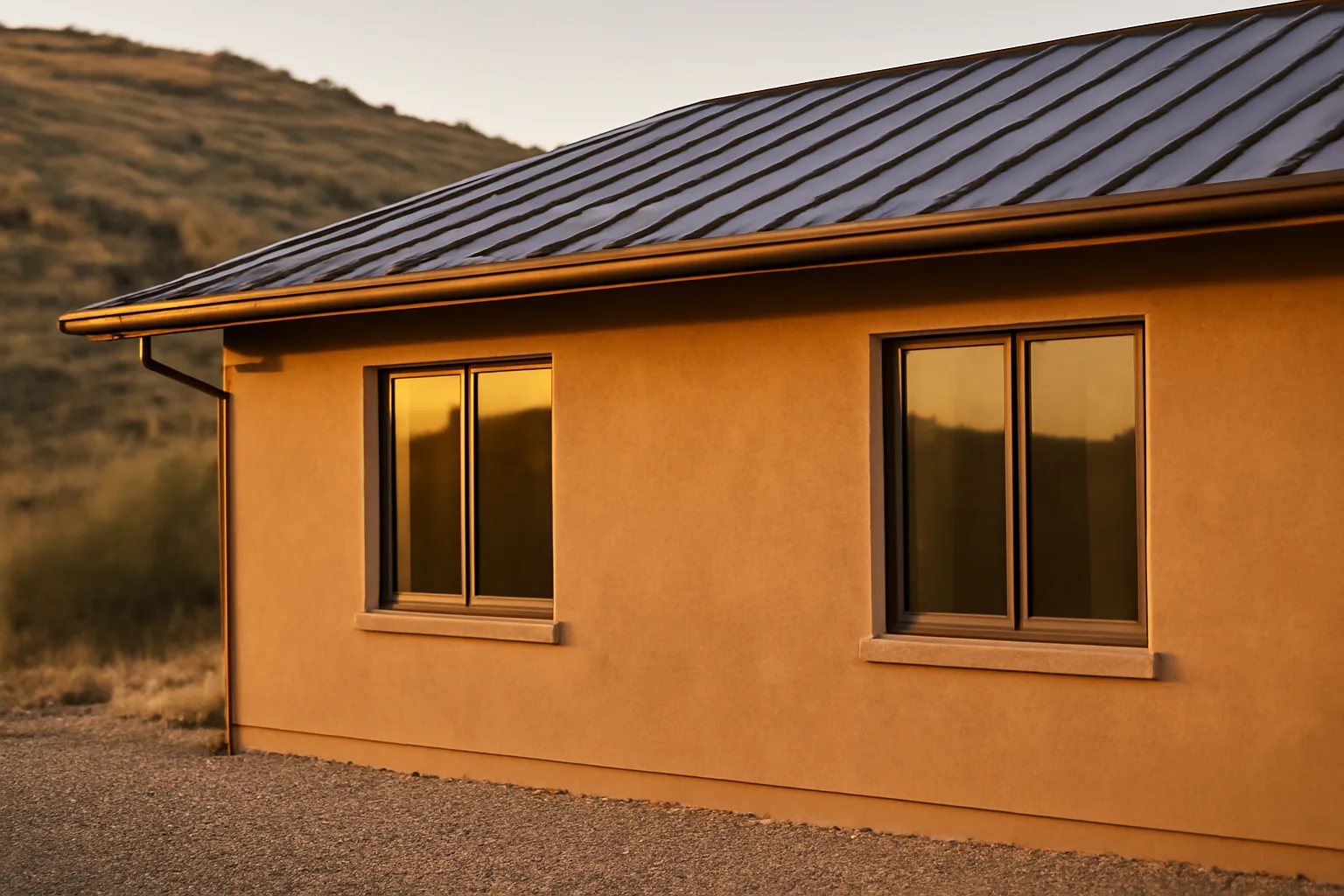
The materials that matter most, in order of how much they reduce ember and radiant heat ignition, are: a Class A rated roof, non-combustible siding, dual-pane tempered glass windows, metal gutters with leaf guards, and ember-resistant vents. None of these are exotic. You can buy all of them at a regular building supply store. Class A roofing means the assembly (more than the shingle) resists severe fire exposure under the ASTM E108 and UL 790 test standards. Asphalt composition shingles rated Class A, concrete tile, clay tile, and standing-seam metal roofing all qualify. Wood shake roofs, even treated ones, are the single worst material you can put on a house in a wildfire zone. CAL FIRE's own guidance is blunt about this: embers land on roofs and in gutters more than anywhere else on a structure [1]. Siding is the second biggest lever. Fiber cement board (Hardie board is the common brand), stucco, brick, and stone don't ignite from radiant heat the way wood lap siding or vinyl does. Vinyl siding actually melts and drips at fairly low temperatures, which can drip flaming plastic onto mulch or vegetation below. If you can only afford to redo siding on part of the house, do the bottom 5 feet first, since that's the zone where ember accumulation and radiant heat from burning shrubs hit hardest. Windows are underrated. Single-pane glass can crack from radiant heat alone, long before flame ever touches the house, and once a window fails, embers pour into the living space. Dual-pane windows with at least one tempered pane hold up dramatically longer. This is spelled out in California's Chapter 7A building code for wildland-urban interface construction.
what does chapter 7a require, and does my house have to meet it
Chapter 7A of the California Building Code applies to new construction and major remodels in designated Wildland-Urban Interface Fire Areas, not automatically to existing homes. If you're building new or doing a significant addition in a WUI zone, your permit will require 7A compliant materials: ignition-resistant siding, Class A roofing, dual-pane tempered windows, and enclosed eaves. Existing homes are not legally forced to retrofit to 7A standards just because the code exists, which is a source of a lot of confusion. What does apply to existing homes, regardless of build date, is California's defensible space law under Public Resources Code 4291, plus (as of new state rulemaking) the ember-resistant Zone 0 requirement. Insurers, though, don't care about the legal distinction between new-construction code and existing-home retrofit obligations. Many California FAIR Plan and admitted-market insurers now ask for photo documentation of roof material, vent type, and defensible space compliance before they'll renew or write a new policy, essentially applying a 7A-like standard voluntarily through underwriting. Check with your specific carrier or district for what's actually required in your case (mitigation rules vary by insurer and by local fire district, so confirm with your county fire marshal or your agent before spending money).
when does the california defensible space law go into effect
California's core defensible space law, Public Resources Code Section 4291, has been in effect since the 1965 State Public Resources Code was adopted and was substantially amended in 2005 to expand the required clearance from 30 feet to 100 feet around structures [2]. It is already active law, not a future requirement. What's newer, and what people mean when they ask this question in 2024-2026, is the Zone 0 ember-resistant zone rule. California Senate Bill 63 (2020) directed the Board of Forestry and Fire Protection to develop regulations for a 0-to-5-foot zone immediately around structures where combustible material (mulch, wood fencing attached to the house, dry vegetation) would be prohibited [3]. The Board has been working through formal rulemaking, and current guidance from CAL FIRE says the regulation is expected to take effect on a phased basis, with an anticipated 2025-2026 implementation window pending final adoption, per Board of Forestry updates. Check the Board of Forestry's website directly for the current adoption date before assuming an exact deadline, because rulemaking timelines slip. Until Zone 0 is formally adopted and enforced, existing PRC 4291 defensible space rules (100 feet, in the two concentric zones) remain the enforceable standard for most California properties.
what fire safe home rules take effect in 2026
The honest answer is that no single nationwide 2026 fire-safe home law exists; what's changing is mostly California's Zone 0 ember-resistant zone regulation working through Board of Forestry rulemaking, targeted for adoption in the 2025-2026 window. Some building code cycles also update Chapter 7A requirements roughly every three years alongside the California Building Standards Code update cycle, with the next major code cycle taking effect January 1, 2026 for new construction statewide. If you're in Oregon, Colorado, or Arizona, there is no equivalent single 2026 deadline. Oregon's wildfire risk map and defensible space code requirements (under Senate Bill 762) have had a rocky rollout, with the state pausing and revising its risk map after public pushback; check the Oregon Department of Forestry site for the current status before assuming a fixed date. Colorado and Arizona regulate mostly at the county and fire-district level rather than through one statewide mandate, so the actual defensible space rule that applies to you depends entirely on your local fire protection district. Fill in your specific district's requirement here, since it varies block to block in some counties. The safest move if you got a non-renewal letter: don't wait for a new law to take effect. Insurers are already applying stricter underwriting standards now, ahead of any formal 2026 rule.
why won't people follow the defensible space law in california
A few real reasons keep showing up in CAL FIRE inspection data and local news coverage. Cost is the biggest one: clearing 100 feet of defensible space on a sloped, heavily wooded lot can run into the thousands of dollars, and low-income and older homeowners often can't absorb that in a single season. A second reason is simple unfamiliarity with what the rule actually requires. PRC 4291 has two zones (0-30 feet, and 30-100 feet) with different vegetation spacing and pruning standards in each, and homeowners often don't know the specifics until an inspector shows up. A third factor is enforcement gaps. CAL FIRE and local fire districts perform defensible space inspections, but staffing and property counts mean not every property gets checked every year, so noncompliance can persist for years without consequence, until a fire happens or an insurer's own inspector flags it. Finally, some homeowners genuinely disagree with clearing vegetation near mature trees they value, or worry about erosion on slopes once ground cover is removed. CAL FIRE's guidance addresses this directly, noting that defensible space work should be done thoughtfully, with erosion control and selective thinning rather than clear-cutting [1]. For landscaping specifics that satisfy both the 100-foot rule and erosion concerns, see fire safe landscaping California next to house.
how to prevent wildfires around your own property
You can't stop a wildfire from starting somewhere else, but you have direct control over whether your property helps it spread once it arrives. The two levers that matter most are defensible space (the vegetation around your house) and home hardening (the materials the house itself is built from). CAL FIRE's defensible space guidance breaks the property into two zones: Zone 1 (0-30 feet from structures), where you remove dead vegetation, prune tree limbs up 6 feet from the ground, and space shrubs apart; and Zone 2 (30-100 feet), where you reduce fuel volume without necessarily clearing it entirely [1]. On the structure side, the ember-resistant details matter more than most people expect: screened attic and foundation vents (1/8 inch mesh, ideally ember-resistant rated vents), gutters cleared of debris or covered with metal guards, and no combustible material stored against the house, including firewood piles and wood fencing that runs directly into siding. A wood fence that touches your house is a wick. For a full property-by-property breakdown by concentric ring, see defensible space zones. On a community level, the National Fire Protection Association's Firewise USA program and CAL FIRE's Fire Safe Councils coordinate neighborhood-scale fuel reduction, since embers and radiant heat travel between properties and one hardened house next to ten unhardened ones is still at risk.
how to prepare for a wildfire before evacuation orders come
Preparation splits into three buckets: documentation, a go-bag, and a household evacuation plan, and Ready.gov's wildfire preparedness page recommends starting all three well before fire season, not during a red flag warning. Documentation matters more than most guides admit. Photograph every room, your roof, your defensible space work, and your major possessions, and store copies somewhere other than your house (cloud storage, a relative's house, a safe deposit box). If you ever need to file an insurance claim, dated photos showing your home's condition and mitigation work before a loss are the single most useful thing you can hand an adjuster. This is where a prebuilt system helps: DefensibleHome's $99 Wildfire Insurance Survival Kit gives you a structured way to document your home's hardening work and defensible space compliance so you have organized proof ready before you ever need it, not scrambled together during an evacuation. You still file your own claim and negotiate your own coverage; this is documentation prep, not adjusting. Your go-bag should include medications, copies of insurance documents and ID, a battery radio, N95 masks for smoke, and a paper map in case cell networks go down. Ready.gov specifically recommends having a plan for pets and livestock, since evacuation shelters often can't take animals. Finally, sign up for your county's emergency alert system before fire season starts, not after a fire is already burning near you. Most CA, CO, OR, and AZ counties run opt-in text/email alert systems that are separate from federal Wireless Emergency Alerts.
how to prevent forest fires and avoid forest fires from starting
Roughly 85 to 90 percent of wildfires in the U.S. are caused by human activity, not lightning, according to the National Park Service and multiple federal wildfire statistics summaries. That means most forest fire prevention is really about controlling ignition sources: campfires, debris burning, equipment sparks, and discarded cigarettes. The practical steps: never leave a campfire unattended, drown and stir campfire ashes until they're cold to the touch (more than no longer smoking), avoid mowing dry grass during the heat of the day since a lawnmower blade hitting a rock can throw a spark, and don't park hot vehicles on dry grass. Chainsaws, grinders, and other spark-producing equipment should be avoided entirely on red flag warning days. Smokey Bear's long-running message, "Only you can prevent wildfires," is corny but statistically accurate given how dominant human ignition sources are [4]. For a deeper breakdown of ignition sources and how they map to specific prevention habits, see only you can prevent wildfires. On public land, check local fire restrictions before any burning activity; many counties impose seasonal burn bans that make even a legal campfire illegal during peak dry months.
is santa barbara safe from fire, and how do i check my own area's risk
No part of Santa Barbara County is fully safe from fire risk; large sections of the county, especially the foothill and mountain-adjacent communities like Montecito, Mission Canyon, and the San Marcos foothills, sit in state-designated Very High Fire Hazard Severity Zones. The 2017 Thomas Fire and the resulting 2018 Montecito debris flow, which killed 23 people, are the starkest reminder that fire risk in this area compounds into secondary hazards like post-fire mudslides on burn scars [5]. That said, "safe" isn't binary. Coastal, flatter parts of the city of Santa Barbara itself have lower wildfire hazard scores than the foothill communities, according to CAL FIRE's Fire Hazard Severity Zone maps, which every California resident can check by address. The actionable move for anyone asking this question about their own area, more than Santa Barbara: pull up CAL FIRE's Fire Hazard Severity Zone viewer and enter your address directly, rather than relying on general reputation about a city or neighborhood. Insurance non-renewal patterns often track these zone maps closely, so knowing your specific zone designation also helps you understand why you got a non-renewal letter in the first place.
what materials should you avoid entirely in a wildfire zone
Wood shake and shingle roofing is the worst offender; it's a Class C or unrated material in most configurations and is functionally an ember catcher. If your house still has one, replacing it is the single highest-value hardening project you can do, even ahead of landscaping work. Vinyl siding is a distant second problem. It doesn't burn as dramatically as wood, but it softens and drips around 160°F and melts fully well below the ignition temperature of nearby vegetation fires, according to material safety data commonly cited in wildland fire testing literature. Once it's gone, whatever combustible sheathing sits behind it is exposed. Untreated wood fencing that attaches directly to the house is a specific, often-missed hazard: CAL FIRE inspectors and multiple post-fire investigations (including after the 2018 Camp Fire in Paradise, CA) found that fences acted as flame paths, carrying fire from a property line directly into a structure's siding. The fix is cheap: install a 5-foot non-combustible gate or metal section where a wood fence meets the house. Open eaves, single-pane windows, and unscreened foundation vents round out the list. None of these require a full remodel to fix, and all of them are common line items on the same inspection checklists insurers now use before non-renewal decisions. For the fire-at-the-property-line specifics, see fire at a house and house fire.
what does a full fire resistant material upgrade actually cost
| Class A asphalt shingle roof replacement | $8,000-$16,000 for average single-family home | Concrete/clay tile or metal runs higher, often $15,000-$30,000+ | |
|---|---|---|---|
| Fiber cement siding (full house) | $12,000-$25,000 | Cost depends heavily on square footage and removal of old siding | |
| Dual-pane tempered window replacement (per window) | $600-$1,200 per window | Whole-house replacement often $10,000-$20,000+ | |
| Ember-resistant vent retrofit | $50-$150 per vent, plus install labor | One of the cheapest high-impact fixes | |
| Metal gutter guards | $7-$15 per linear foot installed | Cheap relative to fire risk reduction | |
| Zone 0 (0-5 ft) landscaping conversion | $500-$3,000 depending on lot | Removing mulch, gravel/hardscape replacement | These ranges are general contractor and home improvement industry estimates, not from a single government source, so treat them as planning figures rather than quotes. Get at least two local bids before committing, since wildfire-zone contractor demand has pushed prices up in some CA counties after major fire events. If budget forces a sequence, do vents and gutters first (cheap, high ember-blocking value), then the roof if it's wood shake, then siding, then windows. |
Costs vary enormously by region, labor market, and house size, but rough national ranges from home improvement cost data give a usable starting point. | Upgrade | Typical cost range | Notes |
how do i document my fire resistant upgrades for my insurer
Photograph every completed upgrade with a date-stamped photo: the roof material label or manufacturer tag if visible, the vent mesh size, the siding material, and wide shots showing defensible space clearance around the structure. Keep receipts and permit records for anything that required a permit, since some insurers and some state programs treat permitted work differently than self-reported work. Many insurers, including several writing through the California FAIR Plan and admitted carriers offering wildfire mitigation discounts, want this documentation in a specific format before they'll consider it for underwriting. Nobody has a universal standard here; each carrier's request differs, so always check what your specific insurer wants before assuming a generic photo packet will work. This is the exact gap the $99 Wildfire Insurance Survival Kit is built to close: a structured, one-time way to organize your home's hardening documentation, defensible space photos, and property records into a format you can hand to an insurer or reference during a claim, without paying a public adjuster or ongoing subscription fee. You still submit your own paperwork and negotiate your own policy; we don't file claims, negotiate with insurers, or promise reinstatement or discounts. Start at /survival-kit-builder. Whatever system you use, redo the documentation photos annually, since vegetation regrows and materials degrade, and a two-year-old photo set won't reflect current conditions during an actual inspection.
Frequently asked questions
When does the California defensible space law go into effect?
California's core defensible space law, Public Resources Code 4291, has been in effect since 1965 and was expanded to a 100-foot clearance requirement in 2005. It is already enforceable. A newer add-on, the Zone 0 ember-resistant 5-foot zone under SB 63, is still in Board of Forestry rulemaking with adoption expected in the 2025-2026 window; check the Board of Forestry's site for the finalized date.
Why won't people follow the defensible space law in California?
Cost is the top reason: clearing 100 feet on a sloped, wooded lot can run into thousands of dollars. Others don't fully understand the two-zone requirement, enforcement is inconsistent since inspectors can't check every property yearly, and some homeowners resist removing mature vegetation they value or worry about erosion once ground cover is cleared.
How do I prevent wildfires from starting on or near my property?
Control ignition sources: never leave campfires unattended, drown ashes fully, avoid mowing dry grass in heat, and skip spark-producing equipment on red flag days. On your house, harden vents, gutters, and roofing so embers from fires elsewhere can't ignite your structure even if you didn't start the fire yourself.
How do I prepare for a wildfire if I get an evacuation warning?
Ready.gov recommends photographing your home and belongings in advance, packing a go-bag with medications, ID, insurance documents, and a battery radio, and signing up for county emergency alerts before fire season. Have a specific plan for pets and livestock, since many shelters can't accept animals during evacuations.
How can we prevent forest fires on public land?
Roughly 85-90% of U.S. wildfires are human-caused, per National Park Service data, so prevention mostly means controlling ignition: fully extinguish campfires, follow local seasonal burn bans, avoid equipment sparks on dry vegetation, and never discard cigarettes on the ground. Check current fire restrictions before any burning activity.
What fire-safe home rules take effect in 2026?
No single national 2026 law exists. California's Zone 0 ember-resistant zone regulation is expected to finalize adoption in the 2025-2026 window through Board of Forestry rulemaking, and the state's building code cycle updates January 1, 2026 for new construction. Other states regulate mostly at the county or fire-district level, so check your local district directly.
Is Santa Barbara safe from fire?
No part of Santa Barbara County is fully safe; foothill and mountain-adjacent communities like Montecito and Mission Canyon sit in state-designated Very High Fire Hazard Severity Zones. The 2017 Thomas Fire and 2018 Montecito debris flow show how fire risk there compounds into mudslide risk. Check CAL FIRE's Fire Hazard Severity Zone viewer for your specific address.
What roofing material is actually fire resistant?
Class A rated roofing assemblies, tested under ASTM E108/UL 790, include concrete tile, clay tile, standing-seam metal, and many asphalt composition shingles rated Class A. Wood shake and shingle roofs are the worst material for wildfire zones and are usually the highest-value upgrade to replace first if you're prioritizing spending.
Is vinyl siding safe in a wildfire zone?
Not ideal. Vinyl siding softens and melts around 160°F, well below typical wildfire radiant heat exposure, and can drip flaming plastic. Fiber cement board, stucco, brick, and stone hold up far better. If replacing the whole house isn't affordable, prioritize the bottom 5 feet where ember accumulation and radiant heat hit hardest.
Do I legally have to retrofit my existing house to Chapter 7A standards?
No. Chapter 7A of the California Building Code applies to new construction and major remodels in Wildland-Urban Interface Fire Areas, not automatically to existing homes. Existing homes are governed by defensible space law (PRC 4291), though many insurers now voluntarily expect 7A-like materials before renewal.
What's the cheapest fire-hardening upgrade with the biggest impact?
Ember-resistant vent retrofits and metal gutter guards. Vents typically cost $50-$150 each plus install labor, and gutter guards run $7-$15 per linear foot. Both block the way embers most commonly enter a structure, according to CAL FIRE guidance, and cost far less than roof or siding replacement.
How often should I redo my wildfire mitigation documentation?
Annually, at minimum, and after any major landscaping or construction work. Vegetation regrows within a season, gutters refill with debris, and a two-year-old photo set won't reflect current conditions if an insurer or fire district inspector shows up. Redo photos each spring before fire season starts.
Does a wood fence attached to my house increase fire risk?
Yes. Post-fire investigations, including after the 2018 Camp Fire in Paradise, CA, found wood fences acted as flame paths carrying fire directly into house siding. Installing a 5-foot non-combustible gate or metal section where a wood fence meets the house is a low-cost way to break that path.
Sources
- CAL FIRE, Defensible Space (PRC 4291) guidance: Two-zone defensible space structure (0-30 ft and 30-100 ft) and ember/gutter vulnerability guidance
- California Public Resources Code Section 4291: PRC 4291 defensible space law, 100-foot clearance requirement since 2005 amendment
- California Legislative Information, Senate Bill 63 (2020): SB 63 directed Board of Forestry to develop Zone 0 ember-resistant zone regulations
- CAL FIRE, Fire Hazard Severity Zone Viewer: State-designated Very High Fire Hazard Severity Zones cover Santa Barbara foothill communities
- CAL FIRE, Camp Fire (2018) investigation and post-fire structure findings: Post-fire investigations found wood fences acted as flame paths into structures during the Camp Fire