Last updated 2026-07-25
TL;DR
Fire resistant modular homes built to California's Chapter 7A wildland-urban interface standard use ignition-resistant siding, dual-pane tempered glass, boxed eaves, and ember-resistant vents. They cost roughly 5-15% more than standard modular construction, but they're the only realistic path to new coverage in many high-severity zones after a non-renewal.
What actually makes a modular home fire resistant in California?
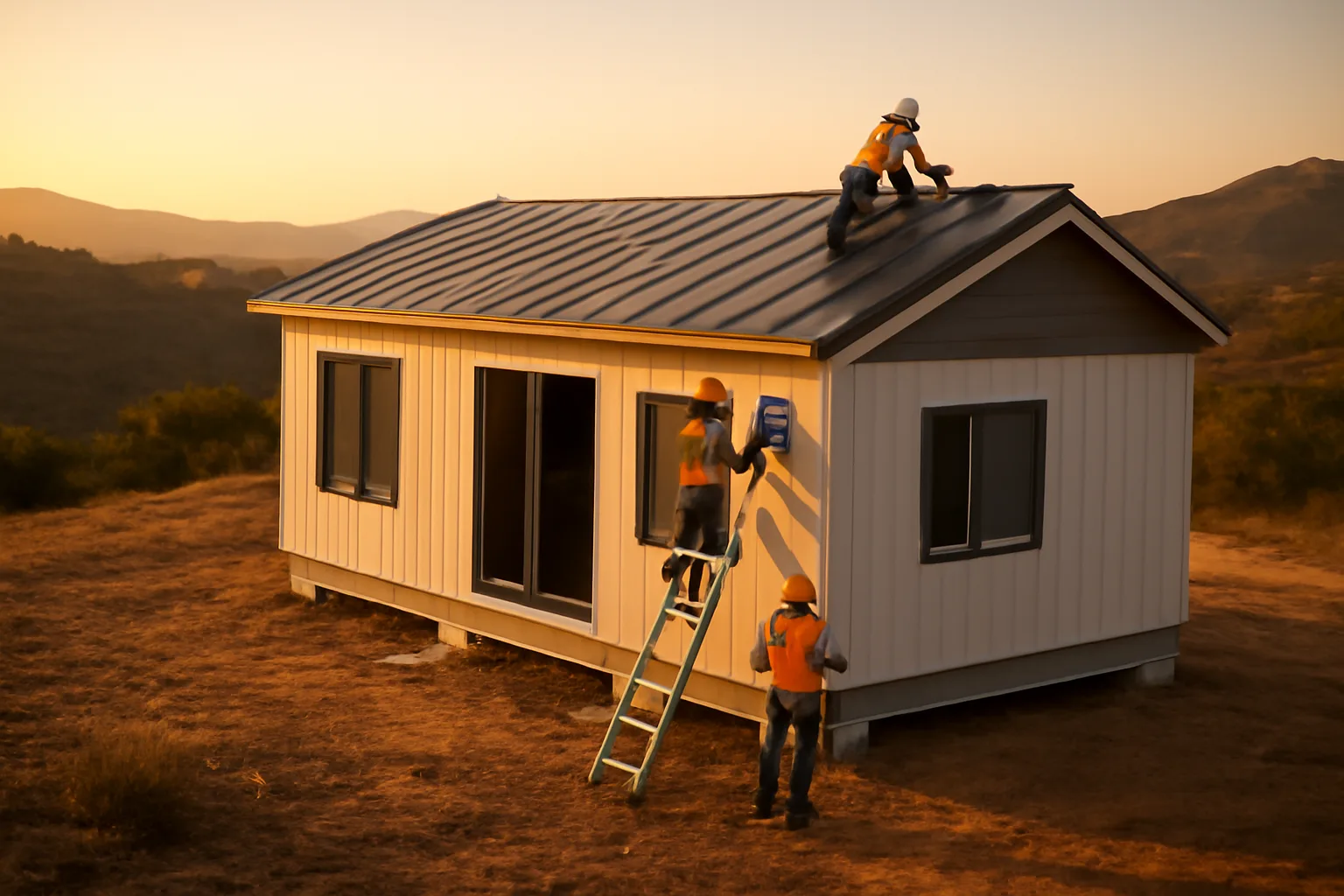
A fire resistant modular home in California is built to Chapter 7A of the California Building Code, the wildland-urban interface (WUI) fire standard that applies to new construction in State Responsibility Areas and designated Very High Fire Hazard Severity Zones [1]. Modular and manufactured homes aren't exempt just because they're built off-site. If the home lands in a WUI zone, it needs the same ignition-resistant assemblies as a stick-built house: Class A roofing, ignition-resistant or noncombustible siding, dual-pane windows with at least one tempered pane, boxed-in eaves, and vents rated to resist ember intrusion. The California State Fire Marshal maintains the actual testing standards under SFM 12-7A, which cover everything from exterior wall siding and sheathing (12-7A-1) to vents (12-7A-3) to decking (12-7A-4a) [2]. A manufacturer can't just slap "fire resistant" on a spec sheet. The product has to pass a specific test, and the module has to carry documentation showing it was built to that listing. This matters because modular construction happens in a factory, then gets trucked to the lot and set on a foundation. The fire hardening has to be baked in before it ever leaves the plant. Retrofitting a modular unit after delivery is possible for some items (vents, gutters, skirting) but not for wall assemblies or window ratings. If you're shopping modular builders, ask for their Chapter 7A compliance package up front, not after you've signed a contract. One more wrinkle: manufactured homes (the kind titled through HUD's federal code rather than a state building permit) sit in a gray area. HUD-code homes built before wildfire-zone rules tightened often don't meet 7A at all. If you're replacing a manufactured home lost to fire or trying to get one insured in a high-severity zone, check with your local building department before you buy, because some jurisdictions require full 7A compliance for any new placement regardless of HUD-code status.
When does the California defensible space law go into effect?
California's defensible space requirement itself isn't new; Public Resources Code 4291 has required 100 feet of defensible space clearance around structures in State Responsibility Areas since 2005 [3]. What's changing is enforcement and the zone structure around it. The big date to know is 2026. CAL FIRE and the Board of Forestry have been finalizing a new "Zone 0" ember-resistant zone rule, the 0-5 foot zone immediately around structures, which the state's wildfire mitigation program has targeted for adoption with an effective date tied to 2026 rulemaking under Government Code 51182 authority [4]. As of this writing, the exact statewide effective date for the Zone 0 regulation is still moving through the Board of Forestry rulemaking process, so check the current status directly with CAL FIRE's defensible space page before you plan work around it [1]. The practical answer for most homeowners: don't wait for a specific date. Insurers and inspectors are already scoring properties as if Zone 0 rules apply, because the underlying wildfire risk hasn't waited for the regulation to catch up. If you got a non-renewal notice, treat the 5-foot noncombustible zone as already required, not as something coming later. Your local fire district's defensible space timeline: ___________ (check with your county fire authority or local CAL FIRE unit for enforcement dates and any local ordinance that's stricter than the state minimum).
Why won't people follow the defensible space law in California?
Cost, confusion, and inertia are the three real reasons, and none of them are irrational on their own. Clearing 100 feet of defensible space on a sloped, brush-covered lot can run into thousands of dollars in labor, and that's before ongoing maintenance, because the work isn't a one-time job. Vegetation grows back every season. A lot of homeowners also genuinely don't know the rule applies to them. PRC 4291 applies in State Responsibility Areas and some Local Responsibility Areas with adopted VHFHSZ maps, but plenty of people bought a home years before the hazard maps were updated and never got a notice. CAL FIRE's own guidance acknowledges defensible space is "the buffer you create between a building on your property and the grass, trees, shrubs, or any wildland area that surround it" [1], but knowing the definition and knowing your specific parcel's zone and 100-foot radius are different things. There's also a trust problem. Some homeowners have watched a neighbor clear brush, get inspected, get a citation anyway over some fine-print item, and conclude the whole system is arbitrary. Others simply can't afford a contractor and don't have the physical ability to do the clearing themselves. Enforcement varies by county too: some fire districts do door-to-door inspections and issue formal notices, others rely on complaint-driven follow-up, which means compliance looks very different block to block. None of that changes what an insurer sees. If your property doesn't show cleared defensible space in an aerial or drone inspection, that's a non-renewal trigger regardless of why the work didn't happen.
How to prevent wildfires around your own property
You can't prevent wildfires in the wildland sense, but you can substantially cut the odds your specific structure ignites. The research on this is fairly consistent: most home losses in wildfires come from embers landing on or near the structure, not from a wall of flame arriving. CAL FIRE's defensible space framework breaks the work into two zones: Zone 1 (0-30 feet, remove dead vegetation, prune trees up 6 feet, space out plants) and Zone 2 (30-100 feet, reduce fuel volume, mow grass to under 4 inches) [1]. The highest-value, lowest-cost actions in order: 1. Clear leaves and needles from roof and gutters (free, do it seasonally) 2. Move firewood stacks and propane tanks at least 30 feet from structures 3. Install 1/8-inch metal mesh over attic and foundation vents to block embers 4. Remove anything combustible within 5 feet of the house (mulch, dry plants, stored items) 5. Trim tree branches so they don't overhang the roof or touch the chimney Most of that costs under $200 in materials if you do it yourself. The mesh vent screens run $10-30 each at a hardware store. Compare that to a Class A roof replacement, which can run $15,000-40,000 depending on square footage and material, and it's obvious where to start. For a full walkthrough of the near-house zone specifically, see fire safe landscaping California next to house.
How to prepare for a wildfire (and how it differs from preventing one)
Preparing for a wildfire means having your documentation, evacuation plan, and go-bag ready before a red flag warning, not scrambling once you smell smoke. Ready.gov's wildfire guidance breaks preparation into three buckets: know your zone, build a kit, make a plan. Documentation is the piece homeowners skip most often, and it's the piece that matters most after the fact. Photograph every room, your exterior siding, roof, deck, and any defensible space work you've done, dated and time-stamped. If you're rebuilding a claim or fighting a non-renewal, having before-and-after photos of your hardening work is the difference between a quick conversation and a drawn-out dispute. This is a records job, not a legal one: you're organizing what you already have so it's usable when someone asks for it. Nothing here replaces advice from a licensed insurance professional or attorney. For evacuation, ready.gov recommends having a plan that accounts for multiple routes, since a single-exit neighborhood can become a bottleneck. Know your county's evacuation zone designation before fire season starts, not during an evacuation order. A basic go-bag: medications, copies of ID and insurance documents, a change of clothes, cash, phone chargers, and pet supplies if applicable. Keep it near the door from May through November in most California fire districts, adjusted for your specific microclimate and local fire season timing. Your local fire district's evacuation zone and go-bag checklist: ___________ (confirm with your county office of emergency services).
How to prevent forest fires and how to avoid forest fires near your community
Preventing forest fires at the community level is mostly about ignition sources, since the vast majority of wildfires in California are human-caused, not lightning-caused. CAL FIRE and the U.S. Forest Service both point to equipment use, debris burning, vehicle-related sparks, and unattended campfires as the leading causes. The practical, individual-level version of "prevent forest fires": don't mow dry grass midday when it's hot and windy, don't drag trailer chains that can spark, don't park a hot vehicle on dry grass, fully extinguish campfires (drown, stir, drown again), and follow local burn permit rules, which usually require a written permit from CAL FIRE or your local air district for any outdoor burning [1]. Many counties suspend all outdoor burning during red flag warning days regardless of permit status. Community-level prevention looks more like coordinated fuel reduction. Neighborhood-wide chipper days, shared brush clearing along a shared property line, and community-level fuel breaks do more collectively than any single homeowner's 100 feet, because fire doesn't respect parcel lines. If your HOA or neighborhood association hasn't organized a group clearing day, that's often the single most cost-effective prevention step available, since contractors give volume discounts for multiple adjacent lots. See only you can prevent wildfires for the messaging history behind that phrase and what it actually means at the property level, and defensible for the base definitions this all builds on.
What fire safe rules for homes take effect in 2026?
The most significant 2026-adjacent change is the CAL FIRE Zone 0 ember-resistant zone regulation, which would require noncombustible surfaces within 5 feet of structures in the highest-risk zones [4]. As of this writing, the Board of Forestry's rulemaking timeline has targeted implementation around 2026, though the exact statewide effective date and any phase-in period for existing homes versus new construction should be confirmed directly with CAL FIRE, since rulemaking dates shift. Separately, California's building code updates on a triennial cycle, and the 2025 California Building Standards Code cycle (effective January 1, 2026 in most jurisdictions) typically folds in updated Chapter 7A material testing standards [2]. That affects new construction and major remodels, not existing homes, unless a local jurisdiction adopts a retrofit ordinance. What this means for modular home buyers specifically: if you're ordering a modular unit for delivery in 2026 or later, confirm with the manufacturer which code cycle their 7A compliance package is built to. A unit built to an older testing standard might still be legally sellable in some contexts but could complicate your insurance application if the insurer's underwriting checklist references the newer standard. Your local fire district's 2026 rule adoption status: ___________ (confirm directly with your county building department, since local adoption timing varies even after state rulemaking finalizes).
Is Santa Barbara safe from fire? What the local risk actually looks like
No California community with wildland interface, including Santa Barbara, can be called "safe" from fire risk, and the county's own history argues against it directly. Santa Barbara County has had multiple major wildfires in the last two decades, including the 2017 Thomas Fire (which at the time was the largest wildfire in modern California history by acreage) and the subsequent 2018 Montecito debris flow that killed 23 people in the fire's burn scar area [5]. Much of the Santa Barbara foothill and mountain-adjacent area sits within CAL FIRE's Very High Fire Hazard Severity Zone designation, which triggers PRC 4291 defensible space requirements and Chapter 7A construction standards for new builds [6]. The coastal flatlands closer to the ocean carry lower direct wildfire exposure, but they're not zero-risk either, since ember cast from foothill fires can travel over a mile under Sundowner wind conditions, the offshore wind pattern specific to the Santa Barbara South Coast that has driven several of the area's worst fire runs. If you're evaluating a specific Santa Barbara property, the honest answer isn't a yes/no on "safe." It's checking the parcel's specific hazard severity zone designation through CAL FIRE's FHSZ viewer, checking the defensible space history, and checking whether the home has any Chapter 7A hardening. That data point matters more than the county's general reputation either way.
How can we prevent forest fires as a community, more than a homeowner?
Community-level prevention beats individual action on cost-effectiveness, because fuel breaks, road clearance, and coordinated brush removal work at a scale no single homeowner's yard can match. The research consensus, reflected in CAL FIRE's own program design, treats defensible space and home hardening as complementary to, not a substitute for, landscape-scale fuel management [1]. What actually works at the neighborhood level: Firewise USA-recognized communities (a National Fire Protection Association program) coordinate group clearing days, shared equipment costs, and joint contractor bids. Getting your neighborhood Firewise-recognized can also factor into some insurers' underwriting decisions, though it's not a guarantee of coverage. At the individual level, the highest-leverage community contribution is simple: do your own defensible space work so your property doesn't become the ignition point that threatens your neighbors' homes too. Fire spread in the 2018 Camp Fire and 2017 Tubbs Fire moved structure-to-structure in dense subdivisions once ember cast ignited a handful of homes, meaning one poorly hardened property can put a whole block at risk. Reporting hazards matters too: downed power lines, illegal debris burns, and abandoned campfires should go to your local fire department or CAL FIRE's reporting line immediately, not "later."
What does Chapter 7A actually require, item by item?
| Roofing | Class A roof covering | SFM 12-7A-1 | |
|---|---|---|---|
| Vents | Ember- and flame-resistant, 1/8" mesh minimum | SFM 12-7A-3 | |
| Exterior siding | Ignition-resistant material or noncombustible | SFM 12-7A-1 | |
| Windows | Multi-pane glazing, one tempered pane minimum | SFM 12-7A-2 | |
| Decking | Ignition-resistant decking materials | SFM 12-7A-4a | |
| Eaves | Boxed or enclosed eave construction | Ch. 7A general | |
| Underfloor/skirting | Enclosed, ember-resistant skirting | Ch. 7A general | Source: California State Fire Marshal, SFM 12-7A standards series [2]. For manufactured and modular homes specifically, the skirting and underfloor enclosure item is where a lot of older or budget units fail. HUD-code manufactured homes traditionally used open or vinyl skirting that doesn't meet ember-resistance standards. If you're buying used or relocating an existing manufactured home into a WUI zone, budget for skirting replacement even if everything else on the unit checks out. |
Chapter 7A breaks the home into assemblies and sets a testing standard for each one, and this is the checklist worth bringing to any modular builder conversation. | Assembly | Requirement | SFM Standard |
How much does fire resistant modular construction actually cost?
Expect roughly 5-15% above a standard modular baseline for full Chapter 7A compliance, though the range depends heavily on which assemblies your base model already includes. Some manufacturers now build 7A compliance into their standard California spec by default, since it's required for delivery into SRA zones anyway, which narrows the premium to closer to 3-8% over a comparable non-WUI unit. The line items that move the needle most: Class A roofing (often a $3,000-8,000 upgrade over a standard asphalt shingle package depending on size and material choice), ignition-resistant siding versus standard vinyl or fiber cement (variable, sometimes a wash if the base spec already uses fiber cement), and tempered dual-pane windows (a modest per-unit upgrade, usually a few hundred dollars per window over standard glazing). The number that's harder to pin down nationally: labor and delivery costs vary enormously by region and site accessibility, so any total-project figure should come from a quote specific to your parcel, not a national average. Worth noting: for homeowners rebuilding after a total loss, insurance settlements sometimes cover code-upgrade costs under an ordinance-or-law endorsement, but whether that applies to your policy is a question for your insurer or agent directly, not something to assume.
What should you document before and after fire hardening work?
Insurers evaluating you for renewal or new coverage want to see dated evidence, not a verbal description of what you did. Photograph the roof (close enough to show material and condition), all vents with mesh screens installed, the 5-foot zone around the foundation, gutters, and any defensible space clearing, before work starts and again after it's done. Keep contractor invoices, material spec sheets (especially anything showing an SFM 12-7A listing number for siding or vents), and any inspection reports from your local fire district. If your fire district does a defensible space inspection, ask for a copy of the written result, more than a verbal pass. This is where organizing the paperwork ahead of time saves real time later. A pre-built binder or folder structure, matched to what CAL FIRE's defensible space checklist and typical insurer inspection forms actually ask for, means you're not scrambling to reconstruct a timeline from memory when a non-renewal letter arrives. DefensibleHome's $99 Wildfire Insurance Survival Kit (see the survival kit builder) is built around exactly that structure: a documentation framework for your hardening work and defensible space history that you assemble yourself and send directly to your insurer. It doesn't file claims or negotiate anything on your behalf; it's a way to have your own case organized in the format insurers actually ask for. For a broader look at how insurers evaluate a property after a fire event nearby, see house fire and fire at a house.
Where should you start if you got a non-renewal letter this year?
Start with the letter itself: most non-renewal notices cite a specific reason (defensible space, roof material, distance to wildland, brush density) and California law requires most insurers to give at least 75 days notice before non-renewal takes effect under California Insurance Code 678 . Read that reason carefully, because it tells you exactly what to fix or document first. Next, pull your parcel's Fire Hazard Severity Zone designation from CAL FIRE's public map viewer, since that's the same data your insurer used. If you're in a Very High zone, assume Chapter 7A and full 100-foot defensible space compliance are both baseline expectations, not optional upgrades. Then prioritize cheap, fast, high-visibility fixes first: vent screens, roof and gutter clearing, and removing anything combustible within 5 feet of the structure. These are the items a reinspection can verify in one visit, and they're the ones most non-renewal letters cite specifically. Finally, document everything as you go, because the same photo evidence that helps you push back on a non-renewal is what a new insurer's underwriter wants to see on an application. Nothing about this process is legal or insurance advice, and none of it guarantees reinstatement or a discount; it's about giving yourself the strongest possible paper trail.
Frequently asked questions
When does the California defensible space law go into effect?
The core defensible space requirement (100 feet of clearance under Public Resources Code 4291) has been in effect since 2005. The newer Zone 0 ember-resistant zone rule (0-5 feet) is in CAL FIRE's Board of Forestry rulemaking process with an implementation target around 2026; confirm the current status on CAL FIRE's defensible space page since rulemaking dates shift.
Why won't people follow the defensible space law in California?
Cost, lack of awareness of which parcels are covered, and inconsistent enforcement across counties are the main reasons. Clearing 100 feet of vegetation on a sloped lot can cost thousands of dollars and needs repeating seasonally, and many homeowners never received formal notice their property falls inside a State Responsibility Area or Very High Fire Hazard Severity Zone.
How do I prevent wildfires around my own home?
Clear roof and gutter debris, install 1/8-inch metal mesh over vents, remove combustibles within 5 feet of the structure, and keep defensible space zones (0-30 ft and 30-100 ft) maintained per CAL FIRE guidance. Most of this costs under a few hundred dollars in materials if done yourself, versus tens of thousands for a full roof replacement.
How do I prepare for a wildfire if I live in a high-risk zone?
Know your evacuation zone, build a go-bag with medications, ID copies, and insurance documents, and photograph your home's exterior and any hardening work before fire season. Ready.gov recommends planning multiple evacuation routes in advance, since single-exit neighborhoods can bottleneck during an active evacuation order.
How do I prevent forest fires from starting in the first place?
Most California wildfires are human-caused, so avoid mowing dry grass in heat and wind, fully extinguish campfires (drown, stir, drown again), follow local burn permit rules, and don't park hot vehicles on dry grass. Local fire districts often suspend all outdoor burning during red flag warning days.
How do I avoid forest fires as a community rather than just individually?
Coordinate group brush-clearing days, get your neighborhood recognized through the National Fire Protection Association's Firewise USA program, and report hazards like downed power lines or abandoned campfires immediately. Fire spread often moves structure-to-structure once a few homes ignite, so one property's hardening protects neighbors too.
What fire safe rules for homes take effect in 2026?
CAL FIRE's Zone 0 ember-resistant zone regulation (noncombustible materials within 5 feet of structures) has an implementation target around 2026, pending final Board of Forestry rulemaking. California's 2025 building code cycle, effective January 1, 2026 in most jurisdictions, also updates Chapter 7A testing standards for new construction.
Is Santa Barbara safe from fire?
No, especially in foothill and mountain-adjacent neighborhoods within CAL FIRE's Very High Fire Hazard Severity Zone. The county experienced the 2017 Thomas Fire and the 2018 Montecito debris flow that killed 23 people. Coastal flatland areas carry lower direct exposure but aren't risk-free, since ember cast can travel over a mile in Sundowner wind events.
Are modular homes required to meet California's wildfire building code?
Yes, if the home is placed in a State Responsibility Area or a designated Very High Fire Hazard Severity Zone, it must meet Chapter 7A regardless of whether it's built modular, site-built, or manufactured. The factory has to build in ignition-resistant assemblies before delivery, since some items can't be retrofitted after the unit is set.
How much more does a fire resistant modular home cost compared to standard construction?
Roughly 5-15% more than a non-compliant baseline model, though many California-spec modular units now include Chapter 7A compliance by default, narrowing the premium to 3-8%. Class A roofing and ignition-resistant siding are typically the largest line-item cost drivers.
Can an older manufactured home be retrofitted to meet Chapter 7A standards?
Partially. Vents, gutters, and skirting can often be retrofitted, but wall assemblies and window glazing generally can't be upgraded after the unit is built. If you're relocating an older manufactured home into a WUI zone, check with your local building department, since some jurisdictions require full compliance regardless of the home's age.
What happens if I don't comply with defensible space requirements before a fire district inspection?
Consequences vary by county but can include a citation, a required compliance timeline, potential fines, and in some cases referral that affects your insurance standing. Requirements and enforcement differ by local fire district, so check directly with your county fire authority for your area's specific process.
Sources
- CAL FIRE, Defensible Space: Definition of defensible space, Zone 1 (0-30 ft) and Zone 2 (30-100 ft) requirements
- California State Fire Marshal, Building Materials Listing / SFM 12-7A Standards: Chapter 7A testing standards for siding, vents, windows, and decking
- California Public Resources Code Section 4291: 100-foot defensible space clearance requirement in State Responsibility Areas since 2005
- California Government Code Section 51182: Statutory authority for defensible space and Zone 0 ember-resistant zone rulemaking
- CAL FIRE, Fire Hazard Severity Zone Maps: Very High Fire Hazard Severity Zone designations covering Santa Barbara foothill areas
- California Insurance Code Section 678: Minimum notice period insurers must give before non-renewal takes effect