Last updated 2026-07-25
TL;DR
A fire risk consultant inspects your home's defensible space, roof, vents, and siding, then writes a report you can use for insurance or permits. Costs run roughly $300 to $3,000 depending on property size and report depth. Most homeowners can do 80% of this themselves using CAL FIRE and state fire marshal checklists first, then hire a consultant only for code compliance sign-off or insurer documentation.
What does a fire risk consultant actually do?
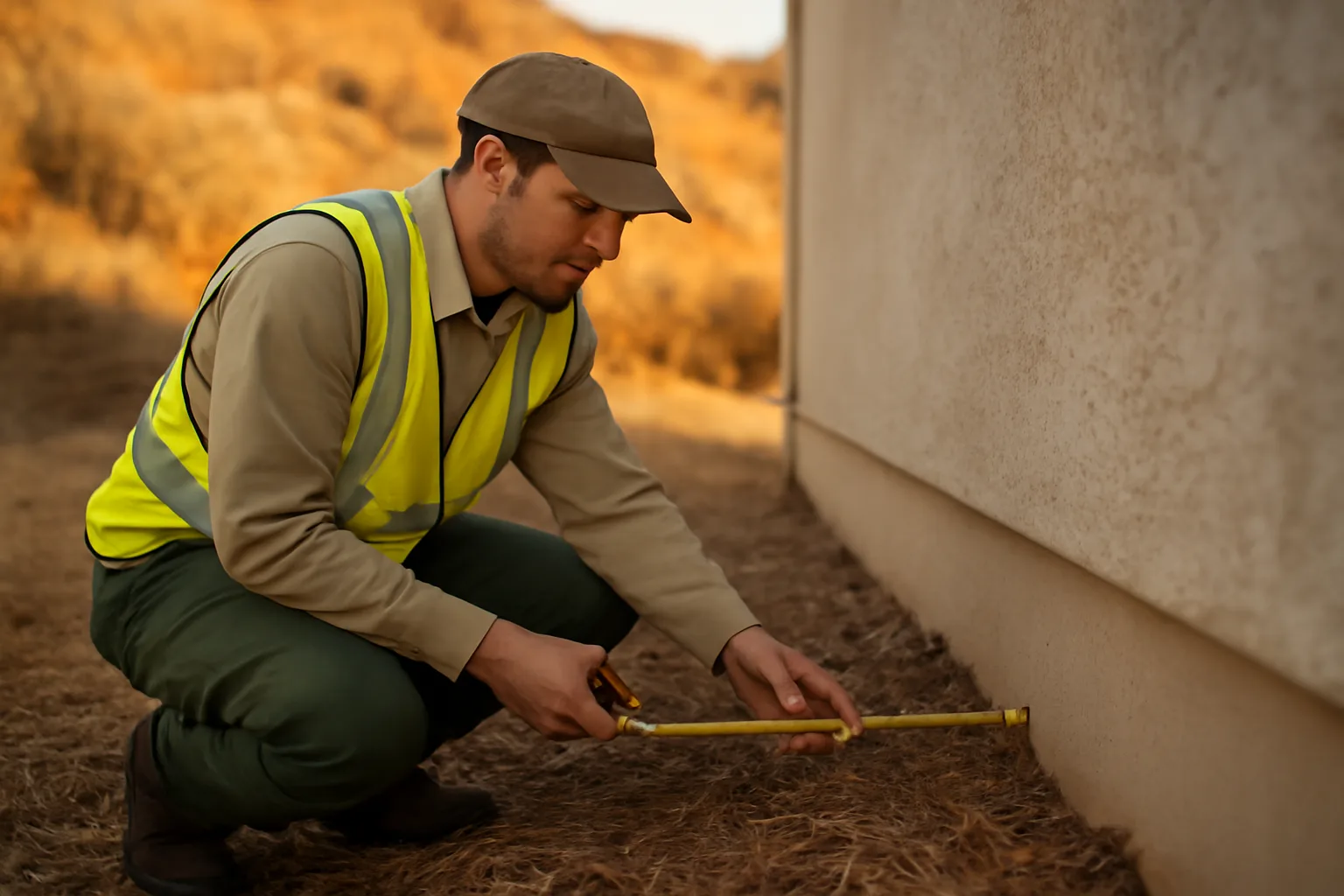
A fire risk consultant (sometimes called a wildfire risk assessor or defensible space inspector) walks your property and rates it against known fire-behavior factors: the condition of your roof and gutters, vent screening, siding material, deck construction, and the vegetation in the zones immediately around your house. They usually produce a written report with photos, a risk score or checklist, and a prioritized list of fixes. Some consultants are independent generalists who work for homeowners directly. Others work for insurance carriers or state programs and show up because of a policy review, not because you hired them. In California, local fire agencies also do defensible space inspections as part of code enforcement under Public Resources Code 4291, and those inspections are free but carry legal weight (a violation notice, more than advice). The useful distinction: a paid private consultant works for you and can advise on insurance strategy, phased budgeting, and documentation. A public agency inspector or insurer-sent inspector is checking compliance or underwriting risk, and their report can trigger a notice of violation or a non-renewal. Know which one is standing on your porch before you ask questions. If you already got a non-renewal letter, a private consultant's report is mostly useful as a paper trail. You are not required to hire one, and nothing they write can force your insurer to reinstate coverage. We do not file claims or promise coverage outcomes on anyone's behalf. What a good report does is give you a dated, photographed record of the work you've done, which you can send yourself when you shop for new coverage or apply to a state FAIR Plan. See our related breakdown on fire safe landscaping in California next to the house for the vegetation-spacing rules a consultant will check first.
How much does a fire risk consultant cost?
| Self-assessment (CAL FIRE checklist) | $0 | Checklist, no report |
|---|---|---|
| Local fire agency inspection (CA, per PRC 4291) | $0 (mandated) | Compliance notice, no fixes advice |
| Independent consultant, basic report | $300-$800 | Photos, priority list |
| Independent consultant, insurance-ready report | $800-$1,500 | Detailed report, product specs |
| Certified wildfire mitigation specialist, large property | $1,500-$3,000+ | Full site plan, phased budget |
Expect somewhere between $300 and $1,500 for a standard single-family home assessment from an independent consultant, and up to $3,000 or more for larger acreage, complex terrain, or a report written specifically for insurance submission or a building permit variance. Prices vary a lot by state and by whether the consultant is a certified wildfire mitigation specialist, a licensed arborist, or a general home inspector who added wildfire to their service list. There is no federal fee schedule for this work, and no single national licensing body, so pricing is set by local market and by how detailed the deliverable is. A one-page checklist costs less than a 20-page report with photo documentation, distance measurements, and specific product recommendations (Class A roofing, ember-resistant vents, etc.). Free alternative: CAL FIRE's Ready for Wildfire program and most state forestry agencies publish self-assessment checklists at no cost. Colorado State Forest Service, Oregon Department of Forestry, and the Arizona State Forestry Division all publish similar home-assessment guides. Start there before paying anyone. | Assessment type | Typical cost | What you get |
When does the California defensible space law go into effect?
California's core defensible space law, Public Resources Code Section 4291, already applies today. It requires 100 feet of defensible space clearance around structures in State Responsibility Areas and some Local Responsibility Areas classified as very high fire hazard severity zones. This is not a future date; it's current law and has been since a 2005 expansion from the original 30-foot standard [1]. What is genuinely upcoming is the Zone 0 ember-resistant zone regulation. Assembly Bill 3074 (2020) directed the Board of Forestry and Fire Protection to develop regulations for a 0-to-5-foot zone immediately around the structure, which would restrict combustible mulch, plants, and stored materials directly against the house. As of the most recent Board of Forestry rulemaking updates, Zone 0 regulations have been under formal development, with the Board's public workshops and 45-day comment periods proceeding through 2024 and 2025 [2]. Homeowners should check the Board of Forestry's current regulatory status page directly, because proposed effective dates have shifted more than once during rulemaking. Don't wait for the final rule to start on Zone 0 in practice. CAL FIRE's existing guidance already recommends non-combustible material within 5 feet of the home; you're just getting ahead of a rule that's coming, not guessing at one that doesn't exist yet.
What fire-safe home rules take effect in 2026?
This is the one people search for but the honest answer is: check your specific jurisdiction, because there is no single nationwide 2026 fire code. California's Zone 0 ember-resistant zone rule, once finalized by the Board of Forestry and Fire Protection, is the most likely candidate to phase in around new construction first, with existing homes following on a longer compliance timeline that the Board sets in the final regulation text [2]. Some CAL FIRE guidance documents have referenced a 2026 target for new construction compliance in very high fire hazard severity zones, but treat any specific date as provisional until you see it published in the California Code of Regulations, Title 14. Separately, some local building departments and insurers are independently pulling forward wildfire-hardening requirements into their own 2025-2026 permit cycles, ahead of any state mandate. That means your county or your specific fire district could already require Class A roofing or ember-resistant vents on remodels, even if the state Zone 0 rule isn't final yet. [Local fire district rule check: enter your county/fire district name here to see current defensible space and building code requirements specific to your parcel.] The practical move: call your local building department and ask directly what wildfire-related code applies to permits pulled this year. Don't rely on a blog post (including this one) for the exact clause number in your jurisdiction.
Why won't people follow the defensible space law in California?
Cost, confusion about what counts as compliant, and enforcement that varies wildly by county are the three real reasons. CAL FIRE's own materials note that defensible space work is often deferred because homeowners underestimate the labor involved or assume a single mow satisfies the 100-foot requirement, when the law actually breaks that space into two zones with different rules [1]. Zone 1 (0-30 feet from structures) requires removing dead vegetation, thinning tree canopies, and keeping grass under about 4 inches. Zone 2 (30-100 feet) allows more vegetation but requires spacing between shrubs and trees to break up continuous fuel. Both zones need ongoing maintenance, not a one-time clearing, and that recurring labor cost is where a lot of compliance quietly lapses. Enforcement gaps matter too. Local fire agencies are supposed to conduct defensible space inspections, but staffing is thin in many rural counties, and a first violation often results in a warning rather than a fine. Homeowners who don't get inspected in a given year sometimes assume they're fine, until a wildfire event or an insurance inspection reveals otherwise. There's also a real disagreement between what looks good and what's fire-safe. Homeowners like mature trees and lush landscaping right next to the house; the law wants the opposite in the first 5 to 30 feet. That aesthetic tension is a genuine, unresolved reason compliance lags, more than laziness or ignorance. If you're not sure where your property currently stands, our guide to defensible space breaks down the zone-by-zone requirements in plain language.
How do I prevent wildfires around my home?
You reduce wildfire risk around a structure through three layers: the home itself (roof, vents, siding, gutters), the immediate zone within 5 feet (Zone 0), and the vegetation management zone out to 100 feet or your property line. Ready.gov's wildfire preparedness guidance frames this as reducing 'the risk of a wildfire spreading to your home' through both structural hardening and vegetation clearance, more than one or the other. Start with the home. Class A fire-rated roofing, metal or ember-resistant vent screens (1/8 inch mesh, no larger), and enclosed eaves matter more than most people think, because embers traveling ahead of a fire front cause most home ignitions, not direct flame contact. CAL FIRE research and NFPA studies on the 2007-2018 California wildfires repeatedly found ember intrusion through vents and gaps as a leading ignition pathway. Then work outward. Clear dead leaves and pine needles from gutters and roof valleys. Keep firewood stacks and propane tanks at least 30 feet from structures. Prune tree limbs so the lowest branches are 6 to 10 feet off the ground (this prevents a ground fire from 'laddering' into the canopy). None of this is exotic advice; it's the same list CAL FIRE, Ready.gov, and most state forestry agencies publish, because it's the list backed by actual post-fire structure surveys [1]. For the parts of your property involving actual removal of fuel, hiring licensed clearing crews (more than any landscaper) matters for both safety and documentation. If you're in Washington State, our piece on defensible space clearing contracts through the state DNR covers what a proper contract should include.
How do I prepare for a wildfire?
Preparation splits into two tracks: getting your home ready to survive an ember exposure, and getting your household ready to evacuate fast if the fire is close. Ready.gov recommends building a go-bag with medications, copies of insurance and identification documents, and a family communication plan before fire season starts, not during an active evacuation order. On the home side, the defensible space work described above is the foundation. Add to that: know your evacuation zone and route (many counties now use Genasys or similar zone-based evacuation apps), sign up for local emergency alerts, and keep your car fueled above half a tank during red flag warning periods. Documentation before a fire matters as much as documentation after. Photograph or video every room of your house, your exterior, and your defensible space work, dated and saved somewhere off-property (cloud storage, more than your phone). If you ever need to file an insurance claim, this record is the single most useful thing you can hand over, and it costs nothing but an afternoon. This is the exact gap our $99 Wildfire Insurance Survival Kit is built for: a structured way to document your home, your mitigation work, and your defensible space status before you need it, so you're not scrambling during an evacuation or a non-renewal notice. We don't file claims or handle insurer communications on your behalf; the kit just helps you build the paper trail yourself. Check the survival-kit-builder if you want a structured starting point.
How do I prevent forest fires (and how is that different from home protection)?
Preventing forest fires broadly is about ignition sources: campfires, equipment sparks, downed power lines, and arson account for the large majority of wildfire starts, while lightning causes the rest. The US Forest Service and CAL FIRE both report that human-caused ignitions make up roughly 85-90% of wildfires nationally in various annual reporting periods, though the exact percentage shifts year to year and by region. At the personal level, forest fire prevention means: fully extinguishing campfires (drown, stir, drown again, until cold to the touch), not parking hot vehicles on dry grass, maintaining equipment that could throw sparks (mowers, chainsaws, ATVs), and following local burn ban restrictions during red flag conditions. These are the fire-cause categories CAL FIRE tracks and the ones state 'only you can prevent' campaigns target directly. Home protection is a separate, narrower problem: given that a wildfire is going to happen somewhere in your region eventually, does your specific structure survive contact with embers and radiant heat? You can't personally prevent every forest fire ignition. You can meaningfully control whether your house is one of the ones left standing afterward, and that's the more useful thing to spend your money and weekends on. For the messaging behind the classic campaign, see only you can prevent wildfires.
Is Santa Barbara safe from fire?
No coastal California city is 'safe' from wildfire risk in the way that word usually means, and Santa Barbara County has a documented history of major fires, including the 1990 Painted Cave Fire and the 2017 Thomas Fire, which at the time was the largest wildfire in modern California history by acreage before being surpassed by later fires [3]. The Thomas Fire burned over 281,000 acres and destroyed more than 1,000 structures across Ventura and Santa Barbara counties [3]. Much of Santa Barbara County, particularly the foothill and mountain-adjacent neighborhoods (Montecito, the Riviera, San Roque foothills), sits within or near CAL FIRE-designated Very High Fire Hazard Severity Zones. You can check the exact designation for any specific address using CAL FIRE's Fire Hazard Severity Zone viewer, which is the authoritative source rather than any general statement about the city [4]. The honest framing: Santa Barbara isn't uniquely dangerous compared to other Southern California wildland-urban interface communities, but it isn't safe either, and the specific answer depends entirely on which neighborhood and how close to open hillside vegetation a given property sits. If you live there or somewhere similar, treat your specific parcel's fire hazard severity zone rating as the real answer, not the city's reputation.
How can we prevent forest fires as a community, more than individually?
Community-level prevention layers on top of individual action: coordinated fuel breaks, prescribed burns managed by state forestry agencies, power line maintenance and vegetation clearance by utilities, and enforced burn bans during red flag conditions. CAL FIRE's Vegetation Management Program and similar programs in Oregon and Colorado use prescribed fire and mechanical thinning on public and cooperating private land specifically to reduce the fuel loads that turn small fires into catastrophic ones. HOAs and neighborhoods can organize group defensible space days, shared chipper rental for cleared brush, and coordinated requests to local fire agencies for community-wide inspections. Insurers increasingly look at community-level mitigation too; some California FAIR Plan and admitted-market discount programs reference whether a community has a Firewise USA recognition (a National Fire Protection Association program) as part of underwriting conversations, though this varies by carrier and isn't a guarantee of coverage or pricing changes. None of this replaces the work on your own parcel. A neighborhood with great fuel breaks and one house with a wood shake roof and needles in the gutters still has a real ignition point. Community prevention and individual hardening are both necessary; neither substitutes for the other.
Should I hire a consultant or do the assessment myself first?
Do the free self-assessment first, always. CAL FIRE's Ready for Wildfire home assessment checklist and the Insurance Institute for Business & Home Safety's Wildfire Prepared Home standard both give you a real, specific list to walk your own property against before you spend a dollar on a consultant [5]. Hire a paid consultant when you need one of these specific things: a written, dated, photographed report to submit for an insurance appeal or new-carrier application; a professional opinion on a genuinely ambiguous compliance question (a slope, a neighbor's overhanging tree, an easement); or a full property plan if you own several acres and don't know where to start. If your situation is 'my insurer sent a non-renewal letter and I need to show I did the work,' a consultant's dated report is worth the few hundred dollars, mainly because it's independent and time-stamped. Skip the consultant if you just want the basic checklist done. A weekend with a rake, pruning shears, and the CAL FIRE zone guide gets most homes 80% of the way there for the cost of your own time. Save the consultant budget for the harder 20%: roof and vent upgrades, tree removal decisions, and anything requiring a permit. One more note on scope: neither a private consultant nor this article can get your policy reinstated or resolve a claim on your behalf. If you're dealing with a non-renewal, the consultant's report is documentation you send yourself; the decision stays with the insurer and your state's licensed agents or public adjusters, not with the person who wrote the report.
Frequently asked questions
When does the California defensible space law go into effect?
The core 100-foot defensible space law (Public Resources Code 4291) is already in effect and has applied since a 2005 expansion. What's still being finalized is the Zone 0 ember-resistant zone rule from AB 3074, which the Board of Forestry and Fire Protection has been developing through public rulemaking; check the Board's current status page for the final effective date.
Why won't people follow the defensible space law in California?
Mainly cost, unclear expectations, and inconsistent enforcement. Clearing and maintaining two vegetation zones is ongoing labor, not a one-time job, and many rural counties don't have staff to inspect every property yearly. There's also a real aesthetic conflict: the law wants sparse vegetation right next to the house, which many homeowners find unattractive.
How do I prevent wildfires around my property?
Combine home hardening (Class A roof, ember-resistant vents, clean gutters) with defensible space clearing in the zones nearest your house. CAL FIRE and Ready.gov both frame ember intrusion, not direct flame contact, as the leading cause of home ignition, so vent screening and roof maintenance matter as much as clearing brush.
How do I prepare for a wildfire evacuation?
Build a go-bag with medications, ID copies, and insurance documents, know your evacuation zone and route, and sign up for local emergency alerts. Ready.gov recommends doing this before fire season, not during an active warning. Also photograph your home and defensible space work now, stored off-property, for any future insurance need.
How do I prevent forest fires from starting in the first place?
Most wildfires are human-caused: fully extinguish campfires (drown, stir, drown again), avoid parking hot vehicles on dry grass, maintain spark-prone equipment, and follow local burn restrictions during red flag warnings. CAL FIRE and the US Forest Service attribute the large majority of ignitions to human activity rather than lightning.
What fire-safe home rules take effect in 2026?
There's no single nationwide 2026 rule. California's Zone 0 ember-resistant zone regulation is the most likely candidate for a 2026-ish phase-in, but the exact date depends on final Board of Forestry rulemaking. Check your specific county or fire district, since some have already pulled wildfire code requirements into current permit cycles.
Is Santa Barbara safe from fire?
No coastal California city is fully safe from wildfire risk. Santa Barbara County has a documented history of major fires including the 1990 Painted Cave Fire and the 2017 Thomas Fire (over 281,000 acres, 1,000+ structures lost). Check CAL FIRE's Fire Hazard Severity Zone viewer for your specific address rather than relying on the city's general reputation.
How can we prevent forest fires as a community?
Coordinated fuel breaks, utility vegetation clearance around power lines, prescribed burns run by state forestry agencies, and enforced burn bans during red flag conditions all reduce community-wide risk. Programs like Firewise USA (NFPA) help neighborhoods organize, though individual home hardening still matters even in a well-prepared community.
What does a fire risk consultant actually check?
A typical inspection covers roof condition and material, vent screening, gutter debris, siding material, deck construction, defensible space vegetation clearance in Zones 1 and 2, and proximity of woodpiles or propane tanks to the structure. Reports usually include photos and a prioritized fix list.
How much does a fire risk consultant cost?
Expect $300 to $1,500 for a standard home assessment, and up to $3,000 or more for larger properties or insurance-ready reports with detailed product recommendations. Free alternatives exist: CAL FIRE and most state forestry agencies publish self-assessment checklists at no cost.
Can a fire risk consultant get my insurance reinstated?
No. A consultant's report documents mitigation work but has no authority over your insurer's underwriting decision. Homeowners send the report themselves as supporting documentation when shopping for coverage or appealing a non-renewal; nobody, consultant or otherwise, can promise coverage, discounts, or reinstatement.
Is a free CAL FIRE inspection different from a paid consultant?
Yes. A local fire agency inspection under Public Resources Code 4291 checks legal compliance and can result in a violation notice; it's not advice-focused. A paid private consultant works for you, offers prioritized recommendations, and produces documentation you control, but carries no legal enforcement weight.
What's the difference between Zone 0, Zone 1, and Zone 2 defensible space?
Zone 0 (0-5 feet from the structure) is the ember-resistant zone under development via AB 3074, aiming for non-combustible materials immediately against the house. Zone 1 (0-30 feet) requires removing dead vegetation and thinning canopy. Zone 2 (30-100 feet) allows more vegetation but requires spacing to break up continuous fuel.
Sources
- California Public Resources Code Section 4291: 100-foot defensible space clearance requirement in State Responsibility Areas
- California Board of Forestry and Fire Protection, Zone 0 rulemaking (AB 3074): Zone 0 ember-resistant zone regulation development and rulemaking status
- CAL FIRE, Thomas Fire incident record: Thomas Fire acreage and structure loss figures in Santa Barbara/Ventura counties
- CAL FIRE, Fire Hazard Severity Zone Viewer: Address-level Fire Hazard Severity Zone designation lookup
- Insurance Institute for Business & Home Safety, Wildfire Prepared Home standard: Home hardening standard used as an alternative to hiring a paid consultant