Last updated 2026-07-25
TL;DR
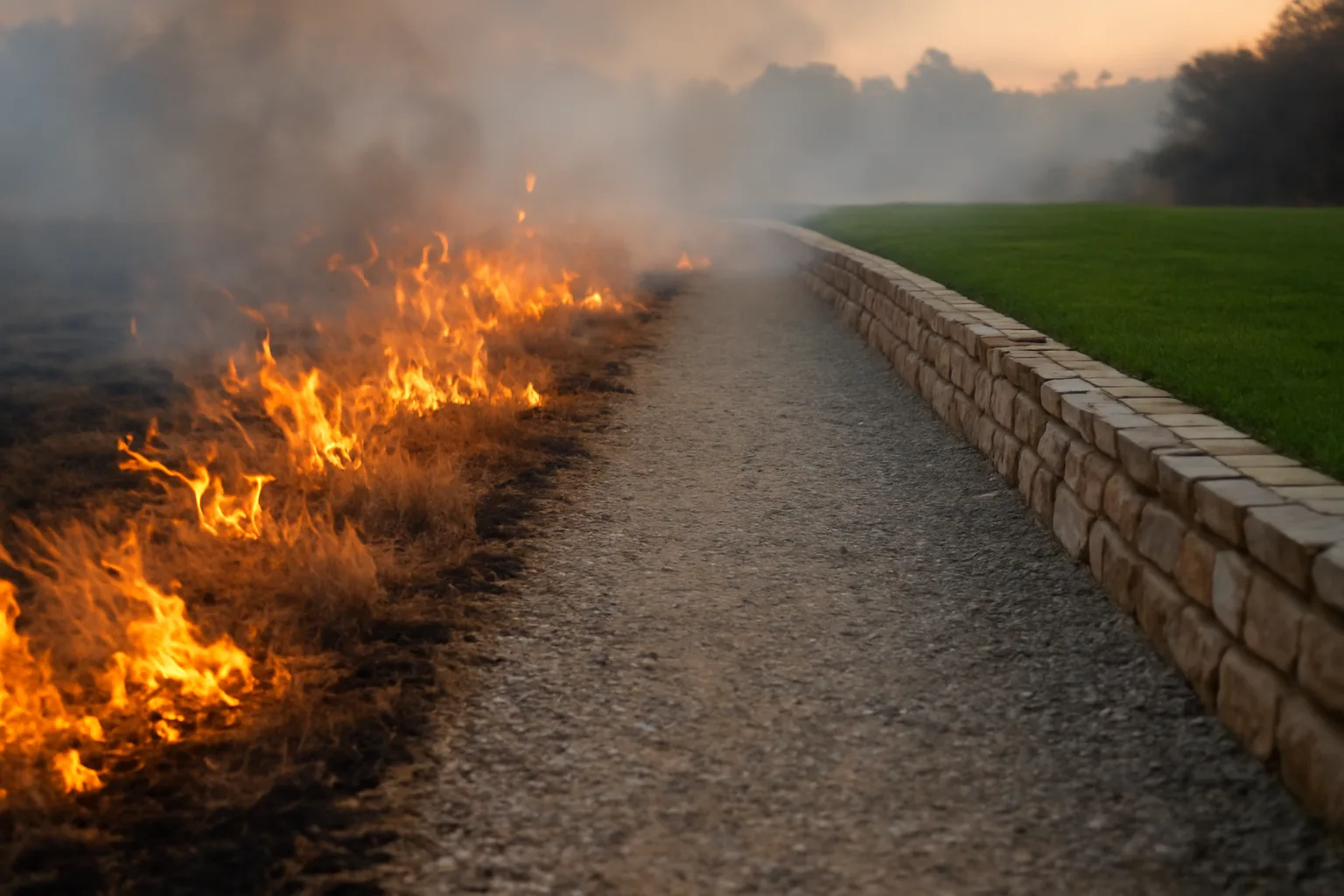
Wildfires stop naturally when they run out of burnable fuel, hit a barrier like rock, water, or wet green vegetation, or lose the wind that's pushing them. Rain and dropping temperatures help, but fuel and terrain matter more. Homeowners can copy this logic at home scale by building fuel breaks and defensible space so fire has nothing left to burn near the house.
How do wildfires stop naturally, without firefighters?
A wildfire stops on its own when one of three things happens: it runs out of fuel, it hits a barrier that fuel can't cross, or the wind and weather conditions that were driving it change enough to slow the flame front. Firefighters spend most of their effort trying to recreate these conditions faster and in a more controlled spot, but fire has been doing this on its own for longer than humans have existed. Fuel exhaustion is the most common natural stop. A fire moving through dry grass and brush will slow down and die out when it reaches an area that was already burned recently, a rockslide, a river, or short green irrigated vegetation that doesn't carry flame well. CAL FIRE's own fire behavior guidance notes that the three factors controlling wildfire spread are fuel, weather, and topography [1], and when any one of those runs out or changes sharply, the fire's momentum breaks. Topography also stops fires on its own. Fire moves fast uphill because heat rises and preheats the fuel above it, but it slows dramatically once it crests a ridge and starts moving downhill into cooler, often damper air. Rivers, lakes, and wide rock fields do the same job as a bulldozed fuel break, just built by geology instead of a dozer operator. Weather is the wildcard. A wind shift, a drop in temperature, or rising humidity overnight (called "relative humidity recovery" by fire behavior analysts) can take a fire from running crown fire to a smoldering ground fire within hours. None of this is guaranteed, and a fire that seems to be dying can flare back up the next afternoon once temperatures climb and humidity drops again.
What actually stops a wildfire (fuel, weather, terrain, or humans)?
| Fuel runs out | Fire has nothing left to consume (rock, water, already-burned ground, green irrigated lawn) | Natural | |
|---|---|---|---|
| Terrain changes | Fire crests a ridge, drops into a canyon with cooler air, or hits a river/lake | Natural | |
| Weather shifts | Wind dies down, humidity rises overnight, rain falls | Natural, sometimes seasonal | |
| Human suppression | Firebreaks, retardant drops, hand crews cutting line, structure protection | Human | Rain is the factor everyone hopes for, but it's the least reliable one to plan around. A single rain event can knock down active fire behavior, yet a lot of Western wildfire seasons run from May through October with almost no rain at all in some regions, meaning fuel and terrain do most of the natural stopping work long before the first real storm arrives. This is also why defensible space matters at the home scale. You're not waiting for luck. You're building your own fuel-run-out zone around the house on purpose. CAL FIRE's defensible space standard asks for two zones: Zone 0 (0 to 5 feet from structures) and an extended zone out to 100 feet where fuel is reduced and spaced out. That's the homeowner version of the same principle that stops fires in nature: take away what it needs to keep burning. |
Four forces stop wildfires: running out of fuel, unfavorable terrain, weather shifts, and human suppression. In practice it's almost always some mix of all four, not one clean cause. Here's roughly how each factor tends to matter, based on how fire agencies describe fire behavior triggers: | Factor | How it stops fire | Natural or human-driven |
How do you prevent wildfires from starting in the first place?
Roughly 85 to 89 percent of wildfires nationally are caused by people, not lightning, according to Insurance Institute for Highway Safety data drawn from federal wildfire statistics and cited by the National Park Service. Preventing wildfires mostly means controlling human ignition sources: vehicles, equipment, campfires, debris burning, and power lines. Specific things that actually reduce ignition risk: never park a hot vehicle on dry grass (catalytic converters run over 500°F and are a documented ignition source), fully drown and stir campfires until they're cold to the touch, avoid using mowers or trimmers on dry vegetation during red flag warnings, and keep chainsaws and grinders away from dry brush without a spotter and water on hand. Ready.gov's wildfire preparedness page recommends checking local burn restrictions before any outdoor burning and avoiding all outdoor fire use during red flag warning conditions [2]. If your area allows debris burning, do it right after rain, in a cleared area, with a hose or shovel and dirt nearby, and never leave it unattended. The Smokey Bear program (US Forest Service) puts it simply: "Only you can prevent wildfires" [3], which is corny but true. Most ignition sources are avoidable. If you want the deeper version of that message and how it applies to home protection, see only you can prevent wildfires.
How do you avoid forest fires when you're out in the woods?
Avoiding forest fires while hiking, camping, or working outdoors comes down to fire discipline: know the local restrictions, keep a water source nearby, and never assume dry-looking ground is safe for sparks. Check current fire restrictions and red flag warnings before you go, since many national forests suspend campfires and even charcoal grills during high-risk stretches. A few practical habits: use existing fire rings instead of building new ones, keep fires small, never leave a fire unattended even for a few minutes, and carry at least a gallon of water or a shovel when you're doing anything that could throw a spark (grinding, welding, target shooting on dry range days). Vehicles are a bigger risk than most people think; dragging chains, dry grass against a hot exhaust, and blown tires exposing hot metal have all started real wildfires. If you smell smoke or see a column building in the distance, don't assume someone else has called it in. Call 911 with your location and a description of what you're seeing. Minutes matter enormously in the first phase of a wildfire, and most large fires started as something a person could have stepped on ten minutes earlier.
How do you prepare for a wildfire at home?
Preparing for a wildfire means doing the defensible space work before fire season, having an evacuation plan with a go-bag ready, and getting your documentation in order before you ever need to file a claim. Ready.gov recommends assembling an emergency supply kit, planning two evacuation routes, and signing up for local emergency alerts well before fire season starts [2]. On the property side, CAL FIRE's defensible space guidance is specific: clear Zone 0 completely of combustible materials within 5 feet of the structure (no mulch, no wood piles, no dry plants), then thin and space vegetation out to 100 feet where terrain requires it. This isn't a one-time project. Grass regrows, leaves pile up in gutters, and wood piles get restacked closer to the house than people remember. Plan to redo the walk-through every spring. Documentation is the part people skip and regret. Before fire season, walk your property with your phone and record video of every room, your roof, your vents, your landscaping, and your detached structures. Insurers increasingly ask for proof of mitigation work (defensible space photos, ember-resistant vent receipts, roof material documentation) either at renewal or after a claim. Keeping that record isn't insurance advice and it doesn't guarantee anything with an insurer, but it's the kind of paperwork that makes your own life easier if you ever need to show what you did and when. A $99 one-time Wildfire Insurance Survival Kit exists specifically to organize this kind of before-and-after documentation; you can build one at /survival-kit-builder, though the underlying habit (photograph everything, date it, keep it somewhere fireproof) matters more than any specific product. For the home-hardening side of prep, start with fire safe landscaping next to the house and general defensible space guidance.
When does the California defensible space law go into effect?
California's core defensible space requirement, Public Resources Code 4291, has been in effect since 2005 and currently requires 100 feet of defensible space clearance around structures in State Responsibility Areas and some Local Responsibility Areas designated as Very High Fire Hazard Severity Zones [4]. This is not a new law; it's been the standard for two decades and gets enforced through CAL FIRE and local fire agency inspections. What is new, and still being finalized, is Zone 0. California's Board of Forestry and Fire Protection has been developing regulations for an ember-resistant zone within 5 feet of structures, required under Assembly Bill 3074 (2020) [5]. As of the most recent rulemaking updates, the Board has not finalized a statewide enforcement date for Zone 0; homeowners should check the Board of Forestry's current rulemaking page directly, since draft implementation timelines have shifted more than once. Don't rely on a specific date you saw somewhere online without confirming it against the Board's current filing status. Because enforcement dates and specific clearance distances vary by local fire district and jurisdiction, confirm your exact requirements with [your local fire district / county fire marshal] before doing any clearing work, since some counties apply stricter rules than the state minimum.
What fire-safe home rules take effect in 2026?
The honest answer is that there is no single nationwide "2026 fire-safe home" rule; requirements vary by state, and several states have rulemaking in progress that could land in 2026 depending on how it goes through public comment. California's Zone 0 ember-resistant zone regulation is the biggest one to watch, since the Board of Forestry has been working toward statewide Zone 0 standards for structures in Very High Fire Hazard Severity Zones, but as of this writing no final adopted regulation with a locked 2026 effective date has been published on the Board's official rulemaking page [5]. Oregon has its own parallel track: the state's wildfire risk map and defensible space code requirements (under Oregon Senate Bill 762, 2021) have gone through multiple revisions after public pushback, and county-level defensible space rules tied to risk classifications continue to be phased in on a schedule set by the Oregon Department of Forestry [6]. Because this changes yearly and by jurisdiction, treat any specific "2026 rule" claim you read (including in this article) as something to verify against your state fire marshal's current page before acting on it. That's a guided fill-in, not a dodge: [check your state fire marshal's office] for the current adopted rule text and effective date in your area.
Why won't people follow the defensible space law in California?
Compliance with California's defensible space law is inconsistent, and the reasons aren't usually stubbornness; they're cost, labor availability, confusion about requirements, and enforcement gaps. CAL FIRE inspection data has repeatedly shown compliance rates well below 100 percent in inspected areas, though exact rates vary a lot by county and year, and CAL FIRE's own reporting notes that many properties inspected show at least one violation on first pass. Cost is real. Clearing 100 feet of defensible space on a sloped, brush-heavy lot can run into the thousands of dollars for tree removal, chipping, and hauling, and that's before ongoing maintenance since vegetation regrows every year. For homeowners on fixed incomes, especially older residents in rural areas, that's a genuine barrier, not an excuse. Confusion is the other big piece. Homeowners get letters referencing state code, local fire district rules, HOA restrictions, and sometimes conflicting guidance about what "clearance" actually means for slope, tree canopy spacing, and defensible space Zone 0 versus the outer zones. Some people also genuinely don't believe their property is at risk, especially if they haven't seen fire nearby in their own lifetime, even if they're mapped into a Very High Fire Hazard Severity Zone. Enforcement capacity matters too. CAL FIRE and local fire departments don't have unlimited inspectors, and in a lot of counties, defensible space enforcement is complaint-driven or tied to a periodic inspection cycle rather than annual mandatory checks on every parcel. That gap between what the law says and what gets checked is where a lot of noncompliance quietly lives.
How can we prevent forest fires as a community, more than a homeowner?
Community-level forest fire prevention works best when it combines coordinated fuel reduction across property lines, shared evacuation planning, and pressure on utilities and local governments to maintain infrastructure. A single homeowner clearing defensible space next to a neighbor who hasn't done the same still leaves the whole block vulnerable, since embers travel and structure-to-structure fire spread doesn't respect property lines. Firewise USA, a National Fire Protection Association program, organizes neighborhoods into recognized communities that coordinate fuel reduction, host chipper days, and track collective mitigation work [7]. It's not a magic shield, but coordinated clearing across a whole street or subdivision does more than any single house doing it alone, because it removes the fuel bridges that let fire jump from yard to yard. At a bigger scale, prescribed burning and mechanical thinning on public land reduces the buildup of dead fuel that drives the worst fire behavior. The U.S. Forest Service has stated that decades of fire suppression policy contributed to unnaturally dense fuel loads in many Western forests, which is part of why modern fire behavior can be more intense than historical fires in the same areas . Prescribed fire and thinning programs are an attempt to walk that back, though funding and staffing for this work varies year to year and has been a persistent bottleneck. For homeowners in wildfire-prone subdivisions, the community angle also means talking to neighbors about shared fuel breaks, checking in on elderly or disabled neighbors who may need help clearing, and pushing your local fire district for clarity on inspection schedules rather than assuming someone else is handling it.
Is Santa Barbara safe from fire?
No part of Santa Barbara County is fully safe from fire; large portions of the county, especially the foothill and canyon communities along the Santa Ynez Mountains, are mapped by CAL FIRE as Very High Fire Hazard Severity Zones, and the region has a documented history of major fires including the 2017 Thomas Fire and the 2018 Montecito debris flow that followed it . That history matters for a specific reason: fire risk in this kind of terrain isn't just about flame, it's about what happens after. The Thomas Fire burned through steep hillsides above Montecito in December 2017, and when heavy rain hit the burn scar in January 2018, the resulting debris flow killed 23 people, according to Santa Barbara County's official after-action reporting . That sequence, fire followed by loss of root structure followed by rain-driven mudslide, is a real risk pattern in steep coastal California terrain, not a one-off. If you live in or near Santa Barbara's foothill communities (Montecito, Mission Canyon, the Riviera, the San Roque foothills), your defensible space work matters more than average, and so does having an evacuation plan that accounts for the fact that the same hillside that burns can later slide. Check your specific parcel's Fire Hazard Severity Zone designation on CAL FIRE's mapping tool, since it varies block by block in this kind of terrain, and confirm current defensible space requirements with [Santa Barbara County Fire Department] directly.
How do you prepare for forest fires if you live near public land?
Preparing for forest fires near public land means treating your property line as the front edge of the fight, not a passive boundary. Homeowners adjacent to national forest, BLM land, or state forest land should assume fuel loads on the public side may not be actively managed on a schedule that matches their own risk tolerance, and plan defensible space accordingly. Practical steps: extend your own defensible space clearing to the maximum distance allowed on your property (even beyond the 100-foot state minimum if your lot allows it and terrain is steep), harden the structure itself with ember-resistant vents and Class A roofing, and maintain a cleared access road wide enough for fire apparatus. Ready.gov's wildfire page also recommends keeping a battery-powered radio for information if power and cell service go down, since remote properties near public land often lose both first [2]. If you're a homeowner in Washington, Oregon, or another state with active state-run defensible space cost-share or contractor programs, check whether your state's Department of Natural Resources offers subsidized clearing contracts; Washington State DNR, for example, has run cost-share and contractor-matching programs for defensible space work in wildfire-prone areas , and similar programs exist in other Western states. See wildfire defensible space clearing contracts in Washington State for how that kind of program works, since other states run comparable versions worth checking on.
What should you do right now if you got a non-renewal or inspection letter?
If you received a non-renewal notice or a defensible space inspection letter, the first move is to read exactly what it's asking for, not what you assume it's asking for. Insurance non-renewal letters in wildfire states increasingly cite specific mitigation gaps (Zone 0 clearance, vent screening, roof material) rather than a generic "high risk" statement, and knowing which specific gap triggered the letter tells you what to fix first. Second, document your current state before you touch anything. Photograph and video every side of the house, the roof, vents, gutters, and all vegetation within 100 feet, with a timestamp. This matters if you're appealing an inspection finding or trying to show an insurer you've already done work they're not crediting you for. Third, do the highest-leverage work first: Zone 0 clearance within 5 feet of the structure, ember-resistant vent screens (1/8 inch metal mesh, per CAL FIRE guidance), and clearing anything combustible touching the house (mulch, stored wood, dry plants against siding). These are cheap relative to a full landscaping overhaul and address the ignition mechanisms that actually burn most homes in wildfires: ember intrusion through vents and combustible material directly against the structure. None of this guarantees reinstatement or a lower premium, and nobody can promise that outcome, since insurers make their own underwriting decisions. What you can control is having a clean, dated record of exactly what you fixed and when. For general house fire risk factors beyond wildfire specifically, see house fire and fire at a house.
Frequently asked questions
When does the California defensible space law go into effect?
The core 100-foot defensible space requirement under Public Resources Code 4291 has been active since 2005. The newer Zone 0 ember-resistant zone rule (5 feet from structures), required by Assembly Bill 3074, is still going through Board of Forestry rulemaking as of this writing, with no finalized statewide enforcement date published yet. Check the Board's current rulemaking page for updates.
Why won't people follow the defensible space law in California?
Mostly cost, confusion, and enforcement gaps, not defiance. Clearing 100 feet of brush on a sloped lot can cost thousands of dollars and needs redoing yearly. Many homeowners also get conflicting guidance from state code, local fire districts, and HOAs, and enforcement in many counties is complaint-driven rather than a mandatory annual inspection of every parcel.
How do you prevent wildfires from starting?
Control ignition sources: never park hot vehicles on dry grass, fully drown campfires, avoid mowing or grinding during red flag warnings, and follow local burn restrictions. About 85 to 89 percent of wildfires are human-caused according to federal data cited by the National Park Service, so avoiding avoidable sparks is the single biggest prevention lever.
How do you prepare for a wildfire?
Build defensible space (Zone 0 within 5 feet, thinning out to 100 feet per CAL FIRE), pack a go-bag with an emergency kit per Ready.gov guidance, plan two evacuation routes, sign up for local alerts, and photograph your property and structures before fire season so you have dated documentation on hand.
How do you prevent forest fires while camping or hiking?
Check current fire restrictions before you go, use existing fire rings, keep fires small and never unattended, drown and stir campfires until cold, and carry water or a shovel if doing anything spark-producing. Report any smoke or fire you see immediately by calling 911 with your location.
How do you avoid forest fires with vehicles and equipment?
Don't park or idle on dry grass, since catalytic converters run over 500°F and are a documented wildfire ignition source. Avoid dragging chains, check for worn brakes that can throw sparks, and avoid mowing, grinding, or welding near dry vegetation during red flag warning days.
How do you prepare for forest fires if you live near public land?
Extend defensible space clearing as far as your lot allows, harden your structure with ember-resistant vents and a Class A roof, keep access roads clear for fire apparatus, and check whether your state runs cost-share defensible space programs, like Washington State DNR's contractor-matching programs for wildfire-prone parcels.
What fire-safe home rules take effect in 2026?
There's no single nationwide 2026 rule. California's Zone 0 ember-resistant zone regulation is in active rulemaking and could finalize around then, and Oregon's defensible space code tied to Senate Bill 762 continues phasing in by county. Always verify the current adopted rule and effective date on your state fire marshal's or Board of Forestry's official page.
Is Santa Barbara safe from fire?
No. Much of Santa Barbara County, especially foothill communities along the Santa Ynez Mountains, is mapped as Very High Fire Hazard Severity Zone by CAL FIRE. The 2017 Thomas Fire and the 2018 Montecito debris flow that followed it, which killed 23 people, show the region's compound fire-then-mudslide risk on steep terrain.
How can we prevent forest fires as a community?
Coordinate fuel reduction across property lines rather than clearing in isolation, since embers and structure-to-structure fire spread ignore property boundaries. Programs like Firewise USA (run by the National Fire Protection Association) organize neighborhoods to do joint fuel reduction, chipper days, and mitigation tracking, which does more collectively than individual homeowners acting alone.
What actually stops a wildfire without firefighters?
Running out of fuel, hitting unfavorable terrain (ridgelines, rivers, rock fields), or a weather shift like rising humidity, dropping wind, or rain. CAL FIRE describes fuel, weather, and topography as the three core factors controlling wildfire spread; when one changes sharply enough, fire momentum breaks on its own.
Does rain stop wildfires?
Rain can knock down active fire behavior quickly, but it's the least reliable factor to plan around since many Western fire seasons run months without meaningful rain. Fuel reduction and terrain do most of the natural stopping work long before the first real storm of the season arrives.
What is Zone 0 in California defensible space rules?
Zone 0 is the area within 5 feet of a structure, where CAL FIRE and pending Board of Forestry regulation call for removing all combustible material (mulch, wood piles, dry plants) to reduce ember ignition risk. It's required under Assembly Bill 3074, though final statewide enforcement details are still being finalized.
Does clearing defensible space guarantee my insurance won't be canceled?
No. Defensible space work and documentation can support your case with an insurer, but no mitigation work guarantees reinstatement, a discount, or continued coverage. Insurers make independent underwriting decisions. Keeping dated photos and receipts of your mitigation work is the most useful thing you control.
Sources
- CAL FIRE, Wildfire Behavior information: Fuel, weather, and topography are the three factors controlling wildfire spread
- USDA Forest Service, Smokey Bear campaign: 'Only you can prevent wildfires' human-caused fire prevention messaging
- California Public Resources Code Section 4291: 100-foot defensible space clearance requirement around structures in State Responsibility Areas
- California Board of Forestry and Fire Protection, Zone 0 rulemaking: Zone 0 ember-resistant zone regulation under AB 3074 is in active rulemaking without a finalized statewide effective date
- National Fire Protection Association, Firewise USA program: Firewise USA organizes neighborhoods for coordinated fuel reduction and mitigation tracking
- USDA Forest Service, fire suppression and fuel load history: Decades of fire suppression policy contributed to denser fuel loads in Western forests
- Santa Barbara County, Thomas Fire and Montecito Debris Flow after-action report: The January 2018 Montecito debris flow following the Thomas Fire killed 23 people