Last updated 2026-07-25
TL;DR
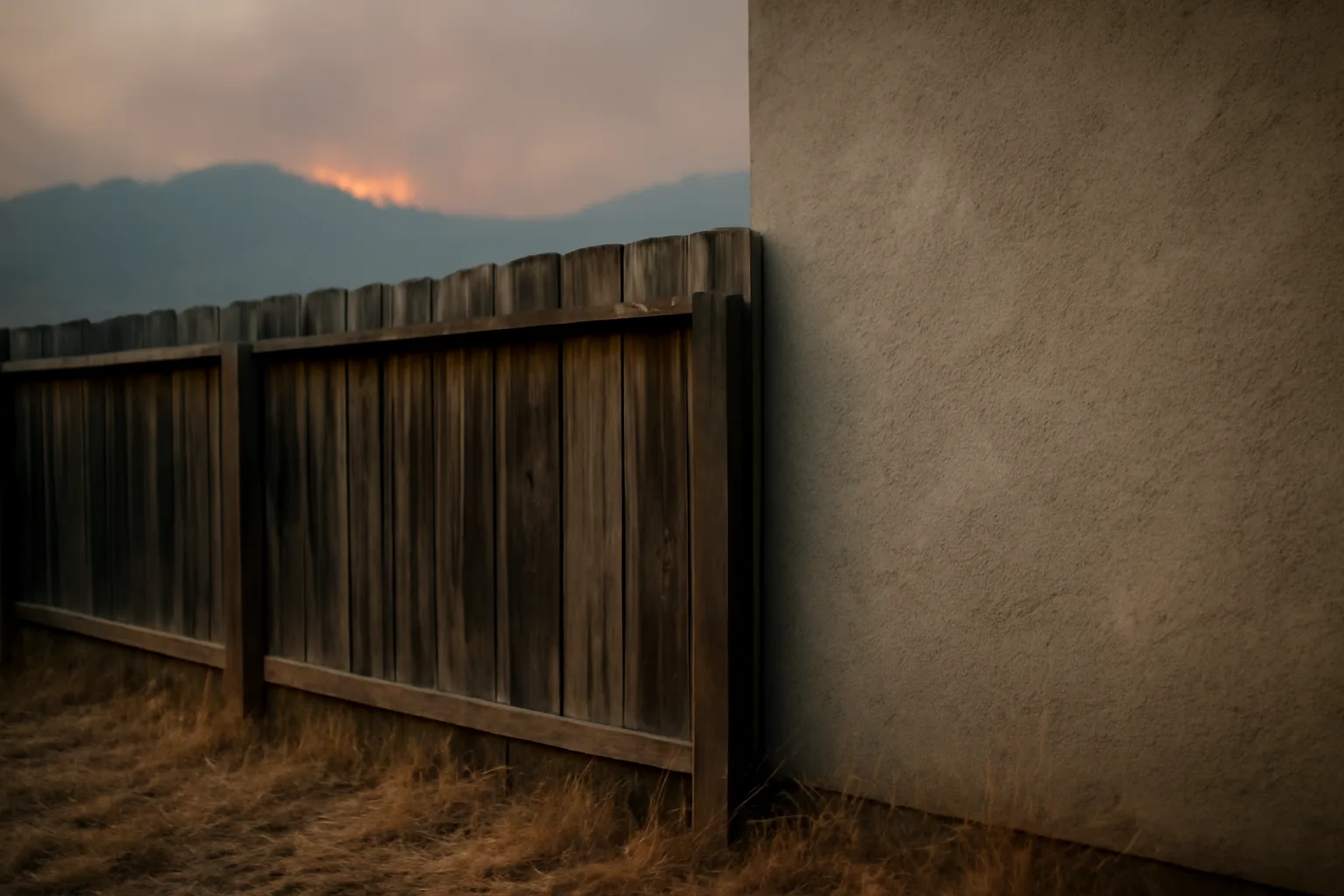
Marbles embedded in a wood fence are not a meaningful wildfire hazard. Glass doesn't burn or ignite fuel. The real fence risk is combustible material (wood, vinyl) touching your house within the first 5 feet, which California's Zone 0 rule targets starting in 2026. Focus inspection prep there, not on decorative glass.
do marbles in a fence actually cause a fire hazard
No, not in any way that shows up in fire science or insurance underwriting. Marbles are solid glass. Glass doesn't ignite, doesn't off-gas flammable vapor at temperatures a wildfire produces, and doesn't spread flame. If anything, a glass marble embedded in a fence board is one of the few truly non-combustible decorations you could put there. This question seems to come from a mix of internet folklore and a mistaken association with glass bottles used as kindling starters or magnifying-glass myths (a bottle focusing sunlight and starting a fire is a real, if rare, phenomenon under very specific conditions, but a flat or embedded marble doesn't behave like a lens the same way). None of the defensible space codes, CAL FIRE guidance, or state fire marshal publications mention marbles, glass inlays, or decorative embeds as a hazard category at all [1]. What inspectors and insurers actually care about is the fence material itself, especially where it connects to your house. A wood fence that runs straight into a stucco wall is a wick. It can carry an ember-caused ignition on your property line straight to your siding. That's a documented, named problem in California's Zone 0 rule. Glass ornamentation on that same fence changes nothing about that risk, for better or worse. If you're worried about a specific yard feature, the more useful move is to check it against your local Wildland Urban Interface (WUI) code or your fire district's defensible space checklist rather than guessing. Fire safe landscaping next to your house covers which decorative and structural elements actually matter.
what fence materials are actually a wildfire risk
| Wood fence touching house wall | High | Continuous fuel path for ember ignition | |
|---|---|---|---|
| Vinyl/PVC fence near house | Moderate | Melts and can drip burning material, though it doesn't sustain flame the way wood does | |
| Wood fence with mulch or dry grass along base | High | Ladder fuel plus wood fence compounds risk | |
| Metal or noncombustible fence | Low | No fuel contribution | |
| Marbles, glass, stone inlays on any fence | None | Glass does not burn or ignite | If your fence is wood and runs into your house, that's the item to fix before you worry about anything cosmetic. A public adjuster or contractor walk-through isn't required to see this; you can check it yourself in five minutes by walking your property line. |
Wood fencing attached directly to a house is the real problem, not decoration on the fence. CAL FIRE's Zone 0 guidance calls out attached wood fencing as one of the most common ways homes ignite from ember showers, because the fence carries flame from the yard to the wall in a continuous fuel path. The fix recommended in state guidance is a noncombustible transition: the last 5 feet of fence attached to the structure should be metal, or there should be a noncombustible gate or gap breaking the wood-to-house connection. This is separate from marbles, stones, or any decorative glass, none of which contribute fuel load. Here's a rough ranking of fence-related risk, based on what actually burns and what doesn't: | Fence feature | Fire risk level | Why |
when does the california defensible space law go into effect
California's core defensible space law (100 feet of clearance around structures) has been in effect since 2005 under Public Resources Code 4291, and it already applies statewide in State Responsibility Areas and in some Local Responsibility Areas with adopted ordinances [2]. What's newer, and what people are actually asking about, is the Zone 0 ember-resistant zone rule. The Zone 0 regulation, mandating an ember-resistant zone in the first 5 feet around a home, was authorized by California SB 63 (2020) and directed CAL FIRE's Board of Forestry to adopt implementing regulations [3]. As of this writing, the Board of Forestry has been working through the regulatory process, and CAL FIRE's own public materials have stated an anticipated effective date, with compliance for existing homes generally expected to be phased in after adoption. Check CAL FIRE's Zone 0 page directly for the current status before you assume a firm date, because state regulatory timelines shift and enforcement dates for existing homes versus new construction differ. The practical takeaway: the 100-foot, three-zone defensible space rule under PRC 4291 is already law and already enforced through annual inspections in many fire districts. The Zone 0 near-home rule is the newer layer, focused specifically on the 5 feet closest to your walls, including fences, mulch, and plantings.
what fire safe rules for homes take effect in 2026
The most commonly cited 2026 date relates to California's Zone 0 ember-resistant zone requirements moving from guidance to enforceable regulation for existing homes in high-risk areas, though the exact compliance timeline depends on final Board of Forestry rulemaking. CAL FIRE's public messaging has referenced 2026 as a target for when Zone 0 requirements could become mandatory for existing homes in Very High Fire Hazard Severity Zones, following the phase-in built into SB 63 [3]. Because rulemaking dates move, don't rely on a single blog post (including this one) for your compliance deadline. Pull the current status from CAL FIRE's Zone 0 program page and from your county or fire district directly, since local ordinances can require compliance earlier than the state minimum [1]. What you can act on right now, regardless of exact enforcement date: clear combustible mulch, dry vegetation, and stored items from the 5 feet against your house; replace or gap wood fencing that touches the structure; and remove anything flammable under decks and around vents. Insurers in wildfire-prone areas are already asking about these items on inspection forms ahead of any formal 2026 deadline, because non-renewal decisions are running ahead of the regulatory calendar.
why won't people follow the defensible space law in california
Cost, confusion about requirements, and inconsistent enforcement are the three most cited reasons homeowners fall short of defensible space compliance. A widely cited academic study on wildfire risk perception and mitigation behavior found that homeowners often understand general wildfire risk but don't translate that into specific, code-compliant action on their own property, partly because guidance varies by jurisdiction and can feel abstract compared to a concrete cost estimate [4]. There's also a real affordability problem. Clearing 100 feet of defensible space on a sloped, brush-heavy lot can run from a few hundred dollars for a small flat yard to several thousand dollars for a large or steep property needing tree removal and chipping, and that's before addressing Zone 0 hardening like fencing or vent replacement. For homeowners on fixed incomes, especially those already facing non-renewal notices, the math doesn't always work fast enough to save a policy. Enforcement inconsistency compounds this. PRC 4291 requires annual defensible space inspections in State Responsibility Areas, but capacity to inspect every parcel every year varies widely by county, and consequences for non-compliance (notice, then citation, then potential fine) can take a while to escalate [2]. That gap between "the law exists" and "someone will check" is a big reason compliance lags, even among homeowners who agree the law makes sense. Finally, some resistance is aesthetic or cultural: people don't want to cut mature trees, remove privacy fencing, or strip a yard they've cultivated for decades. That's a real, human reason, more than an excuse, and it's worth acknowledging rather than dismissing.
how to prevent wildfires
Individual homeowners can't prevent wildfires from starting in the wilderness, but they can dramatically cut their own ignition risk and reduce how a fire spreads once it reaches a neighborhood. Roughly 84 percent of wildfires in the U.S. are human-caused, according to a widely cited National Park Service analysis of federal wildfire data, meaning debris burning, equipment sparks, unattended campfires, and discarded cigarettes account for the large majority of ignitions, not lightning. At the individual level, prevention looks like: never burning debris on windy or red-flag days, keeping vehicles and equipment off dry grass (a hot catalytic converter or dragging trailer chain can ignite roadside grass), maintaining spark arrestors on chainsaws and mowers, and following local burn permit rules. Ready.gov also recommends securing outdoor propane tanks and clearing dead vegetation as basic prevention steps homeowners control directly . At the community level, defensible space compliance functions as fire prevention too, because a fire that can't find fuel at your house is less likely to jump to your neighbor's. This is part of why fire districts treat defensible space as a community obligation, more than a personal one. See only you can prevent wildfires for the classic public-awareness framing of this, and how it applies to home-level choices.
how to prepare for a wildfire
Wildfire preparation has three layers: making your home harder to ignite, having an evacuation plan ready before you need it, and keeping documentation that helps you recover afterward. Ready.gov's wildfire guidance recommends assembling a go-bag with medications, important documents, and supplies for at least three days, and identifying two ways out of your neighborhood in case one route is blocked by fire or traffic . On the home side, this means completing defensible space work in the 100-foot zone under PRC 4291, hardening the first 5 feet (Zone 0) against embers, and keeping gutters and roof valleys clear of dry leaves and needles, since ember accumulation there is a common ignition point [2]. On the documentation side, before a fire ever threatens your area, take dated photos or video of your home's exterior, your defensible space work, and your major possessions. This isn't about the emotional preparation people usually mean by "getting ready," but it's the piece that determines how smooth your insurance claim goes if the worst happens. This is also where a prepared kit of your property photos, inspection records, and mitigation receipts matters. If you haven't organized that yet, the $99 Wildfire Insurance Survival Kit is built specifically to help homeowners assemble that documentation before an inspection or a loss, not after. We don't file claims or negotiate with insurers; you're gathering and sending your own records, on your own timeline.
how to prevent forest fires and how to avoid forest fires
Preventing forest fires (as distinct from home-ignition prevention) centers on human ignition sources in wildland areas: campfires, vehicles, equipment, fireworks, and debris burning. The U.S. Forest Service and National Park Service both point to human activity as the dominant cause of wildland fire starts, with the NPS figure of roughly 84 percent human-caused fires reflecting decades of federal incident data. Practical steps that actually reduce forest fire starts: fully extinguish campfires by dousing, stirring, and dousing again until cold to the touch (more than smoking); avoid parking or driving on dry grass; check and follow local burn bans, which are often issued county-by-county during red-flag conditions; and don't use fireworks in or near wildland areas regardless of state legality, since illegal fireworks use is a recurring cause of major wildfires in the West. "Avoiding" forest fires as a homeowner really means avoiding contributing to ignition and avoiding exposure once one starts nearby: know your evacuation routes, monitor local fire agency alerts, and don't wait for a mandatory evacuation order if conditions look bad and you have somewhere safe to go early. Evacuating a day early costs you an inconvenience. Waiting too long can cost your life.
how to prepare for forest fires as a homeowner near wildland
If your property borders wildland, the preparation priority list is different from a purely urban home: defensible space clearing carries more weight, ember-resistant construction details matter more, and evacuation timing is tighter because fire can move faster through continuous wildland fuel than through a subdivision. CAL FIRE's defensible space guidance describes the 100-foot zone in two parts: Zone 1 (0 to 30 feet, needs the most aggressive clearing) and Zone 2 (30 to 100 feet, reduced fuel but not bare ground) [2]. For rural and wildland-adjacent properties, that 100 feet often means real vegetation management work, more than tidying a suburban yard, including thinning trees so canopies don't touch, removing dead and downed material, and mowing tall grass to under 4 inches in Zone 2 per CAL FIRE guidance. If you're managing a larger wildland-adjacent lot, professional clearing contracts are common, and it's worth knowing what a legitimate contract should specify. See wildfire defensible space clearing contracts (Washington State DNR framework) for what a real scope of work looks like, even if you're clearing under California rules, since the contract structure translates across states.
is santa barbara safe from fire
No California coastal or foothill community, including Santa Barbara, is "safe" from wildfire risk, and Santa Barbara County has direct experience with some of the state's largest and most destructive fires. The Thomas Fire (December 2017) burned over 281,000 acres across Ventura and Santa Barbara counties and was, at the time, the largest wildfire in modern California history, followed within weeks by the Montecito debris flow that killed 23 people, a disaster directly triggered by the burned, denuded hillsides left by the fire . Santa Barbara's risk comes from its geography: dense chaparral-covered foothills (the same fuel type driving many of the state's largest fires) sit directly above populated neighborhoods, and offshore Santa Ana / sundowner wind events can push fire downslope fast. CAL FIRE's Fire Hazard Severity Zone maps classify large portions of the Santa Barbara foothills as Very High severity zones, which is the state's top hazard tier and triggers stricter defensible space and building code requirements [1]. That doesn't mean the area is uninsurable or unlivable; it means homeowners there face some of the state's most rigorous defensible space and Zone 0 enforcement, and some of the highest non-renewal rates from standard insurers, which is part of why FAIR Plan usage has grown in the region. If you're in a Very High FHSZ zone anywhere in the state, more than Santa Barbara, the practical response is the same: complete defensible space work early, document it, and expect stricter inspection scrutiny than a lower-risk zip code.
how can we prevent forest fires at the community level
Community-level forest fire prevention works best as a mix of coordinated fuel reduction, public education, and consistent code enforcement, since no single homeowner's defensible space fully protects a neighborhood if adjoining lots are untouched. Research on wildfire risk reduction has repeatedly found that defensible space effectiveness depends on adjacent parcels doing the work too; a single hardened home surrounded by unmanaged fuel is still exposed to radiant heat and ember cast from neighboring properties [4]. Practical community actions include: neighborhood-level chipper days or cost-shared clearing programs, Firewise USA-style coordination (a National Fire Protection Association program many California and Colorado communities participate in), and pushing local fire districts for consistent, funded annual inspections rather than the honor system many areas currently run on. Homeowners associations and rural fire districts that adopt shared standards, rather than relying on individual compliance alone, tend to see better outcomes, because fuel breaks and defensible space only work as a continuous system across a hillside or subdivision, not as isolated islands.
how to document your fence and defensible space work for insurance
Insurers and fire districts increasingly want photo or video evidence of defensible space and hardening work, more than a verbal claim that you did it. Before and after photos of your fence line, the 5-foot Zone 0 perimeter, vent screens, and roof/gutter clearing give you a paper trail if you're contesting a non-renewal or applying for reinstatement after mitigation work. Date-stamp everything (most phone cameras do this automatically in metadata, but a printed copy with a visible calendar or receipt alongside the work is more persuasive to a claims reviewer). Keep contractor invoices for any clearing, fencing replacement, or vent upgrades, since these are the receipts an underwriter is most likely to ask for during a wildfire mitigation credit review. This is exactly the gap the Wildfire Insurance Survival Kit is built to close: a $99 one-time tool for organizing your property photos, mitigation records, and defensible space documentation into something you can hand to an insurer or inspector without scrambling. It doesn't file claims, negotiate coverage, or promise reinstatement; it just helps you get your own paperwork in order before you need it. If your property has already had a fire at a house nearby or a house fire event in your area, that documentation habit matters even more for future coverage conversations.
Frequently asked questions
Are marbles or glass decorations in a fence a wildfire hazard?
No. Glass marbles don't ignite, burn, or off-gas flammable vapor under wildfire heat conditions. They're not mentioned in any CAL FIRE, state fire marshal, or defensible space code as a hazard. The fence material itself (wood versus metal) and its connection to your house are what actually matter for fire risk.
When does California's defensible space law go into effect?
The core 100-foot defensible space law under Public Resources Code 4291 has been in effect since 2005 and is already enforced through annual inspections in State Responsibility Areas. The newer Zone 0 ember-resistant zone rule, authorized by SB 63, is being phased in through Board of Forestry rulemaking, with CAL FIRE materials referencing 2026 for existing-home compliance; confirm current status on CAL FIRE's site.
What fire safe home rules take effect in 2026?
California's Zone 0 requirement, mandating an ember-resistant 5-foot zone around homes in high fire hazard areas, is the rule most associated with a 2026 timeline for existing homes. The exact enforcement date depends on final Board of Forestry regulations, so check CAL FIRE's Zone 0 page directly rather than relying on a fixed date.
Why do so many California homeowners not comply with defensible space law?
Cost, unclear or jurisdiction-varying requirements, and inconsistent local enforcement are the main reasons, according to wildfire risk perception research. Clearing costs can run from a few hundred to several thousand dollars depending on lot size and slope, and many counties can't inspect every parcel every year, which weakens the practical consequences of non-compliance.
How can homeowners help prevent wildfires?
Complete defensible space clearing in the 100-foot zone around your home, harden the first 5 feet against embers, never burn debris on windy days, keep vehicles off dry grass, and maintain spark arrestors on equipment. Roughly 84 percent of wildfires are human-caused, so individual prevention habits genuinely reduce ignition risk, per National Park Service data.
How should I prepare for a wildfire if I live in a high-risk zone?
Complete defensible space work, harden your home's first 5 feet against embers, pack a go-bag with medications and documents for at least three days, and identify two evacuation routes in advance, per Ready.gov guidance. Also photograph and date your property and mitigation work so you have documentation ready if you need to file an insurance claim later.
How do you prevent forest fires from starting in wildland areas?
Fully extinguish campfires (douse, stir, douse again until cold), avoid driving or parking on dry grass, follow local burn bans, keep equipment spark arrestors maintained, and never use fireworks near wildland. Federal data shows the large majority of wildland fires are human-caused, so controlling ignition sources is the most effective prevention lever.
Is Santa Barbara, California safe from wildfire risk?
No. Santa Barbara County has experienced some of California's largest fires, including the 2017 Thomas Fire, which burned over 281,000 acres. Much of the Santa Barbara foothills is mapped as Very High Fire Hazard Severity Zone by CAL FIRE, meaning residents face stricter defensible space rules and higher insurance non-renewal rates than lower-risk areas.
What's the difference between Zone 0, Zone 1, and Zone 2 defensible space?
Zone 0 is the 5 feet immediately around your home, requiring ember-resistant, mostly noncombustible landscaping. Zone 1 spans 0 to 30 feet and requires aggressive fuel reduction. Zone 2 spans 30 to 100 feet and requires reduced but not eliminated vegetation, per CAL FIRE's defensible space guidance.
Should I replace my wood fence if it touches my house?
Yes, this is one of the highest-value hardening changes you can make. CAL FIRE guidance recommends a noncombustible transition, such as a metal fence section or gap, for the last 5 feet of any fence attached to your home, since a continuous wood fence is a documented path for ember ignition to reach your walls.
Does decorative glass or stone in landscaping help with fire safety?
It doesn't hurt, since glass and stone don't burn, but it also isn't a substitute for actual defensible space work. Noncombustible ground cover like gravel or rock in Zone 0 is genuinely useful; decorative glass inlays in a fence are neutral, neither helping nor hurting fire risk in a measurable way.
How much does defensible space clearing typically cost?
Costs vary widely by lot size, slope, and vegetation density, ranging from a few hundred dollars for a small flat yard to several thousand dollars for a large, steep, or heavily wooded property needing tree removal and chipping. Get a local quote, since fire district requirements and vegetation types differ significantly by region.
Sources
- CAL FIRE, Fire Hazard Severity Zone Maps: Very High Fire Hazard Severity Zone classification for Santa Barbara foothills and stricter requirements in those zones
- California Public Resources Code Section 4291: 100-foot defensible space requirement and annual inspection authority in State Responsibility Areas, in effect since 2005
- California Senate Bill 63 (2020): Authorization for the Board of Forestry to adopt a 5-foot ember-resistant zone (Zone 0) regulation
- Journal of Environmental Management, wildfire risk perception and mitigation behavior research: Homeowner understanding of wildfire risk often doesn't translate into code-compliant mitigation action, and defensible space effectiveness depends on adjacent parcel participation
- California Office of the State Fire Marshal: Defensible space requirements around homes, including zone-based clearance rules, are managed by the California Office of the State Fire Marshal
- California Office of the State Fire Marshal: Ember-resistant zone (Zone 0) requirements near structures, including noncombustible materials within five feet of a home, are part of updated defensible space regulations
- National Fire Protection Association (Firewise USA): Community-level wildfire risk reduction programs like Firewise USA help neighborhoods collectively reduce wildfire risk
- Santa Barbara County Fire Department: Local wildfire risk information and defensible space enforcement specific to Santa Barbara County