Last updated 2026-07-25
TL;DR
Self-storage facilities are not fireproof. Several have burned in major California wildfires, including facilities lost in the 2017 Tubbs Fire and 2018 Camp Fire. If you store belongings near a wildfire-prone area, treat that unit like an extension of your home: document contents, check the facility's defensible space, and confirm what your storage insurance (or lack of it) actually covers.
Can a public storage facility actually burn down in a wildfire?
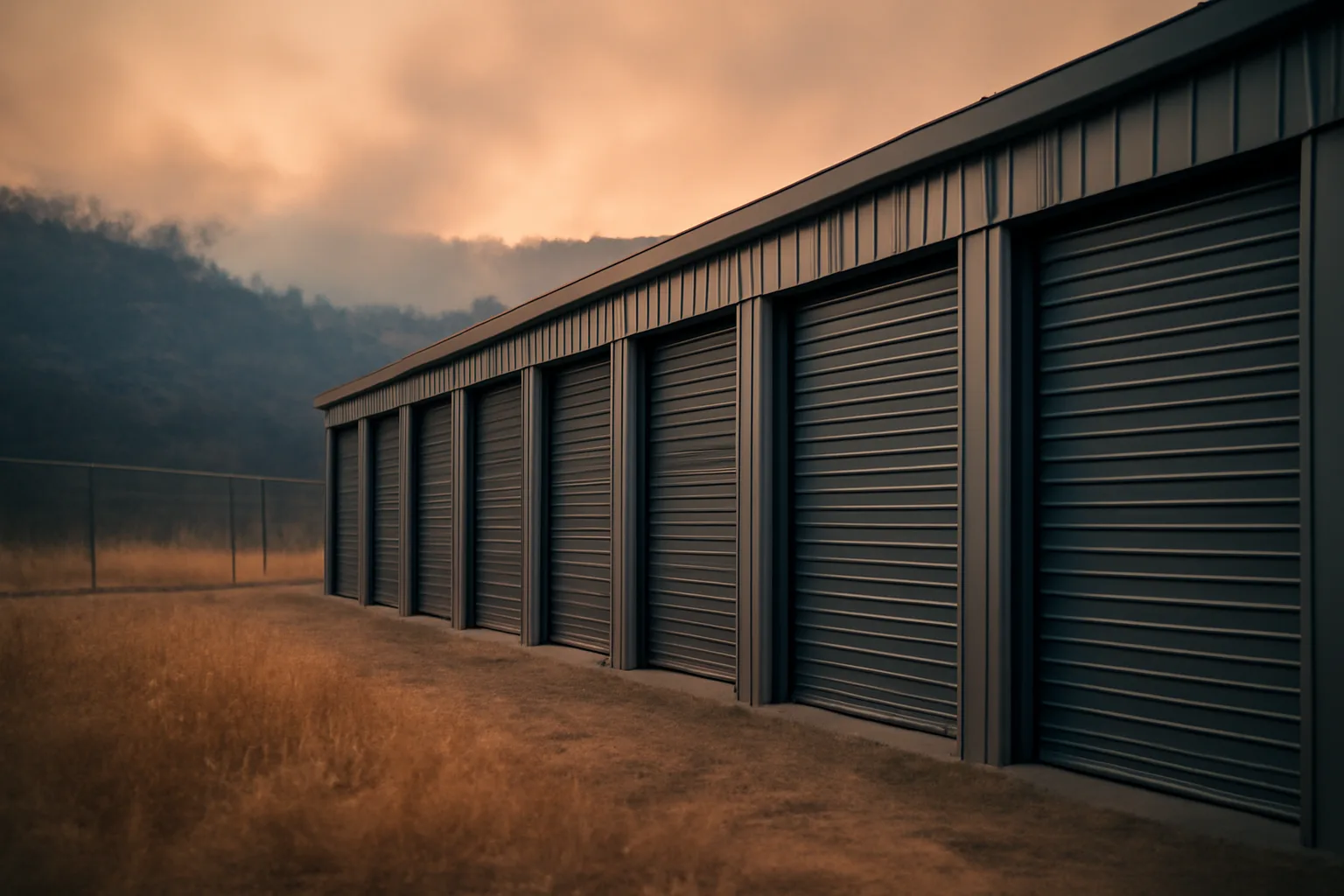
Yes. Self-storage buildings are usually metal-skinned, but metal skin does not stop a wildfire. Roll-up doors, vents, and eaves let embers in, and the contents inside (furniture, boxes, propane, vehicles) burn just like a house does. During the October 2017 Northern California firestorm, CAL FIRE recorded the Tubbs Fire as having destroyed more than 5,600 structures in Sonoma, Napa, and Lake counties, and local reporting documented storage facilities among the commercial buildings lost in Santa Rosa [1]. The 2018 Camp Fire, which CAL FIRE lists as the deadliest and most destructive wildfire in California history at 18,804 structures destroyed, also swept through commercial corridors in Paradise where storage units sat [2]. The lesson isn't that storage facilities are especially dangerous. It's that nothing in a wildfire path gets a pass just because it's made of metal or sits in a parking lot. If you're storing belongings, financial documents, or sentimental items in a facility inside a wildfire-prone county, you need the same mindset you'd apply to your house: assume it can burn, and plan around that.
When does the California defensible space law go into effect?
California's core defensible space law, Public Resources Code 4291, already requires 100 feet of defensible space clearance around structures in State Responsibility Areas, and it has been in effect in some form since the 1960s, with the 100-foot standard set by amendment in 2004 [3]. The newer, more specific "ember-resistant zone" rule, sometimes called Zone 0, is the piece people mean when they ask about a 2026 start date. CAL FIRE's Board of Forestry has been developing Zone 0 regulations under SB 63 (2023) and earlier authorizing legislation (AB 3074, 2020), which require an ember-resistant zone within 5 feet of a structure [4]. As of this writing, the Board of Forestry and Fire Protection has not finalized the Zone 0 regulation text or a hard effective date; draft rulemaking has targeted flammable materials, mulch, and vegetation within that 5-foot ring. Check the Board of Forestry's current rulemaking page for the exact status in your area, because timelines have shifted more than once [4]. Your local fire district or county fire marshal's office will also have the authoritative word on what applies to your specific parcel right now, more than what's proposed statewide.
What fire-safe home rules take effect in 2026?
Nobody has a single clean answer to this yet, and anyone who tells you a firm nationwide 2026 date is guessing. What's real: California's Zone 0 ember-resistant zone rule has been targeted for various effective dates through the Board of Forestry rulemaking process, and some drafts have referenced 2026 or later compliance windows for existing homes, with new construction potentially facing earlier deadlines [4]. Insurers, including State Farm and the California FAIR Plan, have also signaled they'll weight defensible space and hardening compliance more heavily in underwriting over the next few renewal cycles, but that's a private underwriting shift, not a statute [5]. Separately, the 2019 California Building Code Chapter 7A (Wildland-Urban Interface, or WUI, standards) already requires ignition-resistant construction, ember-resistant vents, and Class A roofing for new construction and major remodels in designated Fire Hazard Severity Zones [6]. If you're building or majorly remodeling in a WUI zone, Chapter 7A already applies to you now, not in 2026. Because rulemaking dates move, treat any "2026 rule" claim you read online, including this one, as provisional until you confirm it with your county fire marshal or the CAL FIRE Office of the State Fire Marshal's current regulations page. Guided fill-in for readers: [check with ______ County Fire Marshal or Fire Protection District for your local defensible space and Zone 0 compliance deadline].
Why won't people follow the defensible space law in California?
Cost, labor, and enforcement gaps are the three real reasons, in roughly that order. Clearing 100 feet of defensible space on a sloped, wooded lot can run into thousands of dollars in tree trimming, brush removal, and hauling fees, and that's before anyone touches the house itself. CAL FIRE's own defensible space guidance describes a two-zone system (0-30 feet and 30-100 feet) with different vegetation spacing and clearance requirements depending on slope, and doing it correctly on steep or heavily wooded parcels often requires contractors, not a weekend with a chainsaw. Retired homeowners on fixed incomes, absentee landlords, and people who inherited rural property they don't fully understand are the groups most likely to fall behind. Enforcement is uneven. Some counties do annual defensible space inspections and issue citations for noncompliance; others rely almost entirely on self-reporting or neighbor complaints. CAL FIRE itself has acknowledged that voluntary compliance rates lag in some high-hazard areas, which is part of why the agency pushes public awareness campaigns and why Smokey Bear's message ('Only you can prevent wildfires') has stayed in rotation for decades [7]. If you want to understand what's actually required where you live rather than what's theoretically on the books, read our breakdown of defensible space rules by jurisdiction and compare it against your own fire district's letter.
How to prevent wildfires (and what's actually your responsibility)
You can't stop lightning or arson, but you can eliminate the most common human-caused ignition sources on your own property and in your own habits. CAL FIRE's data consistently shows that a large share of wildfires are human-caused, through equipment sparks, unattended campfires, vehicle exhaust on dry grass, and debris burning done outside permitted windows [7]. Practically, that means: don't mow dry grass in the heat of the day, keep chainsaws and mowers away from dry vegetation when possible, never leave a campfire unattended, check local burn-permit status before doing any outdoor burning, and maintain vehicle exhaust systems (a dragging chain or bad catalytic converter on dry grass has started real fires). None of this is exotic advice. It's also, frankly, the boring stuff that actually moves the needle more than any single home upgrade, because you're removing the spark, more than hardening the target.
How to prepare for a wildfire (the practical checklist)
Preparation splits into three buckets: defensible space around the structure, hardening of the structure itself, and an evacuation plan with documentation ready to go. Ready.gov's wildfire preparedness guidance recommends assembling a go-bag with medications, important documents, and basics for at least three days, and knowing two evacuation routes out of your area before you need them. Defensible space work (clearing the 0-5 foot ember zone, thinning 5-30 feet, and managing fuel out to 100 feet) should happen well before fire season starts in your region, not during a red flag warning. Structure hardening (ember-resistant vents, Class A roofing, enclosed eaves, tempered dual-pane windows) is a bigger financial lift, so prioritize the cheapest, highest-impact items first: vent screens, gutter guards, and clearing anything flammable within 5 feet of the foundation. Our fire-safe landscaping guide for California homes walks through plant selection and spacing if you're starting the defensible space work from scratch. Documentation matters more than most people realize until they've lost something. Photograph every room, your garage, your storage unit contents if you keep one, and your exterior. Keep insurance policy numbers, ID, and a household inventory somewhere you can grab in five minutes or access remotely. This is the exact gap a lot of non-renewed homeowners discover too late: they can describe what they lost, but they can't prove it to an insurer or a FAIR Plan adjuster.
How to prevent forest fires and avoid forest fires as a landowner or camper
If you own forested or brush-covered acreage, prevention looks like active fuel management: removing dead and downed wood, thinning dense stands, and maintaining fuel breaks along property lines and roads. The U.S. Forest Service and CAL FIRE both point to fuel load reduction as the single biggest lever landowners control, since dense, dead, and dried vegetation is what turns a small ignition into a running crown fire [7]. If you're a camper or recreational land user, the fire-prevention basics are simple and well documented: fully drown and stir campfires until cold to the touch, never leave a fire unattended even for a few minutes, check current fire restrictions and burn bans before you go (many public lands impose seasonal restrictions), and avoid parking or idling vehicles over dry grass. These sound like Boy Scout basics because they are, and that's exactly why they still cause a meaningful share of wildfire starts every year despite decades of public messaging [7].
Is Santa Barbara safe from fire?
No California coastal community with chaparral hillsides above it should call itself 'safe' from fire, and Santa Barbara County has the fire history to prove it. The Thomas Fire in December 2017 burned into Santa Barbara County and, combined with the debris flow that followed heavy rain on the burn scar in January 2018, killed 23 people in Montecito, one of the deadliest debris-flow disasters in California history [8]. The 1990 Painted Cave Fire and 2008 Tea Fire also burned into Santa Barbara's foothill neighborhoods. What makes Santa Barbara higher-risk rather than lower-risk is the same thing that makes it beautiful: steep, chaparral-covered hillsides pressed close against dense residential neighborhoods, with offshore Sundowner winds that can push fire downhill toward homes fast. CAL FIRE's Fire Hazard Severity Zone maps classify large sections of the Santa Barbara foothills as Very High severity zones, which is the top tier of the state's rating system [5]. If you own property there, or anywhere with a similar wildland-urban interface profile, the honest answer isn't 'safe' or 'unsafe,' it's 'how well have you hardened this specific property and does your insurer agree.'
How can we prevent forest fires as a community, more than individually?
Individual defensible space work matters, but fire doesn't respect property lines, so community-level coordination changes outcomes more than any single homeowner's effort. CAL FIRE and many county fire departments now support or require Firewise USA-style neighborhood programs, where adjoining properties coordinate fuel reduction, shared evacuation planning, and joint inspections, because a single noncompliant lot can undermine a whole block's hardening work. Community-level prevention also includes supporting local prescribed burn programs and fuel break maintenance on adjacent public land, participating in county chipper-day programs (many fire districts subsidize green waste chipping to make defensible space compliance cheaper), and pushing local utilities on powerline maintenance, since utility equipment has caused some of the largest and most destructive California wildfires on record, including PG&E equipment's role in the 2018 Camp Fire per Cal Fire's investigation findings [2]. If your neighborhood hasn't organized around this, a single homeowner starting the conversation with an HOA or a fire-safe council chapter can matter more than another $5,000 spent on their own property alone.
What if a storage facility or neighbor's property is the ignition risk?
This is a real, under-discussed vulnerability. Commercial properties near you, including storage facilities, RV lots, and vacant land, can carry fuel loads and ignition risks that you have no direct control over but that threaten your home anyway. If a facility near you has overgrown vegetation, stored flammable materials near a fence line, or visible fire code violations, most counties allow you to report it to the local fire marshal or code enforcement office, and many treat defensible space violations on commercial parcels the same way they treat residential ones under PRC 4291 [3]. If you personally use a self-storage unit and live in or near a wildfire-prone area, ask the facility directly about their fire suppression system (sprinklers vs. none), their defensible space around the perimeter, and whether their insurance covers total-loss fire events, because many storage contracts cap liability at a low fixed dollar amount per unit regardless of what's actually inside. That cap is often far below what a fully packed unit is worth, so if you're storing anything irreplaceable there, photograph it and keep that inventory somewhere other than inside the unit itself.
What should be in your wildfire documentation, whether it's for your home or a storage unit?
Insurers and FAIR Plan adjusters respond to documentation, not memory. At minimum, keep: a full photo or video walkthrough of every room and storage area, updated at least once a year; serial numbers and purchase receipts for major electronics and appliances; your policy declarations page with coverage limits; and a written inventory with estimated replacement values. We are not a public adjuster, we don't negotiate with insurers, file claims on your behalf, or promise coverage, discounts, or reinstatement. What we do is help you build the packet you'd want in hand before a claim, inspection, or non-renewal conversation ever starts. That's the whole idea behind the $99 Wildfire Insurance Survival Kit, a one-time tool that walks you through the documentation an insurer or FAIR Plan reviewer actually wants to see, so you're not assembling it from memory after the smoke clears. If you've already had a policy non-renewed, read up on how house fire claims typically get evaluated and what documentation insurers weight most, so you know what to prioritize first instead of guessing.
How does defensible space compliance affect insurance renewal?
Insurers increasingly ask for proof, more than a checkbox. The California Department of Insurance's Safer from Wildfires regulation, adopted in 2022, requires insurers to give discounts or otherwise recognize wildfire safety actions homeowners have taken, including defensible space compliance and Chapter 7A-equivalent hardening, when setting rates . That regulation cuts both ways: it can help you if you've done the work and can document it, and it can hurt you at renewal if a field inspection finds vegetation too close to the structure or a wood shake roof still on file. If you've received a non-renewal or inspection letter, the fastest thing you can do is get current, dated photos of your defensible space zones and any hardening upgrades (vents, roofing, gutters) before you respond. Compare your situation against our guide on wildfire defensible space clearing contracts if you're weighing contractor costs, and check fire at a house for what inspectors and adjusters actually look for structure by structure.
Table: California wildfire defensible space zones at a glance
| Zone | Distance from structure | Core requirement | Governing rule | |
|---|---|---|---|---|
| Zone 0 (ember-resistant zone) | 0-5 feet | Noncombustible surfaces, no mulch or shrubs against walls | Proposed under SB 63 / AB 3074, Board of Forestry rulemaking, effective date not finalized as of this writing [4] | |
| Zone 1 | 5-30 feet | Remove dead vegetation, space live plants, limb up trees | PRC 4291 [3] | |
| Zone 2 | 30-100 feet | Reduce fuel volume, maintain horizontal and vertical spacing | PRC 4291 [3] | |
| New construction, WUI areas | Whole structure | Class A roof, ember-resistant vents, ignition-resistant materials | 2019 CA Building Code Chapter 7A [6] | Check with your specific fire protection district for local amendments, since some counties layer stricter requirements on top of the state minimums. [check with ______ County Fire Marshal for local Zone 0 and defensible space enforcement dates]. |
Frequently asked questions
When does the California defensible space law go into effect?
The base 100-foot defensible space requirement under Public Resources Code 4291 has been in effect for years, expanded to 100 feet by a 2004 amendment. The newer Zone 0 ember-resistant zone rule (5 feet from structures) is still in Board of Forestry rulemaking as of this writing, with no finalized statewide effective date confirmed; check your county fire marshal for current local status.
Why won't people follow the defensible space law in California?
Mostly cost, labor, and uneven enforcement. Clearing 100 feet on a sloped or wooded lot can cost thousands in tree work and hauling, and many counties rely on self-reporting rather than annual inspections, so compliance lags in exactly the high-hazard areas that need it most.
How do I prevent wildfires around my own property?
Eliminate the human-caused ignition sources first: never leave campfires unattended, avoid mowing dry grass in peak heat, keep equipment away from dry vegetation, check burn permit status before any debris burning, and maintain vehicle exhaust systems. CAL FIRE data shows most wildfires are human-caused, so behavior change matters as much as landscaping.
How do I prepare for a wildfire if I get an evacuation warning?
Have a go-bag ready with medications, ID, and important documents, know two evacuation routes out of your area in advance, and keep a photo inventory of your home's contents somewhere accessible off-site. Ready.gov recommends preparing to be self-sufficient for at least three days during an evacuation.
How can we prevent forest fires as a community?
Coordinate defensible space work across adjoining properties (a single noncompliant lot undermines a neighborhood's efforts), join or start a Firewise USA-style group, support local fuel break maintenance and chipper-day programs, and push utilities on powerline maintenance, since utility equipment has caused some of the largest California wildfires on record.
What fire-safe home rules take effect in 2026?
No confirmed nationwide 2026 rule exists yet. California's proposed Zone 0 ember-resistant zone regulation has referenced compliance windows around that timeframe in draft rulemaking, but the Board of Forestry has not finalized dates as of this writing. Confirm current status with your county fire marshal, not a blog post.
Is Santa Barbara safe from fire?
No coastal California community with chaparral hillsides is fully safe from fire. Santa Barbara County has burned repeatedly, including the 2017 Thomas Fire and the deadly 2018 Montecito debris flow that followed it. CAL FIRE maps much of the Santa Barbara foothills as Very High Fire Hazard Severity Zone.
Can a public storage facility burn down in a wildfire?
Yes. Metal-skinned storage buildings are not fireproof; embers enter through vents and roll-up doors, and stored contents burn like any other flammable material. Storage facilities were among the commercial structures lost in California's major recent wildfires, including the 2017 Tubbs Fire and 2018 Camp Fire.
Does storage unit insurance cover fire damage from a wildfire?
It depends entirely on your specific contract; many storage facility liability policies cap payouts per unit at a low fixed amount regardless of actual contents value, and separate tenant storage insurance may be required for full coverage. Ask your facility directly what their fire coverage caps are before assuming you're protected.
How does defensible space compliance affect my insurance renewal?
California's 2022 Safer from Wildfires regulation requires insurers to factor in wildfire safety actions, including defensible space compliance, when setting rates. Documented compliance can help at renewal; an inspection finding vegetation too close to the structure or outdated roofing can trigger non-renewal even without a fire ever occurring.
What's the difference between Zone 0, Zone 1, and Zone 2 in defensible space rules?
Zone 0 covers 0-5 feet from the structure and focuses on noncombustible surfaces (proposed rule, not yet finalized statewide). Zone 1 covers 5-30 feet, requiring dead vegetation removal and plant spacing. Zone 2 covers 30-100 feet, focused on reducing overall fuel volume, both under existing PRC 4291.
How do I report a fire hazard on a neighbor's or commercial property?
Contact your local fire marshal or code enforcement office; most California counties enforce defensible space and fuel load requirements on commercial and residential parcels alike under PRC 4291. Include photos, an address, and specifics on the hazard (overgrown brush, stored flammables, blocked access) when you report it.
Sources
- CAL FIRE, Tubbs Fire incident summary: Tubbs Fire destroyed more than 5,600 structures across Sonoma, Napa, and Lake counties in October 2017
- CAL FIRE, Camp Fire incident summary: Camp Fire destroyed 18,804 structures and is the deadliest and most destructive wildfire in California history
- California Legislative Information, Public Resources Code Section 4291: State law requires 100 feet of defensible space clearance around structures in State Responsibility Areas
- California Board of Forestry and Fire Protection, Fire Regulations rulemaking page: Zone 0 ember-resistant zone regulation is in active rulemaking with no finalized statewide effective date
- California Department of Insurance, Safer from Wildfires regulation: Insurers must factor documented wildfire safety actions, including defensible space compliance, into rate setting
- California Building Standards Commission, 2019 California Building Code Chapter 7A: Chapter 7A requires ignition-resistant construction and Class A roofing for new construction in Wildland-Urban Interface fire areas
- CAL FIRE, Wildfire Prevention page: The majority of California wildfires are human-caused, through campfires, equipment, and debris burning
- CAL FIRE, Fire Hazard Severity Zone Maps: CAL FIRE classifies large sections of the Santa Barbara foothills as Very High Fire Hazard Severity Zone