Last updated 2026-07-25
TL;DR
Utilities in CA, CO, OR, and AZ now run wildfire mitigation plans that include grid hardening, vegetation clearance around power lines, and public safety power shutoffs (PSPS). Homeowners still carry the legal duty for defensible space around structures. CAL FIRE's updated Zone 0 rule, delayed for years, is now expected to take effect through 2026 rulemaking.
What does wildfire mitigation mean for a utility company?
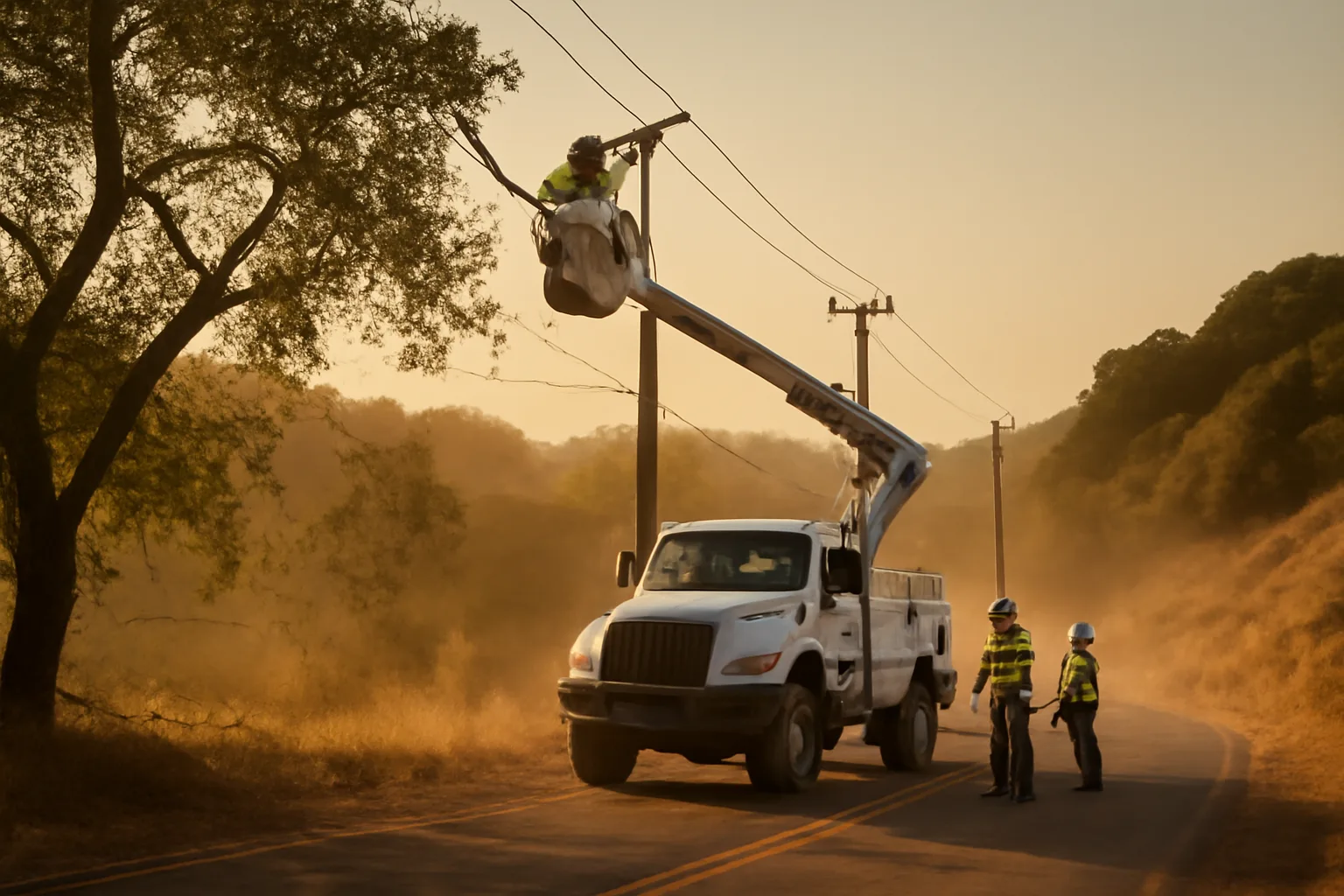
For a utility, wildfire mitigation means every action taken to stop its own equipment from starting a fire and to limit damage if one starts anyway. That covers vegetation management along power line corridors, replacing bare wire with covered conductor, burying lines in high-risk areas, installing weather stations and fault-detecting sensors, and shutting power off during dangerous wind events. California's three largest investor-owned utilities (PG&E, SCE, and SDG&E) file wildfire mitigation plans every three years with the Office of Energy Infrastructure Safety, a state agency created specifically to review them. The current cycle covers 2023 through 2025, with updates required annually [1]. These plans run hundreds of pages and cover everything from pole inspection cycles to public safety power shutoff protocols. The honest version for a homeowner: utility mitigation reduces the odds that a downed line or arcing equipment starts the next big fire near you, but it does nothing about the fuel already sitting against your house. Those are two separate jobs. Utilities own the ignition-source side. You own the structure and the defensible space around it. Conflating the two is why some people assume 'the power company is handling wildfire safety' and then skip their own work. CAL FIRE's statewide wildfire prevention program lists vegetation management, fuel breaks, and defensible space enforcement as core strategies, run alongside but separate from utility infrastructure programs [2].
Why do utilities shut off power during high winds (PSPS)?
Utilities call these Public Safety Power Shutoffs, or PSPS events. They cut power preemptively when wind speed, humidity, and fuel dryness combine into conditions where a spark from equipment could ignite a fast-moving fire. PG&E's PSPS program, for instance, considers factors like sustained winds often in the 25+ mph range near red-flag conditions, though exact thresholds vary by circuit and vegetation density [3]. These shutoffs are blunt and unpopular. They can last from several hours to multiple days, and they hit medical device users, refrigerated food, and rural water pumps hard. But regulators have pushed utilities toward more of them, not fewer, since several California fires including the 2018 Camp Fire were tied to utility equipment failures during high wind events, according to CAL FIRE's investigation findings [4]. If you live somewhere PSPS is common, the practical homeowner move is a battery backup or generator plan, sized for what actually matters (a fridge, a well pump, medical equipment), not the whole house. That's a home-hardening and preparedness question more than an insurance one, but insurers do sometimes ask about backup power in wildfire risk questionnaires.
When does the California defensible space law go into effect?
California's baseline defensible space law, Public Resources Code 4291, has been in effect since it was last substantially amended in 2005, requiring 100 feet of defensible space clearance around structures in State Responsibility Areas and some Local Responsibility Areas [5]. That part is not new and is not changing. What's newer, and what people usually mean when they ask this question, is the 'Zone 0' ember-resistant zone rule: a proposed requirement for the first 5 feet around a home to be nearly free of combustible material (no bark mulch, no wood fencing attached to the house, no stored firewood). This was authorized by Assembly Bill 3074 (2020) but the actual regulation has been delayed multiple times while the Board of Forestry and Fire Protection works through rulemaking [6]. As of the most recent board updates, Zone 0 regulations are moving through the formal rulemaking process with an anticipated effective date in 2026 for at least the first phase of enforcement, though CAL FIRE and the Board of Forestry have pushed the timeline before and homeowners should check the Board's current rulemaking page rather than assume a fixed date [6]. This is exactly the kind of detail your local fire district can pin down for you. [Local fire district guidance: contact your county fire marshal or local fire protection district to confirm the current Zone 0 timeline and enforcement date for your specific address, since implementation can vary by jurisdiction and by whether you're in a State Responsibility Area or Local Responsibility Area.]
What fire-safe home rules take effect in 2026?
The most consequential 2026 rule is the Zone 0 ember-resistant zone requirement described above, applying to homes in Very High Fire Hazard Severity Zones and State Responsibility Areas across California. It will require removing combustible mulch, dead vegetation, and stored fuel within 5 feet of the home's foundation, attached decks, and fences [6]. Oregon has moved on a parallel track. The state's wildfire risk map and defensible space code requirements, tied to Senate Bill 762 (2021), have gone through their own delays and revisions after public pushback over the risk map itself; check the Oregon Department of Forestry's current wildfire program page for the active compliance dates in your county [7]. Colorado doesn't have one statewide defensible space mandate the way California does. Instead, wildfire mitigation requirements come through county and local fire district codes, so a rule that applies in Boulder County may not apply the same way in El Paso County. Arizona is similar: defensible space standards mostly come from county ordinances and the Arizona State Forestry Division's cost-share and mitigation programs rather than one uniform state law [8]. [Local fire district guidance: California, Oregon, Colorado, and Arizona homeowners should confirm active 2026 dates directly with their state fire marshal's office or local fire district, since statewide rules and county-level codes don't always move on the same schedule.]
Why won't people follow the defensible space law in California?
Cost, confusion about the rule, and simple inertia are the three real reasons, and none of them are unique to California. A 2020 survey-based study out of UC Cooperative Extension found that homeowner compliance with defensible space requirements was inconsistent even in high-risk WUI communities, with cost and labor availability cited as major barriers to full compliance. Some homeowners also genuinely don't know the rule applies to them. PRC 4291 covers State Responsibility Area land and some Local Responsibility Area jurisdictions that have adopted it, but plenty of people in wildfire-adjacent suburbs assume it's a rural-only rule. Others know the rule exists but don't know what '100 feet, three zones' actually requires in practice on their specific lot, especially on steep or narrow lots where 100 feet runs into a neighbor's property. There's also a fairness complaint that comes up constantly in public comment periods: doing your own defensible space work doesn't help if your neighbor doesn't do theirs, and enforcement varies a lot by county. CAL FIRE and local fire agencies conduct defensible space inspections, but capacity to inspect every parcel every year is limited, and enforcement has historically leaned on notices and re-inspection rather than immediate fines for first violations [9]. The honest answer for a homeowner reading this: the law being imperfectly enforced doesn't reduce your personal fire risk or your insurer's read of your risk. If you got a non-renewal letter, the insurer already looked at satellite imagery or an inspection and made a decision. Compliance with 4291 is the floor, not a guarantee of anything, but skipping it is a documented reason insurers cite for denying or non-renewing coverage.
How to prevent wildfires (what actually reduces ignition risk)
Most wildfires are human-caused, not lightning-caused. CAL FIRE and the National Interagency Fire Center both note that roughly 85 to 90 percent of wildfires nationally are human-caused, whether from unattended campfires, equipment sparks, debris burning, or vehicle exhaust systems parking on dry grass [10]. Ready.gov's wildfire prevention guidance centers on exactly these controllable behaviors: fully extinguishing campfires, avoiding outdoor burning on red-flag days, and keeping vehicles off dry grass . At the property level, prevention means reducing what can catch and reducing what can carry fire toward your home. That's defensible space (the vegetation and clearance work) plus home hardening (ember-resistant vents, Class A roofing, non-combustible siding within 5 feet of the ground). CAL FIRE's 'Ready, Set, Go!' framework treats these as the two pillars of individual wildfire prevention alongside evacuation readiness [2]. For a deeper walk-through of what defensible space actually looks like zone by zone, see our guide on fire safe landscaping in California next to the house, which covers plant spacing and the specific materials that ember-resistant zones require.
How to prepare for a wildfire (before it starts)
Preparation splits into three buckets: documentation, physical hardening, and an evacuation plan you've actually rehearsed. Ready.gov recommends assembling an emergency supply kit, a family communication plan, and a go-bag with essential documents before fire season starts, not during a red-flag warning . Documentation matters more than most people think, especially if you're already facing insurance non-renewal. Photograph your defensible space work, your roof material, your vent screens, and any hardening upgrades (dual-pane windows, ember-resistant vents, non-combustible fencing). Insurers and the California FAIR Plan increasingly ask for this kind of evidence when reviewing wildfire risk, and having it ready before a renewal decision beats scrambling for it after a non-renewal notice arrives. This is the exact gap a $99 Wildfire Insurance Survival Kit is built to close: a structured way to document your home's defensible space and hardening work so you have something concrete to send your insurer or the FAIR Plan, rather than a phone full of random photos. To be clear: this isn't a claims or negotiation service. We don't file claims, contact insurers on your behalf, or promise coverage outcomes. You prepare your own documentation and send it yourself. For the physical side, our guide on home hardening priorities walks through what to fix first when money and time are both limited.
How to prevent forest fires and avoid forest fires as an individual
The behaviors that prevent forest fires are close to identical to the ones that prevent wildfires near homes, since most forest fires start from the same human sources: campfires, fireworks, discarded cigarettes, and equipment sparks. The U.S. Forest Service's Smokey Bear program, run in partnership with the Ad Council since 1944, remains the most recognized public education campaign on this, built around the idea that individual behavior change is the highest-leverage prevention tool available . Practical steps: never leave a campfire unattended, drown and stir ashes until they're cold to the touch, avoid parking or idling vehicles on dry grass, follow local burn ban notices during red-flag conditions, and check with your county before any debris or agricultural burning. Our article on only you can prevent wildfires covers the history and the specific individual actions behind that slogan in more depth. At a community level, avoiding forest fires also means supporting prescribed burn programs and fuel reduction projects near your area, even when they cause short-term smoke, since these reduce the buildup of dead fuel that turns a small fire into a large one.
How to prepare for forest fires if you live near wildland
If your property backs up to national forest, state forest, or unmanaged wildland, preparation needs to go beyond the standard 100-foot defensible space zones, especially on slopes where fire moves faster uphill. CAL FIRE's defensible space guidance breaks the required clearance into Zone 1 (0 to 30 feet, most restrictive) and Zone 2 (30 to 100 feet, reduced fuel but not bare ground) [5]. On steep terrain adjacent to wildland, local fire districts sometimes require or recommend extending clearance further, since fire on a slope can move dramatically faster than on flat ground. Check with your local fire district for slope-adjusted requirements specific to your parcel. [Local fire district guidance: ask your local fire protection district whether your parcel's slope or wildland adjacency triggers extended clearance requirements beyond the standard 100 feet, and whether they participate in cost-share chipping or vegetation removal programs.]
Is Santa Barbara safe from fire?
No coastal California city is 'safe' from fire in an absolute sense, and Santa Barbara County has a documented history that argues against complacency. The 2017 Thomas Fire, which started in Ventura County and burned into Santa Barbara County, was at the time the largest wildfire in modern California history, burning over 281,000 acres, and it was followed within weeks by the Montecito debris flow that killed 23 people when rain hit the burn scar . Santa Barbara's wildland-urban interface, especially in the foothill communities like Montecito, Mission Canyon, and the Riviera, sits directly against chaparral-covered slopes that carry high fuel loads and see regular Sundowner wind events, a localized downslope wind pattern that has driven several of the region's worst fires. The Santa Barbara County Fire Department and CAL FIRE both classify large portions of the county's foothill communities as Very High Fire Hazard Severity Zones [2]. The realistic framing: Santa Barbara is not uniquely dangerous compared to other California WUI communities, but it is not a low-risk exception either. If you own property in the foothills there, the same defensible space and home hardening rules apply, and insurers have been non-renewing policies in exactly these zip codes at rates that pushed the state's FAIR Plan enrollment sharply upward in recent years.
How can we prevent forest fires at a community level?
Individual behavior matters, but community-level prevention runs through fuel management, building codes, and coordinated evacuation planning that no single homeowner can do alone. Fuel breaks, maintained by CAL FIRE and local agencies along ridgelines and near communities, are designed to slow fire spread and give firefighters a place to make a stand [2]. Local Firewise USA communities, a National Fire Protection Association program, organize neighborhood-level chipping days, joint vegetation clearance, and shared risk assessments, which tend to work better than isolated individual efforts because fire doesn't respect property lines. A single homeowner's perfect defensible space doesn't help much if six neighboring properties are covered in dead brush. Utilities play into this too: coordinated vegetation management along shared power corridors, done at the utility level rather than parcel by parcel, removes one of the most common ignition sources in wildland areas. For a broader look at how contractors and states structure this kind of coordinated clearing work, see our piece on wildfire defensible space clearing contracts in Washington State, which walks through how public agencies structure large-scale clearance contracts.
What should a homeowner do differently because of utility wildfire mitigation?
Mostly, nothing changes about your own required work. Utility mitigation plans and defensible space law run on separate legal tracks, and a strong utility wildfire mitigation plan does not reduce your PRC 4291 obligations or your insurer's expectations for your property. What is worth tracking: whether your utility's PSPS history in your specific area is frequent enough to justify backup power investment, and whether your utility offers any cost-share or rebate program for vegetation clearance near shared lines (some utilities do fund limited tree removal near their equipment on private property, which is worth asking about directly). If you've already gotten a non-renewal letter, utility mitigation efforts are not something you can point to as evidence of reduced risk on your own documentation. Insurers evaluate your specific structure, its defensible space, and its hardening, not the grid infrastructure a mile away. For background on what insurers are actually screening for at the parcel level, see our related piece on house fire risk factors and how they map onto insurance underwriting criteria.
Frequently asked questions
When does the California defensible space law go into effect?
The base defensible space law, PRC 4291, requiring 100 feet of clearance, has been active since a 2005 amendment. The newer Zone 0 ember-resistant zone rule (5 feet around structures) is still in rulemaking and is expected to phase in during 2026, though the Board of Forestry has delayed it before. Confirm the current date with your local fire district.
Why won't people follow the defensible space law in California?
Mostly cost, confusion about whether the rule applies to their property, and inconsistent enforcement. UC Cooperative Extension survey research found cost and labor availability were major barriers to full homeowner compliance, even in high-risk wildland-urban interface communities. Enforcement also varies by county, which reduces the practical pressure to comply.
How do I prevent wildfires around my property?
Extinguish campfires completely, avoid outdoor burning on red-flag days, keep vehicles off dry grass, and maintain the defensible space zones required around your home (100 feet total, split into stricter near and reduced far zones). Most wildfires are human-caused, so behavior change plus fuel reduction covers most of the prevention work an individual can control.
How do I prepare for a wildfire if I get an evacuation warning?
Have a go-bag with medications, documents, and chargers ready year-round, know two evacuation routes out of your neighborhood, and photograph your home's defensible space and hardening features before fire season so you have documentation ready if you need to file anything with your insurer later.
What is the difference between preventing forest fires and preventing wildfires near homes?
They're largely the same behaviors: extinguishing fires fully, avoiding ignition sources on dry vegetation, and following local burn restrictions. The difference is scale and location; forest fire prevention emphasizes wildland recreation behavior, while home wildfire prevention adds defensible space and structure hardening specific to a parcel.
What fire-safe home rules take effect in 2026?
California's Zone 0 ember-resistant zone rule, requiring the first 5 feet around a home to be nearly free of combustible material, is expected to move into enforcement during 2026, pending final Board of Forestry rulemaking. Oregon's SB 762 defensible space code updates are on a separate, county-specific timeline. Confirm exact dates with your state fire marshal.
Is Santa Barbara safe from fire?
No coastal California area is fully safe from fire. Santa Barbara County saw the 2017 Thomas Fire burn over 281,000 acres and the following Montecito debris flow kill 23 people. Foothill communities there are classified Very High Fire Hazard Severity Zones by CAL FIRE, so the same defensible space rules and risks apply as anywhere else in that zone.
How can we prevent forest fires at a community or neighborhood level?
Coordinated vegetation clearance, Firewise USA neighborhood programs, shared fuel breaks, and utility-managed vegetation clearance along power corridors all help more than isolated individual effort, since fire crosses property lines. A single well-prepared home surrounded by unmanaged brush is still at high risk.
Does utility wildfire mitigation reduce my personal insurance risk?
Not directly. Insurers evaluate your specific structure, defensible space, and hardening, not general grid infrastructure improvements a utility makes nearby. Utility mitigation plans and your legal defensible space obligations run on entirely separate tracks, so strong utility mitigation doesn't substitute for your own documented work.
What is a Public Safety Power Shutoff (PSPS) and why does it happen?
A PSPS is a preemptive power shutoff utilities use during high wind and dry conditions to prevent equipment from sparking a fire. Utilities like PG&E use wind speed, humidity, and fuel dryness thresholds to trigger these; several major California fires have been traced to utility equipment failing during exactly these conditions.
Do Colorado and Arizona have statewide defensible space laws like California?
No. Colorado and Arizona mostly regulate defensible space through county and local fire district codes rather than one statewide mandate. Arizona's State Forestry Division runs cost-share mitigation programs, but requirements can differ significantly by county, so check your local fire district or forestry division directly.
What percentage of wildfires are caused by people rather than lightning?
National data cited by CAL FIRE and the National Interagency Fire Center puts human-caused wildfires at roughly 85 to 90 percent nationally, from sources like unattended campfires, equipment sparks, and debris burning. That makes individual behavior the single highest-leverage wildfire prevention tool available to the public.
Sources
- Office of Energy Infrastructure Safety, Wildfire Mitigation Plans: CA's major investor-owned utilities file triennial wildfire mitigation plans with the state's Office of Energy Infrastructure Safety
- CAL FIRE, Wildfire Prevention: CAL FIRE's statewide wildfire prevention program covers vegetation management, fuel breaks, and defensible space
- CAL FIRE, CAMP Fire Incident Investigation: CAL FIRE investigation findings tied the 2018 Camp Fire to utility equipment
- California Public Resources Code Section 4291: State law requiring 100 feet of defensible space clearance around structures in State Responsibility Areas
- California Board of Forestry and Fire Protection, Zone 0 Rulemaking: Zone 0 ember-resistant zone regulation status and rulemaking timeline
- Arizona Department of Forestry and Fire Management, Wildland Fire Mitigation: Arizona's defensible space standards operate mainly through county ordinances and state cost-share programs
- CAL FIRE, Defensible Space Inspections: CAL FIRE and local agencies conduct defensible space inspections with limited annual capacity
- National Interagency Fire Center, Statistics: Roughly 85-90 percent of wildfires nationally are human-caused
- USDA Forest Service, Smokey Bear History: Smokey Bear campaign origin and role in wildfire prevention public education since 1944
- CAL FIRE, Thomas Fire Incident Archive: 2017 Thomas Fire burned over 281,000 acres and was the largest wildfire in modern California history at the time