Last updated 2026-07-25
TL;DR
A fire hardening and defensible space advisory asks you to document your home's zone 0-2 conditions (vents, roof, decking, spacing) and clearance work. Fill it in zone by zone, take dated photos, note any exceptions your local fire district allows, and keep a copy with your insurance file. Most non-renewal appeals hinge on this paperwork being specific, not vague.
What is a fire hardening and defensible space advisory, exactly?
A fire hardening and defensible space advisory is the form a fire agency, insurance inspector, or your own contractor uses to record how your home and property stack up against wildfire risk standards. It's not a citation and it's not usually a pass/fail test on the spot. It's a snapshot: vent type, roof material, siding, deck clearance, vegetation spacing, and access, all logged zone by zone. In California these advisories map to the defensible space zones defined in Public Resources Code 4291, which requires 100 feet of defensible space (or to the property line, whichever is less) around structures in State Responsibility Areas and designated wildland-urban interface areas [1]. CAL FIRE's own guidance breaks that 100 feet into Zone 0 (0-5 feet), Zone 1 (5-30 feet), and Zone 2 (30-100 feet), and most local advisory forms mirror that structure. If you got the advisory because of an insurance non-renewal or a wildfire risk inspection letter, treat it as your evidence file, not a chore. Insurers and the FAIR Plan process look at these documents when you request a re-inspection or appeal. For background on how to read that structure before you fill anything in, see defensible space zones basics. Hardening items (vents, roofing, eaves, windows) usually sit on a separate section of the same form, tied to California's Chapter 7A building code requirements for new construction in high fire hazard zones, and to the state's newer retrofit standard for existing homes.
How do I fill out the Zone 0 section (0-5 feet from the house)?
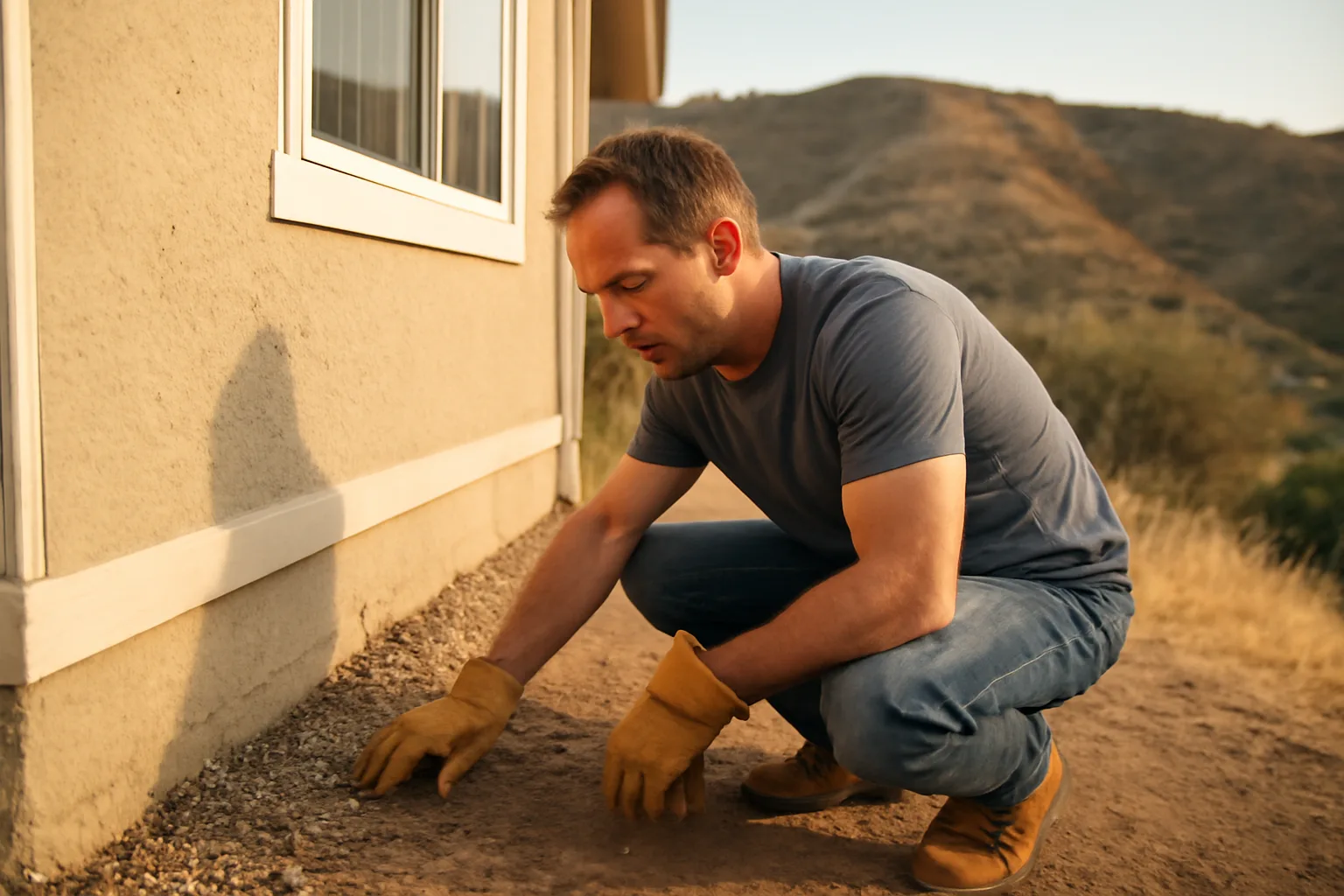
Zone 0 is the section inspectors scrutinize hardest, because it's the newest rule and the one with zero tolerance for mulch, shrubs, or storage against the wall. Walk the perimeter with a tape measure and note, for each side of the house, what's within 5 feet: bare ground, gravel, hardscape, or something combustible. CAL FIRE's ember-aware Zone 0 guidance calls for removing 'all combustible material' including wood mulch, dead vegetation, stored firewood, and combustible fencing attached to the structure within that 5-foot band. Write down specifics on the form: 'wood mulch bed, west side, 3 feet from siding' is useful; 'some plants near house' is not. Don't forget vertical space. If a tree canopy overhangs Zone 0, or a wood fence attaches directly to the house, note it even if it technically starts outside the 5-foot line, because attached fencing is treated as an extension of the structure under most local ordinances. Take photos from at least two angles per side and timestamp them (most phones do this automatically in the file metadata, but write the date on the form too as a backup). If your jurisdiction hasn't finalized local Zone 0 enforcement yet, say so on the form rather than leaving it blank. As of this writing, California's statewide Zone 0 regulation (required under SB 63 and related legislation) has been moving through a formal rulemaking process with the Board of Forestry and Fire Protection, and enforcement dates have shifted; check your county's current status before you assume a deadline. See the section below on 2026 dates for the honest state of play.
How do I fill out Zone 1 and Zone 2 (5 to 100 feet)?
Zone 1 (5-30 feet) and Zone 2 (30-100 feet) sections ask about spacing, not bare ground. You're not clearing everything here, you're breaking up continuous fuel so fire can't run tree to tree or shrub to shrub toward the house. For Zone 1, CAL FIRE recommends removing dead plants, dead branches, and dry leaves and pine needles, and keeping tree canopies at least 10 feet apart. On the form, note actual measured gaps where you can ('canopy spacing approx. 12 ft, north side') rather than just checking a box. For Zone 2, the guidance shifts to fuel reduction: cut annual grass to 4 inches or less, and space trees and shrubs based on slope, since fire moves faster uphill. A lot of advisory forms include a slope field for exactly this reason. If your lot is on a hillside, the spacing requirements tighten. Steeper slope, wider gap. Write your estimated slope percentage if you know it, or note 'moderate slope, no measurement taken' if you don't; guessing a number you can't back up is worse than admitting you didn't measure it. Landscaping questions on these sections often ask about plant flammability. If you're replanting anything in Zone 1 or 2, our guide on fire safe landscaping next to a house covers which species insurers and inspectors tend to flag.
How do I fill out the home hardening section (vents, roof, decking)?
The hardening section usually has four or five subsections: roof, vents, eaves/soffits, windows, and decking. Each one asks for material type and condition, more than yes/no. For roofing, note the covering (Class A asphalt shingle, tile, metal, wood shake) and whether gutters have leaf guards or visible debris. Wood shake and shingle roofs are the highest-risk category and many insurers now decline coverage outright if they see one in a photo. For vents, this is where advisory forms get specific: mesh size matters. Standard 1/4-inch mesh screening does not stop embers; ember-resistant vents use finer mesh (typically 1/16 inch) or intumescent material that swells shut in heat. Note the vent type at attic, foundation, and eave locations separately, since it's common to have compliant vents in one spot and old ones in another. For decking, check what's underneath as well as the surface material. A composite deck board over exposed combustible framing with debris underneath is a different risk than the same board over a clear, enclosed foundation. If you're not sure what you're looking at, our house fire case background explains how vents and decking specifically factor into home ignition during real wildfire events, which helps explain why inspectors ask about them at all. Windows: single-pane windows can fail from radiant heat alone; note pane count and frame material (vinyl frames soften at lower temperatures than metal).
When does the California defensible space law go into effect?
The core 100-foot defensible space requirement under Public Resources Code 4291 has been in effect for years already; it's not new. What's changing is Zone 0. California's Zone 0 ember-resistant zone requirement was authorized by Assembly Bill 3074 (2020), which directed the Board of Forestry and Fire Protection to develop regulations for a 0-to-5-foot ember-resistant zone around homes in high fire severity zones [2]. The Board has been working through formal rulemaking since then, and the effective date for mandatory enforcement has been pushed back more than once as the regulatory language gets finalized. As of mid-2025, CAL FIRE's public messaging describes Zone 0 as strongly recommended now, with formal regulatory enforcement still pending finalization; homeowners in high-risk areas are encouraged to implement it ahead of any mandate. Check your specific county or fire district's current enforcement status before assuming a firm date, because this is a case where 'it varies by jurisdiction' is the honest answer, not a dodge. Note the current status on your advisory form as: 'Zone 0 recommended per CAL FIRE, not yet locally mandated as of [date you filled the form].'
What fire safe rules for homes take effect in 2026?
There's no single nationwide '2026 fire safe home law.' What exists is a patchwork of state and local deadlines, and the honest answer depends heavily on which state and county you're in, so fill in your local specifics rather than relying on a blanket date. In California, expect continued rollout of Zone 0 enforcement timelines as the Board of Forestry finalizes its regulation, plus continued local adoption of Chapter 7A wildfire-resistant construction standards for remodels and additions in State Responsibility Areas. Some counties are moving faster than the state baseline; check your county planning or building department page directly. Oregon's statewide wildfire risk map and defensible space code process, tied to Senate Bill 762 (2021), has had its own multi-year rollout with revised timelines after the original 2022 map drew public pushback and was withdrawn for rework [3]. Confirm your property's current designation status with Oregon Department of Forestry before assuming any specific 2026 requirement applies to you. Colorado and Arizona don't have a single statewide defensible space law comparable to California's PRC 4291; requirements are set more locally, through county wildfire mitigation codes or through individual insurer requirements. This is genuinely a 'check your local fire district' situation, and your advisory form should have a field for exactly that: jurisdiction, applicable code, and enforcement date, filled in from your county or fire district's current published guidance rather than assumed from a national headline.
Why won't people follow the defensible space law in California?
Cost and confusion are the two honest reasons, not defiance. Clearing 100 feet of defensible space on a wooded lot can run into thousands of dollars in labor, tree removal, and debris hauling, and low-income and elderly homeowners in rural SRA areas are disproportionately affected. CAL FIRE's own defensible space compliance data has shown inspection pass rates well below 100% in many counties in past reporting years, with unclear or confusing requirements cited by residents as a recurring complaint in state wildfire planning documents. Renters and absentee owners add another layer: a landlord who doesn't live on-site may simply not know an inspection notice arrived, or may not prioritize spending on a property they're not living in day to day. There's also a real disagreement, in some communities, about aesthetics and ecology. Homeowners who value dense native landscaping sometimes resist removing mature vegetation they see as beneficial for shade, privacy, or wildlife, even when it technically violates spacing guidance. And some rural residents distrust state mandates generally, especially where enforcement has historically been inconsistent, with warnings issued but few actual citations followed through. None of that changes the math for insurance purposes, though. Whatever the reason for non-compliance, an insurer's non-renewal decision usually doesn't care why the work wasn't done, only whether it was.
How do I prepare for a wildfire beyond the advisory form?
The advisory covers your property's fire resistance; a wildfire go-plan covers your family's response when a fire is actually approaching, and you need both. Ready.gov recommends building a family emergency communication plan and a go-bag with at least a 3-day supply of food, water, medications, and copies of important documents, kept somewhere you can grab it in minutes. Practice your evacuation route at least twice a year, and identify two ways out of your neighborhood in case one road is blocked by fire or traffic. Sign up for local emergency alerts specifically; don't rely on a phone notification you might sleep through. Most counties in fire-prone states run a wireless emergency alert system plus a separate opt-in system (like Nixle or a county-specific app) and signing up for both closes a real gap. Inside the house, keep a fire extinguisher rated for the right classes near the kitchen and garage, and know your gas shutoff location before you ever need it in the dark with a fire nearby. If your insurer sent a non-renewal notice, a Wildfire Insurance Survival Kit organizes the advisory paperwork, photos, and mitigation receipts into one file so you're not scrambling to rebuild that record from memory when an appraiser or new insurer asks for it. We don't file claims or negotiate with insurers; the kit just helps you prepare and send your own documentation.
How do I prevent wildfires and forest fires from starting near my home?
Most wildfires near homes start from human causes, not lightning, so the prevention steps that matter most are behavioral, more than landscaping. According to research summarized by federal wildfire agencies, roughly 85-90% of wildfires in the U.S. are human-caused, from unattended campfires, debris burning, equipment sparks, and downed power lines [4]. Around your own property, that translates to concrete habits: never leave a campfire or burn pile unattended, avoid mowing dry grass in the heat of the afternoon (a hot mower blade striking a rock is a real ignition source), and keep chainsaws, grinders, and other spark-producing tools away from dry vegetation during red flag warning days. Check local burn restrictions before any outdoor burning; many counties suspend all burn permits during high fire danger periods, and violating that isn't just a fine risk, it's a genuine community hazard. If you tow a trailer or drive off-road on dry grass, check for dragging chains; a dragging chain striking pavement is a documented ignition source in multiple wildland fire investigations. Defensible space work itself is prevention too, just of a different kind: it doesn't stop a fire from starting, but it stops embers landing near your house from becoming a house fire. See our only you can prevent wildfires piece for the fuller list of ignition-source habits worth changing.
Is Santa Barbara safe from fire, and how do local conditions affect my advisory?
No California community with wildland vegetation nearby is fully 'safe' from fire, and Santa Barbara County has a long documented history of major fires, including the 1990 Painted Cave Fire and the 2017 Thomas Fire, which at the time was the largest wildfire in modern California history before being surpassed by later fires [5]. The honest framing isn't safe versus unsafe, it's risk level and how well-prepared a given property is. Santa Barbara's terrain (steep coastal foothills, chaparral vegetation, and offshore Santa Ana/sundowner wind events) creates conditions that CAL FIRE and county fire officials treat as elevated risk, which is why much of the county's wildland-urban interface falls inside a State Responsibility Area or a designated Very High Fire Hazard Severity Zone. If your property is in one of those zones, PRC 4291's 100-foot defensible space requirement applies directly. This is exactly the kind of local variance your advisory form should capture explicitly: note your specific Fire Hazard Severity Zone classification (check your county's published FHSZ map), your local fire district's specific enforcement contact, and any local ordinance stricter than the state baseline. Santa Barbara County and the city of Santa Barbara have both adopted local defensible space and vegetation management ordinances beyond the state minimum in past years; confirm the current version with the local fire department before submitting your form, since local ordinances get updated more often than state statute.
What should I do after I finish filling out the advisory?
Once every zone and hardening section is filled in, make three copies: one for your records, one for your insurer or agent, and one to keep with your emergency go-bag documents. Attach your dated photos directly to the form or reference photo file names in each section, so a reviewer doesn't have to guess which photo matches which line item. If you did mitigation work specifically to respond to a non-renewal notice, keep receipts and before/after photos together as a single packet; insurers reviewing an appeal or a new applicant's risk profile respond better to a complete, dated record than a verbal description of work done. If any item on the form shows non-compliance, don't leave it blank hoping it goes unnoticed. Note a realistic completion date and, if cost is the barrier, note that too; some counties and utilities offer chipping programs or cost-share grants for defensible space work, and CAL FIRE's Wildfire Mitigation Grant program has funded exactly this kind of work in past cycles for qualifying counties . Finally, calendar a re-inspection or self-review date, typically annually, since vegetation regrows and gutters refill with debris regardless of what the form said last year.
Frequently asked questions
When does the California defensible space law go into effect?
The core 100-foot defensible space rule under Public Resources Code 4291 has applied for years in State Responsibility Areas. The newer Zone 0 (0-5 foot ember-resistant zone) requirement, authorized by AB 3074, is still in formal rulemaking as of mid-2025; CAL FIRE recommends implementing it now even though statewide mandatory enforcement dates keep shifting. Check your county's current status directly.
Why won't people follow the defensible space law in California?
Mostly cost, confusion, and property size, not defiance. Clearing 100 feet on a wooded lot can cost thousands in labor and hauling, low-income and elderly rural homeowners are disproportionately affected, and some residents genuinely don't understand which zone rules apply where. CAL FIRE inspection data has shown compliance well below 100% in several counties in past reporting cycles.
How do I prevent wildfires from starting near my property?
Never leave campfires or burn piles unattended, avoid mowing dry grass in afternoon heat, check for dragging trailer chains, and follow local burn restrictions during red flag warnings. Roughly 85-90% of U.S. wildfires are human-caused according to federal wildfire agency data, so behavior change around ignition sources matters as much as landscaping.
How do I prepare for a wildfire if I get an evacuation warning?
Build a go-bag with a 3-day supply of water, food, medications, and important documents, per Ready.gov guidance. Identify two evacuation routes, sign up for local emergency alerts beyond default phone notifications, and know your gas shutoff location. Practice the route at least twice a year so it's not the first time under pressure.
What fire safe rules for homes take effect in 2026?
There's no single nationwide 2026 deadline. California continues rolling out Zone 0 enforcement and Chapter 7A construction standards locally; Oregon's wildfire risk map and code process under SB 762 has its own revised timeline. Check your specific county or state fire marshal's page, since dates vary by jurisdiction and have shifted before.
Is Santa Barbara safe from fire?
No coastal California community near chaparral terrain is fully safe from fire. Santa Barbara County has a documented history including the 1990 Painted Cave Fire and 2017 Thomas Fire, and much of its wildland-urban interface sits in a Very High Fire Hazard Severity Zone, meaning the state's 100-foot defensible space rule applies directly to many properties there.
How do I fill out the Zone 0 section of my advisory form?
Walk each side of the house and note within 5 feet: bare ground, gravel, or combustible material like mulch, dead plants, stored firewood, or attached wood fencing. CAL FIRE guidance calls for removing all combustible material in this zone. Be specific ('mulch bed, west wall, 3 ft') rather than vague, and photograph each side.
What mesh size do ember-resistant vents need?
Standard 1/4-inch mesh does not stop embers reliably. Ember-resistant vents typically use 1/16-inch mesh or intumescent material that swells shut under heat. Note vent type separately at attic, foundation, and eave locations on your advisory, since it's common for some vents to be upgraded and others not.
How can we prevent forest fires as individuals, more than around our own house?
Follow local burn restrictions, report unattended fires or downed power lines immediately, maintain vehicle spark arrestors if you drive off-road, and support community chipping and fuel-reduction programs. Since most wildfires are human-caused, individual ignition-prevention habits (campfires, equipment sparks, debris burns) matter as much as personal property hardening.
What's the difference between defensible space and home hardening on the advisory?
Defensible space covers vegetation and clearance in zones 0 through 2 (0 to 100 feet). Home hardening covers the structure itself: roof material, vent mesh, eaves, windows, and decking. Both sections usually appear on the same advisory form because embers and radiant heat attack the house through both pathways during a wildfire.
What do I do if my advisory shows I'm not compliant yet?
Don't leave it blank. Note the specific gap, a realistic completion date, and cost barriers if relevant. Some counties and utilities offer chipping programs or cost-share grants; CAL FIRE's Wildfire Mitigation Grant program has funded this kind of work in qualifying counties in past cycles. A documented plan reads better to insurers than silence.
Does completing the advisory guarantee my insurance gets reinstated?
No. Completing and submitting an advisory documents your mitigation work; it doesn't guarantee reinstatement, a discount, or a coverage decision. Insurers make that call independently. This is preparation and documentation only, not insurance or legal advice, and you send your own paperwork rather than having a third party negotiate on your behalf.
Sources
- California Public Resources Code Section 4291: 100 feet of defensible space (or to the property line) is required around structures in State Responsibility Areas
- California Assembly Bill 3074 (2020): Authorized the Board of Forestry and Fire Protection to develop Zone 0 ember-resistant zone regulations
- Oregon Senate Bill 762 (2021): Directed Oregon's statewide wildfire risk mapping and defensible space code process
- National Interagency Fire Center / Congressional Research Service wildfire statistics: The large majority of U.S. wildfires are human-caused rather than lightning-caused
- CAL FIRE, Fire Hazard Severity Zone Maps: Fire Hazard Severity Zone classification determines where the 100-foot defensible space requirement applies