Last updated 2026-07-25
TL;DR
A defensible space contractor clears vegetation and hardens the zone around your home to meet state fire codes and insurer requirements. Expect $1,500 to $8,000+ depending on lot size and slope. Ask for a certificate of insurance, a written scope tied to your local Zone 0/1/2 rules, and dated photos you can send your insurer yourself.
what does a defensible space contractor actually do
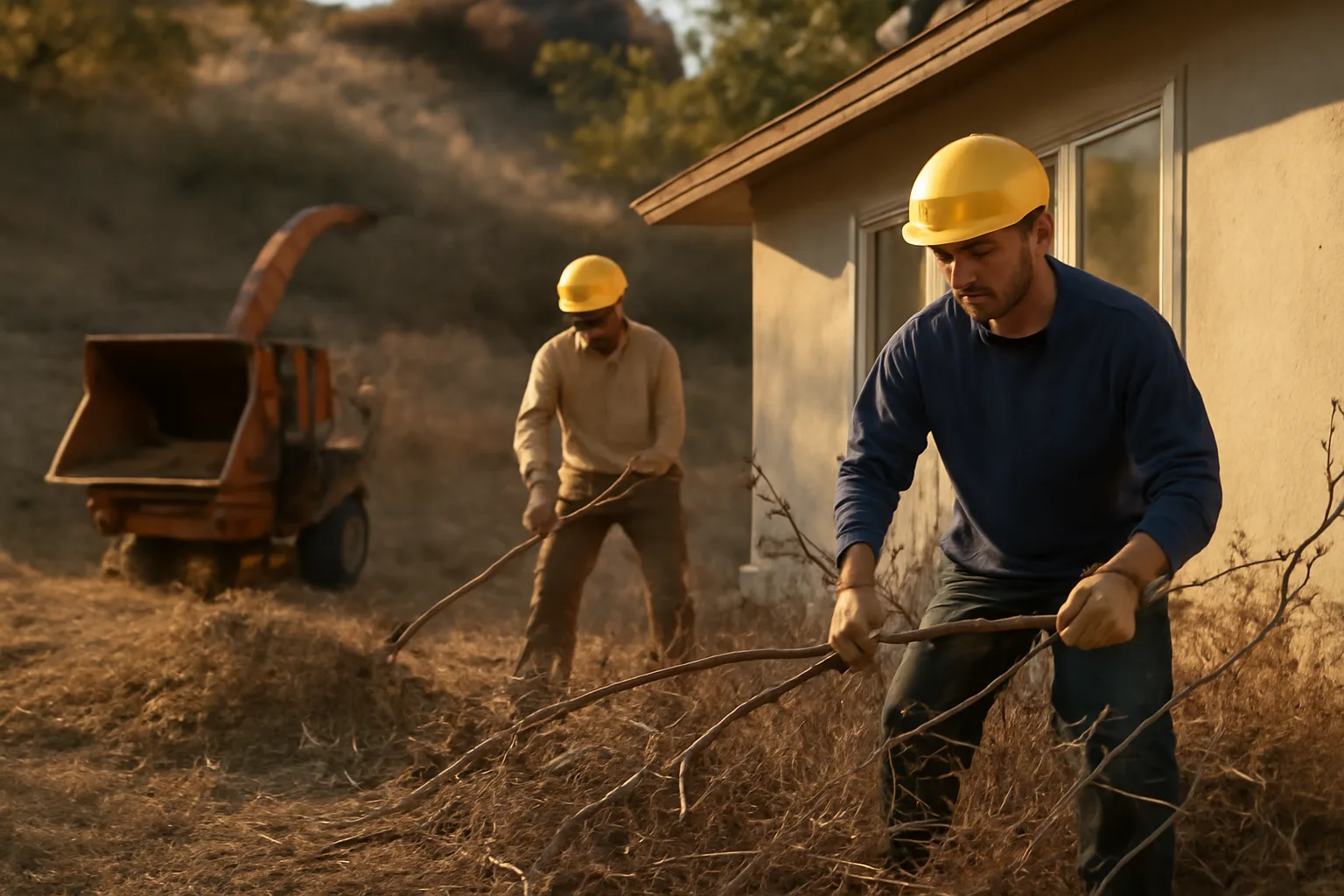
A defensible space contractor clears, thins, and rearranges vegetation and combustible material around a structure so a wildfire has less fuel to burn when it reaches your property. That means cutting dead grass and brush, limbing up trees, removing branches that overhang the roof, relocating woodpiles, and sometimes regrading or adding gravel or hardscape close to the foundation. This is not landscaping in the decorative sense. A good contractor works from the zone system CAL FIRE and most state fire agencies use: Zone 0 (0-5 feet from the structure, the strictest zone, sometimes called the ember-resistant zone), Zone 1 (5-30 feet), and Zone 2 (30-100 feet, sometimes farther depending on slope). Some contractors also do the structural side, mesh screens on vents, ember-resistant gutter guards, replacing wood mulch with rock, but plenty only do vegetation work and subcontract the rest. If you're comparing what's actually required in each ring versus what's just good practice, the fire safe landscaping California next to house breakdown covers plant spacing and material choices zone by zone, which is worth reading before you sign a scope of work so you know what you're paying for. Mitigation rules vary by fire district, so the exact required clearance distance, allowed plant list, and vent-screening mesh size in your area depends on your local fire authority having jurisdiction. Ask your contractor to name the specific ordinance or CAL FIRE unit guidance they're working from, more than "standard practice."
when does the california defensible space law go into effect
California's core defensible space law (Public Resource Code 4291) already requires 100 feet of clearance around structures in State Responsibility Areas and has been in effect for years; it's the newer Zone 0 ember-resistant zone regulation that's still catching up to the statute [1]. The legislature passed AB 3074 back in 2020 directing the Board of Forestry to write specific Zone 0 regulations for the 0-5 foot zone, but as of 2025 those regulations were still in the rulemaking process and had not taken final effect statewide [2]. That gap matters. Homeowners in State Responsibility Areas and some Local Responsibility Areas are legally required to maintain 100 feet of defensible space today, under existing law, whether or not the Zone 0 specifics are finalized [1]. CAL FIRE's own guidance states the 100-foot requirement plainly: "reduce or remove flammable vegetation within 100 feet of your home". The Zone 0 rulemaking (once adopted) is expected to add specific restrictions on combustible items within 5 feet of the structure, things like bark mulch, wood fencing that attaches to the house, and stored firewood. Don't wait for the final Zone 0 regulation to act. Insurers and inspectors are already grading properties against the 100-foot standard and increasingly asking about the 5-foot zone informally, even before it's codified. Check your county's building or fire department page for local timeline updates since state rulemaking timelines shift.
what fire safe home rules take effect in 2026
There isn't one single national "2026 fire safe homes" law, this varies heavily by state, so the honest answer is: check your specific state fire marshal's office, because requirements differ by state and even by county fire district. What's true across most wildfire states is a trend toward parcel-level defensible space enforcement plus insurer-driven hardening requirements running on separate, faster timelines than state statute. In California, the Zone 0 regulation project (Public Resources Code 4291 implementation via the Board of Forestry) has had proposed effective dates pushed multiple times since the 2020 authorizing legislation, and readers should check the Board of Forestry and Fire Protection's current rulemaking status rather than assume a fixed 2026 date [2]. Colorado, Oregon, and Arizona each have their own state fire marshal offices publishing wildland-urban interface codes and model ordinances, and local jurisdictions adopt them on their own schedules. What you can act on now regardless of exact effective dates: insurers in all four states (CA, CO, OR, AZ) are already using their own hardening checklists for non-renewal decisions, often stricter than what state law technically requires yet. Waiting for a law to "kick in" before hardening your home is backwards if you've already gotten a non-renewal or inspection letter. Treat the strictest applicable standard, whichever it is, insurer or state, as your target today.
how much does a defensible space contractor cost
| Basic Zone 0-1 clearing (0-30 ft), small lot | $800-$2,500 | Grass, brush, ladder fuels, debris haul-off | |
|---|---|---|---|
| Full Zone 0-2 clearing, standard lot | $2,500-$6,000 | Includes limbing, spacing, some tree thinning | |
| Steep slope or heavily wooded acre+ lot | $5,000-$15,000+ | Access equipment, more hauling, possible tree removal | |
| Single hazard tree removal | $500-$3,000+ | Depends on size, proximity to structure, access | |
| Annual maintenance (repeat clearing) | $500-$2,000 | Often 30-50% less than initial clearing | Get at least two written quotes before signing anything. Ask each contractor to break out labor, disposal/hauling fees, and any equipment rental separately, because disposal fees are where a lot of quotes balloon quietly. |
Expect to pay somewhere between $1,500 and $8,000 for a typical quarter-acre to one-acre residential defensible space job, with heavily overgrown, steep, or wooded lots running higher. There's no single national price list because labor rates, disposal fees, and lot conditions vary too much, but a few reference points help. CAL FIRE's homeowner guidance doesn't publish contractor pricing, but many California county fire safe councils and resource conservation districts that run chipper/cost-share programs report typical per-acre clearing costs in the low thousands for brush removal alone, before hauling and disposal. Tree removal, if a hazard tree needs to come down entirely, is a separate line item and can run $500 to $3,000+ per tree depending on size and access. | Job type | Typical cost range | Notes |
how do i find a legitimate defensible space contractor near me
Start with your state's licensed contractor registry, not a generic search or a door-to-door flyer. Check whether your state requires a specific license for tree work or land clearing (some states classify this under landscaping, others under tree service or general contracting), and confirm the license is active before you get a quote. Ask your local fire department or fire safe council for a referral list. Many California counties have fire safe councils that maintain vetted contractor lists tied to chipper day or cost-share programs, and CAL FIRE's Ready for Wildfire program links out to local resources [3]. Oregon and Colorado both have state forestry-adjacent programs that do the same at a smaller scale. Red flags to walk away from: a contractor who won't give you a written scope of work, one who wants full payment upfront before any work starts, anyone without a certificate of insurance (general liability at minimum, workers' comp if they have employees), and anyone who can't answer a basic question about your local zone requirements without checking. If someone claims they can guarantee your insurance company will renew your policy once they're done, that's a promise no contractor can legally make. Insurers make their own underwriting decisions.
what should be in a defensible space contract before you sign
A real contract names the specific zones being worked (0, 1, 2), the linear or square footage covered, the disposal method, a start and completion date, and a price broken into labor and disposal. If any of those five things is missing, ask for it in writing before you pay anything. Also ask for: a certificate of insurance naming you (or at least confirming active coverage you can verify by phone with the insurer), photos or a walkthrough before work starts so there's a documented "before" state, and a written statement of what specific standard they're clearing to (your county ordinance, CAL FIRE's 100-foot guidance, or your insurer's specific letter, whichever applies). If your work is being done in response to an insurance non-renewal letter, bring that letter to the first estimate meeting so the contractor scopes work against the actual language your insurer used. Get dated "after" photos once work is done, from multiple angles, especially of the 5-foot and 30-foot lines if those were called out in your notice. You'll want these for your own records regardless of what happens with your policy. This is documentation you send yourself; a contractor doing defensible space work does not contact your insurer on your behalf, file a claim for you, or promise a reinstatement, discount, or renewal. That's on you and your agent.
why won't people follow the defensible space law in california
The most-cited reasons, based on CAL FIRE's own outreach materials and state legislative analyses, are cost, confusion about what's actually required, and the labor of doing it yourself on top of everything else homeowners manage. It's not usually defiance, it's friction. Cost is real for lower-income and elderly homeowners, especially on larger rural parcels where 100 feet of clearance means significant tree and brush removal, sometimes thousands of dollars they don't have. CAL FIRE and several county programs have responded with chipper days, cost-share grants, and senior/low-income assistance programs, but availability and funding vary year to year and county to county, so check locally rather than assuming a program exists everywhere [3]. Confusion is the second big driver. Homeowners genuinely don't always know where their property line sits relative to the 100-foot rule, which plants are considered high-fume or fire-prone locally, or whether their situation falls under State Responsibility Area rules versus a local ordinance. Enforcement is also inconsistent; some counties do systematic inspections and follow up with fines for non-compliance, others rely almost entirely on self-reporting and complaint-driven inspections, so the deterrent effect of the law varies a lot by where you live [1]. If you're unsure which category your parcel falls into, your county fire department or CAL FIRE unit office can tell you directly.
how to prevent wildfires around your home
You can't stop a wildfire from starting somewhere else, but you can dramatically reduce the odds it destroys your specific structure once it arrives, and that's the actual, achievable goal. CAL FIRE's research and post-fire assessments consistently point to embers, not the fire front itself, as the primary way homes ignite, entering through vents, landing on debris in gutters, or igniting mulch and dry vegetation against the wall. The highest-leverage, lowest-cost actions: clear the first 5 feet around your home completely of anything combustible (no bark mulch touching the siding, no wood piles, no dry leaves in that ring), screen attic and foundation vents with 1/8-inch metal mesh to block ember entry, and clean gutters and roof valleys of pine needles and leaf litter before fire season. None of these cost more than a weekend and some hardware store trips, unlike full-lot vegetation clearing. Beyond your own lot, community-level prevention matters too, since a neighbor's uncleared parcel or shared access road with overgrown brush affects your risk regardless of what you do on your own property. This is part of why some California fire safe councils coordinate neighborhood-wide chipper days and shared cost programs, because defensible space works best as a block-level effort, more than a single-parcel one.
how to prepare for a wildfire before it happens
Preparing for a wildfire has two tracks that run in parallel: hardening your property and getting your documentation and evacuation plan in order. Most homeowners only do the first one, if that, and skip the paperwork side entirely until it's too late to do it calmly. On the property side: complete your defensible space zones, harden vents and eaves, and keep a hose and metal rake accessible. Ready.gov's wildfire preparedness guidance recommends assembling a go-bag with medications, copies of key documents, and supplies for at least three days, and identifying two evacuation routes out of your neighborhood in case one is blocked. On the documentation side, and this is the part almost nobody does until they're already in a non-renewal fight: take dated, timestamped photos of your defensible space work, your roof material, your vent screens, and your address numbers being visible from the road, before you need them. If your insurer sends an inspection or non-renewal letter, having your own photo record from before that letter arrived is the single most useful thing you can hand back to them or use when shopping for new coverage. This is exactly the gap our $99 Wildfire Insurance Survival Kit is built to close: a structured way to document defensible space work, hardening upgrades, and inspection responses so you have your own paper trail instead of scrambling after a letter arrives. Start at /survival-kit-builder.
how to prevent forest fires and how to avoid forest fires from spreading
Most forest fires are human-caused, and the U.S. Forest Service estimates roughly 85-90% of wildfires nationally are started by people, whether through unattended campfires, equipment sparks, downed power lines, or arson, rather than lightning [4]. That means individual behavior change, more than home hardening, is a real prevention lever. Simple, boring, effective habits: fully extinguish campfires (drown, stir, drown again, until it's cold to the touch), never use fireworks or exploding targets in dry grass conditions, keep vehicles off dry grass where a hot exhaust or catalytic converter can ignite it, and maintain equipment (chainsaws, mowers, generators) so sparks don't land in dry fuel. Ready.gov and most state fire marshal offices publish red flag warning alerts during high-risk wind and humidity conditions; checking those before doing anything with an open flame or spark-producing tool outdoors is a five-second habit that prevents a real number of fires every year. At the neighborhood and community level, prevention also means reporting downed power lines immediately, supporting local brush clearing and controlled burn programs even when they cause short-term smoke, and not assuming "someone else will call it in." If you want the property-level version of this same logic (why one house burns and the neighbor's doesn't), the defensible explainer covers the mechanics of ember exposure and structure ignition in more depth.
is santa barbara safe from fire
No coastal California city is "safe" from wildfire risk in an absolute sense, and Santa Barbara County specifically sits in one of the more fire-exposed regions in the state due to its combination of steep foothill terrain, chaparral fuel, and Santa Ana/sundowner wind events. The Thomas Fire (2017) burned into Santa Barbara County and was, at the time, the largest wildfire in modern California history by acreage, followed by deadly post-fire debris flows in Montecito that killed 23 people in January 2018 [5]. That history is exactly why insurers treat much of Santa Barbara County, especially the foothill and wildland-urban interface communities like Montecito, Mission Canyon, and the Riviera, as high-risk zones for non-renewal. If you live in or near these areas and haven't gotten a non-renewal letter yet, it's worth assuming your risk profile looks similar to neighbors who have, and getting ahead of documentation now rather than after a letter arrives. The honest framing for any specific city or neighborhood: check your parcel's designation in CAL FIRE's Fire Hazard Severity Zone maps, which are public and searchable by address, rather than relying on general reputation about a city being "fire safe" or not [6]. Hazard zone designations, not city limits, are what insurers and building codes actually key off of.
how can we prevent forest fires at the community level
Community-level prevention works through three channels that individual homeowners can plug into: coordinated fuel breaks, shared defensible space enforcement, and public education campaigns, and all three depend on participation, more than policy. A fuel break or shaded fuel break only works if it's maintained continuously across property lines, which means a single holdout parcel can undercut an entire street's worth of work. Many counties in California, Colorado, Oregon, and Arizona run Firewise USA-recognized communities (a National Fire Protection Association program) where neighbors coordinate defensible space standards and often qualify for grant funding or insurer discounts for collective participation . Joining or starting one of these in your neighborhood is genuinely one of the higher-leverage things a homeowner can do beyond their own parcel, because insurers increasingly look at community-level mitigation status, more than individual home hardening, when making renewal decisions in some wildfire-prone markets. The long-running "Smokey Bear" prevention campaign line, "Only you can prevent wildfires," originated with the U.S. Forest Service and still captures the core truth: ignition prevention is mostly a behavior problem, while defensible space and hardening are the survival-once-ignited problem. Both matter, and treating them as the same task is a common mistake. For more on the ignition-prevention side specifically, see only you can prevent wildfires.
what happens after the contractor finishes the work
Once the crew leaves, your job isn't done, it's just moved from physical labor to paperwork, and this step is the one homeowners skip most often. Take your dated after-photos immediately, before wind or rain changes anything, from the same angles as your before-photos if you took any. Write down (or have the contractor provide) the specific measurements: how many feet of clearance now exist in each zone, what vegetation was removed versus thinned, and whether any structural hardening (vent screens, gutter guards) was included. If your insurer's non-renewal or inspection letter cited specific deficiencies, match your documentation directly to their language, item by item, so there's no ambiguity about what was addressed. Send this package to your insurance agent or company yourself, in writing, with photos attached, and keep a copy. Again: neither your contractor nor a documentation service files claims, contacts your insurer for you, or promises reinstatement, discount, or renewal on your behalf. What you're doing is building the record a human underwriter can actually act on, which is different from hoping the work speaks for itself. If a neighbor's fire loss is part of why you're doing this now, our house fire and fire at a house pieces cover what typically causes total loss versus survivable damage, which is useful context for prioritizing your own hardening budget.
Frequently asked questions
When does the California defensible space law go into effect?
The core 100-foot defensible space requirement under Public Resource Code 4291 is already in effect and has been for years in State Responsibility Areas. The newer Zone 0 (0-5 foot) ember-resistant zone regulation, authorized by AB 3074 in 2020, was still in the Board of Forestry's rulemaking process as of 2025 and had not taken final statewide effect; check the board's current status for updates.
Why won't people follow the defensible space law in California?
CAL FIRE and state analyses point to cost (especially on large rural parcels), confusion about property lines and required clearance, and inconsistent enforcement across counties. It's usually friction, not defiance. Chipper day and cost-share programs exist in many counties to lower the cost barrier, but availability varies year to year, so check with your local fire safe council.
What fire-safe home rules take effect in 2026?
There's no single 2026 national rule; requirements vary by state and county fire district. California's Zone 0 regulation has had proposed dates pushed multiple times since 2020. Insurers in CA, CO, OR, and AZ are already enforcing their own hardening checklists ahead of any state deadline, so treat the strictest applicable standard as your real target now.
How much does defensible space work typically cost?
Most quarter-acre to one-acre residential jobs run $1,500 to $8,000, with steep or heavily wooded lots running higher. Basic Zone 0-1 clearing on a small lot can run $800-$2,500. Single hazard tree removal is a separate cost, typically $500-$3,000+ depending on size and access. Get at least two written quotes broken out by labor and disposal.
How do I find a legitimate defensible space contractor?
Check your state's licensed contractor registry first, then ask your local fire department or county fire safe council for a referral list. Confirm active insurance by phone. Walk away from anyone who won't give a written scope, wants full payment upfront, or promises your insurer will renew your policy, since no contractor can legally guarantee an underwriting decision.
Is Santa Barbara safe from fire?
No coastal California city is fully safe from wildfire risk. Santa Barbara County has steep chaparral terrain and wind exposure that produced the 2017 Thomas Fire and the deadly 2018 Montecito debris flows that killed 23 people. Check your specific parcel's CAL FIRE Fire Hazard Severity Zone designation rather than relying on the city's general reputation.
How can we prevent forest fires as individuals?
Roughly 85-90% of U.S. wildfires are human-caused, per U.S. Forest Service estimates, so behavior matters. Fully extinguish campfires, avoid fireworks or spark-producing equipment in dry grass, keep vehicles off dry vegetation, maintain outdoor power equipment, and check red flag warnings before any outdoor activity involving flame or sparks.
What should be in a defensible space contract?
A written scope naming the specific zones (0, 1, 2) being worked, square or linear footage, disposal method, start/completion dates, and price broken into labor and disposal separately. Also get a certificate of insurance and before/after dated photos. If missing any of these, ask in writing before paying anything.
Do defensible space contractors negotiate with insurance companies?
No, and be wary of anyone who claims they will. A defensible space contractor's job is the physical clearing and hardening work. Filing claims, discussing coverage terms, or promising renewal/discounts is separate and is on you and your insurance agent; document the completed work yourself and send it directly to your insurer.
How to prepare for a wildfire if I live in a high-risk zone?
Complete defensible space clearing in all applicable zones, harden vents with 1/8-inch metal mesh, clear gutters of debris, and keep a go-bag with medications and key documents ready per Ready.gov guidance. Equally important: take dated photos of your property's fire-safe condition now, before any inspection or non-renewal letter arrives.
What's the difference between Zone 0, Zone 1, and Zone 2?
Zone 0 is 0-5 feet from the structure, the strictest ember-resistant zone. Zone 1 runs 5-30 feet and requires spaced, low vegetation. Zone 2 runs 30-100 feet (sometimes farther on slopes) and focuses on fuel reduction and spacing rather than full clearing. Exact rules vary by local fire district.
How often does defensible space need to be redone?
Most fire agencies and insurers expect annual maintenance, since grass, brush, and leaf litter regrow every season. Many contractors offer a repeat annual clearing at 30-50% less than the initial full clearing cost. Treat it like gutter cleaning: a recurring task tied to your local fire season, not a one-time project.
Sources
- California Public Resources Code Section 4291: 100-foot defensible space clearance requirement in State Responsibility Areas
- California Board of Forestry and Fire Protection, Zone 0 rulemaking: AB 3074 (2020) directed Zone 0 regulation development, status as of ongoing rulemaking
- CAL FIRE, Ready for Wildfire: Defensible space preparation resources and cost-assistance program referrals
- USDA Forest Service: Estimated 85-90% of wildfires in the U.S. are human-caused
- CAL FIRE, Fire Hazard Severity Zone Maps: Public, address-searchable fire hazard severity zone designations
- National Fire Protection Association, Firewise USA: Community-level defensible space coordination program with grant and recognition benefits