Last updated 2026-07-25
TL;DR
Fire resistant homes combine Class A roofing, ember-resistant vents, non-combustible siding within 5 feet of the foundation, and 100 feet of managed defensible space. CAL FIRE data shows homes built to California's Chapter 7A wildfire code survive at meaningfully higher rates than older construction. New state fire-hardening rules affecting the wildland-urban interface start phasing in through 2025-2026.
what makes a home fire resistant
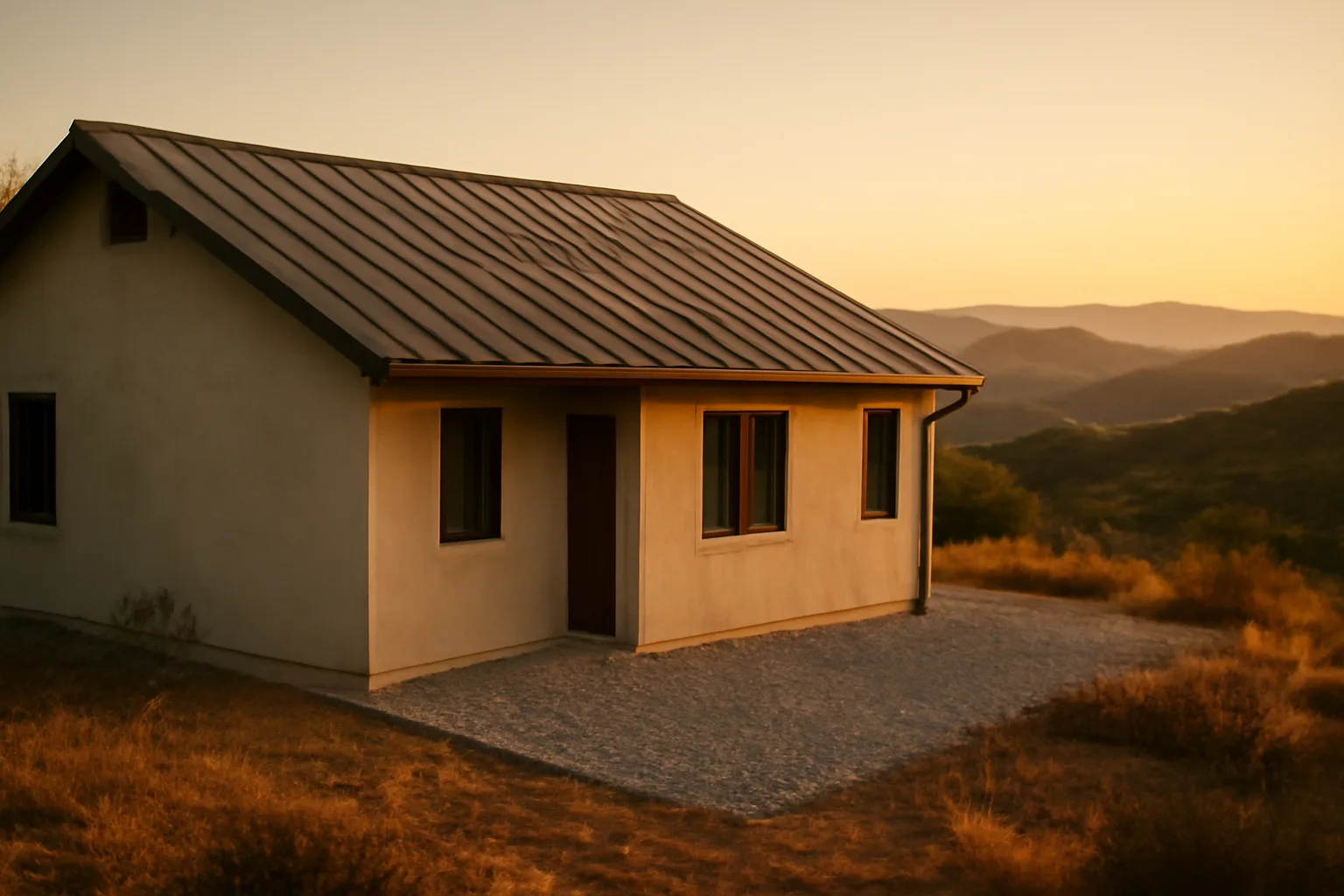
A fire resistant home is built and landscaped so embers and radiant heat can't easily ignite it during a wildfire. That's the whole goal. Most homes that burn in wildfires don't go up because a wall of flame rolls through. They ignite from embers landing on a wood shake roof, blowing into a vented attic, or catching a woodpile stacked against the siding. Research from the Insurance Institute for Business & Home Safety (IBHS) and CAL FIRE both point to the same conclusion: embers, not flame fronts, cause most home losses in wildfires. So a fire resistant home has a few non-negotiables. A Class A fire-rated roof (asphalt shingle, metal, tile, or slate, not wood shake). Ember-resistant vents that block embers from entering attics and crawlspaces. Non-combustible siding, or at minimum a 6-inch "vertical clearance" of non-combustible material where siding meets the ground. Dual-pane, tempered glass windows, since single-pane glass can crack from radiant heat alone and let embers inside. And a 5-foot "ember-resistant zone" around the foundation with no mulch, no wood fencing attached to the house, and no combustible plants. California's Building Code Chapter 7A codifies most of this for homes built or substantially remodeled in designated Fire Hazard Severity Zones since 2008. If your home predates that code, retrofitting the vents and the first 5 feet around the foundation is usually the highest-value money you can spend, more valuable per dollar than a full re-roof in most cases, because vents and near-home combustibles are where ember intrusion actually happens.
how to prevent wildfires from starting near your home
You can't prevent wildfires from starting somewhere else, but you can remove the conditions that let a wildfire become a home-ignition event. Roughly 85% of wildfires in the U.S. are human-caused, according to the National Interagency Fire Center, through unattended campfires, equipment sparks, downed power lines, and debris burning [1]. At the property level, the highest-impact prevention steps are: clearing dead vegetation and pine needles from gutters and roof valleys, keeping grass mowed to 4 inches or less within 30 feet of structures, moving firewood stacks at least 30 feet from the house, and never using equipment (mowers, grinders, welders) on dry vegetation during red flag warning days. CAL FIRE's defensible space guidance breaks this into two zones: Zone 0 (0-5 feet, ember-resistant), and the extended zone out to 100 feet with reduced fuel load. If you're in a rental or HOA-governed property with shared open space, push for the HOA to fund brush clearance on common land. A single unmanaged lot next door can undo everything you did on your own property. This is the most common failure point neighbors report to each other after a near-miss.
how to prepare for a wildfire before evacuation orders come
Preparing for a wildfire means having your documentation, your go-bag, and your property hardening done before a red flag warning, not during one. Ready.gov recommends assembling an emergency kit with at least a 3-day supply of water (one gallon per person per day), non-perishable food, a battery or hand-crank radio, and copies of critical documents in a waterproof container. Beyond the go-bag, the preparation that actually protects your claim and your home falls into three buckets. First, photo and video documentation of your home's exterior, interior, and any recent hardening work (new roof, vent replacement, defensible space clearing), dated and stored somewhere other than your phone alone. Second, a written inventory of major possessions with approximate replacement values. Third, contact information for your insurer's claims line and your agent, printed on paper, because cell towers and internet can go down during major fires. Many homeowners find out how thin their preparation was only after a non-renewal letter arrives, when an insurer wants proof of defensible space work and there's no dated record of it. Building that record before you need it is the difference between a straightforward appeal and a frustrating one. A structured way to organize photos, receipts, and clearing dates before you're asked for them is worth setting up now rather than during a crisis; that's the specific gap our $99 Wildfire Insurance Survival Kit (/survival-kit-builder) is built to fill, though you can absolutely build your own version with a labeled folder and a calendar reminder.
how to prevent forest fires and avoid forest fires as a homeowner or land user
Preventing forest fires as an individual comes down to fire-safe behavior in dry, windy conditions, since the large majority of wildfires trace back to human activity rather than lightning. The National Interagency Fire Center's decade-long data shows roughly 85-90% of wildfires nationally have human causes: campfires, debris burning, equipment use, arson, and vehicle-related sparks (dragging chains, hot catalytic converters on dry grass) [1]. To avoid starting a forest fire: never leave a campfire unattended and drown it completely, stir the ashes, and drown again until cold to the touch. Don't park or idle vehicles over dry grass. Avoid mowing or using power equipment between 10 a.m. and 6 p.m. on hot, windy days. Check local burn permit status before any debris burning, since most states suspend permits during red flag conditions. If you manage forested or brush-covered land, thinning dense stands, removing ladder fuels (low branches and shrubs that let ground fire climb into tree canopies), and creating fuel breaks along property lines all reduce fire spread risk. The U.S. Forest Service's fire science research shows fuel treatments can measurably reduce fire severity and rate of spread in treated areas, though effectiveness depends heavily on weather and treatment maintenance over time [2].
when does the california defensible space law go into effect
California's core defensible space requirement (100 feet of clearance around structures in State Responsibility Areas and designated Very High Fire Hazard Severity Zones) has been in effect since 2005 under Public Resources Code Section 4291, so it's not new [3]. What's newer and still rolling out is the "Zone 0" ember-resistant zone rule. The Board of Forestry and Fire Protection has been developing a regulation requiring the first 5 feet around a home (Zone 0) to be ember-resistant, meaning no combustible mulch, no dry vegetation, and no stored combustibles immediately against the structure. This regulation was authorized by Assembly Bill 3074 (2020) and, after delays, the Board's proposed effective date has moved through several proposed timelines; check the Board of Forestry's current rulemaking page for the confirmed effective date and applicability, since it has shifted more than once and enforcement details (which zones, which structure types, retrofit timelines for existing homes) are still being finalized as of this writing [4]. The practical takeaway: the 100-foot defensible space law is already mandatory and has been for two decades. The 5-foot ember-resistant zone rule is the one to watch, and it will likely require action from homeowners in Very High Fire Hazard Severity Zones once finalized, potentially including removal of bark mulch, wood fencing attached to the house, and combustible plants right up against the foundation.
what fire safe rules for homes take effect in 2026
Several fire-hardening and disclosure rules are converging around 2025-2026 across wildfire states, though exact effective dates vary by state and by local fire district, so verify with your county or state fire marshal before assuming a date applies to you. In California, expect continued phase-in of Zone 0 ember-resistant zone requirements once the Board of Forestry finalizes the regulation, plus expanded defensible space inspection programs in many high-risk counties. Some insurers have also begun requiring proof of "wildfire mitigation" (vent retrofits, roof upgrades, defensible space clearing) as a condition of renewal, independent of any state code timeline, under California's evolving FAIR Plan and admitted-market rules from the California Department of Insurance. Oregon's statewide wildfire risk map and defensible space code requirements (under Senate Bill 762) have had a rocky rollout, with the original map withdrawn in 2022 and a revised version reissued; homeowners in Oregon should check the Oregon Department of Forestry's current wildfire risk map status directly rather than relying on older news coverage [5]. Colorado and Arizona don't have a single statewide defensible space law comparable to California's; requirements are set locally, often by county or fire protection district, so \[GUIDED FILL-IN: check your specific fire district's current defensible space ordinance, since Larimer County, Boulder County, and Coconino County, for example, each have different clearance distances and enforcement mechanisms\].
why won't people follow the defensible space law in california
Non-compliance with California's defensible space law is common, and it's usually not defiance, it's cost, labor, and enforcement gaps. Clearing 100 feet of brush and maintaining it annually is physically hard work, and hiring a crew can run from several hundred to several thousand dollars depending on lot size, slope, and vegetation density; homeowners on fixed incomes or with large wooded lots often fall behind simply because of the ongoing cost. Enforcement is also inconsistent. CAL FIRE and local fire departments conduct defensible space inspections, but capacity varies by county, and many rural parcels go years without a visit. A 2021 CAL FIRE inspection dataset showed compliance rates vary widely by county, and enforcement historically has leaned toward notice-and-correct rather than fines for a first violation. There's also a real disagreement in some communities about what "clearing" should mean. Some residents worry that aggressive brush removal harms erosion control, native habitat, or privacy screening, and push back on interpretation even when they support the underlying law. None of that changes the ignition physics: unmanaged fuel load near a structure is the single strongest predictor of home loss in wildfire studies, which is why the law exists regardless of how well it's followed.
is santa barbara safe from fire
No coastal California city is "safe" from wildfire risk, and Santa Barbara County has a documented history of major fires, including the 1990 Painted Cave Fire and the 2017 Thomas Fire, which was, at the time, the largest wildfire in modern California history at over 281,000 acres before being surpassed by later fires [6]. The Thomas Fire also triggered the January 2018 Montecito debris flow, which killed 23 people, a reminder that wildfire risk compounds into secondary hazards like mudslides on burned, denuded hillsides. Much of Santa Barbara County's foothill and wildland-urban interface area is mapped by CAL FIRE as Very High Fire Hazard Severity Zone, meaning the 100-foot defensible space law and Chapter 7A building code apply to homes there. If you're evaluating a home purchase or your current risk in Santa Barbara, Montecito, Goleta, or the surrounding foothills, check the property's specific Fire Hazard Severity Zone designation on CAL FIRE's mapping tool rather than relying on the city's general reputation, since risk varies block by block depending on proximity to open wildland and slope direction. The honest answer: Santa Barbara is safer in dense, flat, urban-core neighborhoods away from the foothills, and meaningfully more exposed in the hillside and canyon-adjacent areas that make the region desirable in the first place.
how can we prevent forest fires at the community level
Community-level forest fire prevention works best when it combines coordinated fuel management with individual home hardening, since a single unmanaged property can undermine a whole neighborhood's defensible space work. Firewise USA, a National Fire Protection Association program, recognizes communities that organize collective brush clearance, host chipper days, and coordinate defensible space standards across property lines; there are thousands of recognized Firewise sites across the U.S. as of recent NFPA counts [7]. At the neighborhood scale, the actions that matter most are: shared fuel breaks along common boundaries and open space, coordinated vegetation management with utility companies around power lines, community chipper or green waste programs so households actually have somewhere to take cleared brush, and local ordinances requiring vacant-lot owners to maintain defensible space, more than occupied homes. Enforcement against absentee owners of undeveloped or unmaintained lots is often the weakest link, since fines are hard to collect and lots frequently change hands. HOAs and fire-safe councils can also coordinate with local fire departments on evacuation route clearing (keeping roadside vegetation cut back so residents and fire apparatus can pass in both directions during an evacuation), which studies of past fires, including post-incident reviews of the 2018 Camp Fire, identified as a factor in survival outcomes when roads became bottlenecked .
what building materials actually make a difference
| Ember-resistant vents | $30-100/vent + labor | High | |
|---|---|---|---|
| 5-ft non-combustible zone | $200-1,500 (labor-heavy) | High | |
| Class A roof (if replacing anyway) | $8,000-25,000+ | High | |
| Dual-pane tempered windows | $400-1,200/window | Medium | |
| Fiber cement/stucco siding | $15,000-40,000+ | Medium-High | These cost ranges are general estimates based on typical residential remodeling data and vary enormously by region, contractor, and home size; get local quotes rather than budgeting off a national figure. |
Not all fire resistant upgrades are equal in cost-to-benefit terms. Based on IBHS and CAL FIRE research on home ignition, the highest-priority upgrades in rough order of ember-blocking value are: ember-resistant attic and foundation vents (relatively cheap, often $30-100 per vent plus labor), a 5-foot non-combustible zone around the foundation (low material cost, mostly labor), a Class A roof if you're already re-roofing anyway, and dual-pane tempered windows if you're already replacing windows. Full siding replacement to fiber cement or stucco is effective but expensive, often $15,000-$40,000+ for a typical home depending on size and material, and it's usually not worth doing in isolation just for fire resistance if your siding is otherwise sound; it makes more sense bundled into a renovation you'd do anyway. The same logic applies to roof replacement: if your roof still has 10+ years of life left, retrofitting vents and the near-home zone captures most of the risk reduction for a fraction of the cost. |Upgrade|Typical cost range|Ember-blocking value|
how insurers and inspectors evaluate fire resistant homes
Insurers increasingly ask for the same evidence that fire agencies use: dated photos of defensible space, proof of ember-resistant vent installation, and roof material documentation. If you've received a non-renewal or inspection letter, the underlying question the insurer is asking is simple: does this specific structure and its immediate surroundings meet the ignition-resistance standard they're pricing risk against. California's "Safer from Wildfires" regulation, adopted by the California Department of Insurance in 2022, requires insurers to give discounts or premium credits for specific, documented mitigation actions, including Zone 0 compliance, ember-resistant vents, and community Firewise recognition . That means documentation isn't just useful for compliance, it can directly affect your premium if your insurer participates in the admitted market under this rule. We don't negotiate with insurers, file claims on a homeowner's behalf, or promise coverage, discounts, or reinstatement, since that crosses into public-adjuster territory that requires separate licensing in most states. What we do is help homeowners organize the documentation (photos, receipts, clearing dates, material specs) they need to send insurers themselves, which is the actual bottleneck for most people after a non-renewal letter. If you want a structured starting point instead of a folder of loose phone photos, that's what the $99 Wildfire Insurance Survival Kit (/survival-kit-builder) organizes for you; it's a documentation tool, not a claims service.
what to do after receiving a non-renewal or inspection letter
A non-renewal or inspection letter usually gives a window, often 30-75 days depending on your state and insurer, to either complete specific mitigation work or provide documentation that it's already done. Read the letter carefully for the exact list of deficiencies cited, since insurers frequently cite specific, correctable issues (wood mulch against the foundation, overhanging tree limbs, an unmaintained fence line) rather than a blanket "too much risk" determination. Start by walking your property with the letter in hand and photographing each cited issue before and after correction, with a phone photo timestamp or a dated notebook entry. Next, get a written quote or receipt for any contractor work (vent replacement, brush clearance, tree trimming), since insurers and appeals processes both weigh dated paperwork heavily. If your county has a defensible space inspection program, request a courtesy inspection and keep the resulting report, since a fire department's own inspection sign-off is often the strongest single piece of evidence you can submit. Finally, send your documentation directly to your insurer or agent in writing, keep a copy, and follow up in writing if you don't hear back within their stated timeline. This is paperwork you can absolutely assemble yourself with a labeled folder, a calendar, and your phone camera; a structured kit just saves you from re-inventing that system under deadline pressure. For related property-level fire risk, see our guides on defensible space, fire safe landscaping next to your house, and what actually happens during a house fire.
Frequently asked questions
When does the California defensible space law go into effect?
The core 100-foot defensible space requirement under Public Resources Code 4291 has been in effect since 2005. A newer 5-foot "Zone 0" ember-resistant zone rule, authorized by AB 3074 (2020), is still being finalized by the Board of Forestry and Fire Protection; check the Board's current rulemaking page for the confirmed effective date, since it has shifted more than once.
Why won't people follow the defensible space law in California?
Mostly cost, labor, and inconsistent enforcement, not defiance. Clearing and maintaining 100 feet of brush annually is expensive and physically demanding, and CAL FIRE inspection capacity varies widely by county, so many rural parcels go years without a visit or a fine, even though the ignition risk from unmanaged fuel is well documented.
How do I prevent wildfires from starting on or near my property?
Clear dead vegetation from gutters and roof valleys, keep grass under 4 inches within 30 feet of structures, store firewood 30+ feet from the house, and avoid using mowers or grinding equipment on dry vegetation during red flag warnings. Roughly 85-90% of wildfires are human-caused, so behavior around ignition sources matters as much as landscaping.
How do I prepare for a wildfire before an evacuation order?
Assemble a Ready.gov-recommended emergency kit with 3 days of water and food, a battery radio, and copies of critical documents. Separately, document your home's exterior and any hardening work with dated photos, keep a written inventory of possessions, and print your insurer's claims contact information in case cell service fails.
How can we prevent forest fires as a community?
Coordinate fuel breaks along shared boundaries, run community chipper or green waste programs, enforce defensible space maintenance on vacant lots (more than occupied homes), and keep evacuation routes clear of roadside vegetation. Firewise USA, an NFPA program, recognizes communities that organize this kind of collective mitigation work.
What fire-safe rules for homes take effect in 2026?
Expect continued phase-in of California's Zone 0 ember-resistant zone rule once finalized, expanded county-level defensible space inspections, and more insurers requiring documented mitigation proof under California's 2022 Safer from Wildfires regulation. Oregon's wildfire risk map and Senate Bill 762 requirements are also evolving; check your state fire marshal's page directly since dates shift.
Is Santa Barbara safe from fire?
No coastal California area is fully safe from wildfire risk. Santa Barbara County has had major fires including the 2017 Thomas Fire (over 281,000 acres) and the resulting 2018 Montecito debris flow that killed 23 people. Foothill and canyon-adjacent neighborhoods carry meaningfully higher risk than dense urban-core areas; check CAL FIRE's Fire Hazard Severity Zone map for your specific address.
What's the single most cost-effective fire-hardening upgrade?
Ember-resistant vent retrofits and clearing the first 5 feet around your foundation, based on IBHS and CAL FIRE home-ignition research. Both are relatively low-cost compared to roof or siding replacement, and they address the mechanism (ember intrusion) responsible for most home losses in wildfires, rather than radiant heat from a flame front.
How do forest fires typically start?
The National Interagency Fire Center attributes roughly 85-90% of U.S. wildfires to human causes: unattended campfires, debris burning, equipment sparks, vehicle-related ignition, and arson. The remainder come from lightning. Prevention focused on human ignition sources, especially during red flag warnings, addresses the majority of the actual risk.
Do I have to replace my whole roof to make my home fire resistant?
Not necessarily. If your current roof has significant life left, retrofitting ember-resistant vents and clearing the 5-foot zone around your foundation captures much of the risk reduction at a fraction of the cost. Full Class A roof replacement matters most if you're already re-roofing for other reasons or your current roof is wood shake.
What does Zone 0 mean in California wildfire rules?
Zone 0 is the 0-5 foot ember-resistant zone immediately around a structure, proposed under AB 3074 and still being finalized by California's Board of Forestry and Fire Protection. It generally means no combustible mulch, dry vegetation, or stored combustibles directly against the home, since this zone is where wind-blown embers most often ignite structures.
Can insurers actually require proof of defensible space work?
Yes. Many insurers, especially under California's 2022 Safer from Wildfires regulation, ask for documented evidence of mitigation (photos, contractor receipts, inspection reports) as a condition of renewal or to qualify for premium credits. Homeowners prepare and submit this documentation themselves; a public adjuster or claims-negotiation service is a different, separately licensed function.
Sources
- National Interagency Fire Center, Statistics: Approximate share of U.S. wildfires that are human-caused
- USDA Forest Service, Fire and Fuels research: Fuel treatments can reduce fire severity and rate of spread in treated forest areas
- California Public Resources Code Section 4291: Statutory basis and 2005 effective timeline for California's defensible space requirement
- California Board of Forestry and Fire Protection, Zone 0 rulemaking: Status and authorization (AB 3074) of the proposed 5-foot ember-resistant Zone 0 regulation
- CAL FIRE, Thomas Fire incident information: Size and historical ranking of the 2017 Thomas Fire in Santa Barbara/Ventura counties
- NFPA, Firewise USA program: Firewise USA recognizes communities that coordinate collective wildfire mitigation work
- California Department of Insurance, Safer from Wildfires regulation: 2022 regulation requiring insurer discounts for documented wildfire mitigation actions