Last updated 2026-07-25
TL;DR
A fire resistant home in California combines Chapter 7A ignition-resistant construction (Class A roof, tempered/dual-pane windows, ember-resistant vents) with defensible space in the 0-100 foot zones around it. California's new zone 0 (0-5 feet, ember-resistant) rule applies to new construction starting January 1, 2026, per Cal Fire's SB 63/AB 3074 timeline. No home is fireproof, but hardening cuts structure loss risk significantly.
What actually makes a house "fire resistant" in California?
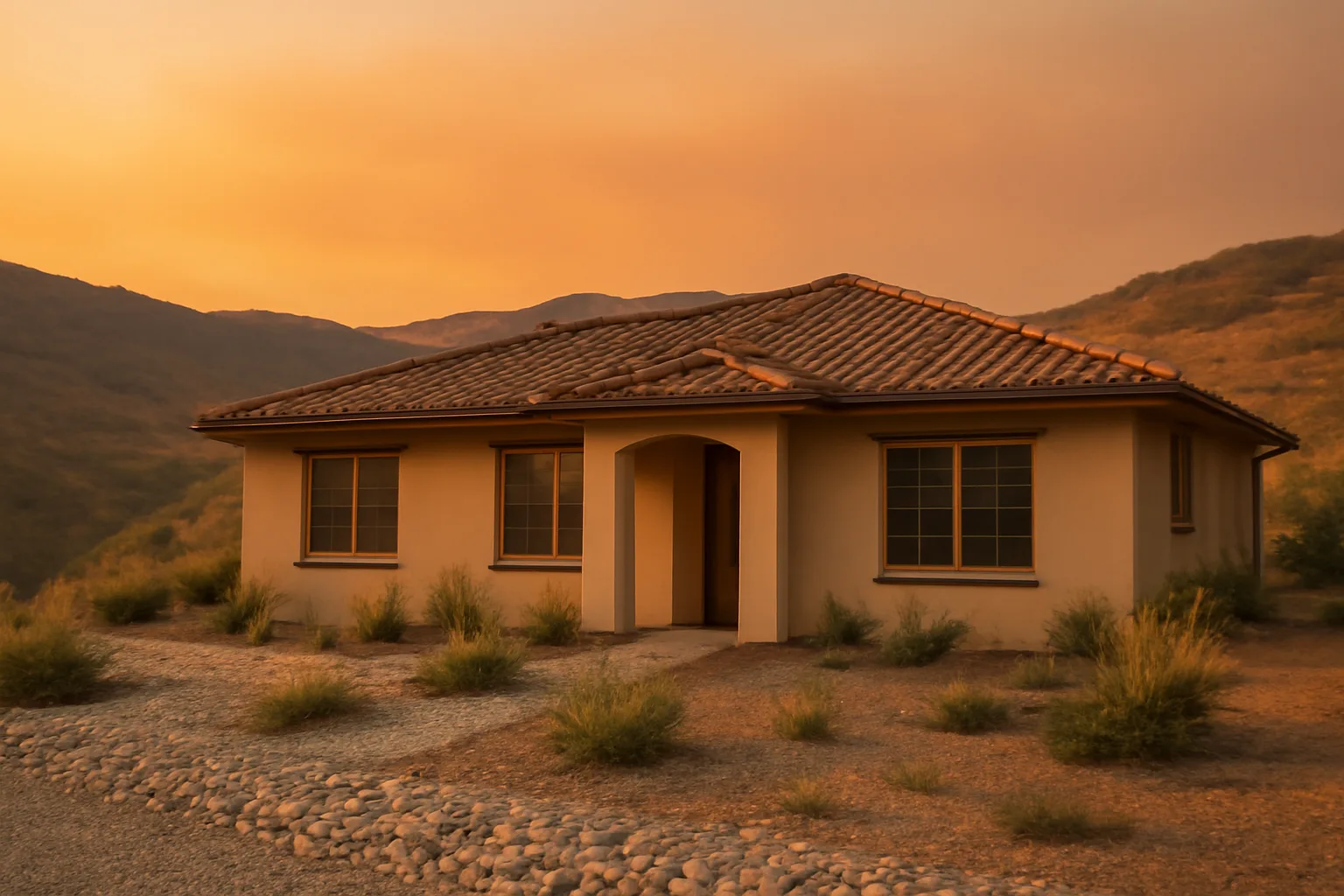
A fire resistant house is not a house that can't burn. It's a house built and maintained so that embers, radiant heat, and short-duration flame contact don't find an easy way in. Cal Fire's own research after major fires like the 2018 Camp Fire and 2017 Tubbs Fire keeps pointing to the same failure points: unscreened vents, wood roofs and roof valleys, single-pane windows, and combustible material touching the house (mulch, wood fencing, stored firewood). California's building code addresses this directly. Chapter 7A of the California Building Code, formally "Materials and Construction Methods for Exterior Wildfire Exposure," sets ignition-resistant construction standards for new buildings in a designated Fire Hazard Severity Zone or a Wildland-Urban Interface Fire Area [1]. That means a Class A fire-rated roof assembly, ember-resistant and mesh-screened attic and foundation vents (typically 1/8 inch mesh, no larger, per the vent testing standard SFM 12-7A-1), multi-pane or tempered glass windows, and non-combustible or ignition-resistant siding and decking. The honest version: Chapter 7A only automatically applies to new construction and some remodels/additions in mapped high-hazard zones. Older homes in those same zones are not required to retrofit unless a local jurisdiction or insurer mandates it. That's the gap this whole article lives in. Home hardening work on an existing house closes that gap voluntarily, and it's often the fastest way to satisfy an insurance inspection.
When does the California defensible space law go into effect?
California's core defensible space law, Public Resources Code 4291, has been in effect for decades and currently requires 100 feet of defensible space clearance (or to the property line, whichever is less) around habitable structures in State Responsibility Area and some Local Responsibility Area lands [2]. That part isn't new. What's new, and what people mean when they ask this question in 2025-2026, is the "zone 0" ember-resistant zone rule. Senate Bill 63 (2024) directed the Board of Forestry and Fire Protection to adopt regulations for an ember-resistant zone within 0 to 5 feet of a structure, and Cal Fire has stated the intent is to apply this to new construction beginning in 2026, with a longer phase-in for existing homes. As of this writing, the formal regulatory package (expected to run through the Board of Forestry's rulemaking process) had not been finalized into an adopted rule for all existing structures, so the exact statewide enforcement date for retrofits keeps moving. Here's the practical answer: don't wait for the final regulation to post zone 0 clearance around your house. Cal Fire's existing zone 0 guidance (remove all combustible mulch, plants, and debris within 5 feet of the structure, keep only hardscape, gravel, or well-irrigated low material) is already what inspectors and many insurers are checking for today. Treat 2026 as the year this becomes mandatory for new homes, and the year existing-home enforcement details should firm up. Fill in for your property: [Local fire district / county deadline for zone 0 compliance: ______]. Check with your local fire safe council or building department, because implementation timelines differ by jurisdiction.
What fire safe rules for homes take effect in 2026?
Two things converge in 2026. First, the zone 0 ember-resistant zone requirement (SB 63) is set to apply to new construction in high fire hazard zones starting January 1, 2026, per Cal Fire's public statements on the regulation's rollout. Second, the state's updated Fire Hazard Severity Zone maps, which California's state fire marshal finalized for SRA in 2024 and has been extending to LRA maps through local adoption, continue to reclassify huge areas as moderate, high, or very high hazard, which pulls more existing homes into Chapter 7A retrofit triggers whenever they remodel or rebuild [3]. What this means for a homeowner: if you're building new or doing a major remodel in a mapped zone anywhere in the state after January 1, 2026, expect zone 0 (0-5 ft, ember resistant, essentially non-combustible) to be inspected alongside the existing 5-30 ft (lean, clean, green) and 30-100 ft (reduced fuel) zones already required under PRC 4291. Existing homes that aren't remodeling aren't automatically required to add zone 0 hardscape yet, but insurers are increasingly asking about it anyway on non-renewal and reinspection letters. If you got a letter referencing "5 foot clearance" or "ember-resistant zone," that's zone 0 language, and it's worth doing now rather than waiting for the mandate. For the broader three-zone system and what's required at 5-30 and 30-100 feet, see defensible space zones.
Why won't people follow the defensible space law in California?
Cal Fire inspection data isn't flattering. In post-fire assessments and public compliance surveys, cited noncompliance reasons cluster around a few things: cost, physical ability, and simple awareness. A homeowner on a fixed income can't easily pay a contractor $3,000 to $8,000 to clear brush on a sloped half-acre lot. An older resident can't do it themselves. And a lot of people genuinely don't know the rule exists until a Cal Fire inspector or a fire district notice shows up, or until their insurer sends a non-renewal letter citing defensible space as the reason. There's also a psychological piece nobody likes to talk about: defensible space work is never finished. It's not a one-time purchase, it's an annual chore (clearing needles, cutting new growth, hauling debris), and that maintenance burden is exactly the kind of task that gets deprioritized when money and time are tight. Enforcement is uneven too. PRC 4291 gives local fire officials authority to inspect and require compliance, and non-compliance can result in a notice to correct followed by fines, but staffing for inspections varies a lot by county, and rural SRA parcels get inspected far less often than urban WUI parcels near a fire station. That patchwork enforcement is part of why insurers started doing their own inspections and using satellite/aerial imagery (through companies like Zesty.ai or Betterview that insurers contract with) to check defensible space independent of the county.
How to prevent wildfires from starting near your home
Most wildfires in California are human-caused, not lightning-caused. Cal Fire's incident data consistently shows that the large majority of wildfire ignitions in the state trace back to human activity: equipment use, vehicle fires, arson, unattended campfires, and power line failures. That means prevention is mostly about controlling ignition sources on and near your own property. The specific actions that matter most: don't mow dry grass on hot, windy afternoons (a lawnmower blade striking a rock is a documented ignition source Cal Fire flags every summer). Keep chainsaws and equipment away from dry vegetation during red flag warning days. Maintain vehicles so exhaust systems and catalytic converters aren't dragging on grass. Don't park on dry grass, full stop, an overheated undercarriage can ignite it in minutes. Extinguish campfires completely (drown, stir, drown again) and never leave one unattended. If you have overhead power lines on your property, keep vegetation clear per your utility's clearance requirements, and report sagging lines or exposed equipment to the utility immediately. On a community level, prevention also means supporting or joining a local Fire Safe Council, participating in chipper days, and reporting unpermitted burning. None of this is glamorous, but ignition prevention is the cheapest wildfire mitigation there is, because it costs nothing but attention.
How to prepare for a wildfire (the practical checklist)
Preparing for a wildfire happens in two tracks: getting the house ready to survive an ember storm with nobody home, and getting your family ready to leave fast. Ready.gov's wildfire preparedness guidance recommends creating a family emergency communication plan, building a go-bag with medications, documents, and supplies for at least three days, and knowing two ways out of your neighborhood in case one route is blocked. On the house side: clear zone 0 (0-5 ft) of combustibles, close all windows and doors but leave them unlocked for firefighter access, remove flammable curtains, shut off gas at the meter if instructed, move patio furniture and doormats inside, and turn on exterior lights so the house is visible in smoke. Cal Fire's "Ready, Set, Go!" program structures this exact sequence: Ready (year-round hardening and defensible space), Set (situational awareness when fire risk is elevated), Go (evacuate early, don't wait for a mandatory order) [4]. Documentation matters more than people expect. Before fire season, photograph and video every room, closet, and the exterior of your house, plus your defensible space work itself, dated and timestamped. If you're ever in a position to file an insurance claim, or to show an insurer you're already compliant to avoid non-renewal, having dated proof is the difference between a fast conversation and a drawn-out dispute. This is the one place a mid-article product mention actually earns its keep: DefensibleHome's $99 Wildfire Insurance Survival Kit is built around exactly this problem, a structured way to document your home, your hardening work, and your defensible space zones so you have organized, insurer-ready records before you ever need them. You still deal with your insurer directly; the kit just gets your paperwork in order. Check it out at defensiblehome.com/survival-kit-builder.
How to prevent forest fires and avoid forest fires on public and shared land
Preventing forest fires works on the same logic as home ignition prevention, just at landscape scale. The U.S. Forest Service and Cal Fire both point to the same top causes nationally and in California: unattended campfires, discarded cigarettes, fireworks, equipment sparks, and debris burning outside permitted windows [5]. If you're recreating in or near wildland: check current fire restrictions before you go (many California national forests impose seasonal campfire bans), use only designated fire rings, never use fireworks on wildland-adjacent property (illegal in unincorporated SRA in most of the state anyway), and don't drive or park on dry grass. If you spot smoke or an unattended fire, call 911 immediately rather than trying to handle it yourself, early reporting is what keeps a spark from becoming an incident. For property owners bordering wildland, coordinating with neighbors on shared fuel breaks and joining a Firewise USA or local Fire Safe Council chapter multiplies the effect of your own defensible space work, since a fire doesn't stop at a property line and neither should mitigation planning.
How to prepare for forest fires when you live in or near the wildland-urban interface
Living inside or next to the WUI means preparation has to cover both the structure and the escape route, because fire behavior near unmanaged wildland can move faster than in a suburban grid. Start with defensible space compliance at all three zones under PRC 4291 (0-5, 5-30, 30-100 feet), then layer Chapter 7A-style hardening on top if your home predates the code: ember-resistant vents, a Class A roof, and dual-pane or tempered windows are the highest-leverage retrofits per dollar spent [1]. Route planning matters as much as the house. If you're on a single-access road, know it, and have a backup plan (a neighbor's property with a second road out, a pre-identified meeting point). Ready.gov's evacuation guidance specifically recommends practicing your route rather than assuming you'll figure it out under smoke and stress. Keep a physical, non-digital copy of your emergency plan and key documents (insurance policy number, ID copies, medical info) somewhere you can grab in under two minutes, because cell networks and home wifi are often the first things to go down in a fast-moving fire. For landscaping choices that reduce risk without turning your yard into gravel, see fire safe landscaping next to the house.
Is Santa Barbara safe from fire?
No coastal California city is "safe" from fire in an absolute sense, and Santa Barbara County has a documented history that argues against complacency: the 1990 Painted Cave Fire destroyed over 400 structures in hours, and the 2017 Thomas Fire, at the time the largest wildfire in modern California history, burned into Santa Barbara County and was followed by the deadly Montecito debris flow in January 2018 that killed 23 people [6] [7]. That combination, wildfire followed by post-fire mudslide risk on burned slopes, is specific to steep coastal terrain like Santa Barbara's foothills. What makes parts of Santa Barbara relatively lower risk is dense urban development away from the foothills, decent road infrastructure for evacuation in some neighborhoods, and active local mitigation work (the county and city both participate in Fire Safe Council programs). What keeps risk elevated is exactly what makes the area desirable: homes built into steep, chaparral-covered hillsides with limited access roads, strong seasonal sundowner winds that behave unlike typical onshore flow, and long dry summers. If you live in the Santa Barbara foothills, Montecito, or similar terrain (Ojai, parts of Malibu, the Oakland/Berkeley hills), you're in one of the higher objective wildfire risk zones in the state regardless of how the immediate neighborhood feels day to day. Check your parcel's Fire Hazard Severity Zone designation directly on the state fire marshal's map viewer rather than relying on general reputation [3].
How can we prevent forest fires as a community, more than as individuals?
Individual defensible space and hardening only goes so far when neighboring parcels are neglected, because embers and radiant heat don't respect property lines. Community-level prevention closes that gap through a few concrete mechanisms. Firewise USA (a National Fire Protection Association recognition program) organizes neighborhoods to do coordinated fuel reduction, track collective mitigation work, and in many cases qualify for reduced insurance consideration or state grant eligibility as a group rather than parcel by parcel. Local Fire Safe Councils, funded partly through Cal Fire grant programs, run community chipper days, host free defensible space assessments, and coordinate with local fire districts on prescribed burns and fuel breaks. Counties and fire districts also run Vegetation Management Programs and can use prescribed fire or mechanical thinning on public land adjacent to neighborhoods, which reduces the fuel load that would otherwise carry fire toward homes even when every individual homeowner has done their own defensible space work. The honest limitation: none of this is free, and grant funding is competitive and often oversubscribed relative to demand. If your HOA or neighborhood association hasn't looked into Firewise USA recognition or your county's Fire Safe Council grant cycle, that's worth doing before the next fire season starts, not after a non-renewal letter arrives.
What does an insurer actually check for a fire resistant home?
Insurers in California increasingly use a mix of aerial/satellite imagery vendors, third-party inspectors, and self-reported checklists to assess wildfire risk on a specific parcel, more than the zip code. The specific items that show up repeatedly on inspection reports and non-renewal letters: roof material and condition, vent screening, defensible space clearance within 5, 30, and 100 feet, proximity of vegetation and woodpiles to the structure, deck material and underside clearance, and gutter debris. California's FAIR Plan, the state's insurer of last resort, has its own underwriting standards, but even FAIR Plan and admitted carriers offering the state's new Safer From Wildfires discount program look for the same mitigation categories: home hardening, defensible space zones, and community-level Firewise recognition . The California Department of Insurance's Safer from Wildfires regulation requires insurers to give discounts or premium credit for specific, documented mitigation actions, which is part of why dated photo documentation of your hardening and clearance work has real practical value beyond just passing an inspection. Fill in for your property: [Your insurer's specific inspection checklist items, if provided in your non-renewal or reinspection letter: ______]. Insurers don't all use identical criteria, so treat any letter you received as the actual source of truth for your situation, not a generic list like this one.
What's the difference between defensible space and home hardening, and do you need both?
| What it addresses | Fuel and flame approach | Ember intrusion and direct ignition | |
|---|---|---|---|
| Zones/scope | 0-5, 5-30, 30-100 ft | Roof, vents, windows, siding, decking | |
| Mandatory for | Existing homes in SRA/LRA under PRC 4291 | New construction and major remodels in mapped zones | |
| Typical cost | $500-$8,000+ depending on lot size and slope | $3,000 (vent retrofit) to $30,000+ (full re-roof and siding) | |
| Who checks | Local fire district/Cal Fire inspector | Building department (new construction); insurer (existing homes) | For a full breakdown of what's required at each distance from the house, see defensible space zones, and for landscaping choices that satisfy both the fuel-reduction and aesthetic goals, see fire safe landscaping. |
Yes, you need both, they solve different problems. Defensible space (PRC 4291's 0-100 foot zone system) reduces the fuel available to a fire as it approaches your property, slowing it down and giving firefighters room to work. Home hardening (Chapter 7A-style construction and retrofits) reduces the chance that embers landing on or near your house actually ignite it, which matters because most home losses in major California wildfires are traced to ember intrusion, not direct flame contact from an approaching fire front [1]. A property with perfect defensible space but a wood shake roof and open eave vents can still burn from an ember that blew in from a mile away. A hardened home with a Class A roof and ember-resistant vents but no clearance can still ignite from direct flame contact with dead brush touching the siding. The two systems are meant to work together. | Category | Defensible space (PRC 4291) | Home hardening (Chapter 7A) |
What should you do first if you got a non-renewal or inspection letter?
Read the letter closely for the specific reason cited, because insurers are required in many cases to state the basis for non-renewal, and "wildfire risk" alone is vague enough that you should push for the specific trigger (defensible space, roof material, brush density, prior claims). If the letter references a specific deficiency, address that one first, it's the fastest path to a reinspection. Document everything before you touch anything: photograph the current state of your roof, vents, siding, and vegetation clearance, dated. Then do the work (or hire a licensed contractor for anything involving roofing or structural vent replacement), and photograph again, dated, from the same angles. That before/after pair, plus receipts, is what you'd send back to an insurer requesting reinspection, and it's also what you'd want on hand if you ever need to demonstrate mitigation for a claims dispute later. A structured way to organize exactly this kind of documentation, before and after photos, contractor receipts, defensible space zone records, is what DefensibleHome's $99 Wildfire Insurance Survival Kit is built for; it's a one-time purchase, not a subscription, and it's meant to sit ready in case you need it, whether that's for a reinspection request or a future claim. You handle the actual conversation with your insurer; we don't negotiate claims or promise reinstatement, we just help you show up with your paperwork already organized. Start at defensiblehome.com/survival-kit-builder. For a broader look at how fire actually destroys homes room by room and what that means for hardening priorities, house fire and fire at a house both cover the mechanics in more depth. And if you're comparing your situation to what neighboring states require, Washington's DNR defensible space clearing contract rules is a useful point of comparison for how differently states structure enforcement.
Frequently asked questions
When does the California defensible space law go into effect?
The core law, Public Resources Code 4291, has been in effect for years and requires 100 feet of defensible space clearance around structures in State Responsibility Areas. The new part is SB 63's zone 0 (0-5 ft ember-resistant zone) rule, which Cal Fire has said will apply to new construction starting January 1, 2026, with existing-home enforcement details still being finalized through Board of Forestry rulemaking.
Why won't people follow the defensible space law in California?
Cost, physical inability, and inconsistent enforcement are the main reasons. Clearing a sloped rural lot can cost thousands of dollars and has to be redone annually, which is a burden for fixed-income and elderly homeowners. Enforcement also varies a lot by county, so many parcels go uninspected for years, and awareness of the specific 5/30/100-foot zone requirements is genuinely low.
What fire safe rules for homes take effect in 2026?
California's zone 0 ember-resistant zone requirement, created by SB 63, is set to apply to new construction in mapped fire hazard zones starting January 1, 2026. It requires the 0-5 foot area around a structure to be essentially non-combustible: no mulch, no combustible plants, hardscape or gravel only. Existing-home retrofit deadlines were still being finalized as of this writing.
How to prevent wildfires from starting?
Most California wildfires are human-caused, so prevention means controlling ignition sources: don't mow dry grass in hot afternoons, keep equipment and vehicles off dry vegetation, fully extinguish campfires, maintain clearance around power lines, and report unattended fires or sparking equipment immediately rather than trying to handle it yourself.
How do you prepare for a wildfire if you have to evacuate?
Build a go-bag with medications, documents, and 3+ days of supplies, know two evacuation routes, and follow Cal Fire's Ready-Set-Go framework: harden and clear year-round (Ready), stay alert when conditions worsen (Set), and leave early rather than waiting for a mandatory order (Go). Photograph your home and belongings beforehand for insurance documentation.
How can we prevent forest fires as individuals and communities?
Individually: avoid equipment sparks, extinguish campfires fully, and follow local fire restrictions. As a community: join or form a Firewise USA group or local Fire Safe Council, participate in chipper days and coordinated fuel breaks, and support prescribed burn or vegetation management programs on adjacent public land, since fire risk doesn't stop at a property line.
Is Santa Barbara safe from fire?
No California hillside community is fully safe from fire. Santa Barbara County has a documented history including the 1990 Painted Cave Fire (400+ structures lost) and the 2017 Thomas Fire, which was followed by the deadly Montecito debris flow. Foothill and canyon neighborhoods carry meaningfully higher risk than dense flatland areas; check your parcel's official Fire Hazard Severity Zone designation.
What is Chapter 7A and does it apply to my existing home?
Chapter 7A of the California Building Code sets ignition-resistant construction standards (roof, vents, windows, siding) for buildings in mapped fire hazard zones. It automatically applies to new construction and many remodels/additions in those zones, but existing homes that aren't remodeling generally aren't required to retrofit unless a local jurisdiction or insurer requires it.
What's the difference between the 5-foot, 30-foot, and 100-foot defensible space zones?
Zone 0 (0-5 ft) should be essentially non-combustible: hardscape or gravel, no mulch or dry plants. Zone 1 (5-30 ft) requires lean, clean, and green landscaping with spaced-out fire-resistant plants. Zone 2 (30-100 ft) allows more natural vegetation but requires reduced fuel load, cut grass, and spacing between trees and shrubs, per Public Resources Code 4291.
Can I get an insurance discount for hardening my home in California?
Yes. California's Safer from Wildfires regulation, from the Department of Insurance, requires insurers to offer discounts or premium credit for documented mitigation actions like defensible space compliance, home hardening, and Firewise USA community recognition. Requirements vary by insurer, so ask yours directly what documentation they require.
Does a fire resistant roof guarantee my house won't burn?
No roof or material makes a house fireproof. A Class A rated roof and ember-resistant vents significantly reduce ignition risk from embers, which cause most home losses in wildfires, but a home can still ignite from direct flame contact if defensible space clearance around it is inadequate. Roofing and clearance work together, neither replaces the other.
What should I do first after getting a wildfire insurance non-renewal letter?
Identify the specific deficiency cited in the letter, document your home's current condition with dated photos, complete the needed hardening or clearance work (using licensed contractors for roofing or structural work), then photograph the results and request reinspection. Keep all receipts and before/after photos organized in case you need them again later.
Sources
- California Building Standards Commission, California Building Code Chapter 7A: Chapter 7A sets ignition-resistant construction standards for buildings in Fire Hazard Severity Zones or WUI Fire Areas
- California Legislature, Public Resources Code Section 4291: 100 feet of defensible space clearance is required around structures in State Responsibility Areas
- California Department of Forestry and Fire Protection / Office of the State Fire Marshal, Fire Hazard Severity Zone Maps: Updated statewide Fire Hazard Severity Zone maps for SRA were finalized in 2024 and continue to be adopted for LRA
- Cal Fire, Ready Set Go! program: Ready Set Go structures wildfire preparation into year-round hardening, situational awareness, and early evacuation
- USDA Forest Service, Wildfire Causes and Evaluation: Human activity including campfires, debris burning, and equipment sparks are leading wildfire causes
- Cal Fire, Painted Cave Fire incident history: The 1990 Painted Cave Fire in Santa Barbara County destroyed more than 400 structures
- California Department of Insurance, Safer from Wildfires regulation: Insurers are required to provide discounts or premium credit for documented wildfire mitigation actions