Last updated 2026-07-25
TL;DR
Firewise USA is a National Fire Protection Association (NFPA) recognition program for neighborhoods, not a building code. NFPA 1144 and 1140 set the actual technical standards for defensible space and construction that many state laws and insurer inspections are built from. Joining Firewise USA won't force an insurer to renew you, but the documentation habit it builds often helps.
What is Firewise USA and how is it different from NFPA standards
Firewise USA is a voluntary recognition program run by the National Fire Protection Association for communities that organize around wildfire risk reduction. A neighborhood forms a committee, does a risk assessment, writes an action plan, and logs volunteer hours and mitigation work. Get recognized, and you're on a list of over 2,000 sites nationwide as of NFPA's most recent count [1]. NFPA itself is the standards body. It writes the technical documents, like NFPA 1140 (Standard for Wildland Fire Protection) and NFPA 1144 (Standard for Reducing Structure Ignition Hazards from Wildland Fire), that define defensible space zones, ember-resistant vents, and construction details [2]. Firewise USA is the community program; NFPA 1140/1144 are the engineering rulebook underneath it. Here's the part people get wrong: Firewise recognition is not a fire-hardening certification for your individual house. It's a community-level designation. Your neighborhood can be Firewise-recognized while your own roof vents are still letting embers in. The two things solve different problems, and conflating them is why some homeowners think they're covered when they're not. Insurers increasingly ask about both. Some FAIR Plan and admitted-market applications ask if your community participates in Firewise USA, and separately ask about your specific home's vents, roof class, and clearance. Answer both honestly. For a broader look at how these standards intersect with state law, see defensible space rules by state.
What does NFPA 1144 actually require for defensible space
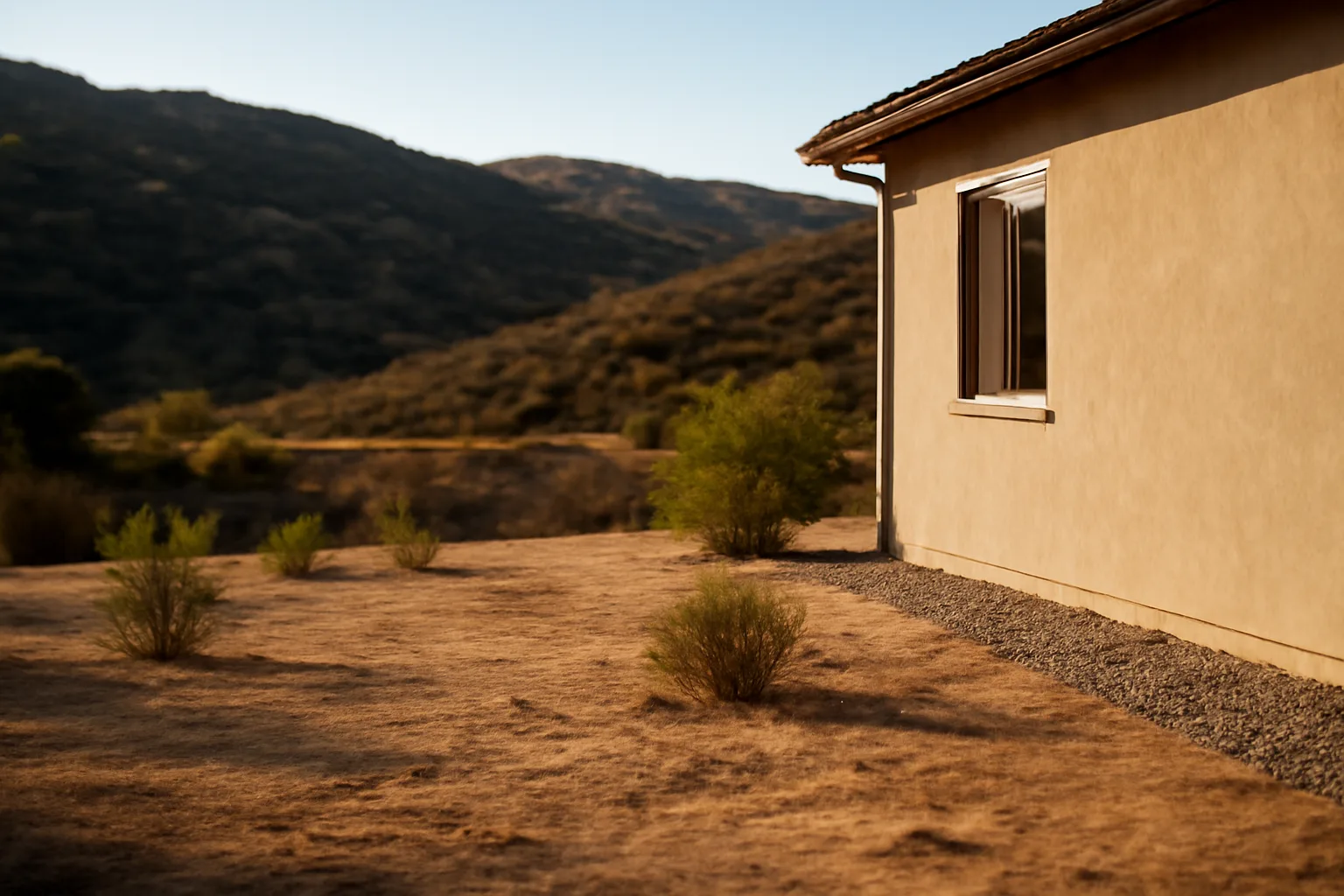
NFPA 1144 defines three zones around a structure: the home ignition zone within 5 feet, an intermediate zone out to 30 feet, and an extended zone out to 100 feet or more depending on slope and vegetation. Requirements get less strict as you move outward. Within 5 feet of the house (Zone 0 in most state adaptations), the standard pushes for noncombustible surfaces: gravel, pavers, or bare soil instead of bark mulch or shrubs touching siding. Zone 2, roughly 5 to 30 feet, calls for spaced-out, low-growing, well-irrigated plants with no continuous fuel path to the structure. Zone 3 extends further and focuses on thinning and spacing of larger vegetation, especially on slopes. California's own defensible space law (Public Resources Code 4291) mirrors this zone structure but sets its own distances: 0-5 feet, 5-30 feet, and 30-100 feet, and it is state law, not a voluntary NFPA recommendation [3]. Colorado, Oregon, and Arizona lean on similar zone concepts through their state forestry agencies but the specific distances and enforcement mechanisms vary by state and even by local fire district. Check your specific fire district's defensible space ordinance before you spend money, because a 5-foot noncombustible zone in one county might be a 3-foot requirement next door. For plant-by-plant guidance on what actually survives inspection near a foundation, see fire safe landscaping next to the house.
When does the California defensible space law go into effect
California's core defensible space law under Public Resources Code 4291 has been in effect for decades and currently requires 100 feet of defensible space clearance around structures in State Responsibility Areas and some Local Responsibility Areas, a distance expanded from 30 feet by SB 1595 in 2004 [3] [4]. That part isn't new. What's newer, and often what people mean when they ask this question, is the ember-resistant Zone 0 regulation. California's Board of Forestry and Fire Protection has been developing a separate ember-resistant zone standard (the 0-5 foot zone) under SB 63 (2021) and Assembly Bill 3074 (2020), which directed the agency to define Zone 0 requirements [5]. As of this writing, the Board has circulated draft Zone 0 regulations, but statewide enforcement dates have shifted more than once, and the effective date depends on final rulemaking. Check CAL FIRE's Zone 0 page directly before you assume a specific date applies to your property. Don't rely on secondhand articles (including this one) for the exact enforcement date. Rulemaking timelines move. Confirm with your local CAL FIRE unit or county fire marshal what applies to your address today, and ask specifically whether Zone 0 is enforced yet in your jurisdiction or still voluntary guidance.
What fire-safe home rules take effect in 2026
There's no single nationwide 2026 fire code that flips on for every wildfire-zone home. What's actually happening is a patchwork of state and local rulemaking, some of it targeting 2025-2026 windows, and you need to check your specific jurisdiction. California's Zone 0 ember-resistant zone regulation, discussed above, has been the subject of proposed compliance deadlines that have moved during rulemaking; some earlier drafts floated 2023, then later target dates were pushed further out. Confirm current status directly with the Board of Forestry and Fire Protection's Zone 0 rulemaking page [5]. Separately, California's Chapter 7A building code (Materials and Construction Methods for Exterior Wildfire Exposure) already applies to new construction and major remodels in Wildland-Urban Interface Fire Areas, requiring ember-resistant vents, ignition-resistant siding, and dual-pane or tempered glass windows [6]. This is existing code, not a 2026 change, but many homeowners only learn about it when a rebuild or major renovation triggers it. Oregon's statewide wildfire risk map and defensible space code requirements, tied to Senate Bill 762 (2021), have gone through their own multi-year rollout with revised maps and phased requirements for high-risk designated properties. Colorado and Arizona don't currently have a single statewide mandatory code equivalent to California's; most of their requirements come through county wildfire ordinances or individual fire protection district rules. Bottom line: 'what takes effect in 2026' is a fill-in-the-blank question you answer by calling your county building department and your local fire marshal, not a fact you can look up once nationally.
How to prepare for a wildfire before it starts
Preparation splits into three buckets: the house itself, the space around it, and your documentation. Miss any one of the three and you're exposed, whether that's to fire damage or to an insurer telling you that you didn't do enough to prove your risk was mitigated. For the house: Class A fire-rated roofing, ember-resistant vents (1/8 inch mesh is the old standard; some jurisdictions now require finer mesh or vent products tested to specific ember-intrusion standards), and enclosed eaves reduce the three most common ways homes ignite from wildfire, which is ember entry, not direct flame contact, according to research from the Insurance Institute for Business & Home Safety [7]. For the space around it: work the zones described above, from the house outward, not the other way around. Most homeowners start clearing brush at the property line and never get to the 5-foot zone that actually matters most for ember ignition. Reverse that order. For documentation: photograph your roof, vents, gutters, and defensible space zones before fire season, keep dated records of any brush clearing or contractor work, and save receipts. Insurers and adjusters (if you ever need one) work from evidence, not memory. This is exactly the gap the Wildfire Insurance Survival Kit is built to close: a $99 one-time tool to organize your own before-the-fire documentation so you have a clear, dated record if you're ever asked to prove mitigation work or file a claim. It doesn't handle your claim or promise a renewal; it just makes sure you're not starting your paperwork from zero after a loss. See also how to prepare for a house fire specifically for the indoor half of this equation.
How to prevent wildfires and forest fires from starting
Roughly 85 percent of wildland fires in the U.S. are human-caused, according to the National Interagency Fire Center's historical data, from unattended campfires, debris burning, equipment sparks, and arson, not lightning [8]. Prevention at the individual level mostly means not being the ignition source. Specific things that matter: never leave a campfire unattended and drown it, stir it, and drown it again until it's cold to the touch (Ready.gov's specific guidance) [9]. Avoid mowing dry grass in the heat of the day; a lawnmower blade striking a rock is a documented ignition source in multiple state fire investigations. Keep vehicles off dry grass, since catalytic converters run hot enough to ignite vegetation. Follow local burn permit rules and red flag warnings; a red flag warning from the National Weather Service means humidity, wind, and dryness have combined into conditions where any spark spreads fast. At the community level, 'how can we prevent forest fires' usually gets answered through fuel management: prescribed burns, thinning overstocked forests, and maintaining fuel breaks, all coordinated through the U.S. Forest Service and state forestry agencies. Individual homeowners can't do controlled burns on their own land without permits in most jurisdictions, so this part of prevention is mostly a policy and land-management question, not a homeowner task list.
Why won't people follow the defensible space law in California
CAL FIRE inspects a sample of properties in State Responsibility Areas each year, and compliance rates vary widely by region; some CAL FIRE unit reports have found less than half of inspected parcels fully compliant with PRC 4291 on first inspection . So the honest answer to 'why won't people follow the law' is a mix of cost, confusion, and enforcement gaps, not simple defiance. Cost is real. Clearing 100 feet of defensible space on a sloped, brush-heavy lot can run several thousand dollars for a contractor, and low-income and elderly homeowners in rural SRA parcels are disproportionately represented among noncompliant properties in several county assessments. Confusion is also real: the zone distances, allowed vegetation, and enforcement authority differ between state law, county ordinance, and individual fire district rules, and homeowners genuinely don't know which one applies to their specific parcel. Enforcement itself is thin. PRC 4291 authorizes local fire officials to inspect and, if a property is found noncompliant, issue a notice to correct; if the owner doesn't comply, the local agency can do the work and bill the owner, or refer for a misdemeanor citation, but actual citation and cost-recovery enforcement is inconsistent across counties given limited inspector staffing [3]. A law with a compliance mechanism that mostly relies on follow-up inspections that may not happen for years produces exactly the gap you're describing. That gap is also exactly why insurers stopped waiting for the state to enforce compliance and started doing their own satellite and drone inspections instead.
Is Santa Barbara safe from fire, and what does 'safe' even mean here
No area in California's coastal or foothill wildland-urban interface, including Santa Barbara County, is 'safe' from wildfire in any absolute sense; the county has had multiple destructive fires in the last two decades, including the 2017 Thomas Fire (at the time California's largest recorded wildfire by acreage) and the 2018 Montecito debris flow that followed it, which killed 23 people . Santa Barbara sits in a landscape of steep chaparral-covered hills, seasonal Sundowner winds, and long dry summers, which is a combination fire scientists consistently flag as high-risk terrain, not a place where risk has been engineered away. What 'safe' means practically is relative risk reduction, not elimination. A home in Montecito or the Santa Ynez foothills with a Class A roof, ember-resistant vents, cleared Zone 0, and defensible space out to 100 feet has meaningfully better odds of surviving an ember storm than an identical home without those features, based on the pattern of surviving versus destroyed structures documented in CAL FIRE and IBHS post-fire damage assessments after major California fires [7] . But 'better odds' isn't the same as 'safe,' and no honest article should tell a Santa Barbara homeowner otherwise. If you're specifically worried about insurance non-renewal in that region, the mitigation-versus-coverage question is separate from the fire-risk question, and worth reading about directly through your state's FAIR Plan or admitted-market guidance rather than assuming that hardening your home guarantees a renewal.
How does Firewise USA recognition affect insurance
Firewise USA recognition, by itself, does not guarantee an insurance discount or block a non-renewal; NFPA's own program materials describe it as a risk-reduction and community-organizing framework, not an insurance product [1]. Some insurers do ask about it on applications, and some state programs (check your own state's rules) tie certain premium credit programs partly to community-level mitigation participation, but this varies enormously by carrier and state. What actually moves the needle with insurers, based on FAIR Plan and admitted-carrier underwriting criteria published in several states, is individual-property mitigation: roof class, vent type, defensible space clearance, and proximity to fuel, documented with dates and photos [3]. Community recognition is a signal that your neighborhood is organized and taking this seriously, which can matter at the margins, but it doesn't substitute for your own house meeting the standard. If your goal is specifically to avoid non-renewal or to have a strong file if you're ever inspected or need to file a claim, treat Firewise participation as one piece of a larger paper trail, not the whole strategy. Pair it with your own dated photos, contractor invoices, and defensible space measurements. That combination is what an underwriter or adjuster actually wants to see, and it's the gap a lot of homeowners discover only after they've already gotten a non-renewal letter.
What should you do first if you got a non-renewal or inspection letter
Read the letter for the specific reason cited, more than the fact of non-renewal. Insurers are increasingly required in some states to state the underwriting reason; California, for instance, requires specific notice content under Insurance Code provisions governing residential property non-renewal . If the letter cites brush, roof condition, or vent type, that's your priority list, not a general 'do everything' response. Second, get your own documentation before you do anything else, including before you spend money on mitigation work. Photograph the roof, vents, siding, and all three defensible space zones from multiple angles, with a visible date stamp or a dated photo log. If you're going to dispute the letter's basis or request reconsideration, dated before-photos are the only thing that will actually help you make that case. Third, prioritize the highest-leverage fixes first: ember-resistant vents and Zone 0 clearance tend to matter more to both fire survival and underwriting than distant brush clearance, based on IBHS post-fire structure damage patterns [7]. Don't spend your first dollars on the 100-foot zone if your 5-foot zone still has bark mulch touching the siding. This is not legal or insurance advice, and nothing here promises a reinstated policy or a discount; a public adjuster or licensed insurance professional handles claim disputes, and we don't do that. What this article and the Wildfire Insurance Survival Kit can do is help you organize the record so you're prepared to make your own case, whether that's to an underwriter, an adjuster, or your own peace of mind. For state-specific defensible space clearing contract questions in Washington, see wildfire defensible space clearing contracts through Washington DNR.
Frequently asked questions
When does the California defensible space law go into effect
The core 100-foot defensible space requirement under Public Resources Code 4291 has been law since it was expanded from 30 to 100 feet by SB 1595 in 2004; it's already in effect. A newer, separate ember-resistant Zone 0 (0-5 foot) regulation is still moving through Board of Forestry rulemaking, so check CAL FIRE's Zone 0 page for the current enforcement date in your area.
Why won't people follow the defensible space law in California
Mostly cost, confusion about which rule applies (state, county, or local fire district), and thin enforcement. Clearing 100 feet on a sloped brush lot can cost thousands, and CAL FIRE unit compliance surveys have found many inspected parcels not fully compliant on first inspection. Enforcement relies on follow-up inspections that don't always happen quickly given limited staffing.
How can we prevent forest fires and wildfires
About 85 percent of U.S. wildland fires are human-caused, per National Interagency Fire Center data, so prevention mostly means not being the ignition source: drown and stir campfires until cold, avoid mowing dry grass midday, keep vehicles off dry vegetation, and follow burn permits and red flag warnings. Larger-scale prevention (prescribed burns, fuel breaks) is handled by state and federal forestry agencies.
How do I prepare for a wildfire as a homeowner
Work three tracks: harden the house (Class A roof, ember-resistant vents, enclosed eaves), clear defensible space starting at the 5-foot zone closest to the structure and working outward, and document everything with dated photos before fire season starts. Also build a go-bag and evacuation plan; Ready.gov has a specific wildfire action guide worth following.
What fire-safe home rules take effect in 2026
There's no single national 2026 rule. California's Zone 0 ember-resistant zone regulation has moved through multiple proposed deadlines during Board of Forestry rulemaking; Oregon's SB 762 wildfire risk map and code requirements have their own phased rollout. Check your specific state fire marshal and county building department, since requirements and dates vary by jurisdiction.
Is Santa Barbara safe from fire
No coastal or foothill area of Santa Barbara County is fully safe from wildfire; the region has had major fires including the 2017 Thomas Fire and the deadly 2018 Montecito debris flow that followed it. Steep chaparral terrain and seasonal Sundowner winds make it a genuinely high fire-risk landscape, and hardening a home reduces risk but doesn't eliminate it.
What is the difference between Firewise USA and NFPA 1144
Firewise USA is NFPA's voluntary community recognition program; it organizes neighborhoods around risk reduction planning and volunteer hours. NFPA 1144 is the technical standard defining defensible space zones and structure ignition hazard reduction. Firewise recognizes communities; NFPA 1144 sets the engineering rules that a homeowner or contractor actually follows for construction and clearance.
Does joining Firewise USA lower my home insurance rate
Not automatically. Firewise USA recognition is a community-level program, not an individual insurance credential, and NFPA doesn't administer insurance discounts. Some carriers ask about it on applications, and some state mitigation credit programs may reference it, but individual home features (roof class, vents, defensible space) typically matter more to underwriters.
What are the three defensible space zones under NFPA 1144 and California law
Zone 0 (0-5 feet from the structure) calls for noncombustible surfaces. Zone 1 or the intermediate zone (roughly 5-30 feet) calls for spaced, low, irrigated vegetation. Zone 2 or the extended zone (roughly 30-100 feet) focuses on thinning and spacing larger vegetation, especially on slopes. Exact distances vary by state law and local fire district.
What percentage of wildfires are caused by humans
Roughly 85 percent of wildland fires in the United States are human-caused, according to National Interagency Fire Center historical data, from sources like unattended campfires, debris burning, equipment sparks, and arson rather than lightning.
What should I do first after getting a wildfire insurance non-renewal letter
Read it for the specific stated reason, then document your property immediately with dated photos of the roof, vents, and all defensible space zones before doing any mitigation work. Prioritize ember-resistant vents and Zone 0 clearance over distant brush clearing. This isn't legal advice; a licensed insurance professional or public adjuster handles claim disputes, not this article.
How much does it cost to create 100 feet of defensible space
Costs vary widely by lot size, slope, and vegetation density, and no single national average is reliably documented; contractor quotes for brush clearing on sloped, heavily vegetated lots commonly run from a few hundred to several thousand dollars. Get multiple local quotes and check whether your county or fire district offers cost-share or chipper day programs before hiring a contractor.
Sources
- NFPA, Firewise USA program overview: Firewise USA is NFPA's recognition program with over 2,000 recognized sites nationwide
- California Public Resources Code Section 4291: California defensible space law requires 100 feet of clearance and defines enforcement mechanism
- California Board of Forestry and Fire Protection, Zone 0 rulemaking: California is developing a separate ember-resistant Zone 0 regulation under SB 63 and AB 3074
- CAL FIRE, Zone 0 Ember-Resistant Zone guidance: CAL FIRE publishes current Zone 0 guidance and enforcement status
- California Building Standards Commission, California Building Code Chapter 7A: Chapter 7A requires ember-resistant vents and ignition-resistant materials in WUI fire areas for new construction
- National Interagency Fire Center, wildfire statistics: Roughly 85 percent of U.S. wildland fires are human-caused
- CAL FIRE, Defensible Space Inspection program summaries: CAL FIRE unit inspections have found significant portions of surveyed parcels non-compliant with PRC 4291
- CAL FIRE, Thomas Fire incident information: The 2017 Thomas Fire was at the time California's largest recorded wildfire by acreage, preceding the Montecito debris flow
- California Insurance Code Section 675.1: California law requires specific notice content for residential property insurance non-renewal