Last updated 2026-07-25
TL;DR
Home Depot sells canned spray foam sealants and some fire-block foam for gaps and penetrations, not whole-structure fire-retardant coatings. Those products (Phos-Chek, Barricade) are sold through licensed applicators or specialty suppliers, not big-box shelves. For real wildfire prep, foam sealant helps close ember entry points, but it's one small piece of a defensible-space and home-hardening plan under CAL FIRE Chapter 7A rules.
Does Home Depot sell fire-resistant foam for wildfire protection?
Not the kind most people are looking for. Home Depot carries fire-block and fire-stop spray foams (Great Stuff Fireblock is the common one) meant for gaps around electrical boxes, plumbing penetrations, and framing, so a fire inside a wall cavity doesn't spread through the stud bays as fast. That's a building-code product, tested to standards like ASTM E814 for through-penetration firestops, not a wildfire ember-defense coating [1]. What it is not: it's not the long-term fire retardant gel or foam that firefighters spray on structures ahead of an approaching wildfire (brands like Phos-Chek or Barricade). Those are applied by contractors or, in some evacuation situations, by fire crews themselves, and they're sold through wildland fire suppliers, not retail aisles. If you've seen news footage of a house wrapped in pink or white foam before a fire front arrives, that's a different product category entirely, and Home Depot doesn't stock it. So if you searched "fire resistant foam home depot" hoping to buy something to coat your house before fire season, the honest answer is: the closest in-store product handles small gaps, not whole-home protection. For actual structure protection you're looking at hardening work (vents, roofing, siding) covered in home hardening, not a can of foam.
What fire-resistant foam products actually exist, and where do you buy them?
| Fireblock spray foam | Sealing gaps/penetrations, code compliance | Home Depot, Lowe's | $6-$12/can |
|---|---|---|---|
| Class A fire retardant gel/foam | Pre-treating structures ahead of fire | Wildland fire suppliers, some direct-to-consumer | $150-$400+ per kit |
| Intumescent coatings | Decks, fences, siding fire resistance | Building supply, specialty retailers | $30-$80/gallon |
There are three real categories worth knowing apart, because people conflate them constantly. Fireblock/firestop spray foam (Great Stuff Fireblock, Hilti CP 620, DAP Fireblock): sold at Home Depot, Lowe's, and building supply stores. Used inside walls, around penetrations, in accordance with local building code requirements for fire-rated assemblies. Cost is roughly $6 to $12 per 12-ounce can. Class A fire retardant coatings and gels (Phos-Chek, FireIce, Barricade): these are ammonium-phosphate or gel-based products designed to coat exterior structures, vegetation, or materials ahead of fire exposure. They're distributed through wildland fire equipment suppliers and, in some programs, applied by fire agencies or licensed contractors. Homeowner-grade versions exist (FireIce sells small kits direct to consumers) but they are not a Home Depot shelf item as of this writing. Intumescent fire-retardant paints and coatings for decks, fences, and siding: these do show up at building supply stores and are a legitimate hardening product, rated under standards like ASTM E84 for surface burning characteristics. If you want a real product to buy for your house, this category, not canned foam, is the one that matters for wildfire prep. | Product type | What it's for | Where sold | Typical cost |
What actually meets California's wildfire building code (Chapter 7A)?
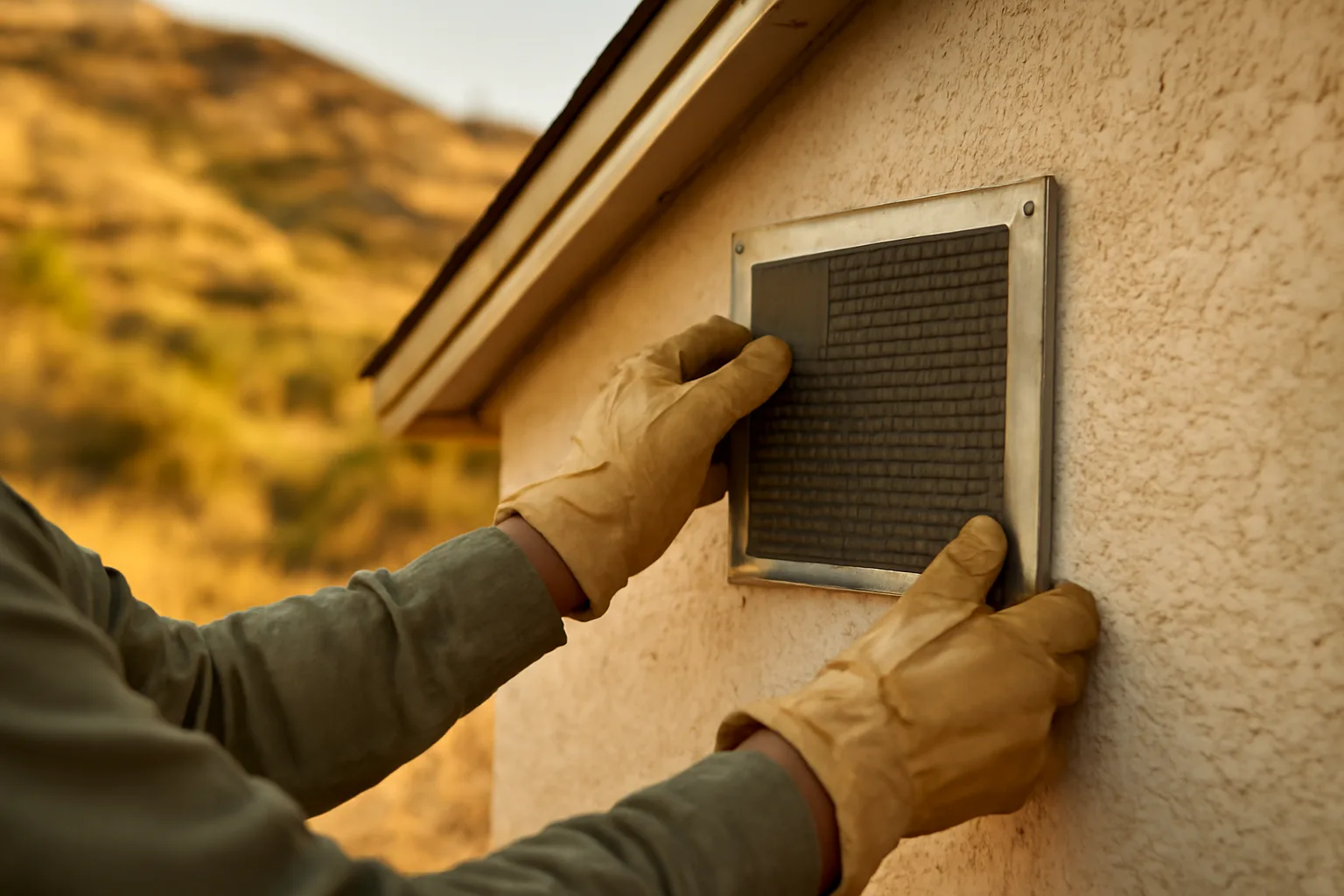
California's Chapter 7A of the building code governs "materials and construction methods for exterior wildfire exposure" in Wildland-Urban Interface Fire Areas, and it does not reference or require any spray foam product [2]. It requires ignition-resistant materials for roofing, siding, decking, vents, windows, and eaves, tested under standards like ASTM E2707 and SFM 12-7A-1 through 12-7A-5. That means the fix for wildfire vulnerability is almost never a coating you spray on. It's swapping out vulnerable materials: metal or 1/8-inch mesh ember-resistant vents instead of standard screen, Class A roofing, non-combustible siding within the first 6 inches above grade, and dual-pane tempered windows. None of that comes in a can. If your insurer or a fire inspector flagged specific items, cross-check them against your state fire marshal's ignition-resistant construction list before spending money on any retrofit product, foam included.
When does the California defensible space law go into effect?
California's core defensible space requirement, 100 feet of clearance around structures (or to the property line, whichever is closer), has been law since 2005 under Public Resources Code 4291 [3]. It is already in effect and enforced annually, not a future deadline. What's newer and still rolling out is the "ember-resistant zone" (Zone 0) requirement, the 0-to-5-foot zone immediately around structures. Assembly Bill 3074 (2020) directed the Board of Forestry to adopt Zone 0 regulations, but as of the most recent update from CAL FIRE, the Office of the State Fire Marshal has not finalized that regulation for statewide enforcement; CAL FIRE's own defensible space page notes Zone 0 rulemaking is in progress and says to check for updates rather than treating it as active law yet. Locally, some jurisdictions have already adopted their own Zone 0 ember-resistant zone ordinances ahead of the state rule, so [check your local fire district's current defensible space ordinance] before assuming state timing applies to your address. Don't wait for Zone 0 to become mandatory to act on it. Clearing combustible mulch, removing plants touching the house, and swapping wood fencing that touches the structure are things insurers are already asking about in non-renewal and inspection letters.
What fire-safe home rules take effect in 2026?
This is genuinely unsettled and worth being straight about: there is no single nationwide "2026 fire-safe home" rule. What's real and confirmed: California's Zone 0 ember-resistant zone regulation has been in a multi-year rulemaking process through the Board of Forestry and Fire Protection; check CAL FIRE's defensible space page for the current adoption and effective date before assuming a 2026 start. Insurance-side, California's SB 11 and related "Safer from Wildfires" regulation (effective 2022) already requires insurers to give discounts for specific mitigation actions like Zone 0 clearance, ember-resistant vents, and Class A roofing, and that framework continues to shape what gets rewarded on renewal [4]. Colorado, Oregon, and Arizona each have their own wildfire building code and defensible space timelines running on separate tracks (Oregon's SB 762 wildfire hazard map and defensible space code work, for instance, has had multiple delays and revisions since 2021) [5]. If a specific 2026 date matters to your renewal or permit, [confirm the exact effective date with your state fire marshal's office] rather than a general web search, because these dates move.
How do you prevent wildfires from starting near your home?
Most wildfires that threaten homes are human-caused, not lightning. CAL FIRE and the National Interagency Fire Center both point to debris burning, equipment use (mowers, chainsaws, ATVs), unattended campfires, and downed power lines as leading causes in the wildland-urban interface. Practical prevention around your own property: mow before 10 a.m. in fire season, never on windy or red-flag days; keep chainsaws and mowers away from dry grass when the blade can strike rock; don't park a hot vehicle on dry grass (catalytic converters routinely start roadside fires); fully drown and stir campfire ash, don't just douse the top; and report sparking power lines to your utility immediately rather than waiting. If you're asking "how can we prevent forest fires" at a broader level, the honest answer is a mix of things individual homeowners can't fully control: prescribed burns and fuel reduction on public land, utility infrastructure hardening, and enforcement of burn bans. Smokey Bear's message, "Only you can prevent wildfires," still holds for the human-caused share of ignitions, and it's worth reading CAL FIRE's own prevention guidance alongside your own defensible space work.
Why won't people follow California's defensible space law?
There's no single national study that tracks compliance rates precisely, so take this as an honest synthesis rather than a hard number. CAL FIRE's own defensible space inspection program reports that a meaningful share of properties fail initial inspections each year, largely for the same repeat issues: dead vegetation not cleared, wood piles too close to structures, and combustible materials under decks. The reasons people cite, based on CAL FIRE outreach materials and state legislative analyses, cluster around a few things: cost (removing large trees or regrading slopes can run into thousands of dollars), physical capacity (elderly or disabled homeowners on large rural parcels can't do the labor themselves), and simple unawareness that the 100-foot rule applies to their specific parcel. There's also a real category of people who did the work once, years ago, and haven't kept up with regrowth, because defensible space isn't a one-time job, it's an annual maintenance cycle. Enforcement varies a lot by county too. Some fire districts do proactive inspections and issue citations for non-compliance; others rely on complaint-driven enforcement, which means plenty of non-compliant parcels never get flagged unless a neighbor calls it in. [Check your specific fire district's enforcement and citation policy] since penalties and inspection frequency aren't uniform statewide.
How do you prepare for a wildfire before it happens?
Ready.gov's wildfire action guide breaks prep into three buckets: defensible space, home hardening, and an evacuation plan with a go-bag ready before you need it [6]. Here's the practical order I'd actually do it in. First, clear the 5-foot zone immediately around your house: no mulch, no stored firewood, no plants touching siding. This is the cheapest, highest-return work you can do in a weekend. Second, check your vents; ember-resistant 1/8-inch mesh vents are a low-cost swap that closes one of the most common ember entry points into attics. Third, clean gutters and roof valleys of pine needles and leaves before fire season starts, not after a red flag warning is already issued. Beyond the property, build a documented evacuation kit: a list of what's already in your house (photos, receipts, model numbers), copies of ID and insurance policy declarations pages, and a go-bag with medications and chargers. This is also where non-renewal letters get complicated: insurers often want to see proof you did the mitigation work, more than a claim that you did. That's the gap a lot of homeowners hit after a non-renewal notice, they did real work but never photographed or dated it. A $99 Wildfire Insurance Survival Kit is built around exactly that documentation gap: a structured way to log defensible-space work, photograph vents and clearances, and organize the paperwork insurers and adjusters ask for, without you having to guess what format they want.
How do you prepare for forest fires if you live near wildland, not a subdivision?
The core steps are the same as suburban prep, but the margins matter more. If your nearest fire engine is 20+ minutes out, your own defensible space work is doing more of the job that a fast response would otherwise cover. Widen the standard 100-foot clearance zone where you can, especially on the downhill and downwind sides of the structure, since fire moves faster uphill and with wind. Make sure your driveway and access road can fit a fire engine, CAL FIRE's rural access standards generally call for at least 10 feet of vertical clearance and a road width sufficient for emergency apparatus, with specifics set by local fire code [7]. Keep a water source (pond, tank, or hydrant) marked and accessible, since rural properties often lack hydrant access that urban fire crews rely on. If you have livestock or large animals, build the evacuation plan around them specifically. Ready.gov's guidance to have a family and pet plan applies just as much to horses and livestock, and waiting until evacuation orders are issued to figure out trailer logistics costs people animals every fire season.
How do you avoid forest fires when recreating or working outdoors?
Most avoidable ignitions come down to a handful of repeat behaviors, and CAL FIRE's fire prevention guidance names them specifically: dragging trailer chains that spark on pavement, mowing dry grass during red flag conditions, burning debris on windy days, and abandoning campfires without fully extinguishing them. The "drown, stir, feel" method for campfires (drown with water, stir the ashes, feel for heat with the back of your hand before leaving) is the actual standard fire agencies teach, more than "pour water on it." A campfire that looks out the next morning can still have hot coals buried a few inches down. If you're working outdoors with equipment (chainsaws, grinders, welding) during fire season, most states and counties impose seasonal restrictions or require a spark arrestor and a shovel/extinguisher on site. Check your county fire department's current burn and equipment restriction status before doing any spark-producing work in dry conditions, because these rules change week to week based on fuel moisture and weather, not a fixed calendar date.
Is Santa Barbara safe from fire risk?
No coastal California city is "safe" from wildfire in an absolute sense, and Santa Barbara County has direct history that makes this concrete: the 2017 Thomas Fire burned over 281,000 acres and was followed by the January 2018 Montecito debris flow, which killed 23 people after rain hit the burn scar above town . That sequence, fire followed by mudslide, is specific to steep coastal terrain with chaparral fuel loads, and it's exactly the risk profile much of the Santa Barbara foothills share. CAL FIRE's Fire Hazard Severity Zone maps rate large portions of the hills above Santa Barbara, Montecito, and Goleta as Very High severity zones, which is the state's highest classification and triggers the strictest defensible space and building code requirements . If you own property in or near those zone boundaries, you're already subject to the 100-foot defensible space rule and Chapter 7A construction standards, regardless of how the coastline itself looks on a calm day. So the honest framing: coastal fog and ocean proximity don't cancel out chaparral fuel and Santa Ana wind exposure. Check your specific parcel against CAL FIRE's Fire Hazard Severity Zone viewer before assuming distance from downtown means low risk.
What should you actually buy at Home Depot for wildfire prep, if not fire foam?
If you're standing in the aisle wondering what's worth putting in the cart, here's what's real and useful versus what's marketing dressing. Worth buying: 1/8-inch corrosion-resistant metal mesh (for re-screening vents), fireblock foam for genuine gap-sealing around penetrations, metal flashing for the base of fences and gates where they meet the house, and a Class A-rated fire extinguisher rated for your specific hazards. Ember-resistant vent covers are increasingly stocked too, sometimes under brand names like Vulcan or Brandguard, worth asking a store associate to source if not on the shelf. Not worth it, or not what you think it is: any spray-can product marketed loosely as "fire resistant" without a specific ASTM or SFM listing number on the label. If the can doesn't cite a test standard, it's not a wildfire product, it's a marketing label. Same goes for "fireproof" landscape fabric or mulch alternatives that aren't backed by a specific ignition-resistance rating. For the landscaping side of hardening (what to plant, what to remove within 5 feet of the house), see fire safe landscaping next to your house, and for the vent, roof, and siding retrofit checklist see defensible space and home hardening basics.
What should you do right now if you got a non-renewal or inspection letter?
Read the letter for specifics, most insurers cite exact deficiencies (vegetation clearance, roof material, vent type) rather than a vague "high risk" label, and those specifics tell you exactly what to fix or document. Photograph your current defensible space zones dated and time-stamped, since "I did the work" without proof is the single most common reason homeowners lose non-renewal appeals. Check whether your state has a FAIR Plan or insurer-of-last-resort option if standard coverage is denied; California, Oregon, and other wildfire states maintain these programs specifically for properties that can't get standard market coverage. Compare your specific mitigation work against your state fire marshal's ignition-resistant construction standards, not general internet advice, since insurers increasingly cross-reference those exact code sections. This is the exact gap the $99 Wildfire Insurance Survival Kit is built for: a structured way to document defensible space zones, vent and roof material, and clearance work with photos and dates, organized the way insurers and adjusters actually ask for it. To be clear on scope: this is a documentation tool, not a claims service. We don't negotiate with insurers, file claims on your behalf, or promise coverage, discounts, or reinstatement. You prepare the documentation and send it yourself.
Frequently asked questions
When does the California defensible space law go into effect?
The core 100-foot defensible space requirement under Public Resources Code 4291 has been law since 2005 and is already enforced annually, not a future deadline. The newer Zone 0 (0-5 foot ember-resistant zone) regulation is still in rulemaking through the Board of Forestry; check CAL FIRE's defensible space page for the current adoption status before assuming a specific start date.
Does Home Depot sell fire-retardant coating for the outside of a house?
Not the certified structure-coating type. Home Depot stocks fireblock spray foam for sealing gaps and penetrations inside walls, and some intumescent coatings for decks and siding. Whole-structure fire retardant gels like Phos-Chek or FireIce are sold through wildland fire suppliers or direct-to-consumer kits, not typical big-box retail shelves.
Why won't people follow the defensible space law in California?
CAL FIRE's outreach materials and legislative analyses point to cost of large-scale vegetation removal, physical inability to do the labor (especially elderly or disabled homeowners), and unawareness that the rule applies to their specific parcel. Enforcement also varies by county, with some districts doing proactive inspections and others relying on complaints, so non-compliance isn't caught uniformly.
How do you prevent wildfires from starting?
Most wildfires near homes are human-caused: debris burning, mower or equipment sparks on dry grass, unattended campfires, and dragging trailer chains. Mow before 10 a.m. and never on windy days, fully drown and stir campfire ash, and never park a hot vehicle on dry grass. Report sparking power lines to your utility immediately.
How do you prepare for a wildfire if you get an evacuation warning?
Ready.gov recommends having defensible space done in advance, a go-bag with medications and documents ready, and a specific evacuation route planned before an order is issued. Photograph your home's exterior and vegetation clearance for insurance records, and keep insurance and ID documents in the go-bag, more than stored on a phone.
What fire-safe home rules take effect in 2026?
There's no single confirmed nationwide 2026 rule. California's Zone 0 ember-resistant zone regulation has been in multi-year rulemaking; check CAL FIRE's defensible space page for the current effective date. Oregon, Colorado, and Arizona each have separate wildfire building code timelines running independently, so confirm your specific state fire marshal's current schedule.
Is Santa Barbara safe from wildfire risk?
No. Much of the hillside area above Santa Barbara and Montecito is mapped by CAL FIRE as a Very High Fire Hazard Severity Zone, the state's highest rating. The 2017 Thomas Fire burned over 281,000 acres there and was followed by a deadly 2018 debris flow. Coastal fog doesn't offset chaparral fuel loads and wind exposure in the foothills.
How can we prevent forest fires at a community level, more than individually?
Community-level prevention relies on prescribed burns and fuel reduction on public land, utility infrastructure hardening to prevent power-line ignitions, and enforcement of seasonal burn bans. Individual homeowners can't control all of this, but consistent defensible space compliance across a neighborhood measurably reduces how fast a fire can move between properties.
What's the difference between fireblock foam and wildfire-retardant foam?
Fireblock foam (sold at Home Depot) seals gaps in wall assemblies to slow fire spread inside a structure per building code; it's tested to standards like ASTM E814. Wildfire-retardant foam or gel (Phos-Chek, FireIce) is applied to a structure's exterior ahead of an approaching wildfire to resist ember ignition; it's a different product sold through different channels.
Do ember-resistant vents actually matter, or is that overkill?
They matter. Embers entering attic and crawlspace vents is one of the most documented ways homes ignite during wildfires, according to CAL FIRE's home hardening guidance. Swapping standard vent screens for 1/8-inch corrosion-resistant metal mesh is a relatively low-cost retrofit (often under $200 per vent installed) that closes a major entry point.
How often do you need to redo defensible space clearance?
Defensible space is annual maintenance, not a one-time project. Grass regrows, leaf litter accumulates in gutters, and dead branches build up every season. Most fire districts expect the 100-foot zone to be maintained continuously through fire season, and inspections typically happen once a year, though timing varies by county.
What should I photograph for insurance if I already did defensible space work?
Photograph all four sides of the house showing the 5-foot and 30-foot zones, roof material and condition, attic/foundation vent screens, and any wood fencing or decking touching the structure. Date-stamp everything and keep before/after photos if you removed vegetation, since insurers and adjusters ask for documented proof, more than a description.
Sources
- ASTM International, E814 Standard Test Method for Fire Tests of Penetration Firestop Systems: Fireblock/firestop foam products are tested under ASTM E814 for through-penetration firestop performance
- California Building Standards Commission, 2022 California Building Code Chapter 7A: Chapter 7A governs materials and construction methods for exterior wildfire exposure in WUI fire areas
- California Public Resources Code Section 4291: 100 feet of defensible space clearance around structures has been required by law since 2005
- California Department of Insurance, Safer from Wildfires regulation: California insurers must give discounts for specific mitigation actions like Zone 0 clearance and ember-resistant vents
- CAL FIRE, Fire Prevention page: Leading human causes of wildfires include debris burning, equipment use, and unattended campfires
- CAL FIRE, Fire Safe Regulations / rural road access standards: Rural access roads must generally provide sufficient vertical clearance and width for emergency apparatus
- CAL FIRE, Fire Hazard Severity Zone Maps: CAL FIRE rates large portions of the Santa Barbara foothills as Very High Fire Hazard Severity Zones